Page 242 of 300

Insure nylon tubing in these areas has not melted or
collapsed.
Inspect all hose clamps and couplings to make sure they
are secure and no leaks are present.
NOTE:Fluids such as oil, power steering fluid, and
brake fluid are used during assembly plant operations to
ease the assembly of hoses to couplings. Therefore, oil
wetness at the hose-coupling area is not necessarily an
indication of leakage. Actual dripping of hot fluid when
systems are under pressure (during vehicle operation),
should be noted before hose is replaced based on leakage.
You are urged to use only manufacturer specified hoses
and clamps, or their equivalent in material and specifi-
cation, in any fuel system servicing. It is mandatory to
replace all clamps that have been loosened or removed
during service. Care should be taken in installing new
clamps to insure they are properly torqued.
Positive Crankcase Ventilation (PCV) Valve
Proper operation of the crankcase ventilation system
requires that the PCV valve be free of sticking or plug-
ging because of deposits. Deposits can accumulate in thePCV valve and passage with increasing mileage. Have
the PCV valve, hoses, and passages checked for proper
operation at the intervals specified. If the valve is
plugged or sticking, replace with a new valve.Do not
attempt to clean the oil PCV valve!Check ventilating
hose for indication of damage or plugging with deposits.
Replace if necessary.
242 MAINTAINING YOUR VEHICLE
Page 254 of 300

NOTE:If you are leaving your vehicle dormant for
longer than 21 days, you may want to take steps to
protect your battery. You may do this by disconnecting
the battery or by disconnecting the ignition-off draw
(I.O.D.) fuse in cavity #12. The I.O.D. cavity includes a
snap-in retainer that allows the fuse to be disconnected,
without removing it from the fuse block. Pressing the
I.O.D. fuse back into the cavity reconnects it.
VEHICLE STORAGE
If you are storing your vehicle for more than 21 days, we
recommend that you take the following steps to mini-
mize the drain on your vehicle's battery:
²Disconnect the Ignition-Off Draw fuse (I.O.D.) fuse
located in cavity #12 of the fuse block. The I.O.D.
cavity includes a snap-in retainer that allows the fuse
to be disconnected, without removing it from the fuse
block.
²The transfer case should be placed in the 4HI mode
and kept in this position to minimize the battery drain.
²As an alternative to the above steps you may discon-
nect the negative cable from the battery.
REPLACEMENT LIGHT BULBS
LIGHT BULBS Ð Inside Bulb No.
A/C Control............................. 74
Ash Tray.............................. 161
Brake System Warning Indicator.............. 194
Dome Light............................ 579
EGR Reminder.......................... 194
Glove Box.............................. 194
Heater Control.......................... 158
High Beam Indicator...................... 194
Instrument Cluster........................ 194
Low Fuel Indicator....................... 194
Low Washer Fluid Indicator................. 194
Oil Indicator............................ 194
Overhead Console........................ 578
Seat Belt Indicator........................ 194
Switched Dome.......................... 578
Temperature Indicator..................... 194
Turn Signals............................ 194
Underhood Light......................... 561
4x4 Shift Indicator........................ 161
254 MAINTAINING YOUR VEHICLE
Page 258 of 300
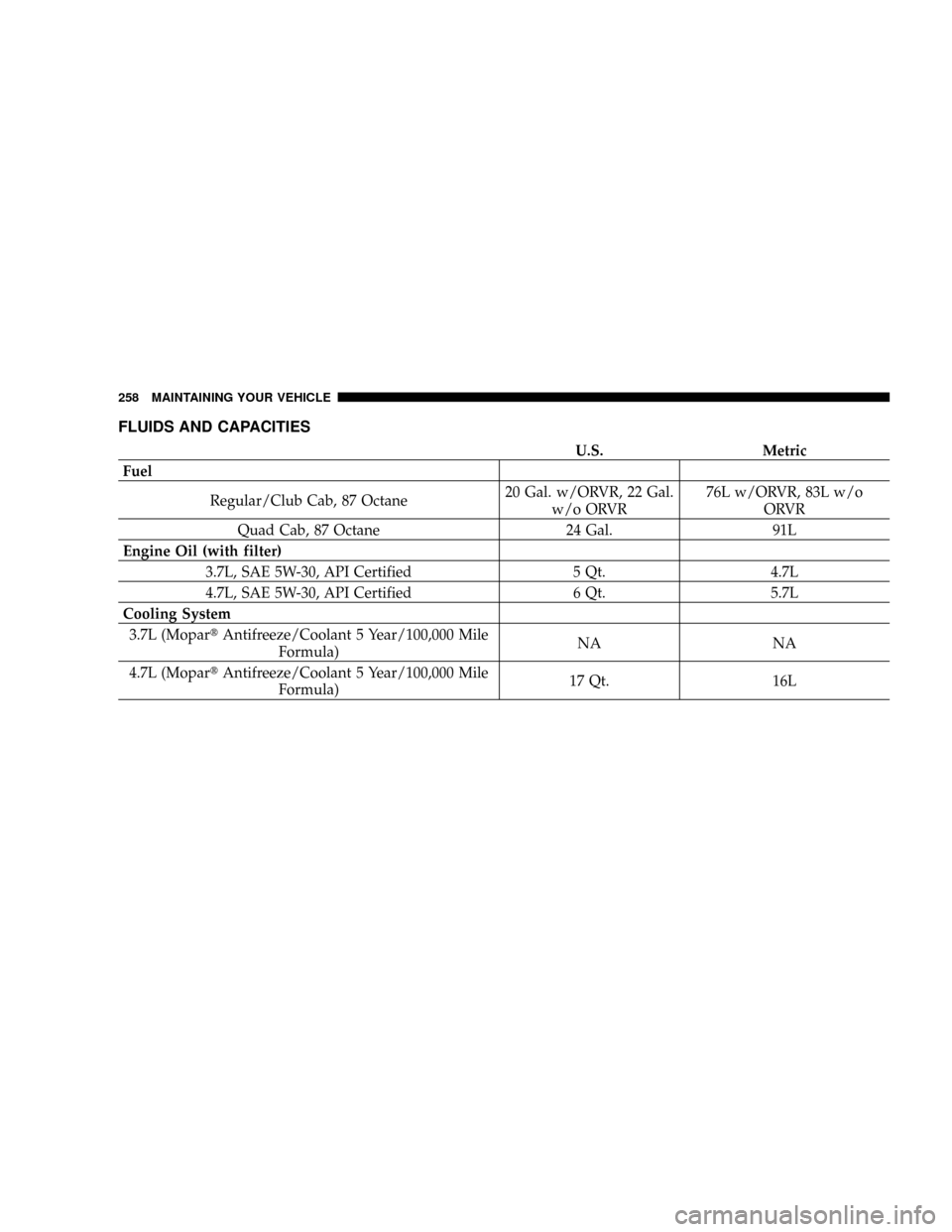
FLUIDS AND CAPACITIES
U.S. Metric
Fuel
Regular/Club Cab, 87 Octane20 Gal. w/ORVR, 22 Gal.
w/o ORVR76L w/ORVR, 83L w/o
ORVR
Quad Cab, 87 Octane 24 Gal. 91L
Engine Oil (with filter)
3.7L, SAE 5W-30, API Certified 5 Qt. 4.7L
4.7L, SAE 5W-30, API Certified 6 Qt. 5.7L
Cooling System
3.7L (MopartAntifreeze/Coolant 5 Year/100,000 Mile
Formula)NA NA
4.7L (MopartAntifreeze/Coolant 5 Year/100,000 Mile
Formula)17 Qt. 16L
258 MAINTAINING YOUR VEHICLE
Page 259 of 300
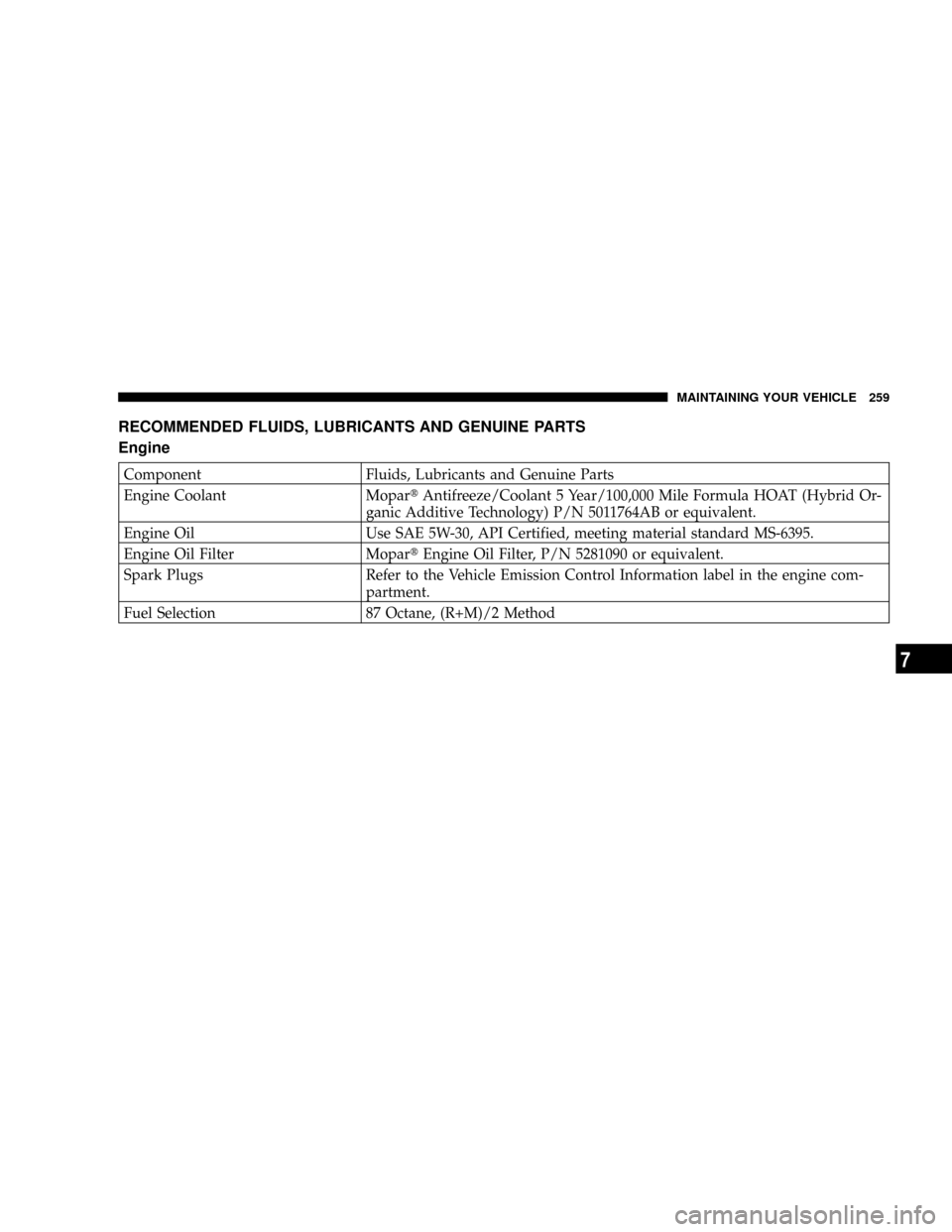
RECOMMENDED FLUIDS, LUBRICANTS AND GENUINE PARTS
Engine
Component Fluids, Lubricants and Genuine Parts
Engine Coolant MopartAntifreeze/Coolant 5 Year/100,000 Mile Formula HOAT (Hybrid Or-
ganic Additive Technology) P/N 5011764AB or equivalent.
Engine Oil Use SAE 5W-30, API Certified, meeting material standard MS-6395.
Engine Oil Filter MopartEngine Oil Filter, P/N 5281090 or equivalent.
Spark Plugs Refer to the Vehicle Emission Control Information label in the engine com-
partment.
Fuel Selection 87 Octane, (R+M)/2 Method
MAINTAINING YOUR VEHICLE 259
7
Page 263 of 300
MAINTENANCE SCHEDULES
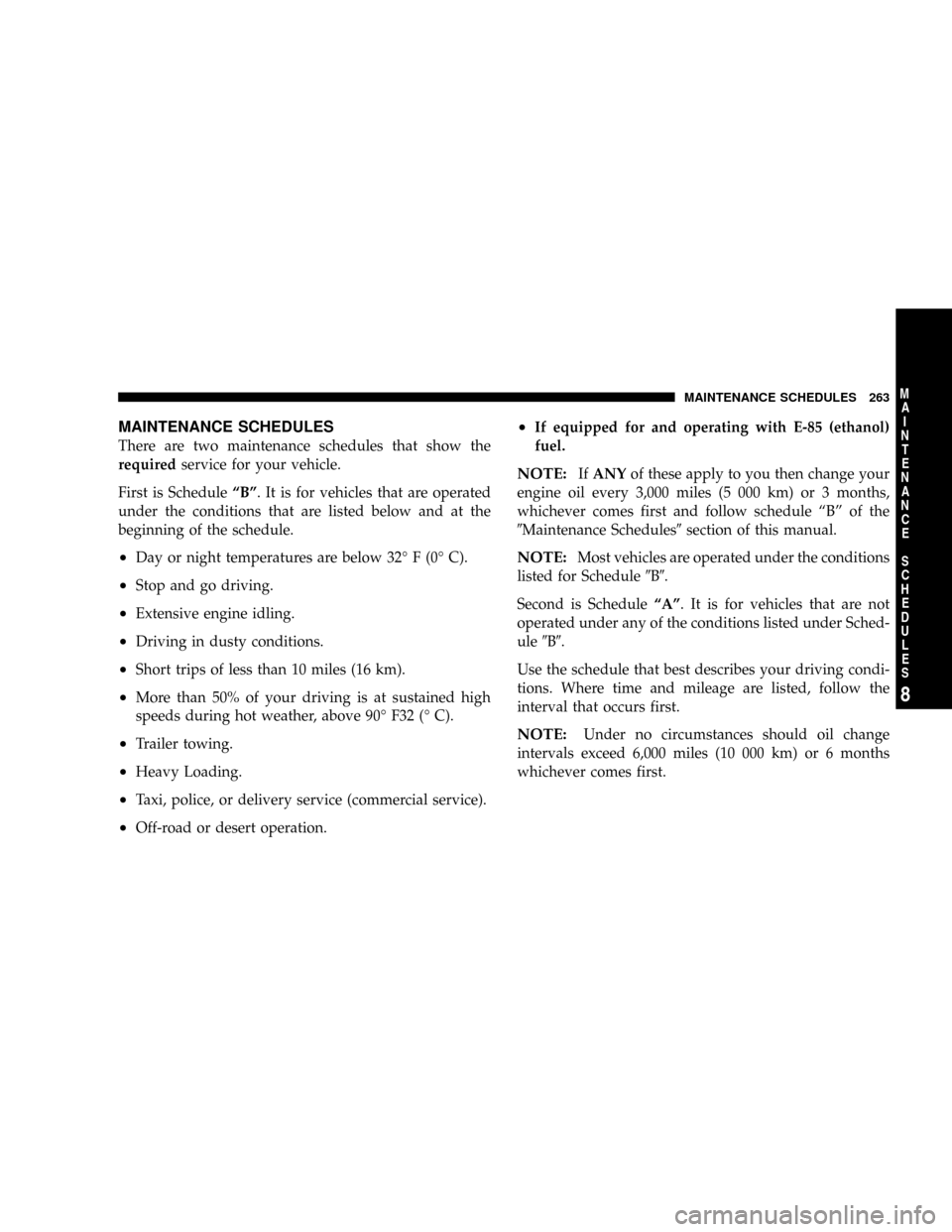
There are two maintenance schedules that show the
requiredservice for your vehicle.
First is ScheduleªBº. It is for vehicles that are operated
under the conditions that are listed below and at the
beginning of the schedule.
²Day or night temperatures are below 32É F (0É C).
²Stop and go driving.
²Extensive engine idling.
²Driving in dusty conditions.
²Short trips of less than 10 miles (16 km).
²More than 50% of your driving is at sustained high
speeds during hot weather, above 90É F32 (É C).
²Trailer towing.
²Heavy Loading.
²Taxi, police, or delivery service (commercial service).
²Off-road or desert operation.
²If equipped for and operating with E-85 (ethanol)
fuel.
NOTE:IfANYof these apply to you then change your
engine oil every 3,000 miles (5 000 km) or 3 months,
whichever comes first and follow schedule ªBº of the
9Maintenance Schedules9section of this manual.
NOTE:Most vehicles are operated under the conditions
listed for Schedule9B9.
Second is ScheduleªAº. It is for vehicles that are not
operated under any of the conditions listed under Sched-
ule9B9.
Use the schedule that best describes your driving condi-
tions. Where time and mileage are listed, follow the
interval that occurs first.
NOTE:Under no circumstances should oil change
intervals exceed 6,000 miles (10 000 km) or 6 months
whichever comes first.
MAINTENANCE SCHEDULES 263
8
M
A
I
N
T
E
N
A
N
C
E
S
C
H
E
D
U
L
E
S
Page 264 of 300

CAUTION!
Failure to perform the required maintenance items
may result in damage to the vehicle.
At Each Stop for Fuel
²
Check the engine oil level about 5 minutes after a fully
warmed engine is shut off. Checking the oil level while
the vehicle is on level ground will improve the accu-
racy of the oil level reading. Add oil only when the
level is at or below the ADD or MIN mark.
²Check the windshield washer solvent and add if
required.
Once a Month
²
Check tire pressure and look for unusual wear or
damage.
²Inspect the battery and clean and tighten the terminals
as required.
²Check the fluid levels of coolant reservoir, brake
master cylinder, and transmission and add as needed.
²Check all lights and all other electrical items for correct
operation.
At Each Oil Change
²
Change the engine oil filter.
²Inspect the exhaust system.
²Inspect the brake hoses.
²Inspect the CV joints (if equipped) and front suspen-
sion components.
²Check the automatic transmission fluid level (if
equipped).
²Check the manual transmission fluid level (if
equipped).
²Check the coolant level, hoses, and clamps.
Tire Rotation
²
Rotate the tires every 6,000 miles (10 000 km).
264 MAINTENANCE SCHEDULES
8
M
A
I
N
T
E
N
A
N
C
E
S
C
H
E
D
U
L
E
S
Page 265 of 300
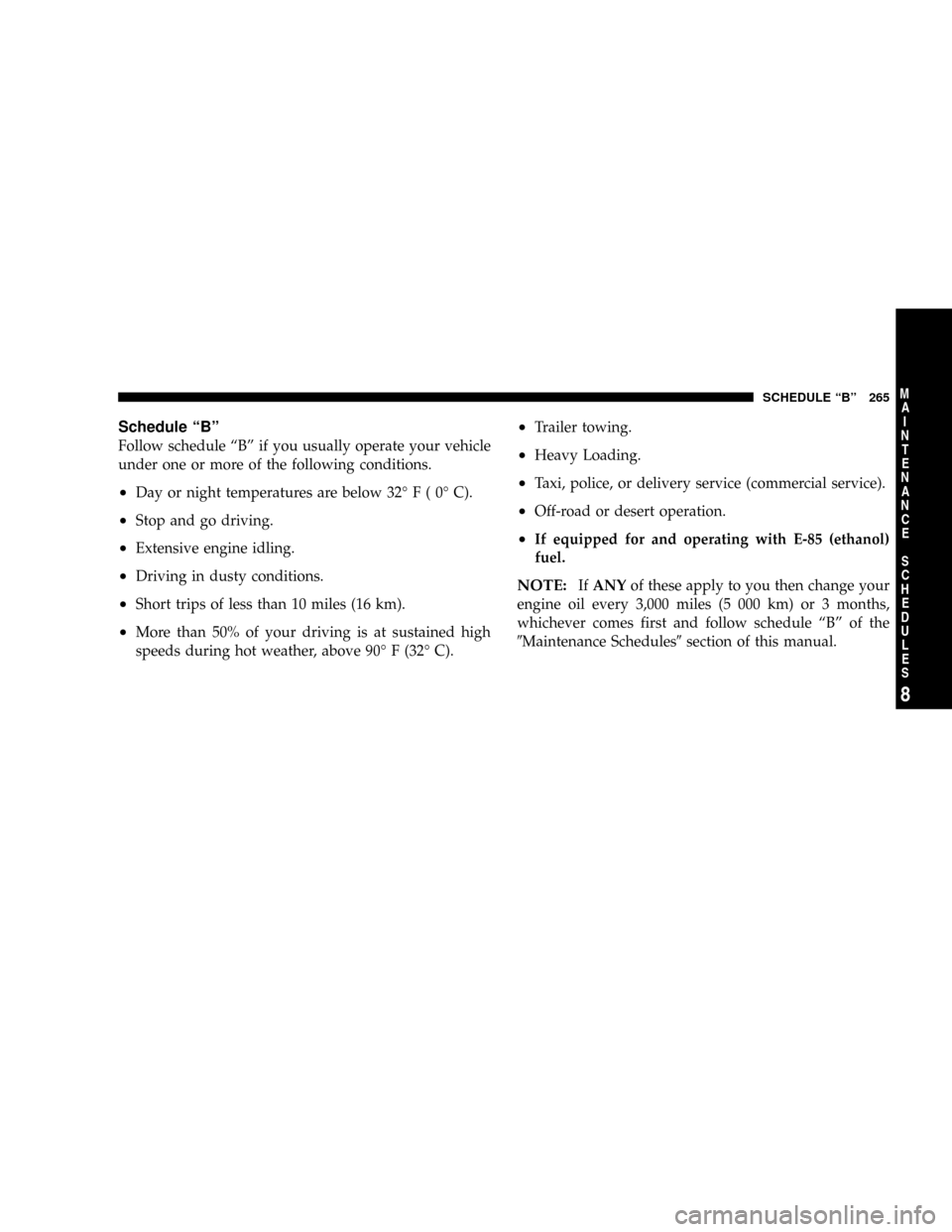
Schedule ªBº
Follow schedule ªBº if you usually operate your vehicle
under one or more of the following conditions.
²Day or night temperatures are below 32ÉF(0ÉC).
²Stop and go driving.
²Extensive engine idling.
²Driving in dusty conditions.
²Short trips of less than 10 miles (16 km).
²More than 50% of your driving is at sustained high
speeds during hot weather, above 90É F (32É C).
²Trailer towing.
²Heavy Loading.
²Taxi, police, or delivery service (commercial service).
²Off-road or desert operation.
²If equipped for and operating with E-85 (ethanol)
fuel.
NOTE:IfANYof these apply to you then change your
engine oil every 3,000 miles (5 000 km) or 3 months,
whichever comes first and follow schedule ªBº of the
9Maintenance Schedules9section of this manual.
SCHEDULE ªBº 265
8
M
A
I
N
T
E
N
A
N
C
E
S
C
H
E
D
U
L
E
S
Page 288 of 300

Adding Engine Coolant (Antifreeze)......... 239
Adding Fuel........................186,208
Air Conditioner Maintenance.............. 233
Air Conditioning....................... 134
Air Conditioning, Operating Tips........135,137
Air Conditioning Refrigerant.............. 234
Air Conditioning System................. 134
Air Pressure, Tires...................176,182
Airbag...........................31,34,102
Airbag Light........................... 38
Airbag On/Off Switch.................... 34
Alarm.............................21,102
Alarm, Panic........................... 19
Alignment and Balance.................. 181
Alterations/Modifications, Vehicle............ 5
Antifreeze (Engine Coolant)............238,258
Anti-Lock Brake System...............164,165
Anti-Lock Warning Light................. 102
Anti-Theft System....................21,102
Appearance Care....................... 249
Automatic Dimming Mirror................ 59
Automatic Transmission............144,146,245
Adding Fluid........................ 246Fluid and Filter Changes................ 247
Fluid Level Check..................... 245
Fluid Type.......................247,260
Gear Ranges......................... 147
Overdrive........................... 148
Shifting............................ 146
Special Additives..................... 247
Torque Converter..................... 149
Axle Fluid............................ 260
Axle Lubrication....................... 248
Backfire, Engine........................ 190
Ball Joints............................ 235
Battery............................... 232
Charging........................... 215
Emergency Starting.................... 215
Gas Caution......................... 215
Keyless Transmitter Replacement.......... 21
Saving Feature........................ 68
Belts, Drive........................... 230
Belts, Seat............................. 25
Body Mechanism Lubrication.............. 235
B-Pillar Location....................... 172
288 INDEX