4F – 56IANTILOCK BRAKE SYSTEM
DAEWOO V–121 BL4
J3B14F04
60A Ef230A Ef5
2
42
C107 C105
2
C110
G106
A19
A13 A1 A14
C110 C202
C202WHT LT GRN
DK
GRN LT GRN/
BLK
BLK
DK BLUDK BLU
PPL/WHT
PPL/WHT ABS
TCS Parking
Brake
Hot at all times
RED REDRED/WHT
Ignition
Switch
RED
RED
I/P Cluster
EBCM8
20
22 2216 41
1211
18 1621
1
C107
10A F410AF11
32 31
43
6 62 C201
C201 C201C201
C110 C202
Hot in Run and Start
30
4
1711
C202
15
B15
DLC
(Data Link
Connector)12
G106
BLK/WHTOil Feeding
Connector
”2” Ter.
BRNBRN BRN
BRN PNK PNK PNK
19J1
59B1
ONStart Lock
Acc
IG1
19
DIAGNOSTIC TROUBLE CODE (DTC) C0800
LOW VOLTAGE FAULT
Circuit Description
Proper operation of the electronic brake control module
(EBCM) requires a certain minimum voltage. The EBCM
monitors the ignition feed circuit to determine if the voltage
falls below a minimum level.
Diagnosis
This test checks for battery output, proper grounding,
blown fuses, faulty ignition switch, and problems in the cir-
cuitry.
Cause(s)
S The battery is defective.
S There is a defective ground connection.
S A connector is damaged.
S A wire is broken or shorted.
S A fuse is blown.
S The ignition switch is malfunctioning.
Fail Action
ABS action is disabled during the period of low voltage,and the ABS warning lamp is ON for the remainder of the
ignition cycle. If the failure is intermittent, the EBCM will
enable the system at the next ignition cycle and set a histo-
ry DTC C0800.
Test Description
The number(s) below refer to step(s) on the diagnostic
table.
1. This step determines whether there is voltage at
the battery and at the high current source.
7. This step checks for voltage at the ignition 1
source.
11. This step begins the check for voltage at the EBCM
end of the ABS harness.
15. This step checks for a defective ground connection.
16. This is a check for a defective EBCM connector.
Diagnostic Aids
It is very important to perform a thorough inspection of the
wiring and the connectors. Failure to do so may result in
misdiagnosis, causing part replacement with a reappear-
ance of the malfunction.
SUPPLEMENTAL INFLATABLE RESTRAINTS (SIR) 8B – 101
DAEWOO V–121 BL4
FRONT SEAT BELT
PRETENSIONERS
CAUTION : Tempering with seat belt pretensioner
creates the risk of an injury from unexpected deploy-
ment. Therefore, the driver airbag module should
never be disassembled.
The seat belt pretensioners(with load limiter for some ve-
hicles) are assembled with each front seat belt retractors
to retract the seat belt webbing when accounted frontal
collision. The seat belt pretensioners are controlled by
sensing and diagnostic module(SDM). The seat belt pre-
tensioner contains an igniter charge and a gas generator
to pull the seat belt webbing. The seat belt pretensioner
must be replaced after an accident that causes its activa-
tion.
The seat belt pretensioner also contains a shorting bar to
prevent current from travelling through the seat belt pre-
tensioner during servicing. The shorting bar is disengaged
when the connector is connected.
SENSING AND DIAGNOSTIC
MODULE (SDM)
CAUTION : During the service procedures, be careful
when handling the SDM. Never shake or jar the SDM.
Never apply power to SIR when the SDM is not rigidly
attached to the vehicle. All SDM mounting bolts and
grounding nuts must be fully tightened. Failure to fol-
low these precautions could cause deployment and
result in personal injury.
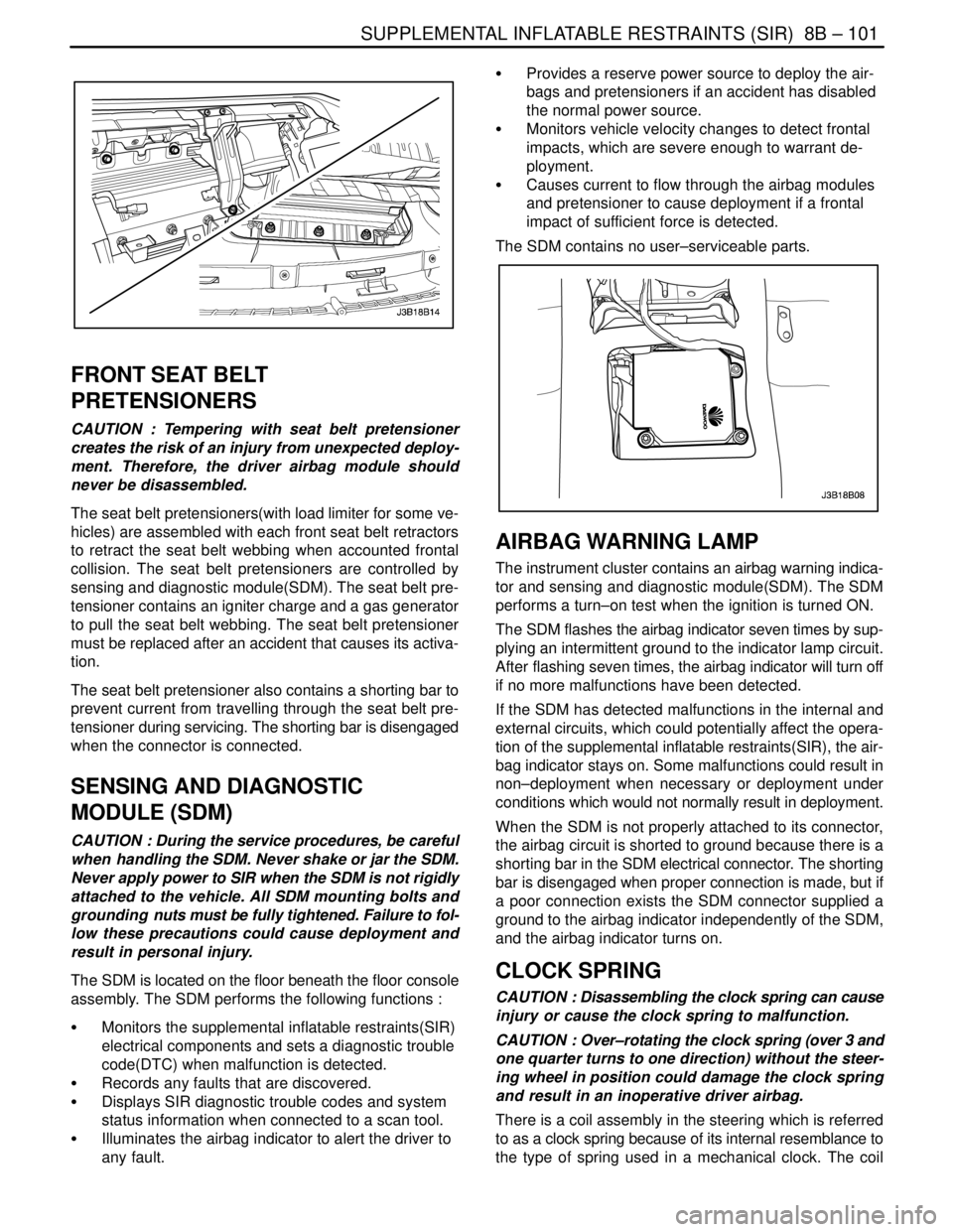
The SDM is located on the floor beneath the floor console
assembly. The SDM performs the following functions :
S Monitors the supplemental inflatable restraints(SIR)
electrical components and sets a diagnostic trouble
code(DTC) when malfunction is detected.
S Records any faults that are discovered.
S Displays SIR diagnostic trouble codes and system
status information when connected to a scan tool.
S Illuminates the airbag indicator to alert the driver to
any fault.S Provides a reserve power source to deploy the air-
bags and pretensioners if an accident has disabled
the normal power source.
S Monitors vehicle velocity changes to detect frontal
impacts, which are severe enough to warrant de-
ployment.
S Causes current to flow through the airbag modules
and pretensioner to cause deployment if a frontal
impact of sufficient force is detected.
The SDM contains no user–serviceable parts.
AIRBAG WARNING LAMP
The instrument cluster contains an airbag warning indica-
tor and sensing and diagnostic module(SDM). The SDM
performs a turn–on test when the ignition is turned ON.
The SDM flashes the airbag indicator seven times by sup-
plying an intermittent ground to the indicator lamp circuit.
After flashing seven times, the airbag indicator will turn off
if no more malfunctions have been detected.
If the SDM has detected malfunctions in the internal and
external circuits, which could potentially affect the opera-
tion of the supplemental inflatable restraints(SIR), the air-
bag indicator stays on. Some malfunctions could result in
non–deployment when necessary or deployment under
conditions which would not normally result in deployment.
When the SDM is not properly attached to its connector,
the airbag circuit is shorted to ground because there is a
shorting bar in the SDM electrical connector. The shorting
bar is disengaged when proper connection is made, but if
a poor connection exists the SDM connector supplied a
ground to the airbag indicator independently of the SDM,
and the airbag indicator turns on.
CLOCK SPRING
CAUTION : Disassembling the clock spring can cause
injury or cause the clock spring to malfunction.
CAUTION : Over–rotating the clock spring (over 3 and
one quarter turns to one direction) without the steer-
ing wheel in position could damage the clock spring
and result in an inoperative driver airbag.
There is a coil assembly in the steering which is referred
to as a clock spring because of its internal resemblance to
the type of spring used in a mechanical clock. The coil