2004 CHRYSLER VOYAGER fuel filter
[x] Cancel search: fuel filterPage 1542 of 2585
THROTTLE BODY
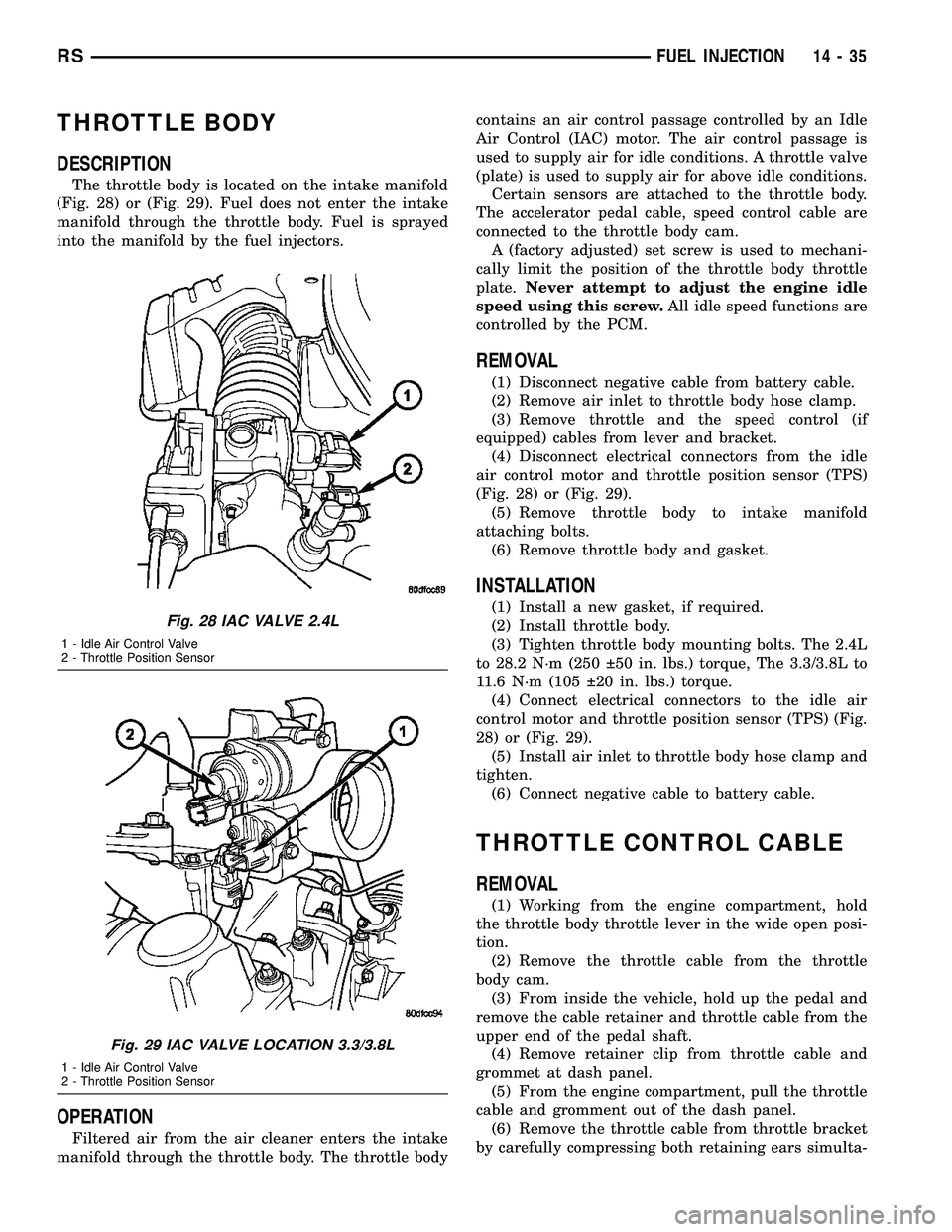
DESCRIPTION
The throttle body is located on the intake manifold
(Fig. 28) or (Fig. 29). Fuel does not enter the intake
manifold through the throttle body. Fuel is sprayed
into the manifold by the fuel injectors.
OPERATION
Filtered air from the air cleaner enters the intake
manifold through the throttle body. The throttle bodycontains an air control passage controlled by an Idle
Air Control (IAC) motor. The air control passage is
used to supply air for idle conditions. A throttle valve
(plate) is used to supply air for above idle conditions.
Certain sensors are attached to the throttle body.
The accelerator pedal cable, speed control cable are
connected to the throttle body cam.
A (factory adjusted) set screw is used to mechani-
cally limit the position of the throttle body throttle
plate.Never attempt to adjust the engine idle
speed using this screw.All idle speed functions are
controlled by the PCM.
REMOVAL
(1) Disconnect negative cable from battery cable.
(2) Remove air inlet to throttle body hose clamp.
(3) Remove throttle and the speed control (if
equipped) cables from lever and bracket.
(4) Disconnect electrical connectors from the idle
air control motor and throttle position sensor (TPS)
(Fig. 28) or (Fig. 29).
(5) Remove throttle body to intake manifold
attaching bolts.
(6) Remove throttle body and gasket.
INSTALLATION
(1) Install a new gasket, if required.
(2) Install throttle body.
(3) Tighten throttle body mounting bolts. The 2.4L
to 28.2 N´m (250 50 in. lbs.) torque, The 3.3/3.8L to
11.6 N´m (105 20 in. lbs.) torque.
(4) Connect electrical connectors to the idle air
control motor and throttle position sensor (TPS) (Fig.
28) or (Fig. 29).
(5) Install air inlet to throttle body hose clamp and
tighten.
(6) Connect negative cable to battery cable.
THROTTLE CONTROL CABLE
REMOVAL
(1) Working from the engine compartment, hold
the throttle body throttle lever in the wide open posi-
tion.
(2) Remove the throttle cable from the throttle
body cam.
(3) From inside the vehicle, hold up the pedal and
remove the cable retainer and throttle cable from the
upper end of the pedal shaft.
(4) Remove retainer clip from throttle cable and
grommet at dash panel.
(5) From the engine compartment, pull the throttle
cable and gromment out of the dash panel.
(6) Remove the throttle cable from throttle bracket
by carefully compressing both retaining ears simulta-
Fig. 28 IAC VALVE 2.4L
1 - Idle Air Control Valve
2 - Throttle Position Sensor
Fig. 29 IAC VALVE LOCATION 3.3/3.8L
1 - Idle Air Control Valve
2 - Throttle Position Sensor
RSFUEL INJECTION14-35
Page 2520 of 2585
period the switch ratio reaches a predetermined
value, a counter is incremented by one. The monitor
is enabled to run another test during that trip. When
the test fails 6 times, the counter increments to 3, a
malfunction is entered, and a Freeze Frame is stored,
the code is matured and the MIL is illuminated. If
the first test passes, no further testing is conducted
during that trip.
The MIL is extinguished after three consecutive
good trips. The good trip criteria for the catalyst
monitor is more stringent than the failure criteria. In
order to pass the test and increment one good trip,
the downstream sensor switch rate must be less than
45% of the upstream rate. The failure percentages
are 59% respectively.
Enabling ConditionsÐThe following conditions
must typically be met before the PCM runs the cat-
alyst monitor. Specific times for each parameter may
be different from engine to engine.
²Accumulated drive time
²Enable time
²Ambient air temperature
²Barometric pressure
²Catalyst warm-up counter
²Engine coolant temperature
²Vehicle speed
²MAP
²RPM
²Engine in closed loop
²Fuel level
Pending ConditionsÐ
²Misfire DTC
²Front Oxygen Sensor Response
²Front Oxygen Sensor Heater Monitor
²Front Oxygen Sensor Electrical
²Rear Oxygen Sensor Rationality (middle check)
²Rear Oxygen Sensor Heater Monitor
²Rear Oxygen Sensor Electrical
²Fuel System Monitor
²All TPS faults
²All MAP faults
²All ECT sensor faults
²Purge flow solenoid functionality
²Purge flow solenoid electrical
²All PCM self test faults
²All CMP and CKP sensor faults
²All injector and ignition electrical faults
²Idle Air Control (IAC) motor functionality
²Vehicle Speed Sensor
²Brake switch (auto trans only)
²Intake air temperature
ConflictÐThe catalyst monitor does not run if any
of the following are conditions are present:
²EGR Monitor in progress (if equipped)
²Fuel system rich intrusive test in progress
²EVAP Monitor in progress²Time since start is less than 60 seconds
²Low fuel level-less than 15 %
²Low ambient air temperature
²Ethanol content learn is taking place and the
ethanol used once flag is set
SuspendÐThe Task Manager does not mature a
catalyst fault if any of the following are present:
²Oxygen Sensor Monitor, Priority 1
²Oxygen Sensor Heater, Priority 1
²EGR Monitor, Priority 1 (if equipped)
²EVAP Monitor, Priority 1
²Fuel System Monitor, Priority 2
²Misfire Monitor, Priority 2
OPERATION - NON-MONITORED CIRCUITS
The PCM does not monitor all circuits, systems
and conditions that could have malfunctions causing
driveability problems. However, problems with these
systems may cause the PCM to store diagnostic trou-
ble codes for other systems or components. For exam-
ple, a fuel pressure problem will not register a fault
directly, but could cause a rich/lean condition or mis-
fire. This could cause the PCM to store an oxygen
sensor or misfire diagnostic trouble code.
The major non-monitored circuits are listed below
along with examples of failures modes that do not
directly cause the PCM to set a DTC, but for a sys-
tem that is monitored.
FUEL PRESSURE
The fuel pressure regulator controls fuel system
pressure. The PCM cannot detect a clogged fuel
pump inlet filter, clogged in-line fuel filter, or a
pinched fuel supply or return line. However, these
could result in a rich or lean condition causing the
PCM to store an oxygen sensor, fuel system, or mis-
fire diagnostic trouble code.
SECONDARY IGNITION CIRCUIT
The PCM cannot detect an inoperative ignition coil,
fouled or worn spark plugs, ignition cross firing, or
open spark plug cables. The misfire will however,
increase the oxygen content in the exhaust, deceiving
the PCM in to thinking the fuel system is too lean.
Also see misfire detection.
CYLINDER COMPRESSION
The PCM cannot detect uneven, low, or high engine
cylinder compression. Low compression lowers O2
content in the exhaust. Leading to fuel system, oxy-
gen sensor, or misfire detection fault.
EXHAUST SYSTEM
The PCM cannot detect a plugged, restricted or
leaking exhaust system. It may set a EGR (if
equipped) or Fuel system or O2S fault.
RSEMISSIONS CONTROL25-5
EMISSIONS CONTROL (Continued)
Page 2521 of 2585
FUEL INJECTOR MECHANICAL MALFUNCTIONS
The PCM cannot determine if a fuel injector is
clogged, the needle is sticking or if the wrong injector
is installed. However, these could result in a rich or
lean condition causing the PCM to store a diagnostic
trouble code for either misfire, an oxygen sensor, or
the fuel system.
EXCESSIVE OIL CONSUMPTION
Although the PCM monitors engine exhaust oxygen
content when the system is in closed loop, it cannot
determine excessive oil consumption.
THROTTLE BODY AIR FLOW
The PCM cannot detect a clogged or restricted air
cleaner inlet or filter element.
VACUUM ASSIST
The PCM cannot detect leaks or restrictions in the
vacuum circuits of vacuum assisted engine control
system devices. However, these could cause the PCM
to store a MAP sensor diagnostic trouble code and
cause a high idle condition.
PCM SYSTEM GROUND
The PCM cannot determine a poor system ground.
However, one or more diagnostic trouble codes may
be generated as a result of this condition. The mod-
ule should be mounted to the body at all times,
including when diagnostics are performed.
PCM CONNECTOR ENGAGEMENT
The PCM may not be able to determine spread or
damaged connector pins. However, it might store
diagnostic trouble codes as a result of spread connec-
tor pins.
DESCRIPTION - MONITORED SYSTEMS
There are new electronic circuit monitors that
check fuel, emission, engine and ignition perfor-
mance. These monitors use information from various
sensor circuits to indicate the overall operation of the
fuel, engine, ignition and emission systems and thus
the emissions performance of the vehicle.
The fuel, engine, ignition and emission systems
monitors do not indicate a specific component prob-
lem. They do indicate that there is an implied prob-
lem within one of the systems and that a specific
problem must be diagnosed.
If any of these monitors detect a problem affecting
vehicle emissions, the Malfunction Indicator (Check
Engine) Lamp will be illuminated. These monitors
generate Diagnostic Trouble Codes that can be dis-
played with the a DRBIIItscan tool.
The following is a list of the system monitors:
²EGR Monitor (if equipped)²Misfire Monitor
²Fuel System Monitor
²Oxygen Sensor Monitor
²Oxygen Sensor Heater Monitor
²Catalyst Monitor
²Evaporative System Leak Detection Monitor (if
equipped)
Following is a description of each system monitor,
and its DTC.
Refer to the appropriate Powertrain Diagnos-
tics Procedures manual for diagnostic proce-
dures.
OXYGEN SENSOR (O2S) MONITOR
Effective control of exhaust emissions is achieved
by an oxygen feedback system. The most important
element of the feedback system is the O2S. The O2S
is located in the exhaust path. Once it reaches oper-
ating temperatures of 300É to 350ÉC (572É to 662ÉF),
the sensor generates a voltage that is inversely pro-
portional to the amount of oxygen in the exhaust.
The information obtained by the sensor is used to
calculate the fuel injector pulse width. The PCM is
programmed to maintain the optimum air/fuel ratio.
At this mixture ratio, the catalyst works best to
remove hydrocarbons (HC), carbon monoxide (CO)
and nitrous oxide (NOx) from the exhaust.
The O2S is also the main sensing element for the
EGR (if equipped), Catalyst and Fuel Monitors.
The O2S may fail in any or all of the following
manners:
²Slow response rate
²Reduced output voltage
²Dynamic shift
²Shorted or open circuits
Response rate is the time required for the sensor to
switch from lean to rich once it is exposed to a richer
than optimum A/F mixture or vice versa. As the sen-
sor starts malfunctioning, it could take longer to
detect the changes in the oxygen content of the
exhaust gas.
The output voltage of the O2S ranges from 0 to 1
volt (voltages are offset by 2.5 volts on NGC vehi-
cles). A good sensor can easily generate any output
voltage in this range as it is exposed to different con-
centrations of oxygen. To detect a shift in the A/F
mixture (lean or rich), the output voltage has to
change beyond a threshold value. A malfunctioning
sensor could have difficulty changing beyond the
threshold value.
OXYGEN SENSOR HEATER MONITOR
If there is an oxygen sensor (O2S) DTC as well as
a O2S heater DTC, the O2S heater fault MUST be
repaired first. After the O2S fault is repaired, verify
that the heater circuit is operating correctly.
25 - 6 EMISSIONS CONTROLRS
EMISSIONS CONTROL (Continued)
Page 2523 of 2585
chemical reaction takes place. This means the con-
centration of oxygen will be the same downstream as
upstream. The output voltage of the downstream
O2S copies the voltage of the upstream sensor. The
only difference is a time lag (seen by the PCM)
between the switching of the O2S's.
To monitor the system, the number of lean-to-rich
switches of upstream and downstream O2S's is
counted. The ratio of downstream switches to
upstream switches is used to determine whether the
catalyst is operating properly. An effective catalyst
will have fewer downstream switches than it has
upstream switches i.e., a ratio closer to zero. For a
totally ineffective catalyst, this ratio will be one-to-
one, indicating that no oxidation occurs in the device.
The system must be monitored so that when cata-
lyst efficiency deteriorates and exhaust emissions
increase to over the legal limit, the MIL (Check
Engine lamp) will be illuminated.
NATURAL VACUUM LEAK DETECTION (NVLD) (if equipped)
The Natural Vacuum Leak Detection (NVLD) sys-
tem is the next generation evaporative leak detection
system that will first be used on vehicles equipped
with the Next Generation Controller (NGC). This
new system replaces the leak detection pump as the
method of evaporative system leak detection. This is
to detect a leak equivalent to a 0.0209(0.5 mm) hole.
This system has the capability to detect holes of this
size very dependably.
The basic leak detection theory employed with
NVLD is the9Gas Law9. This is to say that the pres-
sure in a sealed vessel will change if the temperature
of the gas in the vessel changes. The vessel will only
see this effect if it is indeed sealed. Even small leaks
will allow the pressure in the vessel to come to equi-
librium with the ambient pressure. In addition to the
detection of very small leaks, this system has the
capability of detecting medium as well as large evap-
orative system leaks.
The NVLD seals the canister vent during engine off
conditions. If the EVAP system has a leak of less than
the failure threshold, the evaporative system will be
pulled into a vacuum, either due to the cool down
from operating temperature or diurnal ambient tem-
perature cycling. The diurnal effect is considered one
of the primary contributors to the leak determination
by this diagnostic. When the vacuum in the system
exceeds about 19H2O (0.25 KPA), a vacuum switch
closes. The switch closure sends a signal to the NGC.
The NGC, via appropriate logic strategies (described
below), utilizes the switch signal, or lack thereof, to
make a determination of whether a leak is present.
The NVLD device is designed with a normally open
vacuum switch, a normally closed solenoid, and a
seal, which is actuated by both the solenoid and a
diaphragm. The NVLD is located on the atmosphericvent side of the canister. The NVLD assembly may
be mounted on top of the canister outlet, or in-line
between the canister and atmospheric vent filter. The
normally open vacuum switch will close with about 19
H2O (0.25 KPA) vacuum in the evaporative system.
The diaphragm actuates the switch. This is above the
opening point of the fuel inlet check valve in the fill
tube so cap off leaks can be detected. Submerged fill
systems must have recirculation lines that do not
have the in-line normally closed check valve that pro-
tects the system from failed nozzle liquid ingestion,
in order to detect cap off conditions.
The normally closed valve in the NVLD is intended
to maintain the seal on the evaporative system dur-
ing the engine off condition. If vacuum in the evapo-
rative system exceeds 39to 69H2O (0.75 to 1.5 KPA),
the valve will be pulled off the seat, opening the seal.
This will protect the system from excessive vacuum
as well as allowing sufficient purge flow in the event
that the solenoid was to become inoperative.
The solenoid actuates the valve to unseal the can-
ister vent while the engine is running. It also will be
used to close the vent during the medium and large
leak tests and during the purge flow check. This sole-
noid requires initial 1.5 amps of current to pull the
valve open but after 100 ms. will be duty cycled down
to an average of about 150 mA for the remainder of
the drive cycle.
Another feature in the device is a diaphragm that
will open the seal in the NVLD with pressure in the
evaporative system. The device will9blow off9at
about 0.59H2O (0.12 KPA) pressure to permit the
venting of vapors during refueling. An added benefit
to this is that it will also allow the tank to9breathe9
during increasing temperatures, thus limiting the
pressure in the tank to this low level. This is benefi-
cial because the induced vacuum during a subse-
quent declining temperature will achieve the switch
closed (pass threshold) sooner than if the tank had to
decay from a built up pressure.
The device itself has 3 wires: Switch sense, sole-
noid driver and ground. It also includes a resistor to
protect the switch from a short to battery or a short
to ground. The NGC utilizes a high-side driver to
energize and duty-cycle the solenoid.
DESCRIPTION - HIGH AND LOW LIMITS
The PCM compares input signal voltages from each
input device with established high and low limits for
the device. If the input voltage is not within limits
and other criteria are met, the PCM stores a diagnos-
tic trouble code in memory. Other diagnostic trouble
code criteria might include engine RPM limits or
input voltages from other sensors or switches that
must be present before verifying a diagnostic trouble
code condition.
25 - 8 EMISSIONS CONTROLRS
EMISSIONS CONTROL (Continued)
Page 2531 of 2585
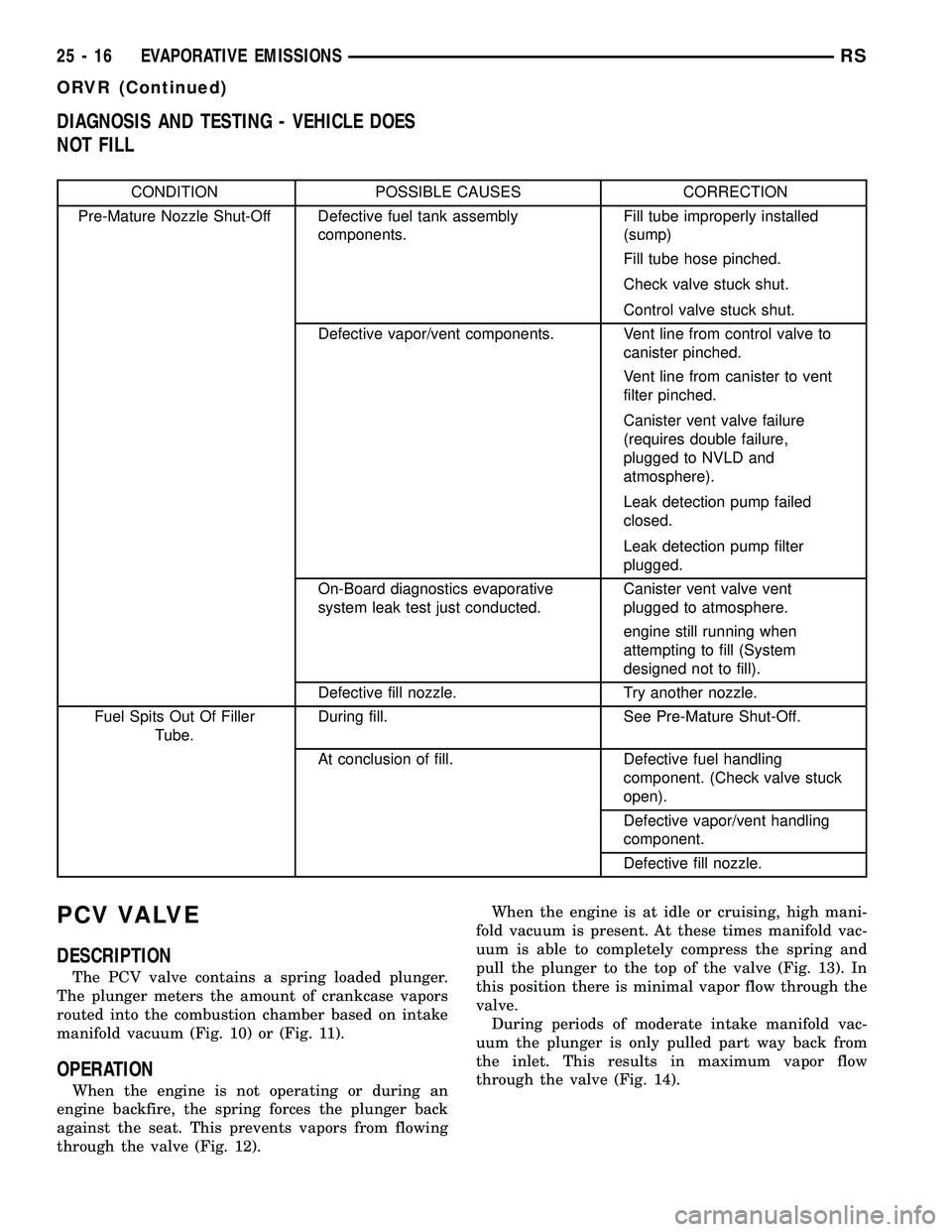
DIAGNOSIS AND TESTING - VEHICLE DOES
NOT FILL
CONDITION POSSIBLE CAUSES CORRECTION
Pre-Mature Nozzle Shut-Off Defective fuel tank assembly
components.Fill tube improperly installed
(sump)
Fill tube hose pinched.
Check valve stuck shut.
Control valve stuck shut.
Defective vapor/vent components. Vent line from control valve to
canister pinched.
Vent line from canister to vent
filter pinched.
Canister vent valve failure
(requires double failure,
plugged to NVLD and
atmosphere).
Leak detection pump failed
closed.
Leak detection pump filter
plugged.
On-Board diagnostics evaporative
system leak test just conducted.Canister vent valve vent
plugged to atmosphere.
engine still running when
attempting to fill (System
designed not to fill).
Defective fill nozzle. Try another nozzle.
Fuel Spits Out Of Filler
Tube.During fill. See Pre-Mature Shut-Off.
At conclusion of fill. Defective fuel handling
component. (Check valve stuck
open).
Defective vapor/vent handling
component.
Defective fill nozzle.
PCV VALVE
DESCRIPTION
The PCV valve contains a spring loaded plunger.
The plunger meters the amount of crankcase vapors
routed into the combustion chamber based on intake
manifold vacuum (Fig. 10) or (Fig. 11).
OPERATION
When the engine is not operating or during an
engine backfire, the spring forces the plunger back
against the seat. This prevents vapors from flowing
through the valve (Fig. 12).When the engine is at idle or cruising, high mani-
fold vacuum is present. At these times manifold vac-
uum is able to completely compress the spring and
pull the plunger to the top of the valve (Fig. 13). In
this position there is minimal vapor flow through the
valve.
During periods of moderate intake manifold vac-
uum the plunger is only pulled part way back from
the inlet. This results in maximum vapor flow
through the valve (Fig. 14).
25 - 16 EVAPORATIVE EMISSIONSRS
ORVR (Continued)
Page 2544 of 2585
INDEX
ABS FASTENER TORQUE,
SPECIFICATIONS......................5-79
ABSORBER - DESCRIPTION, SHOCK.......2-37
ABSORBER - INSTALLATION, SHOCK......2-38
ABSORBER - OPERATION, SHOCK........2-37
ABSORBER - REMOVAL, SHOCK..........2-37
ABSORBER (UPPER BUSHING) -
ASSEMBLY, SHOCK....................2-38
ABSORBER (UPPER BUSHING) -
DISASSEMBLY, SHOCK.................2-37
A/C COMPRESSOR - DESCRIPTION......24-73
A/C COMPRESSOR - OPERATION........24-73
A/C COMPRESSOR CLUTCH COIL -
DIAGNOSIS AND TESTING.............24-15
A/C COMPRESSOR CLUTCH RELAY -
DESCRIPTION.......................24-19
A/C COMPRESSOR CLUTCH RELAY -
INSTALLATION.......................24-20
A/C COMPRESSOR CLUTCH RELAY -
OPERATION.........................24-19
A/C COMPRESSOR CLUTCH RELAY -
REMOVAL..........................24-20
A/C COMPRESSOR CLUTCH/COIL -
DESCRIPTION.......................24-15
A/C COMPRESSOR CLUTCH/COIL -
INSPECTION........................24-17
A/C COMPRESSOR CLUTCH/COIL -
INSTALLATION.......................24-17
A/C COMPRESSOR CLUTCH/COIL -
OPERATION.........................24-15
A/C COMPRESSOR CLUTCH/COIL -
REMOVAL..........................24-16
A/C COMPRESSOR MOUNTING BRACKET
- 2.4L ENGINE - INSTALLATION.........24-76
A/C COMPRESSOR MOUNTING BRACKET
- 2.4L ENGINE - REMOVAL.............24-75
A/C CONDENSER - DESCRIPTION........24-76
A/C CONDENSER - INSTALLATION.......24-78
A/C CONDENSER - OPERATION..........24-76
A/C CONDENSER - REMOVAL...........24-77
A/C COOL DOWN TEST - DIAGNOSIS
AND TESTING........................24-6
A/C DISCHARGE LINE - INSTALLATION . . . 24-80
A/C DISCHARGE LINE - REMOVAL.......24-79
A/C EVAPORATOR - DESCRIPTION . . 24-80,24-97
A/C EVAPORATOR - INSTALLATION......24-80
A/C EVAPORATOR - INSTALLATION,
REAR..............................24-99
A/C EVAPORATOR - OPERATION....24-80,24-97
A/C EVAPORATOR - REMOVAL..........24-80
A/C EVAPORATOR - REMOVAL, REAR.....24-97
A/C EVAPORATOR LINE EXTENSION -
INSTALLATION, REAR.................24-99
A/C EVAPORATOR LINE EXTENSION -
REMOVAL..........................24-98
A/C EXPANSION VALVE - DESCRIPTION . . . 24-99
A/C EXPANSION VALVE - DIAGNOSIS
AND TESTING.......................24-81
A/C EXPANSION VALVE - INSTALLATION . 24-100
A/C EXPANSION VALVE - OPERATION.....24-99
A/C EXPANSION VALVE - REMOVAL.....24-100
A/C HEATER CONTROL - DESCRIPTION . . . 24-20
A/C HEATER CONTROL - INSTALLATION . . . 24-21
A/C HEATER CONTROL - REMOVAL......24-21
A/C PERFORMANCE TEST - DIAGNOSIS
AND TESTING........................24-7
A/C PRESSURE TRANSDUCER -
DESCRIPTION.......................24-21
A/C PRESSURE TRANSDUCER -
DIAGNOSIS AND TESTING.............24-22
A/C PRESSURE TRANSDUCER -
INSTALLATION.......................24-22
A/C PRESSURE TRANSDUCER -
OPERATION.........................24-21
A/C PRESSURE TRANSDUCER -
REMOVAL..........................24-22
A/C SYSTEM, CAUTION................24-66
A/C SYSTEM, SPECIFICATIONS..........24-11
A/C SYSTEM, WARNING...............24-65
ACCELERATOR PEDAL - INSTALLATION . . . 14-24
ACCELERATOR PEDAL - REMOVAL
.......14-24
ACCESSORY DRIVE BELT - DIAGNOSIS
AND TESTING
.........................7-7
ACCESSORY DRIVE BELT TENSION,
SPECIFICATIONS
.......................7-5
ACCUMULATOR - DESCRIPTION
.......21-188,
21s-206,21s-94
ACCUMULATOR - OPERATION
....21-189,21s-94A/C-HEATER CONTROL - DESCRIPTION . . . 24-34
A/C-HEATER CONTROL - INSTALLATION . . . 24-35
A/C-HEATER CONTROL - OPERATION.....24-34
A/C-HEATER CONTROL - REMOVAL......24-34
A/C-HEATER CONTROL CALIBRATION -
STANDARD PROCEDURE...............24-20
ACTUATOR - DESCRIPTION, BLEND
DOOR........................24-23,24-35
ACTUATOR - DESCRIPTION, ENGAGE.....8N-10
ACTUATOR - DESCRIPTION, LATCH......8N-14
ACTUATOR - DESCRIPTION, MODE
DOOR.............................24-30
ACTUATOR - DESCRIPTION,
RECIRCULATION DOOR................24-32
ACTUATOR - INSTALLATION, BLEND
DOOR........................24-23,24-36
ACTUATOR - INSTALLATION, ENGAGE....8N-11
ACTUATOR - INSTALLATION, INSIDE
HANDLE............................23-27
ACTUATOR - INSTALLATION, LATCH.....8N-14
ACTUATOR - INSTALLATION, MODE
DOOR.............................24-31
ACTUATOR - INSTALLATION,
RECIRCULATION DOOR................24-33
ACTUATOR - OPERATION, BLEND DOOR . . 24-23,
24-35
ACTUATOR - OPERATION, ENGAGE......8N-11
ACTUATOR - OPERATION, LATCH........8N-14
ACTUATOR - OPERATION, MODE DOOR . . . 24-30
ACTUATOR - OPERATION,
RECIRCULATION DOOR................24-32
ACTUATOR - REAR - DESCRIPTION,
MODE DOOR........................24-39
ACTUATOR - REAR - INSTALLATION,
MODE DOOR........................24-40
ACTUATOR - REAR - OPERATION, MODE
DOOR.............................24-40
ACTUATOR - REAR - REMOVAL, MODE
DOOR.............................24-40
ACTUATOR - REMOVAL, BLEND DOOR . . . 24-23,
24-36
ACTUATOR - REMOVAL, ENGAGE........8N-11
ACTUATOR - REMOVAL, INSIDE HANDLE . . 23-27
ACTUATOR - REMOVAL, LATCH.........8N-14
ACTUATOR - REMOVAL, MODE DOOR....24-30
ACTUATOR - REMOVAL, RECIRCULATION
DOOR.............................24-33
ADAPTER - INSTALLATION, FRONT DISC
BRAKE CALIPER.................5-31,5s-30
ADAPTER - INSTALLATION, OIL FILTER . . . 9-139
ADAPTER - REMOVAL, FRONT DISC
BRAKE CALIPER.................5-31,5s-30
ADAPTER - REMOVAL, OIL FILTER.......9-139
ADAPTIVE MEMORIES, OPERATION -
FUEL CORRECTION OR................14-20
ADDING ADDITIONAL COOLANT -
STANDARD PROCEDURE.................7-5
ADDITIONAL COOLANT - STANDARD
PROCEDURE, ADDING...................7-5
ADHESIVE ATTACHED - INSTALLATION,
EXTERIOR NAME PLATES..............23-51
ADHESIVE ATTACHED - REMOVAL,
EXTERIOR NAME PLATES..............23-51
ADHESIVE LOCATIONS -
SPECIFICATIONS, STRUCTURAL
........23-156
ADJUSTABLE - INSTALLATION, PEDALS
. . . 5s-40
ADJUSTABLE - REMOVAL, PEDALS
.......5s-38
ADJUSTABLE PEDALS SWITCH -
INSTALLATION
.......................5s-10
ADJUSTABLE PEDALS SWITCH -
REMOVAL
..........................5s-10
ADJUSTER-BORC-PILLAR -
INSTALLATION, SEAT BELT HEIGHT
......8O-13
ADJUSTER-BORC-PILLAR -
REMOVAL, SEAT BELT HEIGHT
..........8O-13
ADJUSTER - DIAGNOSIS AND TESTING,
DRUM BRAKE AUTOMATIC
.........5-13,5s-13
ADJUSTER - INSTALLATION, FRONT
SEAT TRACK MANUAL
................23-95
ADJUSTER - INSTALLATION, FRONT
SEAT TRACK POWER
.................23-95
ADJUSTER - REMOVAL, FRONT SEAT
TRACK MANUAL
.....................23-95
ADJUSTER - REMOVAL, FRONT SEAT
TRACK POWER
......................23-95
ADJUSTER KNOB - INSTALLATION, SEAT
BELT HEIGHT
.......................8O-14ADJUSTER KNOB - REMOVAL, SEAT
BELT HEIGHT.......................8O-14
ADJUSTER NOISE DIAGNOSIS -
DIAGNOSIS AND TESTING, HYDRAULIC
LASH...............................9-34
ADJUSTER TENSION RELEASE -
STANDARD PROCEDURE, PARKING
BRAKE AUTOMATIC...............5-58,5s-61
ADJUSTER TENSION RESET -
STANDARD PROCEDURE, PARKING
BRAKE AUTOMATIC...............5-59,5s-61
ADJUSTERS - INSTALLATION,
HYDRAULIC LASH.....................9-34
ADJUSTERS - REMOVAL, HYDRAULIC
LASH...............................9-34
AERATION - DIAGNOSIS AND TESTING,
COOLING SYSTEM.....................7-3
AFTER AN AIRBAG DEPLOYMENT -
STANDARD PROCEDURE, SERVICE.......8O-3
AIR CLEANER ELEMENT - INSTALLATION . . 9-24,
9-98
AIR CLEANER ELEMENT - REMOVAL . . 9-24,9-98
AIR CLEANER HOUSING - INSTALLATION . . 9-24,
9-99
AIR CLEANER HOUSING - REMOVAL . . 9-24,9-99
AIR CONDITIONER - DESCRIPTION,
HEATER .............................24-1
AIR CONDITIONER - OPERATION,
HEATER .............................24-4
AIR CONTROL MOTOR - DESCRIPTION,
IDLE...............................14-28
AIR CONTROL MOTOR - INSTALLATION,
IDLE...............................14-29
AIR CONTROL MOTOR - OPERATION,
IDLE...............................14-28
AIR CONTROL MOTOR - REMOVAL, IDLE . . 14-29
AIR EXHAUSTER - DESCRIPTION, REAR
QUARTER PANEL/FENDER..............23-57
AIR EXHAUSTER - INSTALLATION, REAR
QUARTER PANEL/FENDER..............23-58
AIR EXHAUSTER - REMOVAL, REAR
QUARTER PANEL/FENDER..............23-57
AIR FILTER - DESCRIPTION............24-43
AIR FILTER - INSTALLATION............24-44
AIR FILTER - REMOVAL...............24-43
AIR GAP, SPECIFICATIONS - WHEEL
SPEED SENSOR.......................5-79
AIR INTAKE PIPE - INSTALLATION......24-114
AIR INTAKE PIPE - REMOVAL..........24-113
AIR OUTLETS - DESCRIPTION.....24-44,24-56
AIR OUTLETS - INSTALLATION..........24-56
AIR OUTLETS - REMOVAL.............24-56
AIR PRESSURE TESTS - DIAGNOSIS
AND TESTING, CLUTCH.........21-122,21s-30
AIR TEMPERATURE SENSOR -
DESCRIPTION, INLET.................14-30
AIRBAG - DESCRIPTION, DRIVER........8O-6
AIRBAG - DESCRIPTION, PASSENGER.....8O-8
AIRBAG - DESCRIPTION, SEAT..........8O-11
AIRBAG - INSTALLATION, DRIVER........8O-7
AIRBAG - INSTALLATION, PASSENGER . . . 8O-10
AIRBAG - OPERATION, DRIVER..........8O-6
AIRBAG - OPERATION, PASSENGER.......8O-9
AIRBAG - OPERATION, SEAT...........8O-11
AIRBAG - REMOVAL, DRIVER
............8O-6
AIRBAG - REMOVAL, PASSENGER
........8O-9
AIRBAG DEPLOYMENT - STANDARD
PROCEDURE, SERVICE AFTER AN
........8O-3
AIRBAG SYSTEM - DIAGNOSIS AND
TESTING
............................8O-2
AIRBAG TRIM COVER - INSTALLATION,
DRIVER
.............................8O-7
AIRBAG TRIM COVER - REMOVAL,
DRIVER
.............................8O-7
AIRBAGS - STANDARD PROCEDURE,
HANDLING
..........................8O-3
AJAR SWITCH - EXPORT -
INSTALLATION, HOOD
.................8Q-3
AJAR SWITCH - EXPORT - REMOVAL,
HOOD
..............................8Q-3
ALIGNMENT - DESCRIPTION, WHEEL
......2-47
ALIGNMENT - EXPORT - STANDARD
PROCEDURE, FRONT FOG LAMP UNIT
.....8L-9
ALIGNMENT - EXPORT - STANDARD
PROCEDURE, HEADLAMP UNIT
.........8L-14
ALIGNMENT - STANDARD PROCEDURE,
FRONT FOG LAMP UNIT
................8L-9
RSINDEX1
Description Group-Page Description Group-Page Description Group-Page
Page 2550 of 2585
CHAIN WEAR - STANDARD PROCEDURE,
MEASURING TIMING..................9-153
CHANGE - STANDARD PROCEDURE,
DIFFERENTIAL ASSEMBLY FLUID.........3-40
CHANGE - STANDARD PROCEDURE,
ENGINE OIL AND FILTER...........9-137,9-53
CHANGE - STANDARD PROCEDURE,
OVERRUNNING CLUTCH HOUSING
FLUID..............................3-41
CHANGE - STANDARD PROCEDURE, PTU
FLUID..............................21-5
CHANGER - DESCRIPTION, CD...........8A-7
CHANGER - INSTALLATION, CD..........8A-8
CHANGER - OPERATION, CD.............8A-7
CHANGER - REMOVAL, CD..............8A-8
CHANNEL - INSTALLATION, WATER.....23-121
CHANNEL - REMOVAL, WATER.........23-121
CHARGE - STANDARD PROCEDURE,
REFRIGERANT SYSTEM...............24-72
CHARGE LEVEL TEST - 2.5L DIESEL -
DIAGNOSIS AND TESTING, SYSTEM......24-68
CHARGE LEVEL TEST - GASOLINE
ENGINES - DIAGNOSIS AND TESTING,
SYSTEM............................24-67
CHARGING - STANDARD PROCEDURE,
CONVENTIONAL BATTERY..............8F-11
CHARGING - STANDARD PROCEDURE,
SPIRAL PLATE BATTERY...............8F-10
CHARGING SYSTEM - DESCRIPTION.....8F-20
CHARGING SYSTEM - OPERATION.......8F-20
CHARTS - DIAGNOSIS AND TESTING,
STEERING SYSTEM DIAGNOSIS...........19-3
CHARTS - SPECIFICATIONS, COLOR
CODE..............................23-84
CHATTER COMPLAINTS - DIAGNOSIS
AND TESTING, CLUTCH.................6-6
CHECK - DIAGNOSIS AND TESTING,
COOLING SYSTEM FLOW................7-3
CHECK - DIAGNOSIS AND TESTING,
EXHAUST SYSTEM RESTRICTION.........11-2
CHECK - STANDARD PROCEDURE,
COOLANT LEVEL.......................7-5
CHECK - STANDARD PROCEDURE,
ENGINE OIL LEVEL...................9-137
CHECK - STANDARD PROCEDURE, FLUID
LEVEL.............................21-71
CHECK, STANDARD PROCEDURE -
ENGINE OIL LEVEL....................9-53
CHECK, STANDARD PROCEDURE - FLUID
LEVEL AND CONDITION........21-201,21s-102
CHECK STRAP - INSTALLATION.........23-15
CHECK STRAP - REMOVAL.............23-15
CHECKING - STANDARD PROCEDURE,
BRAKE FLUID LEVEL..............5-32,5s-31
CHECKING - STANDARD PROCEDURE,
POWER STEERING FLUID LEVEL........19-44
CHECKING BATTERY ELECTROLYTE
LEVEL - STANDARD PROCEDURE........8F-14
CHECKING ENGINE OIL PRESSURE -
DIAGNOSIS AND TESTING..............9-52
CHECKING POWER STEERING BELT
TENSION - STANDARD PROCEDURE.......7-8
CHILD RESTRAINT ANCHOR -
DESCRIPTION........................8O-4
CHILD RESTRAINT ANCHOR -
OPERATION..........................8O-4
CHILD SEAT - INSTALLATION, QUAD.....23-89
CHILD SEAT - REMOVAL, QUAD.........23-89
CHILD SEAT MODULE, BENCH SEAT -
REMOVAL..........................23-87
CHIME SYSTEM - DIAGNOSIS AND
TESTING
............................8B-1
CHIME/BUZZER - DESCRIPTION
..........8B-1
CHIME/BUZZER - OPERATION
............8B-1
CHIME/BUZZER - WARNING
.............8B-1
CHIME/THERMISTOR - DESCRIPTION
....8N-10
CHIME/THERMISTOR - INSTALLATION
....8N-10
CHIME/THERMISTOR - OPERATION
......8N-10
CHIME/THERMISTOR - REMOVAL
.......8N-10
CHIRP PREFERENCE - STANDARD
PROCEDURE, HORN
..............8N-42,8N-5
CIRCUIT - DIAGNOSIS AND TESTING,
AMBIENT TEMPERATURE SENSOR
......8M-12
CIRCUIT FUNCTIONS - DESCRIPTION
. . 8W-01-6
CIRCUIT INFORMATION - DESCRIPTION
. 8W-01-5
CIRCUIT RESISTANCE TEST -
DIAGNOSIS AND TESTING, FEED
. . . 8F-32,8F-34CIRCUIT TEST - DIAGNOSIS AND
TESTING, CONTROL..............8F-30,8F-32
CIRCUIT TEST - DIAGNOSIS AND
TESTING, FEED.................8F-33,8F-35
CIRCUITS - OPERATION, NON-
MONITORED.........................25-5
CIRCUITS AND VALVES - OPERATION,
HYDRAULIC..........................5-83
CLAMP - STANDARD PROCEDURE,
HOSES..............................14-7
CLAMPS - DESCRIPTION, FUEL
LINES/HOSES........................14-6
CLAMPS - DESCRIPTION, HOSE...........7-1
CLAMPS - OPERATION, HOSE.............7-2
CLEAN, CLEANING...................21-114
CLEARANCE - STANDARD PROCEDURE,
MEASURING CONNECTING ROD
BEARING...........................9-120
CLEARANCE USING PLASTIGAGE -
STANDARD PROCEDURE, MEASURING
BEARING........................9-12,9-84
CLOCK SPRING - DESCRIPTION..........8O-4
CLOCK SPRING - INSTALLATION.........8O-5
CLOCK SPRING - OPERATION...........8O-4
CLOCK SPRING - REMOVAL.............8O-5
CLOCK SPRING CENTERING -
STANDARD PROCEDURE...............8O-5
CLUSTER - DESCRIPTION, INSTRUMENT . . . 8J-1
CLUSTER - OPERATION, INSTRUMENT.....8J-1
CLUSTER BEZEL - INSTALLATION........23-63
CLUSTER BEZEL - REMOVAL.............23-63
CLUSTER DIAGNOSIS - DIAGNOSIS AND
TESTING............................8J-2
CLUSTER ILLUMINATION LAMPS -
INSTALLATION.......................8L-21
CLUSTER ILLUMINATION LAMPS -
REMOVAL..........................8L-21
CLUSTER LENS - INSTALLATION........8J-10
CLUSTER LENS - REMOVAL............8J-10
CLUTCH - DESCRIPTION.................6-1
CLUTCH - DESCRIPTION, BI-
DIRECTIONAL OVERRUNNING...........3-34
CLUTCH - OPERATION, BI-DIRECTIONAL
OVERRUNNING.......................3-36
CLUTCH AIR PRESSURE TESTS -
DIAGNOSIS AND TESTING.......21-122,21s-30
CLUTCH ASSEMBLY - ASSEMBLY,
INPUT.....................21-216,21s-116
CLUTCH ASSEMBLY - DISASSEMBLY,
INPUT.....................21-208,21s-107
CLUTCH ASSY - 2.4L GAS -
INSTALLATION, MODULAR..............6-11
CLUTCH ASSY - 2.4L GAS - REMOVAL,
MODULAR...........................6-11
CLUTCH CHATTER COMPLAINTS -
DIAGNOSIS AND TESTING...............6-6
CLUTCH COIL - DIAGNOSIS AND
TESTING, A/C COMPRESSOR...........24-15
CLUTCH COVER AND DISC RUNOUT -
DIAGNOSIS AND TESTING...............6-6
CLUTCH DISC AND PRESSURE PLATE -
2.5L TD - INSTALLATION
...............6-12
CLUTCH DISC AND PRESSURE PLATE -
2.5L TD - REMOVAL
...................6-11
CLUTCH HOUSING FLUID CHANGE -
STANDARD PROCEDURE,
OVERRUNNING
.......................3-41
CLUTCH PEDAL INTERLOCK SWITCH -
INSTALLATION
........................6-14
CLUTCH PEDAL INTERLOCK SWITCH -
REMOVAL
...........................6-13
CLUTCH PEDAL UPSTOP SWITCH -
INSTALLATION
........................6-16
CLUTCH PEDAL UPSTOP SWITCH -
REMOVAL
...........................6-15
CLUTCH RELAY - DESCRIPTION, A/C
COMPRESSOR
.......................24-19
CLUTCH RELAY - INSTALLATION, A/C
COMPRESSOR
.......................24-20
CLUTCH RELAY - OPERATION, A/C
COMPRESSOR
.......................24-19
CLUTCH RELAY - REMOVAL, A/C
COMPRESSOR
.......................24-20
CLUTCH RELEASE LEVER AND BEARING
- INSTALLATION
.......................6-7
CLUTCH RELEASE LEVER AND BEARING
- REMOVAL
...........................6-6CLUTCH SYSTEM - DIAGNOSIS AND
TESTING.............................6-3
CLUTCH/COIL - DESCRIPTION, A/C
COMPRESSOR.......................24-15
CLUTCH/COIL - INSPECTION, A/C
COMPRESSOR.......................24-17
CLUTCH/COIL - INSTALLATION, A/C
COMPRESSOR.......................24-17
CLUTCH/COIL - OPERATION, A/C
COMPRESSOR.......................24-15
CLUTCH/COIL - REMOVAL, A/C
COMPRESSOR.......................24-16
CLUTCHES - DESCRIPTION, DRIVING . . . 21-190,
21s-95
CLUTCHES - DESCRIPTION, HOLDING . . . 21-207,
21s-106
CLUTCHES - OPERATION, DRIVING.....21-190,
21s-95
CLUTCHES - OPERATION, HOLDING....21-207,
21s-106
COAT/CLEARCOAT FINISH -
DESCRIPTION, BASE..................23-85
CODE - DESCRIPTION, PAINT...........23-85
CODE CHARTS - SPECIFICATIONS,
COLOR.............................23-84
CODE PLATE - DESCRIPTION, BODY....Intro.-1
CODES - STANDARD PROCEDURE,
ERASING TRANSMITTER..............8M-11
CODES - STANDARD PROCEDURE,
OBTAINING DIAGNOSTIC TROUBLE......8E-15
CODES - STANDARD PROCEDURE,
SETTING TRANSMITTER..............8M-11
COIL - DESCRIPTION, IGNITION............8I-6
COIL - DIAGNOSIS AND TESTING, A/C
COMPRESSOR CLUTCH...............24-15
COIL - OPERATION, IGNITION............8I-7
COLLAR - INSTALLATION, STRUCTURAL . . . 9-48
COLLAR - REMOVAL, STRUCTURAL.......9-47
COLOR CODE CHARTS -
SPECIFICATIONS.....................23-84
COLUMN - DESCRIPTION, STEERING.....19-10
COLUMN - DIAGNOSIS AND TESTING,
STEERING..........................19-12
COLUMN COVER - INSTALLATION,
LOWER STEERING...................23-70
COLUMN COVER - INSTALLATION, OVER
STEERING..........................23-70
COLUMN COVER - REMOVAL, LOWER
STEERING..........................23-70
COLUMN COVER - REMOVAL, OVER
STEERING..........................23-70
COLUMN COVER BACKING PLATE -
INSTALLATION, STEERING.............23-70
COLUMN COVER BACKING PLATE -
REMOVAL, STEERING.................23-70
COLUMN TORQUE, SPECIFICATIONS.....19-14
COMBUSTION PRESSURE LEAKAGE
TEST - DIAGNOSIS AND TESTING,
CYLINDER........................9-83,9-9
COMMON PROBLEM CAUSES -
DIAGNOSIS AND TESTING.............21-30
COMMUNICATION RECEIVE - PCM INPUT
- OPERATION, DATA BUS..............8E-15
COMMUNICATIONS INTERFACE (PCI)
BUS, OPERATION - PROGRAMMABLE....14-21
COMPASS CALIBRATION - STANDARD
PROCEDURE.........................8M-3
COMPASS DEMAGNETIZING -
STANDARD PROCEDURE...............8M-4
COMPASS MINI-TRIP COMPUTER -
DIAGNOSIS AND TESTING.............8M-10
COMPASS VARIATION ADJUSTMENT -
STANDARD PROCEDURE...............8M-5
COMPASS/MINI-TRIP COMPUTER -
DESCRIPTION........................8M-9
COMPASS/MINI-TRIP COMPUTER -
INSTALLATION......................8M-10
COMPASS/MINI-TRIP COMPUTER -
OPERATION.........................8M-9
COMPASS/MINI-TRIP COMPUTER -
REMOVAL..........................8M-10
COMPLAINTS - DIAGNOSIS AND
TESTING, CLUTCH CHATTER
..............6-6
COMPRESSION PRESSURE TEST -
DIAGNOSIS AND TESTING, CYLINDER
. . 9-83,9-9
COMPRESSOR - DESCRIPTION, A/C
......24-73
COMPRESSOR - OPERATION, A/C
........24-73
COMPRESSOR - REMOVAL
.............24-74
RSINDEX7
Description Group-Page Description Group-Page Description Group-Page
Page 2555 of 2585
DRIVE UNIT - INSTALLATION, LOWER....8N-33
DRIVE UNIT - OPERATION, LOWER......8N-32
DRIVE UNIT - REMOVAL, LOWER.......8N-33
DRIVE UNIT TRACK & RACK -
DESCRIPTION, LOWER................8N-34
DRIVE UNIT TRACK & RACK -
INSTALLATION, LOWER...............8N-34
DRIVE UNIT TRACK & RACK -
OPERATION, LOWER..................8N-34
DRIVE UNIT TRACK & RACK -
REMOVAL, LOWER...................8N-34
DRIVELINE MODULE - DESCRIPTION,
REAR...............................3-23
DRIVELINE MODULE - OPERATION,
REAR...............................3-23
DRIVELINE MODULE - SPECIFICATIONS,
REAR...............................3-34
DRIVELINE MODULE FLUIDS -
DESCRIPTION, AWD REAR...............0-6
DRIVELINE MODULE NOISE -
DIAGNOSIS AND TESTING, REAR.........3-24
DRIVELINE MODULE OPERATION -
DIAGNOSIS AND TESTING, REAR.........3-26
DRIVER AIRBAG - DESCRIPTION.........8O-6
DRIVER AIRBAG - INSTALLATION........8O-7
DRIVER AIRBAG - OPERATION...........8O-6
DRIVER AIRBAG - REMOVAL............8O-6
DRIVER AIRBAG TRIM COVER -
INSTALLATION.......................8O-7
DRIVER AIRBAG TRIM COVER -
REMOVAL...........................8O-7
DRIVER HEATED SEAT SWITCH -
DESCRIPTION........................8G-8
DRIVER HEATED SEAT SWITCH -
DIAGNOSIS AND TESTING..............8G-9
DRIVER HEATED SEAT SWITCH -
INSTALLATION......................8G-10
DRIVER HEATED SEAT SWITCH -
OPERATION..........................8G-8
DRIVER HEATED SEAT SWITCH -
REMOVAL..........................8G-10
DRIVER POWER SEAT TRACK -
DESCRIPTION..................8N-15,8N-58
DRIVER POWER SEAT TRACK -
DIAGNOSIS AND TESTING........8N-15,8N-58
DRIVER POWER SEAT TRACK -
INSTALLATION.................8N-16,8N-59
DRIVER POWER SEAT TRACK -
OPERATION...................8N-15,8N-58
DRIVER POWER SEAT TRACK -
REMOVAL.....................8N-16,8N-59
DRIVER SEAT SWITCH - DESCRIPTION . . . 8N-10,
8N-53
DRIVER SEAT SWITCH - DIAGNOSIS
AND TESTING..................8N-11,8N-54
DRIVER SEAT SWITCH - INSTALLATION . . 8N-12,
8N-55
DRIVER SEAT SWITCH - OPERATION....8N-11,
8N-54
DRIVER SEAT SWITCH - REMOVAL . 8N-12,8N-55
DRIVING CLUTCHES - DESCRIPTION....21-190,
21s-95
DRIVING CLUTCHES - OPERATION.....21-190,
21s-95
DROP - STANDARD PROCEDURE,
TESTING FOR A VOLTAGE...........8W-01-10
DRUM - INSTALLATION............5-32,5s-31
DRUM - REMOVAL...............5-32,5s-31
DRUM BRAKE - INSTALLATION,
SUPPORT PLATE.................5-56,5s-58
DRUM BRAKE - REMOVAL, SUPPORT
PLATE .........................5-56,5s-58
DRUM BRAKE AUTOMATIC ADJUSTER -
DIAGNOSIS AND TESTING.........5-13,5s-13
DRUM BRAKE SHOE LINING -
INSPECTION, REAR...............5-22,5s-21
DRUM BRAKE SHOES - ADJUSTMENT,
REAR..........................5-23,5s-22
DRUM BRAKE SHOES - INSTALLATION,
REAR..........................5-22,5s-21
DRUM BRAKE SHOES - REMOVAL, REAR . . 5-19,
5s-18
DRUM BRAKES (REAR) - DESCRIPTION
. . . 5-13,
5s-12
DUAL ZONE - DESCRIPTION
.............24-2
DUAL ZONE - OPERATION
...............24-5
DUCT - INSTALLATION, DEFROSTER
.....24-50
DUCT - INSTALLATION, DISTRIBUTION
. . . 24-57DUCT - INSTALLATION, REAR FLOOR
HEAT ..............................24-63
DUCT - REMOVAL, DEFROSTER.........24-50
DUCT - REMOVAL, DISTRIBUTION.......24-57
DUCT - REMOVAL, REAR FLOOR HEAT . . . 24-62
DUCTS - INSTALLATION, FLOOR
DISTRIBUTION.......................24-50
DUCTS - INSTALLATION, INSTRUMENT
PANEL.............................24-55
DUCTS - INSTALLATION, INSTRUMENT
PANEL DEMISTER....................24-55
DUCTS - REMOVAL, FLOOR
DISTRIBUTION.......................24-50
DUCTS - REMOVAL, INSTRUMENT
PANEL.............................24-55
DUCTS - REMOVAL, INSTRUMENT
PANEL DEMISTER....................24-55
DUTY, CARGO - INSTALLATION, AWD,
HEAVY..............................2-36
DUTY, CARGO - REMOVAL, AWD, HEAVY . . . 2-36
DVD PLAYER - DESCRIPTION............8A-8
DVD PLAYER - INSTALLATION...........8A-8
DVD PLAYER - OPERATION.............8A-8
DVD PLAYER - REMOVAL...............8A-8
ELECTROLYTE LEVEL - STANDARD
PROCEDURE, CHECKING BATTERY.......8F-14
ELECTRONIC VARIABLE BRAKE
PROPORTIONING - DESCRIPTION........5-75
ELECTRONIC VARIABLE BRAKE
PROPORTIONING - OPERATION..........5-77
ELECTRONIC VEHICLE INFO CENTER -
DESCRIPTION........................8M-6
ELECTRONIC VEHICLE INFO CENTER -
INSTALLATION.......................8M-9
ELECTRONIC VEHICLE INFO CENTER -
OPERATION.........................8M-7
ELECTRONIC VEHICLE INFO CENTER -
REMOVAL...........................8M-9
ELECTRONIC VEHICLE INFORMATION
CENTER - DIAGNOSIS AND TESTING......8M-7
ELECTRONIC VEHICLE INFORMATION
CENTER PROGRAMMING - STANDARD
PROCEDURE.........................8M-7
ELECTROSTATIC DISCHARGE (ESD)
SENSITIVE DEVICES - STANDARD
PROCEDURE......................8W-01-8
ELEMENT - INSTALLATION, AIR
CLEANER........................9-24,9-98
ELEMENT - REMOVAL, AIR CLEANER . . 9-24,9-98
ELEMENTS - DESCRIPTION, HEATED
SEAT ..............................8G-10
ELEMENTS - DIAGNOSIS AND TESTING,
HEATED SEAT .......................8G-10
ELEMENTS - INSTALLATION, HEATED
SEAT ..............................8G-11
ELEMENTS - OPERATION, HEATED SEAT . . 8G-10
ELEMENTS - REMOVAL, HEATED SEAT . . . 8G-11
E-MARK LABEL - DESCRIPTION.......Intro.-11
EMISSION CONTROL INFORMATION
LABEL - DESCRIPTION, VEHICLE.........25-1
END CAP - INSTALLATION, INSTRUMENT
PANEL.............................23-68
END CAP - REMOVAL, INSTRUMENT
PANEL.............................23-68
END COVER BALL BEARING -
INSTALLATION.......................21-10
END COVER BALL BEARING - REMOVAL . . . 21-9
END COVER SEAL - INSTALLATION......21-11
END COVER SEAL - REMOVAL..........21-11
END PLAY - ADJUSTMENT,
DIFFERENTIAL SIDE GEAR.............21-70
END PLAY - STANDARD PROCEDURE,
CRANKSHAFT....................9-36,9s-6
END PLAY - STANDARD PROCEDURE,
MEASURING CAMSHAFT................9-29
END PLAY - STANDARD PROCEDURE,
MEASURING CRANKSHAFT.............9-125
END SEAL - INSTALLATION, INPUT
SHAFT.............................21-16
END SEAL - REMOVAL, INPUT SHAFT....21-15
ENGAGE ACTUATOR - DESCRIPTION.....8N-10
ENGAGE ACTUATOR - INSTALLATION.....8N-11
ENGAGE ACTUATOR - OPERATION
.......8N-11
ENGAGE ACTUATOR - REMOVAL
........8N-11
ENGINE - CLEANING
...................7-18
ENGINE - DESCRIPTION, 2.4L/3.3L/3.8L
. . . 19-51
ENGINE - DESCRIPTION, FUEL
REQUIREMENTS - DIESEL
...............0-6ENGINE - INSPECTION.................7-18
ENGINE - INSTALLATION, 2.4L.....19-46,19-49,
19-50,19-52
ENGINE - INSTALLATION, 3.3L/3.8L . 19-47,19-49,
19-50,19-52
ENGINE - INSTALLATION, A/C
COMPRESSOR MOUNTING BRACKET -
2.4L...............................24-76
ENGINE - REMOVAL, 2.4L . . . 19-45,19-48,19-50,
19-51
ENGINE - REMOVAL, 3.3L/3.8L....19-45,19-48,
19-50,19-51
ENGINE - REMOVAL, A/C COMPRESSOR
MOUNTING BRACKET - 2.4L............24-75
ENGINE - SPECIFICATIONS, 2.4L.....9-17,9s-1
ENGINE - STANDARD PROCEDURE,
HYDROSTATIC LOCKED.............9-10,9-85
ENGINE 2.4L - DESCRIPTION.............9-3
ENGINE 3.3/3.8L - DESCRIPTION.........9-76
ENGINE ASSEMBLY - INSTALLATION . . 9-16,9-89
ENGINE ASSEMBLY - REMOVAL......9-13,9-86
ENGINE BLOCK - CLEANING........9-112,9-36
ENGINE BLOCK - DESCRIPTION.....9-112,9-35
ENGINE BLOCK - INSPECTION......9-112,9-36
ENGINE BLOCK HEATER - DESCRIPTION . . . 7-20
ENGINE BLOCK HEATER - INSTALLATION . . . 7-20
ENGINE BLOCK HEATER - OPERATION.....7-20
ENGINE BLOCK HEATER - REMOVAL......7-20
ENGINE BLOCK HEATER TESTING -
DIAGNOSIS AND TESTING................7-20
ENGINE COOLANT - DESCRIPTION........7-19
ENGINE COOLANT - DESCRIPTION.........0-3
ENGINE COOLANT TEMPERATURE
SENSOR - 2.4L - DESCRIPTION..........7-21
ENGINE COOLANT TEMPERATURE
SENSOR - 2.4L - INSTALLATION..........7-21
ENGINE COOLANT TEMPERATURE
SENSOR - 2.4L - REMOVAL.............7-21
ENGINE COOLANT TEMPERATURE
SENSOR - 3.3/3.8L - DESCRIPTION.......7-21
ENGINE COOLANT TEMPERATURE
SENSOR - 3.3/3.8L - INSTALLATION.......7-22
ENGINE COOLANT TEMPERATURE
SENSOR - 3.3/3.8L - REMOVAL..........7-21
ENGINE COOLANT THERMOSTAT - 2.4L -
INSTALLATION........................7-23
ENGINE COOLANT THERMOSTAT - 2.4L -
REMOVAL...........................7-23
ENGINE COOLANT THERMOSTAT -
3.3/3.8L - INSTALLATION...............7-24
ENGINE COOLANT THERMOSTAT -
3.3/3.8L - REMOVAL...................7-23
ENGINE COOLANT THERMOSTAT -
DESCRIPTION........................7-22
ENGINE COOLANT THERMOSTAT -
DIAGNOSIS AND TESTING..............7-23
ENGINE COOLANT THERMOSTAT -
OPERATION..........................7-22
ENGINE COOLING SYSTEM - DIAGNOSIS
AND TESTING........................7-14
ENGINE COOLING SYSTEM
REQUIREMENTS - DESCRIPTION.........24-1
ENGINE COOLING SYSTEM, WARNING
....24-65
ENGINE CORE AND OIL GALLERY PLUGS
- STANDARD PROCEDURE
..........9-10,9-86
ENGINE DIAGNOSIS - INTRODUCTION -
DIAGNOSIS AND TESTING
...........9-3,9-76
ENGINE DIAGNOSIS - MECHANICAL -
DIAGNOSIS AND TESTING
...........9-6,9-80
ENGINE DIAGNOSIS - PERFORMANCE -
DIAGNOSIS AND TESTING
...........9-4,9-78
ENGINE GASKET SURFACE
PREPARATION - STANDARD
PROCEDURE
.....................9-11,9-85
ENGINE MOUNTING - DESCRIPTION
. 9-131,9-48
ENGINE OIL - DESCRIPTION, FLEXIBLE
FUEL
................................0-3
ENGINE OIL - DIESEL ENGINES -
DESCRIPTION
.........................0-6
ENGINE OIL AND FILTER CHANGE -
STANDARD PROCEDURE
...........9-137,9-53
ENGINE OIL AND LUBRICANTS -
DESCRIPTION
.........................0-1
ENGINE OIL LEAK INSPECTION -
DIAGNOSIS AND TESTING
...........9-8,9-82
ENGINE OIL LEVEL CHECK - STANDARD
PROCEDURE
........................9-137
12 INDEXRS
Description Group-Page Description Group-Page Description Group-Page