2004 CHRYSLER VOYAGER Asd
[x] Cancel search: AsdPage 1175 of 2585
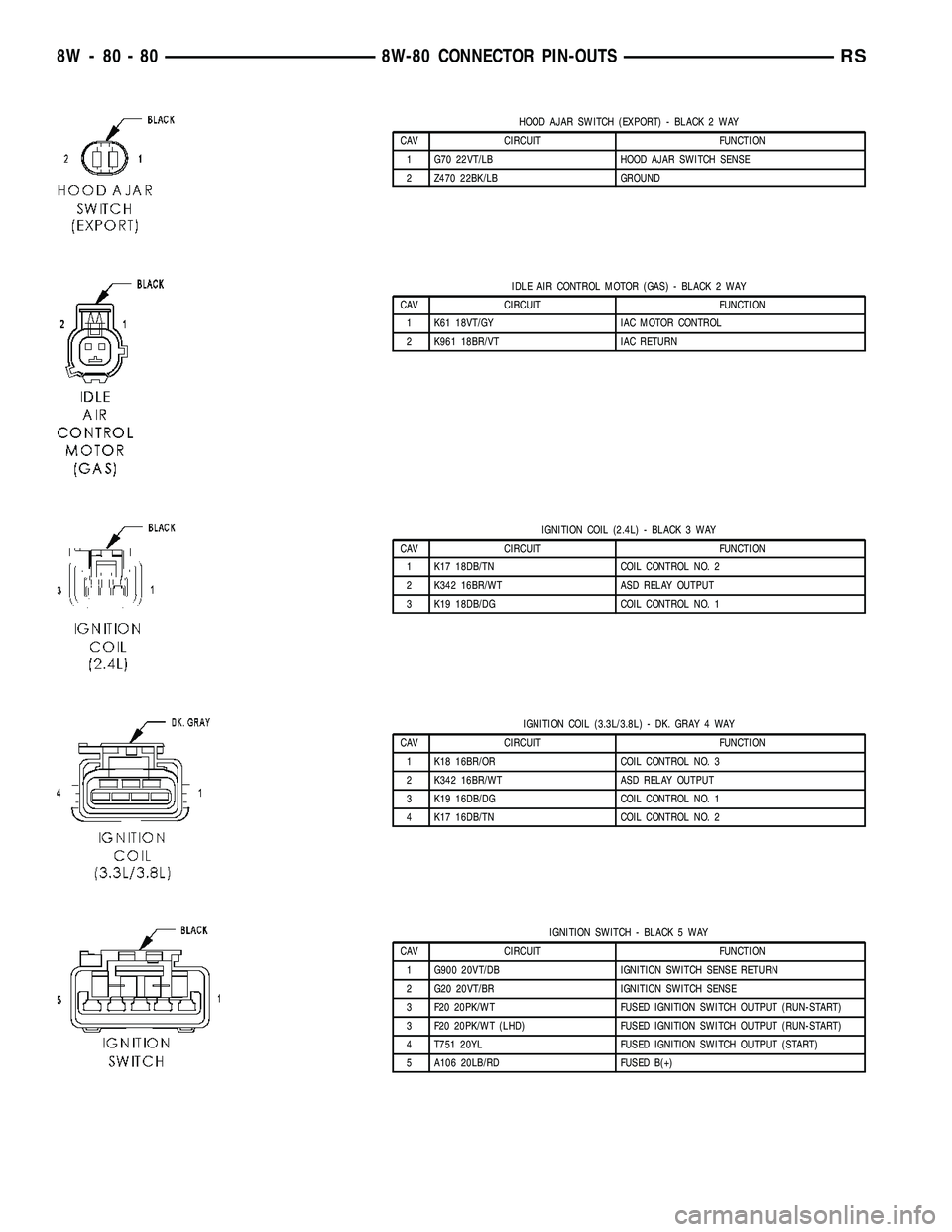
HOOD AJAR SWITCH (EXPORT) - BLACK 2 WAY
CAV CIRCUIT FUNCTION
1 G70 22VT/LB HOOD AJAR SWITCH SENSE
2 Z470 22BK/LB GROUND
IDLE AIR CONTROL MOTOR (GAS) - BLACK 2 WAY
CAV CIRCUIT FUNCTION
1 K61 18VT/GY IAC MOTOR CONTROL
2 K961 18BR/VT IAC RETURN
IGNITION COIL (2.4L) - BLACK 3 WAY
CAV CIRCUIT FUNCTION
1 K17 18DB/TN COIL CONTROL NO. 2
2 K342 16BR/WT ASD RELAY OUTPUT
3 K19 18DB/DG COIL CONTROL NO. 1
IGNITION COIL (3.3L/3.8L) - DK. GRAY 4 WAY
CAV CIRCUIT FUNCTION
1 K18 16BR/OR COIL CONTROL NO. 3
2 K342 16BR/WT ASD RELAY OUTPUT
3 K19 16DB/DG COIL CONTROL NO. 1
4 K17 16DB/TN COIL CONTROL NO. 2
IGNITION SWITCH - BLACK 5 WAY
CAV CIRCUIT FUNCTION
1 G900 20VT/DB IGNITION SWITCH SENSE RETURN
2 G20 20VT/BR IGNITION SWITCH SENSE
3 F20 20PK/WT FUSED IGNITION SWITCH OUTPUT (RUN-START)
3 F20 20PK/WT (LHD) FUSED IGNITION SWITCH OUTPUT (RUN-START)
4 T751 20YL FUSED IGNITION SWITCH OUTPUT (START)
5 A106 20LB/RD FUSED B(+)
8W - 80 - 80 8W-80 CONNECTOR PIN-OUTSRS
Page 1178 of 2585
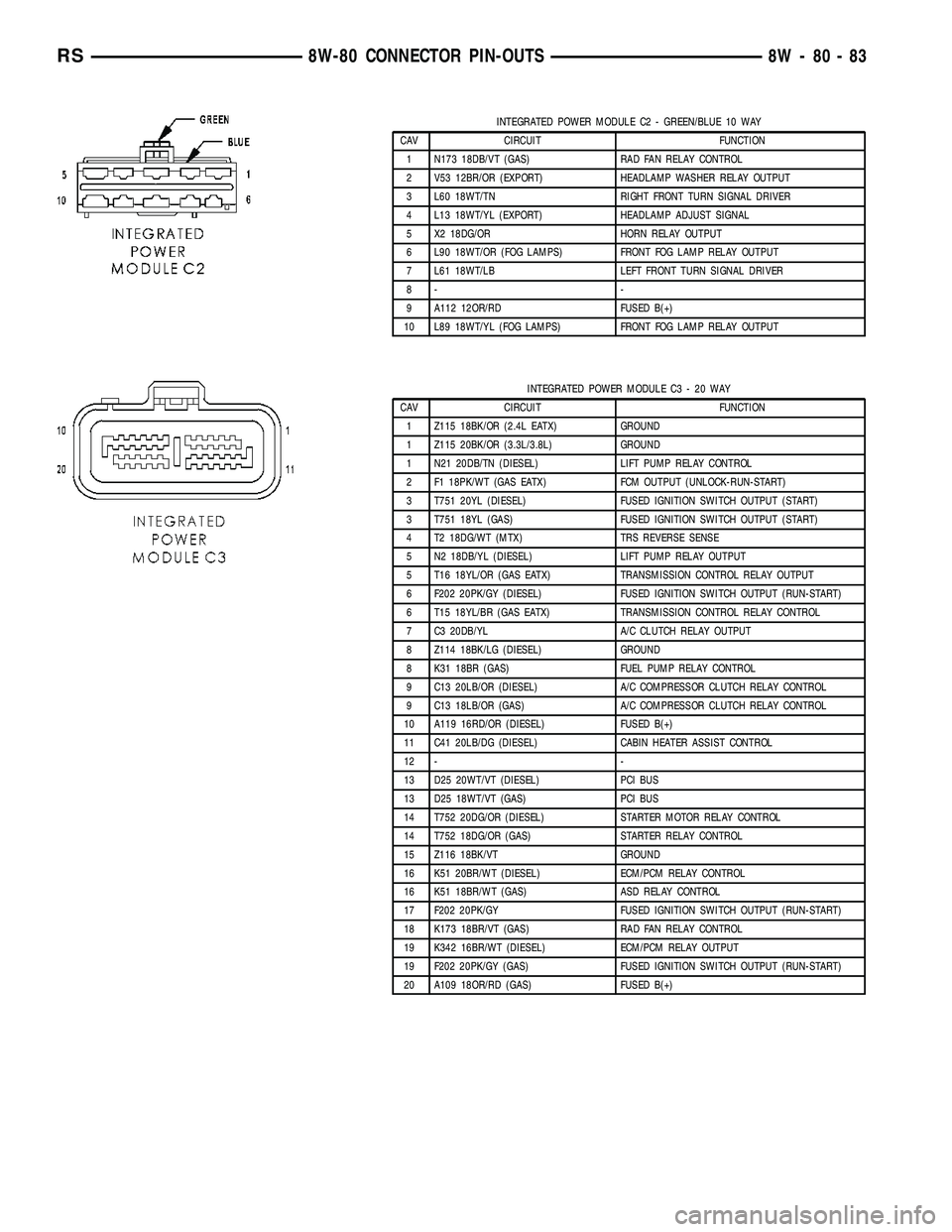
INTEGRATED POWER MODULE C2 - GREEN/BLUE 10 WAY
CAV CIRCUIT FUNCTION
1 N173 18DB/VT (GAS) RAD FAN RELAY CONTROL
2 V53 12BR/OR (EXPORT) HEADLAMP WASHER RELAY OUTPUT
3 L60 18WT/TN RIGHT FRONT TURN SIGNAL DRIVER
4 L13 18WT/YL (EXPORT) HEADLAMP ADJUST SIGNAL
5 X2 18DG/OR HORN RELAY OUTPUT
6 L90 18WT/OR (FOG LAMPS) FRONT FOG LAMP RELAY OUTPUT
7 L61 18WT/LB LEFT FRONT TURN SIGNAL DRIVER
8- -
9 A112 12OR/RD FUSED B(+)
10 L89 18WT/YL (FOG LAMPS) FRONT FOG LAMP RELAY OUTPUT
INTEGRATED POWER MODULE C3 - 20 WAY
CAV CIRCUIT FUNCTION
1 Z115 18BK/OR (2.4L EATX) GROUND
1 Z115 20BK/OR (3.3L/3.8L) GROUND
1 N21 20DB/TN (DIESEL) LIFT PUMP RELAY CONTROL
2 F1 18PK/WT (GAS EATX) FCM OUTPUT (UNLOCK-RUN-START)
3 T751 20YL (DIESEL) FUSED IGNITION SWITCH OUTPUT (START)
3 T751 18YL (GAS) FUSED IGNITION SWITCH OUTPUT (START)
4 T2 18DG/WT (MTX) TRS REVERSE SENSE
5 N2 18DB/YL (DIESEL) LIFT PUMP RELAY OUTPUT
5 T16 18YL/OR (GAS EATX) TRANSMISSION CONTROL RELAY OUTPUT
6 F202 20PK/GY (DIESEL) FUSED IGNITION SWITCH OUTPUT (RUN-START)
6 T15 18YL/BR (GAS EATX) TRANSMISSION CONTROL RELAY CONTROL
7 C3 20DB/YL A/C CLUTCH RELAY OUTPUT
8 Z114 18BK/LG (DIESEL) GROUND
8 K31 18BR (GAS) FUEL PUMP RELAY CONTROL
9 C13 20LB/OR (DIESEL) A/C COMPRESSOR CLUTCH RELAY CONTROL
9 C13 18LB/OR (GAS) A/C COMPRESSOR CLUTCH RELAY CONTROL
10 A119 16RD/OR (DIESEL) FUSED B(+)
11 C41 20LB/DG (DIESEL) CABIN HEATER ASSIST CONTROL
12 - -
13 D25 20WT/VT (DIESEL) PCI BUS
13 D25 18WT/VT (GAS) PCI BUS
14 T752 20DG/OR (DIESEL) STARTER MOTOR RELAY CONTROL
14 T752 18DG/OR (GAS) STARTER RELAY CONTROL
15 Z116 18BK/VT GROUND
16 K51 20BR/WT (DIESEL) ECM/PCM RELAY CONTROL
16 K51 18BR/WT (GAS) ASD RELAY CONTROL
17 F202 20PK/GY FUSED IGNITION SWITCH OUTPUT (RUN-START)
18 K173 18BR/VT (GAS) RAD FAN RELAY CONTROL
19 K342 16BR/WT (DIESEL) ECM/PCM RELAY OUTPUT
19 F202 20PK/GY (GAS) FUSED IGNITION SWITCH OUTPUT (RUN-START)
20 A109 18OR/RD (GAS) FUSED B(+)
RS8W-80 CONNECTOR PIN-OUTS8W-80-83
Page 1179 of 2585
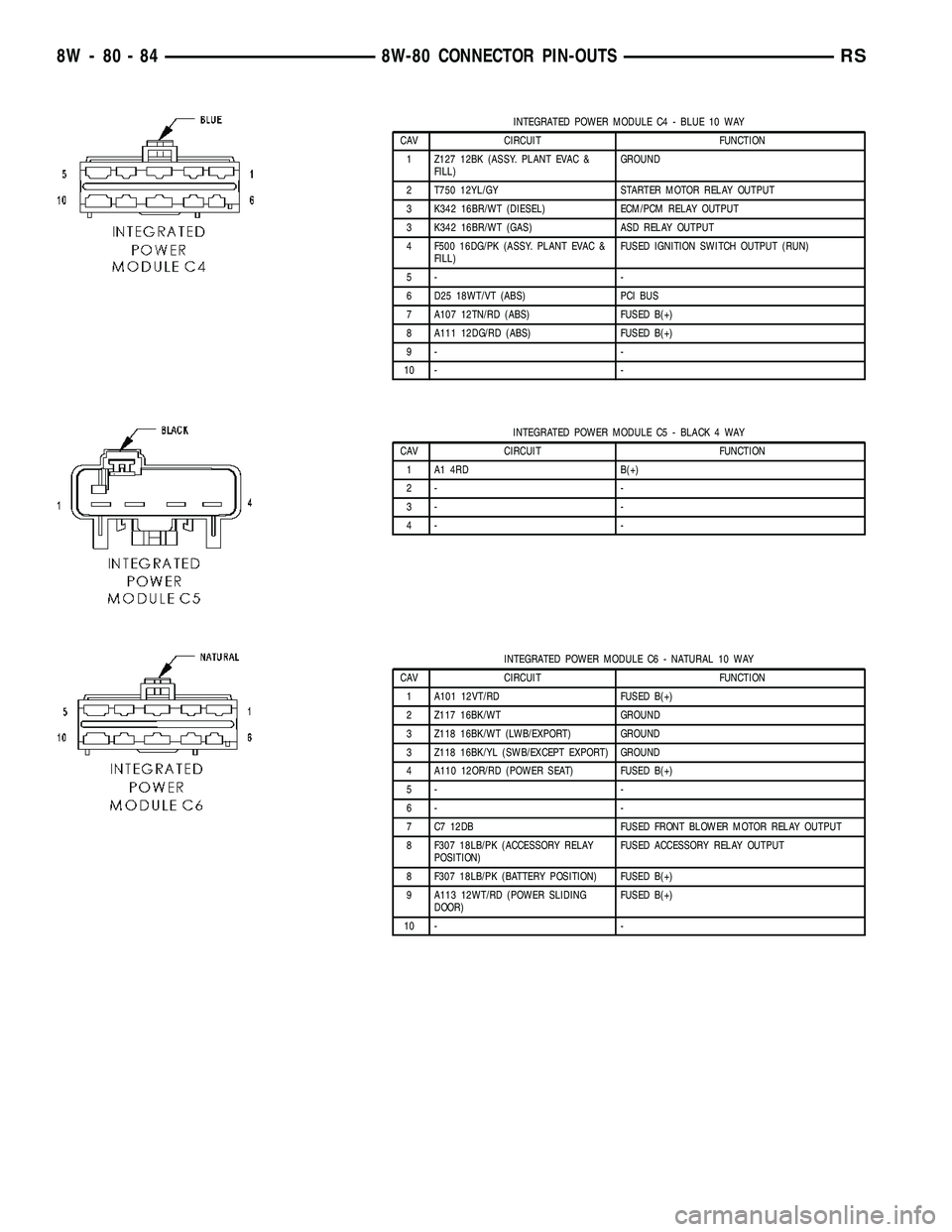
INTEGRATED POWER MODULE C4 - BLUE 10 WAY
CAV CIRCUIT FUNCTION
1 Z127 12BK (ASSY. PLANT EVAC &
FILL)GROUND
2 T750 12YL/GY STARTER MOTOR RELAY OUTPUT
3 K342 16BR/WT (DIESEL) ECM/PCM RELAY OUTPUT
3 K342 16BR/WT (GAS) ASD RELAY OUTPUT
4 F500 16DG/PK (ASSY. PLANT EVAC &
FILL)FUSED IGNITION SWITCH OUTPUT (RUN)
5- -
6 D25 18WT/VT (ABS) PCI BUS
7 A107 12TN/RD (ABS) FUSED B(+)
8 A111 12DG/RD (ABS) FUSED B(+)
9- -
10 - -
INTEGRATED POWER MODULE C5 - BLACK 4 WAY
CAV CIRCUIT FUNCTION
1 A1 4RD B(+)
2- -
3- -
4- -
INTEGRATED POWER MODULE C6 - NATURAL 10 WAY
CAV CIRCUIT FUNCTION
1 A101 12VT/RD FUSED B(+)
2 Z117 16BK/WT GROUND
3 Z118 16BK/WT (LWB/EXPORT) GROUND
3 Z118 16BK/YL (SWB/EXCEPT EXPORT) GROUND
4 A110 12OR/RD (POWER SEAT) FUSED B(+)
5- -
6- -
7 C7 12DB FUSED FRONT BLOWER MOTOR RELAY OUTPUT
8 F307 18LB/PK (ACCESSORY RELAY
POSITION)FUSED ACCESSORY RELAY OUTPUT
8 F307 18LB/PK (BATTERY POSITION) FUSED B(+)
9 A113 12WT/RD (POWER SLIDING
DOOR)FUSED B(+)
10 - -
8W - 80 - 84 8W-80 CONNECTOR PIN-OUTSRS
Page 1207 of 2585
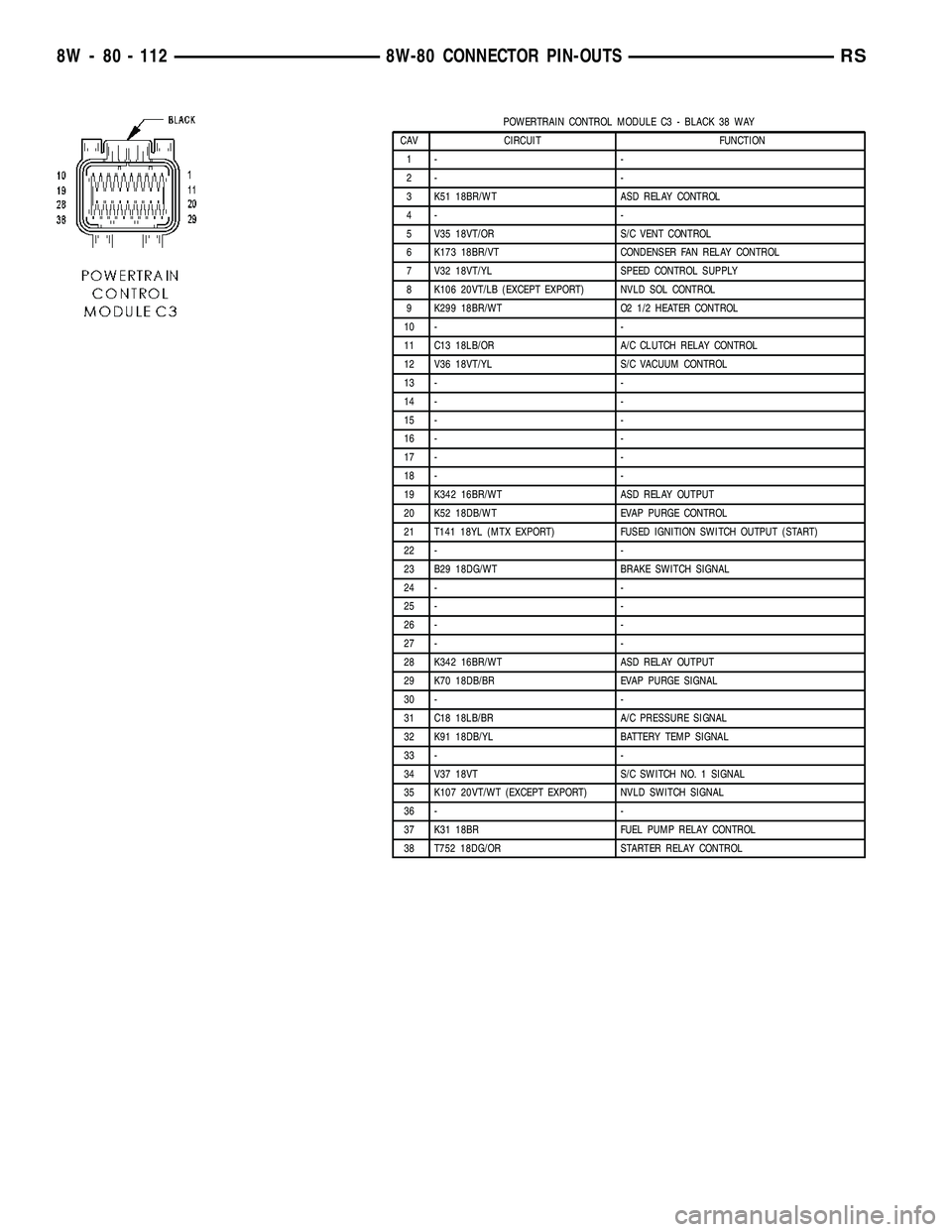
POWERTRAIN CONTROL MODULE C3 - BLACK 38 WAY
CAV CIRCUIT FUNCTION
1- -
2- -
3 K51 18BR/WT ASD RELAY CONTROL
4- -
5 V35 18VT/OR S/C VENT CONTROL
6 K173 18BR/VT CONDENSER FAN RELAY CONTROL
7 V32 18VT/YL SPEED CONTROL SUPPLY
8 K106 20VT/LB (EXCEPT EXPORT) NVLD SOL CONTROL
9 K299 18BR/WT O2 1/2 HEATER CONTROL
10 - -
11 C13 18LB/OR A/C CLUTCH RELAY CONTROL
12 V36 18VT/YL S/C VACUUM CONTROL
13 - -
14 - -
15 - -
16 - -
17 - -
18 - -
19 K342 16BR/WT ASD RELAY OUTPUT
20 K52 18DB/WT EVAP PURGE CONTROL
21 T141 18YL (MTX EXPORT) FUSED IGNITION SWITCH OUTPUT (START)
22 - -
23 B29 18DG/WT BRAKE SWITCH SIGNAL
24 - -
25 - -
26 - -
27 - -
28 K342 16BR/WT ASD RELAY OUTPUT
29 K70 18DB/BR EVAP PURGE SIGNAL
30 - -
31 C18 18LB/BR A/C PRESSURE SIGNAL
32 K91 18DB/YL BATTERY TEMP SIGNAL
33 - -
34 V37 18VT S/C SWITCH NO. 1 SIGNAL
35 K107 20VT/WT (EXCEPT EXPORT) NVLD SWITCH SIGNAL
36 - -
37 K31 18BR FUEL PUMP RELAY CONTROL
38 T752 18DG/OR STARTER RELAY CONTROL
8W - 80 - 112 8W-80 CONNECTOR PIN-OUTSRS
Page 1306 of 2585
(3) Remove torque converter or clutch housing
cover and inspect rear of block for evidence of oil.
Use a black light to check for the oil leak. If a leak is
present in this area, remove transmission for further
inspection.
(a) Circular spray pattern generally indicates
seal leakage or crankshaft damage.
(b) Where leakage tends to run straight down,
possible causes are a porous block, oil gallery cup
plug, bedplate to cylinder block mating surfaces
and seal bore. See proper repair procedures for
these items.
(4) If no leaks are detected, pressurize the crank-
case as previously described.
CAUTION: Do not exceed 20.6 kPa (3 psi).
(5) If the leak is not detected, very slowly turn the
crankshaft and watch for leakage. If a leak is
detected between the crankshaft and seal while
slowly turning the crankshaft, it is possible the
crankshaft seal surface is damaged. The seal area on
the crankshaft could have minor nicks or scratches
that can be polished out with emery cloth.
CAUTION: Use extreme caution when crankshaft
polishing is necessary to remove minor nicks and
scratches. The crankshaft seal flange is especially
machined to complement the function of the rear oil
seal.
(6) For bubbles that remain steady with shaft
rotation, no further inspection can be done until dis-
assembled.
(7) After the oil leak root cause and appropriate
corrective action have been identified, replace compo-
nent(s) as necessary.
DIAGNOSIS AND TESTING - CYLINDER
COMPRESSION PRESSURE TEST
The results of a cylinder compression pressure test
can be utilized to diagnose several engine malfunc-
tions.
Ensure the battery is completely charged and the
engine starter motor is in good operating condition.
Otherwise the indicated compression pressures may
not be valid for diagnosis purposes.
(1) Check engine oil level and add oil if necessary.
(2) Drive the vehicle until engine reaches normal
operating temperature. Select a route free from traf-
fic and other forms of congestion, observe all traffic
laws, and accelerate through the gears several times
briskly.
(3) Remove all spark plugs from engine. As spark
plugs are being removed, check electrodes for abnor-
mal firing indicators fouled, hot, oily, etc. Record cyl-
inder number of spark plug for future reference.(4) Remove the Auto Shutdown (ASD) relay from
the PDC.
(5) Be sure throttle blade is fully open during the
compression check.
(6) Insert compression gauge adaptor Special Tool
8116 or the equivalent, into the #1 spark plug hole in
cylinder head. Connect the 0±500 psi (Blue) pressure
transducer (Special Tool CH7059) with cable adap-
tors to the DRBIIIt. For Special Tool identification,
(Refer to 9 - ENGINE - SPECIAL TOOLS).
(7) Crank engine until maximum pressure is
reached on gauge. Record this pressure as #1 cylin-
der pressure.
(8) Repeat the previous step for all remaining cyl-
inders.
(9) Compression should not be less than 689 kPa
(100 psi) and not vary more than 25 percent from cyl-
inder to cylinder.
(10) If one or more cylinders have abnormally low
compression pressures, repeat the compression test.
(11) If the same cylinder or cylinders repeat an
abnormally low reading on the second compression
test, it could indicate the existence of a problem in
the cylinder in question.The recommended com-
pression pressures are to be used only as a
guide to diagnosing engine problems. An engine
should not be disassembled to determine the
cause of low compression unless some malfunc-
tion is present.
DIAGNOSIS AND TESTING - CYLINDER
COMBUSTION PRESSURE LEAKAGE TEST
The combustion pressure leakage test provides an
accurate means for determining engine condition.
Combustion pressure leakage testing will detect:
²Exhaust and intake valve leaks (improper seat-
ing).
²Leaks between adjacent cylinders or into water
jacket.
²Any causes for combustion/compression pressure
loss.
WARNING: DO NOT REMOVE THE PRESSURE CAP
WITH THE SYSTEM HOT AND UNDER PRESSURE
BECAUSE SERIOUS BURNS FROM COOLANT CAN
OCCUR.
Check the coolant level and fill as required. DO
NOT install the pressure cap.
Start and operate the engine until it attains nor-
mal operating temperature, then turn the engine
OFF.
Clean spark plug recesses with compressed air.
Remove the spark plugs.
Remove the oil filler cap.
Remove the air cleaner.
RSENGINE 2.4L9-9
ENGINE 2.4L (Continued)
Page 1380 of 2585
(3) Remove torque converter or clutch housing
cover and inspect rear of block for evidence of oil.
Use a black light to check for the oil leak. If a leak is
present in this area, remove transmission for further
inspection.
(a) Circular spray pattern generally indicates
seal leakage or crankshaft damage.
(b) Where leakage tends to run straight down,
possible causes are a porous block, oil gallery cup
plug, bedplate to cylinder block mating surfaces
and seal bore. See proper repair procedures for
these items.
(4) If no leaks are detected, pressurize the crank-
case as previously described.
CAUTION: Do not exceed 20.6 kPa (3 psi).
(5) If the leak is not detected, very slowly turn the
crankshaft and watch for leakage. If a leak is
detected between the crankshaft and seal while
slowly turning the crankshaft, it is possible the
crankshaft seal surface is damaged. The seal area on
the crankshaft could have minor nicks or scratches
that can be polished out with emery cloth.
CAUTION: Use extreme caution when crankshaft
polishing is necessary to remove minor nicks and
scratches. The crankshaft seal flange is especially
machined to complement the function of the rear oil
seal.
(6) For bubbles that remain steady with shaft
rotation, no further inspection can be done until dis-
assembled.
(7) After the oil leak root cause and appropriate
corrective action have been identified, replace compo-
nent(s) as necessary.
DIAGNOSIS AND TESTING - CYLINDER
COMPRESSION PRESSURE TEST
The results of a cylinder compression pressure test
can be utilized to diagnose several engine malfunc-
tions.
Ensure the battery is completely charged and the
engine starter motor is in good operating condition.
Otherwise the indicated compression pressures may
not be valid for diagnosis purposes.
(1) Check engine oil level and add oil if necessary.
(2) Drive the vehicle until engine reaches normal
operating temperature. Select a route free from traf-
fic and other forms of congestion, observe all traffic
laws, and accelerate through the gears several times
briskly.
(3) Remove all spark plugs from engine. As spark
plugs are being removed, check electrodes for abnor-
mal firing indicators fouled, hot, oily, etc. Record cyl-
inder number of spark plug for future reference.(4) Remove the Auto Shutdown (ASD) relay from
the PDC.
(5) Be sure throttle blade is fully open during the
compression check.
(6) Insert compression gauge adaptor Special Tool
8116 or the equivalent, into the #1 spark plug hole in
cylinder head. Connect the 0±500 psi (Blue) pressure
transducer (Special Tool CH7059) with cable adap-
tors to the DRBIIIt. For Special Tool identification,
(Refer to 9 - ENGINE - SPECIAL TOOLS).
(7) Crank engine until maximum pressure is
reached on gauge. Record this pressure as #1 cylin-
der pressure.
(8) Repeat the previous step for all remaining cyl-
inders.
(9) Compression should not be less than 689 kPa
(100 psi) and not vary more than 25 percent from cyl-
inder to cylinder.
(10) If one or more cylinders have abnormally low
compression pressures, repeat the compression test.
(11) If the same cylinder or cylinders repeat an
abnormally low reading on the second compression
test, it could indicate the existence of a problem in
the cylinder in question.The recommended com-
pression pressures are to be used only as a
guide to diagnosing engine problems. An engine
should not be disassembled to determine the
cause of low compression unless some malfunc-
tion is present.
DIAGNOSIS AND TESTING - CYLINDER
COMBUSTION PRESSURE LEAKAGE TEST
The combustion pressure leakage test provides an
accurate means for determining engine condition.
Combustion pressure leakage testing will detect:
²Exhaust and intake valve leaks (improper seat-
ing).
²Leaks between adjacent cylinders or into water
jacket.
²Any causes for combustion/compression pressure
loss.
WARNING: DO NOT REMOVE THE PRESSURE CAP
WITH THE SYSTEM HOT AND UNDER PRESSURE
BECAUSE SERIOUS BURNS FROM COOLANT CAN
OCCUR.
Check the coolant level and fill as required. DO
NOT install the pressure cap.
Start and operate the engine until it attains nor-
mal operating temperature, then turn the engine
OFF.
Clean spark plug recesses with compressed air.
Remove the spark plugs.
Remove the oil filler cap.
Remove the air cleaner.
RSENGINE 3.3/3.8L9-83
ENGINE 3.3/3.8L (Continued)
Page 1521 of 2585
QUICK CONNECT FITTING
STANDARD PROCEDURE - QUICK-CONNECT
FITTINGS
REMOVAL
When disconnecting a quick-connect fitting, the
retainer will remain on the fuel tube nipple.
WARNING: RELEASE FUEL SYSTEM PRESSURE
BEFORE DISCONNECTING A QUICK-CONNECT FIT-
TINGS. REFER TO THE FUEL PRESSURE RELEASE
PROCEDURE. THIS MAY RESULT IN PERSONAL
INJURY OR DEATH.
(1) Perform Fuel Pressure Release Procedure.
Refer to the Fuel Pressure Release Procedure in this
section.
(2) Disconnect negative cable from battery or aux-
iliary jumper terminal.
(3) Squeeze retainer tabs together and pull fuel
tube/quick-connect fitting assembly off of fuel tube
nipple. The retainer will remain on fuel tube.
INSTALLATION
CAUTION: Make sure that the o-ring in installed in
fitting. Never install a quick-connect fitting without
the retainer being either on the fuel tube or already
in the quick-connect fitting. In either case, ensure
the retainer locks securely into the quick-connect
fitting by firmly push-pulling-push on fuel tube and
fitting to ensure it is secured.
(1) Using a clean lint free cloth, clean the fuel tube
nipple and retainer.
(2) Prior to connecting the fitting to the fuel tube,
coat the fuel tube nipple with clean engine oil.
(3) Push the quick-connect fitting over the fuel
tube until theretainer seats and a click is heard.
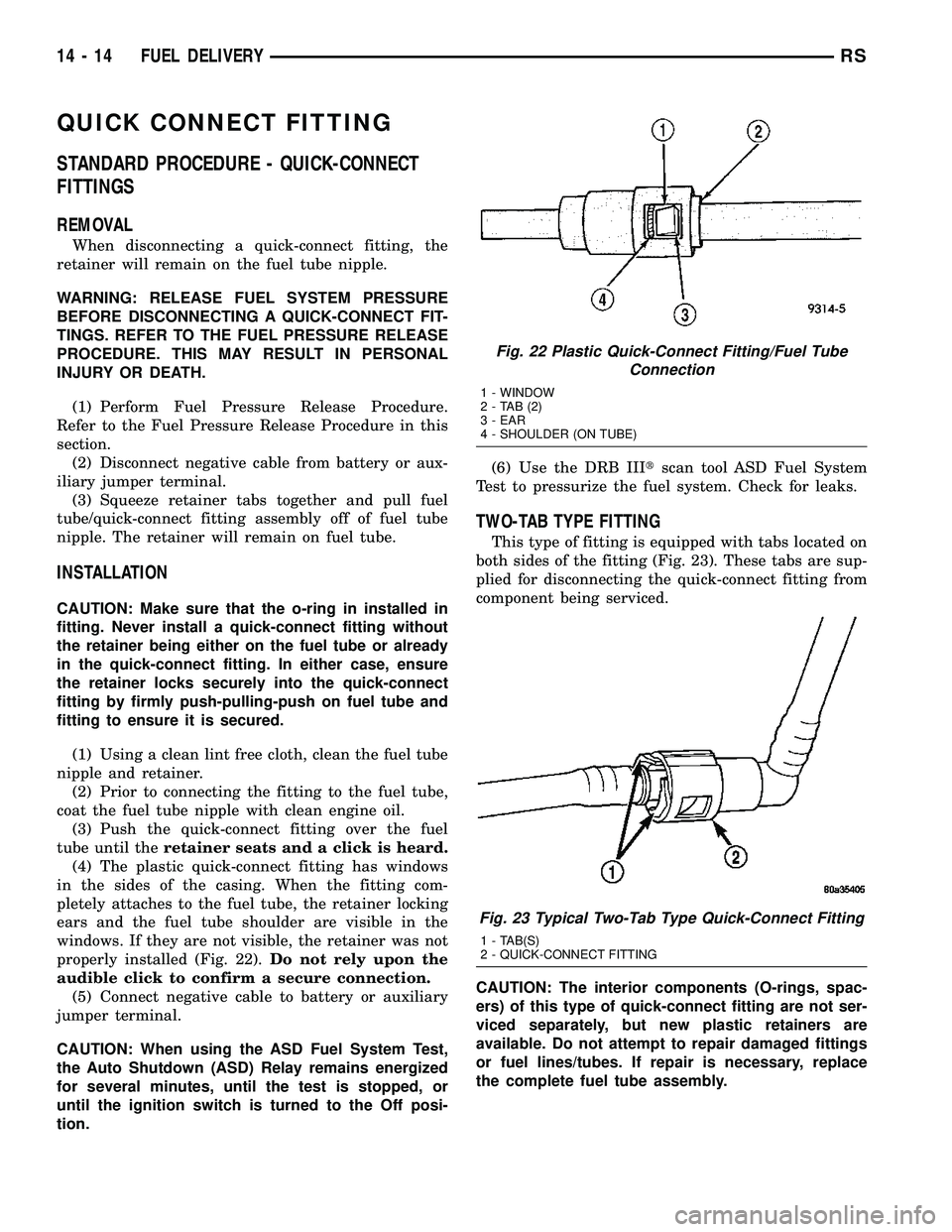
(4) The plastic quick-connect fitting has windows
in the sides of the casing. When the fitting com-
pletely attaches to the fuel tube, the retainer locking
ears and the fuel tube shoulder are visible in the
windows. If they are not visible, the retainer was not
properly installed (Fig. 22).Do not rely upon the
audible click to confirm a secure connection.
(5) Connect negative cable to battery or auxiliary
jumper terminal.
CAUTION: When using the ASD Fuel System Test,
the Auto Shutdown (ASD) Relay remains energized
for several minutes, until the test is stopped, or
until the ignition switch is turned to the Off posi-
tion.(6) Use the DRB IIItscan tool ASD Fuel System
Test to pressurize the fuel system. Check for leaks.
TWO-TAB TYPE FITTING
This type of fitting is equipped with tabs located on
both sides of the fitting (Fig. 23). These tabs are sup-
plied for disconnecting the quick-connect fitting from
component being serviced.
CAUTION: The interior components (O-rings, spac-
ers) of this type of quick-connect fitting are not ser-
viced separately, but new plastic retainers are
available. Do not attempt to repair damaged fittings
or fuel lines/tubes. If repair is necessary, replace
the complete fuel tube assembly.
Fig. 22 Plastic Quick-Connect Fitting/Fuel Tube
Connection
1 - WINDOW
2-TAB(2)
3 - EAR
4 - SHOULDER (ON TUBE)
Fig. 23 Typical Two-Tab Type Quick-Connect Fitting
1 - TAB(S)
2 - QUICK-CONNECT FITTING
14 - 14 FUEL DELIVERYRS
Page 1522 of 2585
WARNING: THE FUEL SYSTEM IS UNDER A CON-
STANT PRESSURE (EVEN WITH THE ENGINE OFF).
BEFORE SERVICING ANY FUEL SYSTEM HOSES,
FITTINGS OR LINES, THE FUEL SYSTEM PRES-
SURE MUST BE RELEASED. REFER TO THE FUEL
PRESSURE RELEASE PROCEDURE IN THIS
GROUP. THIS MAY RESULT IN PERSONAL INJURY
OR DEATH.
DISCONNECTION/CONNECTION
(1) Perform fuel pressure release procedure. Refer
to Fuel Pressure Release Procedure in this group.
(2) Disconnect negative battery cable from battery
or auxiliary jumper terminal.
(3) Clean fitting of any foreign material before dis-
assembly.
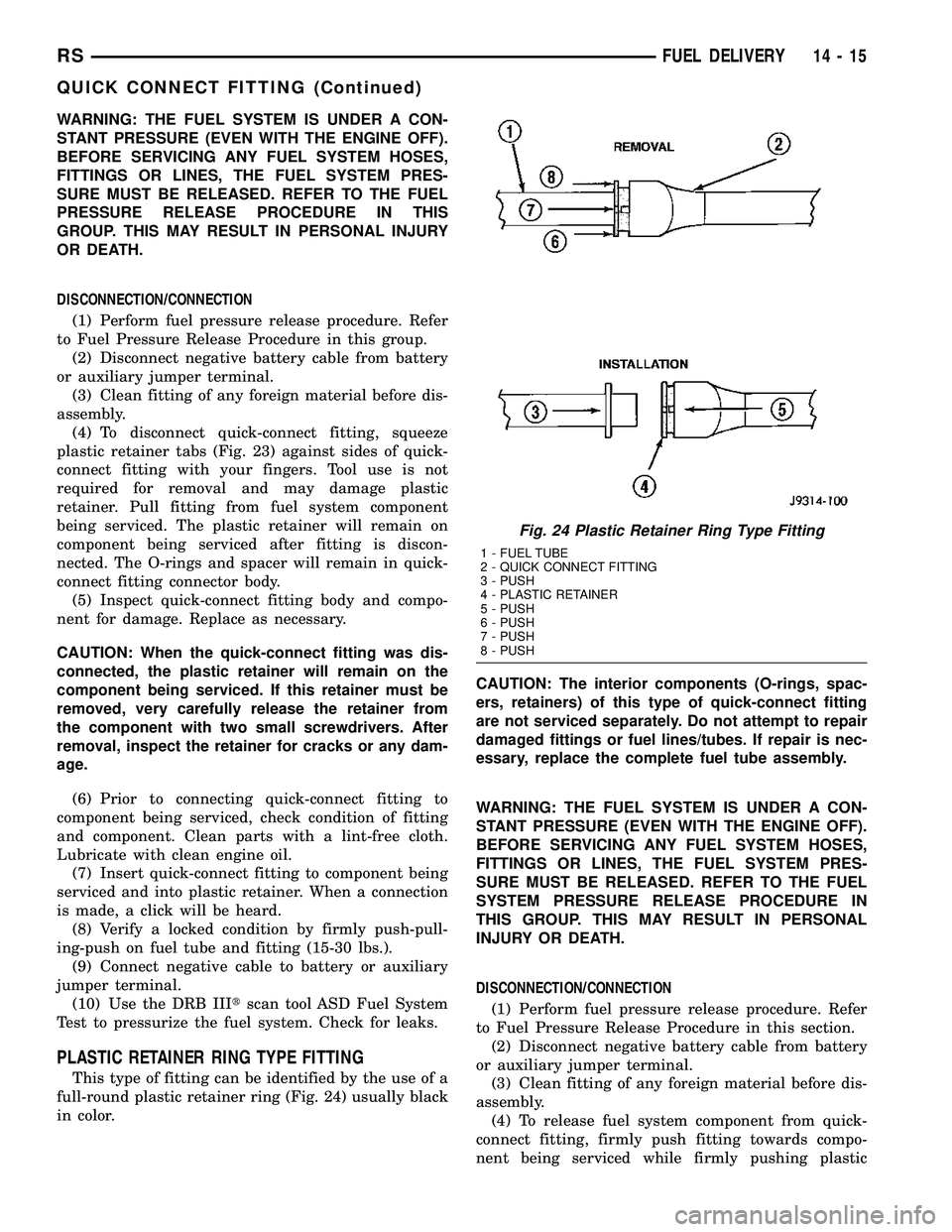
(4) To disconnect quick-connect fitting, squeeze
plastic retainer tabs (Fig. 23) against sides of quick-
connect fitting with your fingers. Tool use is not
required for removal and may damage plastic
retainer. Pull fitting from fuel system component
being serviced. The plastic retainer will remain on
component being serviced after fitting is discon-
nected. The O-rings and spacer will remain in quick-
connect fitting connector body.
(5) Inspect quick-connect fitting body and compo-
nent for damage. Replace as necessary.
CAUTION: When the quick-connect fitting was dis-
connected, the plastic retainer will remain on the
component being serviced. If this retainer must be
removed, very carefully release the retainer from
the component with two small screwdrivers. After
removal, inspect the retainer for cracks or any dam-
age.
(6) Prior to connecting quick-connect fitting to
component being serviced, check condition of fitting
and component. Clean parts with a lint-free cloth.
Lubricate with clean engine oil.
(7) Insert quick-connect fitting to component being
serviced and into plastic retainer. When a connection
is made, a click will be heard.
(8) Verify a locked condition by firmly push-pull-
ing-push on fuel tube and fitting (15-30 lbs.).
(9) Connect negative cable to battery or auxiliary
jumper terminal.
(10) Use the DRB IIItscan tool ASD Fuel System
Test to pressurize the fuel system. Check for leaks.
PLASTIC RETAINER RING TYPE FITTING
This type of fitting can be identified by the use of a
full-round plastic retainer ring (Fig. 24) usually black
in color.CAUTION: The interior components (O-rings, spac-
ers, retainers) of this type of quick-connect fitting
are not serviced separately. Do not attempt to repair
damaged fittings or fuel lines/tubes. If repair is nec-
essary, replace the complete fuel tube assembly.
WARNING: THE FUEL SYSTEM IS UNDER A CON-
STANT PRESSURE (EVEN WITH THE ENGINE OFF).
BEFORE SERVICING ANY FUEL SYSTEM HOSES,
FITTINGS OR LINES, THE FUEL SYSTEM PRES-
SURE MUST BE RELEASED. REFER TO THE FUEL
SYSTEM PRESSURE RELEASE PROCEDURE IN
THIS GROUP. THIS MAY RESULT IN PERSONAL
INJURY OR DEATH.
DISCONNECTION/CONNECTION
(1) Perform fuel pressure release procedure. Refer
to Fuel Pressure Release Procedure in this section.
(2) Disconnect negative battery cable from battery
or auxiliary jumper terminal.
(3) Clean fitting of any foreign material before dis-
assembly.
(4) To release fuel system component from quick-
connect fitting, firmly push fitting towards compo-
nent being serviced while firmly pushing plastic
Fig. 24 Plastic Retainer Ring Type Fitting
1 - FUEL TUBE
2 - QUICK CONNECT FITTING
3 - PUSH
4 - PLASTIC RETAINER
5 - PUSH
6 - PUSH
7 - PUSH
8 - PUSH
RSFUEL DELIVERY14-15
QUICK CONNECT FITTING (Continued)