Page 131 of 273
NE-85 General Information................167
NEthanol Fuel (E-85)....................167
NFuel Requirements....................168
NSelection Of Engine Oil.................168NStarting............................170
NCruising Range.......................170
NReplacement Parts.....................170
NMaintenance.........................170
STARTING AND OPERATING 131
5
Page 133 of 273

WARNING!
Never pour fuel or other flammable liquid into the
throttle body air inlet opening in an attempt to start
the vehicle. This could result in flash fire causing
serious personal injury.
CAUTION!
Do not attempt to push or tow your vehicle to get it
started. Vehicles equipped with an automatic trans-
axle cannot be started this way. Unburned fuel could
enter the catalytic converter and once the engine has
started, ignite and damage the converter and vehicle.
If the vehicle has a discharged battery, booster cables
may be used to obtain a start from another vehicle.
This type of start can be dangerous if done improp-
erly, so follow the procedure carefully. See section 6
of this manual for jump starting instructions.
Extreme Cold Weather (below -20ÉF or -29ÉC)
To insure reliable starting at these temperatures, use of an
externally powered electric engine block heater and
battery blanket heater package (available from your
dealer) is recommended.
STARTING AND OPERATING 133
5
Page 134 of 273

If Engine Fails to Start
If the engine fails to start after you have followed the
ªNORMAL STARTINGº or ªEXTREME COLD
WEATHERº procedures, it may be flooded. Push the
accelerator pedal all the way to the floor and hold it there
while cranking the engine. This should clear any excess
fuel in case the engine is flooded.
CAUTION!
To prevent damage to the starter, do not crank the
engine for more than 15 seconds at a time. Wait 10 to
15 seconds before trying again.
If the engine has been flooded, it may start to run, but not
have enough power to continue running when the key is
released. If this occurs, continue cranking with the accel-
erator pedal pushed all the way to the floor. Release the
accelerator pedal and the key once the engine is running
smoothly.If the engine shows no sign of starting after two 15
second periods of cranking with the accelerator pedal
held to the floor, the ªNORMAL STARTINGº or ªEX-
TREME COLD WEATHERº procedure should be re-
peated.
After Starting
The idle speed will automatically decrease as the engine
warms up. At cooler ambient temperatures, the idle
speed for the 2.7L engine may increase during extended
idles for improved heater performance.
BATTERY AND ENGINE BLOCK HEATERS Ð If
EQUIPPED
The engine block heater warms engine coolant and
permits quicker starts in cold weather. Connect the cord
to a standard 110-115 volt AC electrical outlet with a
grounded, three wire extension cord. The engine block
heater cord is found under the hood near the air cleaner
housing.
134 STARTING AND OPERATING
Page 138 of 273

WARNING!
Your vehicle could move and injure you and others if
it is not completely in P (Park). Check by trying to
move the gearshift lever back and forth without
depressing the shift button after you have set it in P.
Make sure it is in Park before leaving the vehicle.
WARNING!
Never use the Park position as a substitute for the
parking brake. Always apply the parking brake fully
when parked to guard against vehicle movement and
possible injury or damage.
ªRº Reverse
Shift into this range only after the vehicle has come to a
complete stop.
ªNº Neutral
Engine may be started in this range.
ªDº Overdrive
This range should be used for most city and highway
driving. It provides smoothest up shifts and down shifts
and best fuel economy.
When frequent transaxle shifting occurs while using the
Overdrive range, such as when operating the vehicle
under heavy loading conditions (in hilly terrain, travel-
ing into strong head winds, or while towing heavy
trailers), use the ª3º range.
ª3º Drive
This range eliminates shifts into Overdrive. The transaxle
will operate normally in first and second while in this
range.
A delayed shift from second to third will occur at speeds
of about 31 to 38 mph (50 to 60 km/h) and low levels of
accelerator pedal travel. An early down-shift from third
to second will occur at a speed of about 34 to 30 mph (54
to 48 km/h). This is done to provide second gear engine
braking at speeds less than 30 mph (48 km/h).
138 STARTING AND OPERATING
Page 139 of 273
NOTE:Using the ª3º range while operating the vehicle
under heavy operating conditions will improve perfor-
mance, fuel economy, and extend transaxle life by reduc-
ing excessive shifting and heat build up.
Use the ª3º range when descending steep grades to
prevent brake system distress.
ªLº Low
This range should be used for maximum engine braking
when descending steep grades. In this range, up shifts
will occur only to prevent engine over speed while down
shifts occur as early as possible.
WARNING!
Never use Park position on an automatic transmis-
sion as a substitute for the parking brake. Always
apply parking brake fully when parked to guard
against vehicle movement and possible injury or
damage.
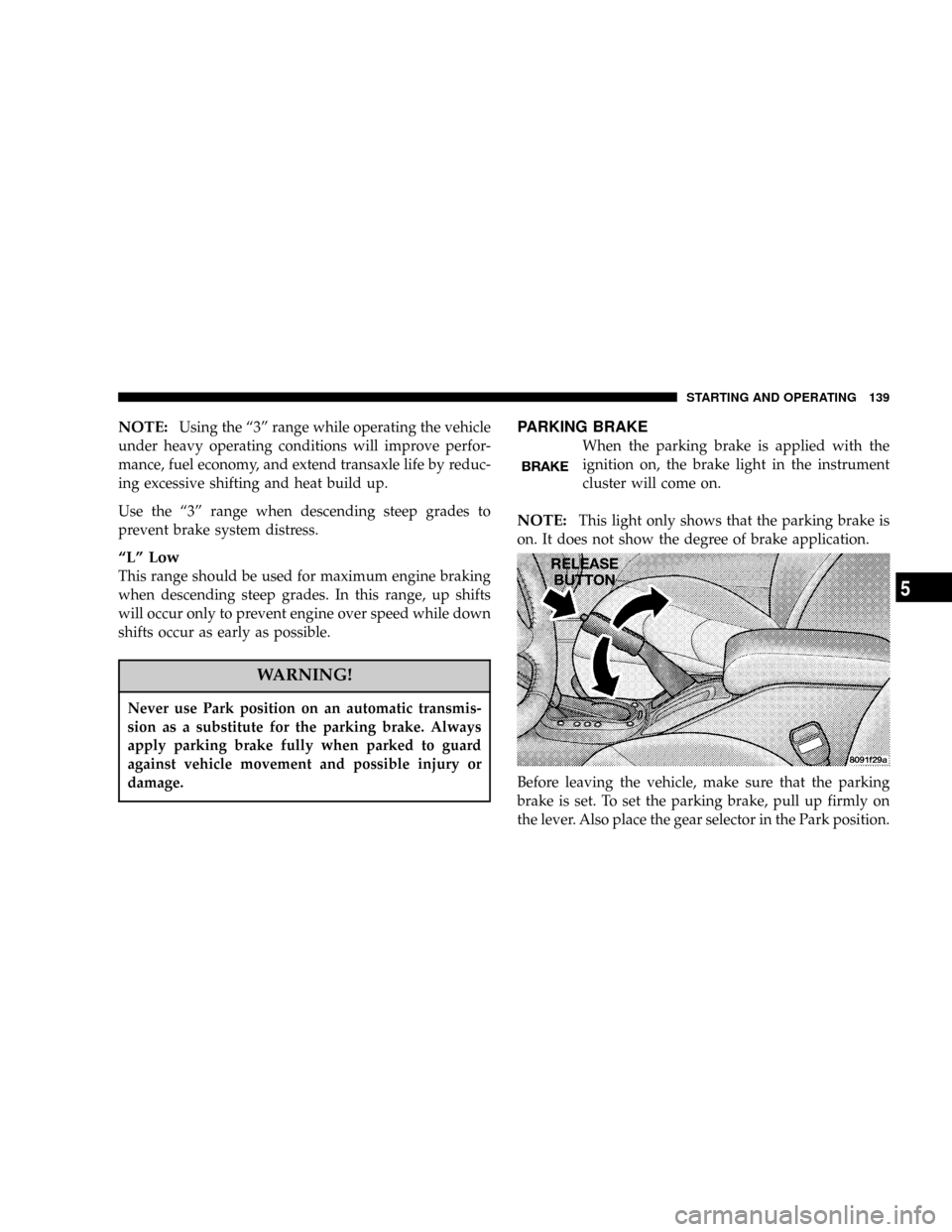
PARKING BRAKE
When the parking brake is applied with the
ignition on, the brake light in the instrument
cluster will come on.
NOTE:This light only shows that the parking brake is
on. It does not show the degree of brake application.
Before leaving the vehicle, make sure that the parking
brake is set. To set the parking brake, pull up firmly on
the lever. Also place the gear selector in the Park position.
STARTING AND OPERATING 139
5
Page 152 of 273

2. EconomyÐ
Improper inflation pressures can cause uneven wear
patterns to develop across the tire tread. These abnormal
wear patterns will reduce tread life resulting in a need for
earlier tire replacement. Underinflation also increases tire
rolling resistance and results in higher fuel consumption.
3. Ride Comfort and Vehicle StabilityÐ
Proper tire inflation contributes to a comfortable ride.
Overinflation produces a jarring and uncomfortable ride.
Tire Inflation Pressures
The proper cold tire inflation pressure for passenger cars
is listed on either the face of the driver's door or the
driver's side ªBº pillar. For vehicles other than passenger
cars, the cold tire inflation pressures are listed on either
the ªBº pillar, the Certification Label or in the Tire
Inflation Pressures brochure in the glove compartment.
Some vehicles may have Supplemental Tire Pressure
Information for vehicle loads that are less that the maxi-
mum loaded vehicle condition. These pressure condi-
tions will be found in the ªSupplemental Tire Pressure
Informationº section of this manual.The pressure should be checked and adjusted as well as
inspecting for signs of tire wear or visible damage at least
once a month. Use a good quality pocket-type gauge to
check tire pressure. Do not make a visual judgement
when determining proper inflation. Radial tires may look
properly inflated even when they are underinflated.
ªBº PILLAR
152 STARTING AND OPERATING
Page 161 of 273

²Starting out in third gear is helpful in snowy or icy
conditions.
²While in the Autostick mode, Speed Control will only
function in third or fourth gear. Downshifting out of
third gear turns off speed control.
²If the system detects powertrain overheating, the
transaxle will revert to the automatic shift mode and
remain in that mode until the powertrain cools off.
²If the system detects a problem it will disable the
Autostick mode and the transaxle will return to the
automatic mode until the problem is corrected.
FUEL REQUIREMENTS
Your vehicle is designed to meet all emis-
sion regulations and provide excellent fuel
economy when using high quality regular
unleaded gasoline with an octane rating of
87. The use of premium gasoline is not
recommended. The use of premium gaso-
line will provide no benefit over high quality regular
gasolines, and in some circumstances, may result in
poorer performance.Light spark knock at low engine speeds is not harmful to
your engine. However, continued heavy spark knock at
high speeds can cause damage and should be reported to
your dealer immediately. Engine damage resulting from
operating with a heavy spark knock may not be covered
by the new vehicle warranty.
Poor quality gasoline can cause problems such as hard
starting, stalling and stumble. If you experience these
problems, try another brand of regular gasoline before
considering service for the vehicle.
Reformulated Gasoline
Many areas of the country require the use of cleaner
burning fuel referred to as ªReformulated Gasolineº.
Reformulated gasolines contain oxygenates, and are spe-
cially blended to reduce vehicle emissions and improve
air quality.
The manufacturer supports the use of reformulated gaso-
lines. Properly blended reformulated gasolines will pro-
vide excellent performance and durability of engine and
fuel system components.
STARTING AND OPERATING 161
5
Page 162 of 273

Gasoline/Oxygenate Blends
Some fuel suppliers blend unleaded gasoline with mate-
rials called oxygenates such as 10% ethanol, MTBE and
ETBE. Oxygenates are required in some areas of the
country during the winter months to reduce carbon
monoxide emissions. Fuels blended with these oxygen-
ates may be used in your vehicle.
CAUTION!
DO NOT use gasolines containing Methanol. Use of
these blends may result in starting and driveability
problems and may damage critical fuel system com-
ponents.
Problems that result from using methanol/gasoline
blends are not the responsibility of the manufacturer and
may not be covered by the vehicle warranty. While MTBE
is an oxygenate made from Methanol, it does not have
the negative effects of Methanol.
MMT in Gasoline
MMT is a manganese containing metallic additive that is
blended into some gasoline to increase the octane num-
ber. Gasolines blended with MMT offer no performance
advantage beyond gasolines of the same octane number
without MMT. Gasolines blended with MMT have shown
to reduce spark plug life and reduce emission system
performance in some vehicles. The manufacturer recom-
mends using gasolines without MMT. Since the MMT
content of gasoline may not be indicated on the pump,
you should ask your gasoline retailer whether or not
his/her gasoline contains MMT.
It is even more important to look for gasolines without
MMT in Canada because MMT can be used at higher
levels than allowed in the United States.
MMT is prohibited in both Federal and California refor-
mulated gasolines.
162 STARTING AND OPERATING