Page 82 of 382
3. To activate the ALR mode, slowly pull the shoulder
part of the belt all the way out until it stops, then let the
belt feed back into the retractor.
4. After the belt has retracted, tug on it. If the belt is
locked, you will not be able to pull it out. If you can pull
the belt out, it is not locked and not in the ALR mode. You
will need to repeat steps 3 and 4.5. After confirming that the belt is locked, grab the
shoulder part of the belt near the buckle and pull up to
remove any slack from the lap part of the belt. Remem-
ber, if the lap part of the belt is not tight, the child
restraint system will not be secure. It may help to put
weight on the child restraint system and/or push on its
seatback while pulling up on the belt (see illustration).
G18C0550G18C0560
82 SEATS, SEAT BELTS, CHILD RESTRAINTS AND AIR BAGS
Page 85 of 382
WARNING!
²Children who are not buckled up, with all the
doors locked, can be thrown out of the vehicle or
otherwise be seriously or fatally injured in the
event of a collision.
²A child should never be left unattended or unsu-
pervised around the vehicle. When you leave the
vehicle, always take the child out as well.
²Children can die from heat stroke if trapped
inside vehicles, especially on hot days.
²Keep vehicles locked and trunks closed when not
in use. Keep vehicle keys away from children.
Seat Belts And Pregnant Women
We recommend that pregnant women use the seat belts
throughout their pregnancy. Keeping the mother safe is
the best way to keep the baby safe.
Pregnant women should wear the lap part of the belt
across the thighs and as snug across the hips as possible.
Keep the belt low so that it does not come across the
abdomen. That way the strong bones of the hips will take
the force if there is a collision.
SEATS, SEAT BELTS, CHILD RESTRAINTS AND AIR BAGS 85
3
Page 86 of 382

MAINTENANCE AND INSPECTION OF SEAT
BELTS
The seat belt webbing may be cleaned with mild soap or
detergent solution. Allow the belts to dry in the shade.
Do not allow them to retract until completely dry. Do not
attempt to bleach or re-dye belts. The color may rub off
and webbing strength could be affected.
Regularly check seat belt buckles and release mecha-
nisms for positive action and the retractors when in the
automatic locking retractor mode for positive engage-
ment. Refer to ªInstalling a child restraint system to a
UNIBELTº on page 80.
Check that the anchor mounting bolts are tight. If the seat
belt webbing shows obvious cuts, tears, protruding bro-
ken fibers that cause a local increase in webbing thick-
ness, or severe fading which indicates weakening by
exposure to sunlight, the entire seat belt assembly should
be replaced.The lap belt portion of the front UNIBELT has a sleeve
inside which the belt is folded back over itself in a loop.
This allows the belt to help absorb the energy of a
collision through a controlled release of the loop. In the
event that the loop inside the sleeve has come loose,
replace the entire seat belt assembly.
G28A0420
Good
No GoodSleeve
Sleeve
86 SEATS, SEAT BELTS, CHILD RESTRAINTS AND AIR BAGS
Page 101 of 382

INSTRUMENTS AND CONTROLS
CONTENTS
mInstrument cluster......................104
NMeter cluster.........................104
NIndicator and warning light package........105
NSpeedometer.........................106
NTachometer..........................106
NFuel gauge..........................107
NOdometer/Trip odometer................108
NEngine coolant temperature gauge..........109
NTurn signal indicators/hazard warning lights . . 110
NHigh beam indicator...................110
NTheft-alarm indicator...................110
NDoor-ajar warning light and chime.........110NAnti-lock braking system warning light
(if so equipped).......................111
NCruise/speed control indicator............111
NLow-fuel warning light and chime..........111
NFront fog light indicator.................112
NCharging system warning light............112
NOil pressure warning light...............112
NMalfunction indicator light
(SERVICE ENGINE SOON)...............113
NSupplemental Restraint System (SRS)-air bag
warning light.........................114
NBrake warning light....................115
NSeat belt reminder/warning light...........116
4
Page 105 of 382
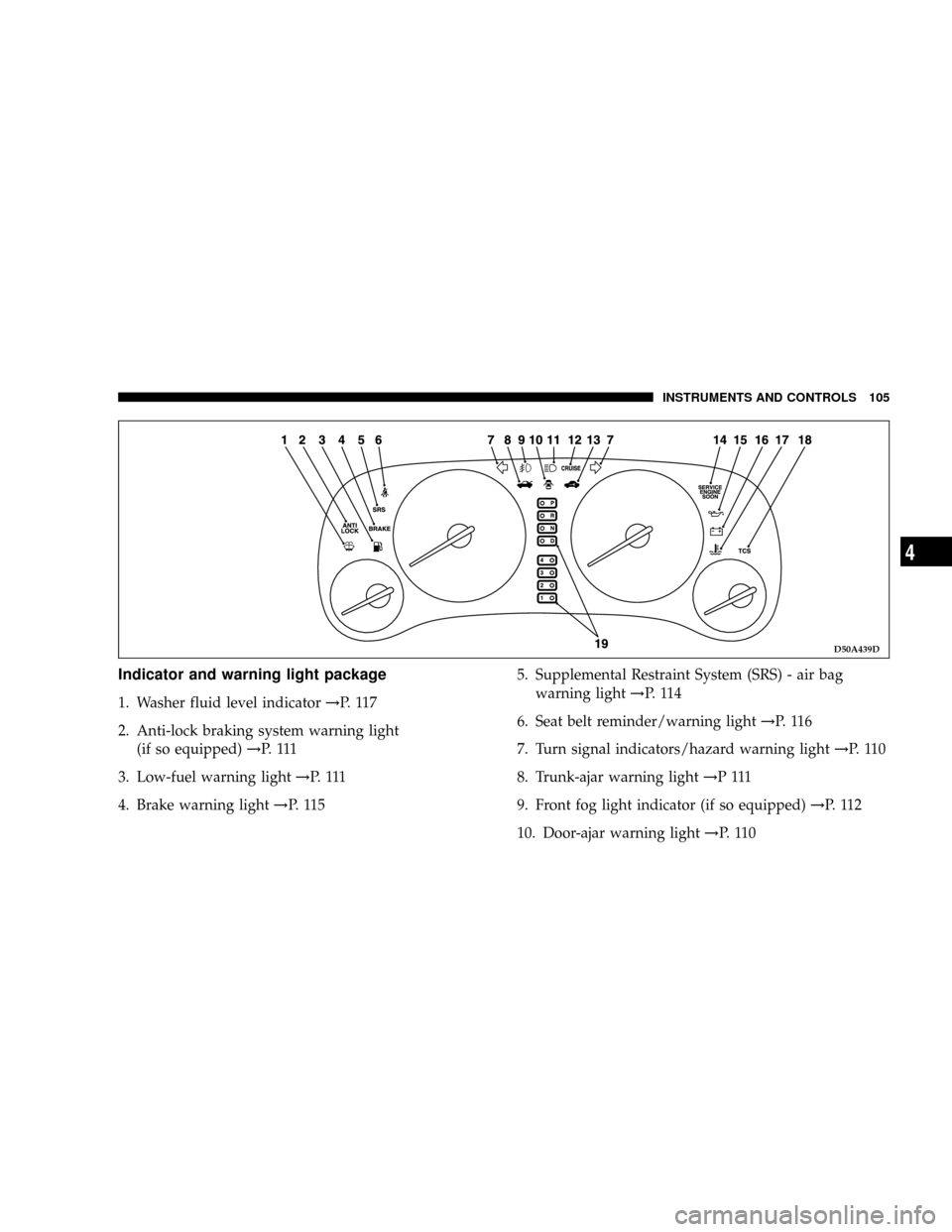
Indicator and warning light package
1. Washer fluid level indicator!P. 1 1 7
2. Anti-lock braking system warning light
(if so equipped)!P. 111
3. Low-fuel warning light!P. 111
4. Brake warning light!P. 1 1 55. Supplemental Restraint System (SRS) - air bag
warning light!P. 1 1 4
6. Seat belt reminder/warning light!P. 1 1 6
7. Turn signal indicators/hazard warning light!P. 1 1 0
8. Trunk-ajar warning light!P 111
9. Front fog light indicator (if so equipped)!P. 1 1 2
10. Door-ajar warning light!P. 1 1 0
D50A439D
INSTRUMENTS AND CONTROLS 105
4
Page 111 of 382

Trunk-ajar warning light and chime
This light illuminates when the trunk lid is
open or not completely closed.
When the vehicle is moving at more than 5
mph (8 km/h) and the trunk lid is open or
ajar, a chime will sound to inform the driver that the
trunk lid is not properly shut.
Anti-lock braking system warning light (if so
equipped)
This light comes on in the event of a mal-
function in the anti-lock braking system.
Always be sure that the light goes out
before beginning to drive.
It also comes on when the ignition key is turned to the
ªONº position and should go out shortly after starting
the engine.
If the light illuminates during driving;
1. Stop the vehicle in a safe place and turn off the engine.
Test the system by restarting the engine and driving at a
speed of about 12 mph (20 km/h) or higher.
If the light goes out, there is no abnormal condition.2. If the light does not go out or if it illuminates again,
the anti-lock braking system is not functioning, and only
the standard braking system is functioning.
If this occurs, take your vehicle to an authorized dealer
and have the system checked.
NOTE: If the light remains illuminated after the engine
is started, it indicates that a fault has occured in the
Anti-lock brake system. The standard brake system will
function normally. (Refer to ªAnti-lock braking systemº
on page 169).
Cruise/speed control indicator
This indicator will illuminate when the
cruise/speed control main switch is ªONº.
Low-fuel warning light and chime
When the fuel level in the fuel tank gets
low, the light illuminates and the chime will
also sound. It is recommended that fuel be
added as soon as this light illuminates.
INSTRUMENTS AND CONTROLS 111
4
Page 114 of 382

CAUTION!
²Prolonged driving with the malfunction indicator
light on may result in further damage to the
emission control system. Continued driving could
also affect fuel economy and driveability.
²If the light does not illuminate when the ignition
key is turned to the ªONº position (bulb check),
have the system checked at an authorized dealer.
NOTE: Do not disconnect the battery cable when the
Malfunction indicator light (SERVICE ENGINE SOON) is
ON.
The engine electronic control module stores critical OBD
data, which may be lost if the battery is disconnected.
This can make rapid diagnosis more difficult.
If the fuel tank filler cap is not secured properly, the
light may come on. Be sure the fuel tank filler tube cap
is tightened every time you add fuel. (Turn the fuel
tank filler cap clockwise until you hear clicking
sounds.)Overheating warning light
If the warning light illuminates while the
engine is running, it is possible that the
engine is overheated.
Immediately park your vehicle in a safe
place and make the necessary corrections.
(Refer to ``Engine overheating'' on page 272.)
While driving, care should always be taken to maintain
the normal operating temperature.
Supplemental Restraint System (SRS)-air bag
warning light
This light illuminates when the Supplemen-
tal Restraint System-air bag is not working
properly. It will also illuminate for about 7
seconds after the ignition key is turned to the ªONº
position or after the engine is started. The light should
then go out.
Check the light every time the vehicle is started.
If it does not illuminate, or stays on for more than
approximately 7 seconds after the ignition key is turned
ªONº or after the engine is started, or if it comes on while
114 INSTRUMENTS AND CONTROLS
Page 115 of 382
![CHRYSLER SEBRING COUPE 2004 2.G Owners Manual driving, take your vehicle to your authorized dealer and
have the system checked.
[See ªSupplemental Restraint System (SRS)º on page
114.]
Brake warning light
This light illuminates when the ignitio](/manual-img/25/8545/w960_8545-114.png "CHRYSLER SEBRING COUPE 2004 2.G Owners Manual driving, take your vehicle to your authorized dealer and
have the system checked.
[See ªSupplemental Restraint System (SRS)º on page
114.]
Brake warning light
This light illuminates when the ignitio")
driving, take your vehicle to your authorized dealer and
have the system checked.
[See ªSupplemental Restraint System (SRS)º on page
114.]
Brake warning light
This light illuminates when the ignition key
is turned to the ªONº position (engine off).
When the engine is started, the light should go off. But
when the parking brake is applied or the brake fluid falls
below the prescribed level, the light illuminates.
Before driving your vehicle, release the parking brake
fully and make certain that the brake warning light has
gone out.
CAUTION!
If the brake warning light does not go on when you
pull the parking brake lever, or if it does not go out
when you release the lever, contact an authorized
dealer immediately.
If the brake warning light illuminates while driving, it
could mean braking performance deterioration. Park
your vehicle in a safe place using the following proce-
dures:
1. If, when pressing the brake pedal, braking is poor,
press your foot harder against the brake pedal.
2. Should the braking deteriorate, use engine braking by
shifting the transaxle into a lower gear (Manual transaxle
or Automatic transaxle autostick) or into the ``3'' (THIRD)
or the ``2'' (SECOND) or the ``L'' (LOW) position (Auto-
matic transaxle) to reduce the speed and slowly pull the
parking brake lever, while applying pressure against the
brake pedal.
Depress the brake pedal to turn on the stop light (brake
light) to alert the vehicles behind you.
CAUTION!
Suddenly applying the parking brake is dangerous,
the wheels may lock.
INSTRUMENTS AND CONTROLS 115
4