Page 257 of 382

EMERGENCIES
CONTENTS
mIf the vehicle breaks down................259
NIf the engine quits.....................259
mOperation under adverse driving conditions...259
NIf your vehicle becomes stuck in sand, mud or
snow..............................259
NOnawetroad........................260
NOn snowy or icy roads..................261
mSpare tire, jack and tool set storage.........262
NHandling spare tire....................262
NJack...............................263
mCompact spare tire.....................263
mWheel covers (if so equipped).............264
mJacking and tire changing................266
NJacking up the vehicle..................266
mEngine overheating.....................274
mJump-starting the engine.................275
NIf your vehicle has anti-lock brakes.........280
mTowing..............................280
mFuses...............................282
NFuse block...........................282
mFusible links..........................283
NFuse load capacities....................283
mReplacement of light bulbs................288
NBulb capacity.........................288
8
Page 262 of 382
SPARE TIRE, JACK AND TOOL SET STORAGE
The spare tire, jack and tool set are stowed in the trunk.
Handling spare tire
Remove the installation clamp to remove the spare tire.
To install the spare tire, tighten the clamp firmly with
your fingers until the spare tire has no more play.
N01A1180
Tool setJack
N03A1870
Clamp Loosen
262 EMERGENCIES
Page 263 of 382

Jack
To remove
Turn the shaft end so that the jack contracts and detach it
from the storage bracket.
To store
Turn the shaft end by hand to expand the jack until it is
secured firmly in position.
COMPACT SPARE TIRE
The compact spare tire is designed to save space in the
trunk and its lighter weight makes it easier to use if a flat
tire occurs.
CAUTION!
²The tire pressure should be periodically checked
and maintained at the specified pressure while
the tire is stowed.
²Driving with an insufficient tire pressure can lead
to an accident. If you have no choice but to drive
with an insufficient tire pressure, keep your speed
down and adjust to the specified pressure [60 psi
(420 kPa)] as soon as possible.
²The compact spare should only be used temporarily
and should be returned to the trunk and the
original
tire repaired or replaced as soon as possible. If your
vehicle is equipped with aluminum type wheels, the
wheel nuts for aluminum type wheels can be used
temporarily on the compact spare tire wheel.
²Do not exceed 50 mph (80 km/h) while the com-
pact spare tire is installed on the vehicle.
N21C0010To removeTo storeStorage
bracket
EMERGENCIES 263
8
Page 264 of 382

CAUTION!
²Avoid rapid starting and braking with a compact
spare tire.
²Avoid driving through automatic vehicle washes
and over obstacles that could possibly damage the
vehicle's under-carriage. Because the tire is
smaller than the original tire, vehicle ground
clearance is slightly reduced.
²As the compact spare tire is specifically designed
for your vehicle, it should not be used on any
other vehicle.
²The compact spare tire should not be used on any
other wheels, nor should standard tires, snow tires,
wheel covers or trim rings be used with the compact
spare wheel. If such use is attempted, damage to
these items or other vehicle components may occur.
²Do not use snow chains with your compact spare
tire. Because of the smaller tire size, a snow chain
will not fit properly. This could cause damage to
the vehicle and could result in loss of the chains.
²The compact spare tire pressure should be
checked once a month while the tire is stowed.
WHEEL COVERS (IF SO EQUIPPED)
To remove
Wrap the tip of the bar with a cloth, insert it deeply into
the notch provided in the wheel cover, and pry the cover
away from the wheel.
Using the same procedure on the other side, work the
wheel cover away from the wheel to remove it com-
pletely.
N23B0630
264 EMERGENCIES
Page 276 of 382

WARNING!
When using jumper cables to start a vehicle, follow
procedures exactly and exercise extreme caution.
CAUTION!
Do not try to start your vehicle by pushing or towing.
Vehicles equipped with an automatic transaxle can-
not be started this way. Pushing or towing a vehicle
equipped with a manual transaxle may overheat and
damage the catalytic converter. Also, there is a
greater risk of an accident when a vehicle is being
pushed or towed.
1. Remove any metal jewelry such as watch bands or
bracelets that might make an inadvertent electrical con-
tact.
2. Position the vehicles close enough together so the
booster cables can reach, but be sure the vehicles aren't
touching each other. If they are, it could cause a groundconnection. You wouldn't be able to start your vehicle,
and the bad ground could damage the electrical systems.
CAUTION!
Check the other vehicle. It must have a 12-volt
battery. If the other system isn't 12-volts, both sys-
tems can be damaged.
3. You could be injured if the vehicles move. Set the
parking brake firmly on each vehicle. Put an automatic
transaxle in ªPº (PARK) or a manual transaxle in ªNº
(Neutral). Turn the ignition key to the ªLOCKº position.
WARNING!
Turn the ignition key to the ªLOCKº position on
both vehicles.
Use care to make sure that the cables or your clothes
are never caught by the fan or drive belt. Personal
injury could result.
276 EMERGENCIES
Page 280 of 382

WARNING!
²Always wear protective clothing and goggles
when working near the battery.
²Keep the battery out of the reach of children.
If your vehicle has anti-lock brakes
If the vehicle is driven without sufficient battery charge,
after the engine has been started by using booster cables,
the engine may misfire. This can cause the anti-lock
braking system warning light to blink on and off. This is
a result of insufficient battery voltage; it is not a malfunc-
tion of the brake system. If this happens, fully charge the
battery before driving.
TOWING
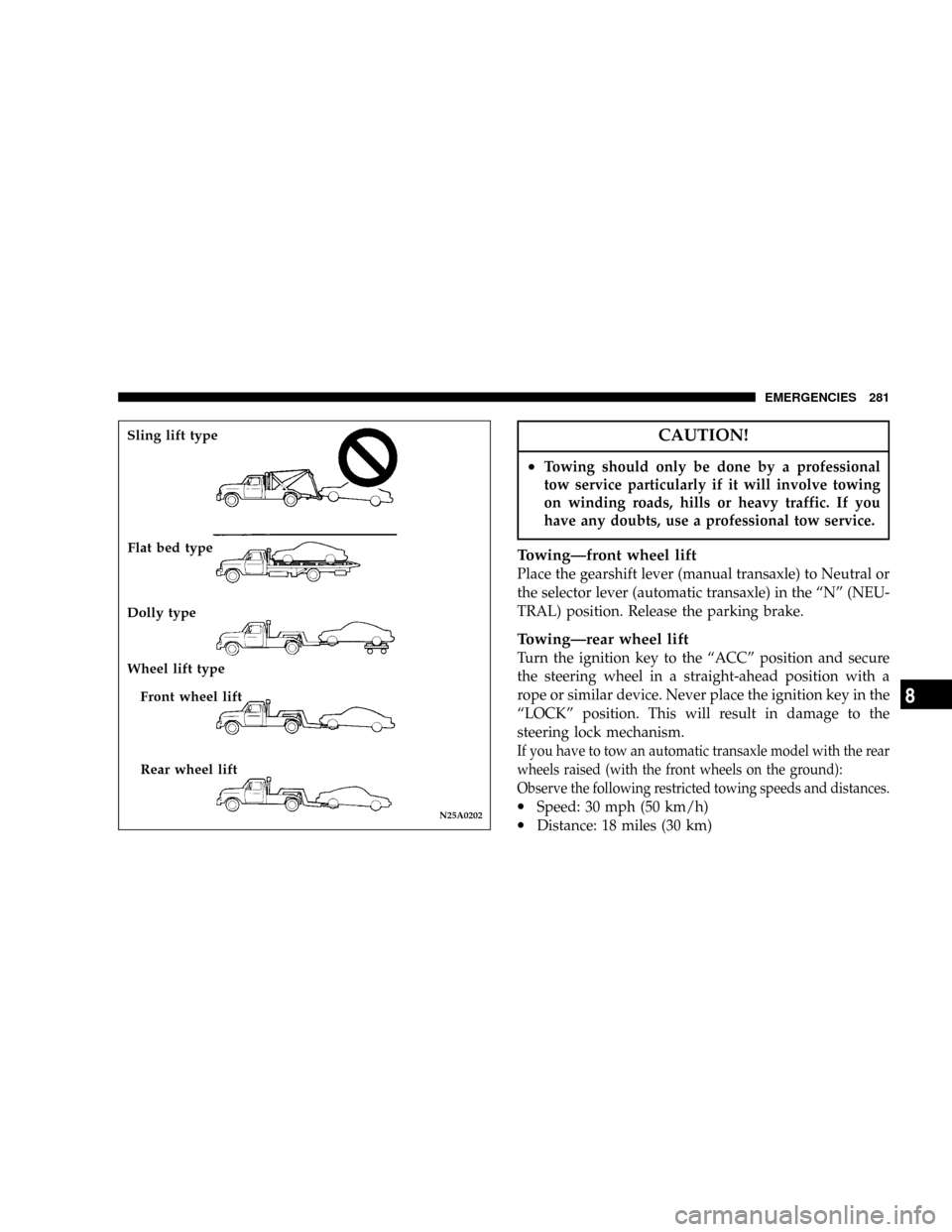
When towing your vehicle, all state and local regulations for
towing must be followed. Incorrect towing equipment could
damage your vehicle. When towing is required, contact a
professional towing service and make sure that flat bed type,
dolly type or wheel lift type towing equipment is used. Do
not attempt to be towed by another vehicle with a rope using
the tie-down hooks.
CAUTION!
²Tie-down hooks should never be used for towing
purposes.
²This vehicle can NOT be towed by a tow truck
using sling lift type equipment. This is to prevent
the bumper from deformation. If this vehicle is
towed, use wheel lift, dolly type or flat bed
equipment.
²Use the flat bed type, dolly type or dolly type
equipment if a vehicle has the following condi-
tions:
·Any of the transaxle, axles, steering system or
power train is damaged.
·Automatic transaxle fluid level is low.
280 EMERGENCIES
Page 281 of 382
CAUTION!
²Towing should only be done by a professional
tow service particularly if it will involve towing
on winding roads, hills or heavy traffic. If you
have any doubts, use a professional tow service.
TowingÐfront wheel lift
Place the gearshift lever (manual transaxle) to Neutral or
the selector lever (automatic transaxle) in the ªNº (NEU-
TRAL) position. Release the parking brake.
TowingÐrear wheel lift
Turn the ignition key to the ªACCº position and secure
the steering wheel in a straight-ahead position with a
rope or similar device. Never place the ignition key in the
ªLOCKº position. This will result in damage to the
steering lock mechanism.
If you have to tow an automatic transaxle model with the rear
wheels raised (with the front wheels on the ground):
Observe the following restricted towing speeds and distances.
·Speed: 30 mph (50 km/h)
·Distance: 18 miles (30 km)N25A0202
Sling lift type
Flat bed type
Dolly type
Wheel lift type
Front wheel lift
Rear wheel lift
EMERGENCIES 281
8
Page 282 of 382
CAUTION!
Never tow an automatic transaxle model with the
rear wheels raised (with the front wheels on the
ground) when the automatic transaxle fluid level is
low. This may cause serious and expensive damage
to the transaxle.
FUSESFuse block
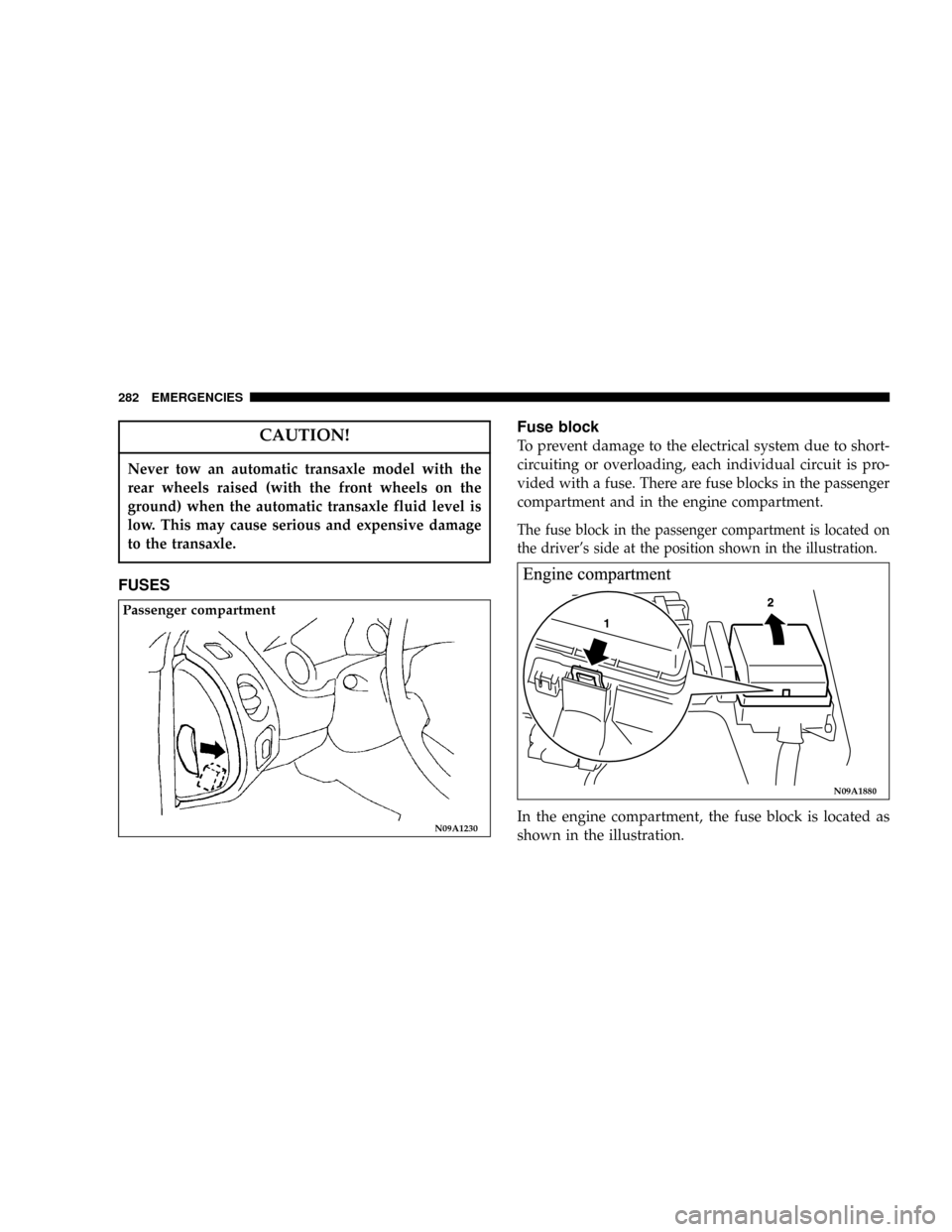
To prevent damage to the electrical system due to short-
circuiting or overloading, each individual circuit is pro-
vided with a fuse. There are fuse blocks in the passenger
compartment and in the engine compartment.
The fuse block in the passenger compartment is located on
the driver's side at the position shown in the illustration.
In the engine compartment, the fuse block is located as
shown in the illustration.N09A1230
Passenger compartment
N09A1880
282 EMERGENCIES