Page 37 of 271

than one year. These child seats are also held in the
vehicle by the lap/shoulder belt or the LATCH child
restraint anchorage system. (See the LATCH Ð Child
Seat Anchorage System Section.)
The belt-positioning booster seat is for children weighing
more than 40 lbs (18 kg), but who are still too small to fit
the vehicle's seat belts properly. If the child cannot sit
with knees bent over the vehicle's seat cushion while the
child's back is against the seat back, they should use a
belt-positioning booster seat. The child and belt-
positioning booster seat are held in the vehicle by the
lap/shoulder belt.
Children Too Large For Booster Seats
Children who are large enough to wear the shoulder belt
comfortably, and whose legs are long enough to bend
over the front of the seat when their back is against the
seat back, should use the lap/shoulder belt in a rear seat.
²Make sure that the child is upright in the seat.
²The lap portion should be low on the hips and as snug
as possible.
²Check belt fit periodically. A child's squirming or
slouching can move the belt out of position.
²If the shoulder belt contacts the face or neck, move the
child closer to the center of the vehicle. Never allow a
child to put the shoulder belt under an arm or behind
their back.
LATCH Ð Child Seat Anchorage System (Lower
Anchors and Tether for CHildren)
Your vehicle's rear seat is equipped with the child
restraint anchorage system called LATCH. The LATCH
system provides for the installation of child restraints
without using the vehicle's seat belts, instead securing
the chid restraint using lower anchorages and upper
tether straps from the child restraint to the vehicle
structure.
LATCH-compatible child restraint systems are now avail-
able. However, because the lower anchorages are to be
introduced over a period of years, child restraint systems
having attachments for those anchorages will continue to
also have features for installation using the vehicle's seat
belts. Child restraints having tether straps and hooks for
THINGS TO KNOW BEFORE STARTING YOUR VEHICLE 37
2
Page 38 of 271
connection to the top tether anchorages have been avail-
able for some time. For some older child restraints, many
child restraint manufacturers offer add-on tether strap
kits or retro-fit kits. You are urged to take advantage of all
the available attachments provided with your child re-
straint in any vehicle.
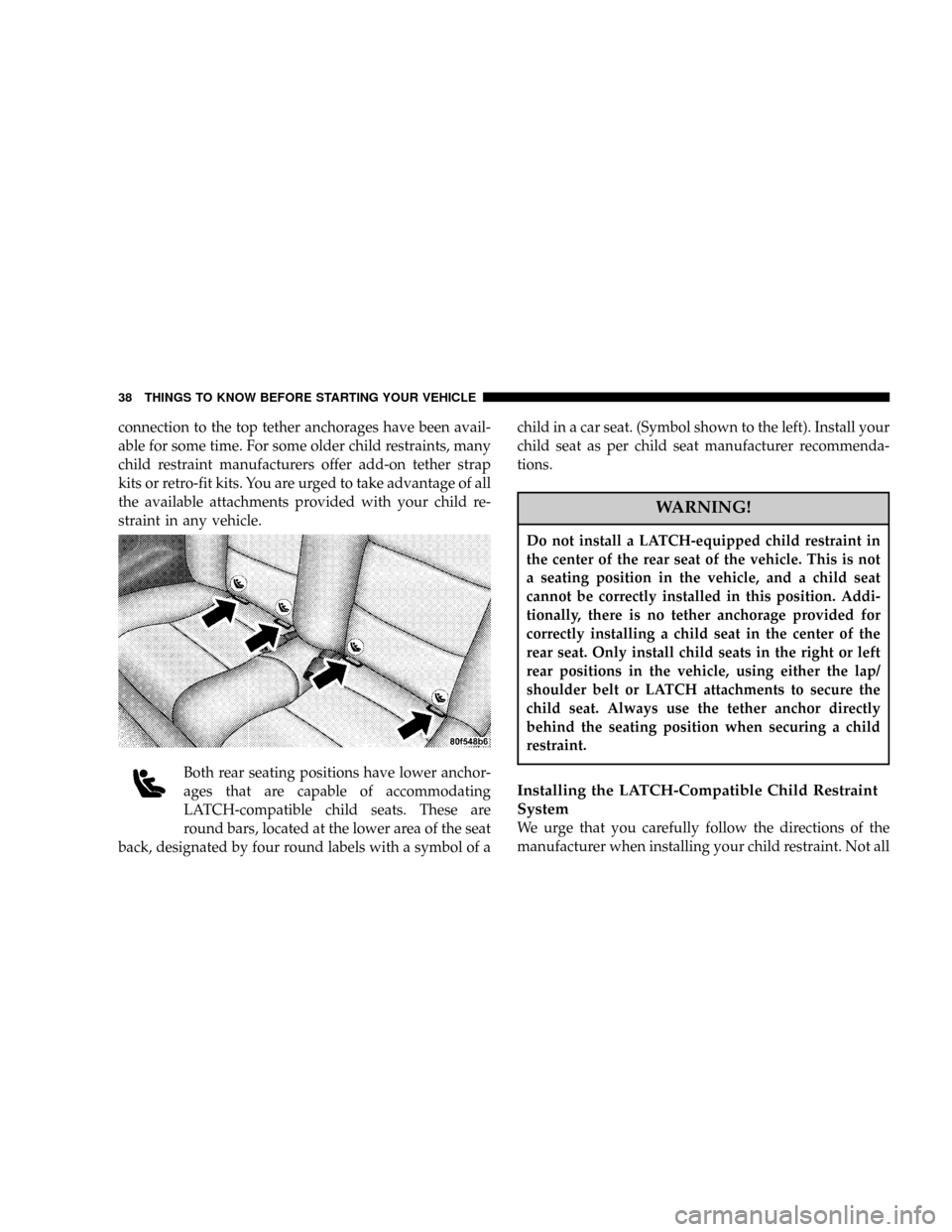
Both rear seating positions have lower anchor-
ages that are capable of accommodating
LATCH-compatible child seats. These are
round bars, located at the lower area of the seat
back, designated by four round labels with a symbol of achild in a car seat. (Symbol shown to the left). Install your
child seat as per child seat manufacturer recommenda-
tions.
WARNING!
Do not install a LATCH-equipped child restraint in
the center of the rear seat of the vehicle. This is not
a seating position in the vehicle, and a child seat
cannot be correctly installed in this position. Addi-
tionally, there is no tether anchorage provided for
correctly installing a child seat in the center of the
rear seat. Only install child seats in the right or left
rear positions in the vehicle, using either the lap/
shoulder belt or LATCH attachments to secure the
child seat. Always use the tether anchor directly
behind the seating position when securing a child
restraint.
Installing the LATCH-Compatible Child Restraint
System
We urge that you carefully follow the directions of the
manufacturer when installing your child restraint. Not all
38 THINGS TO KNOW BEFORE STARTING YOUR VEHICLE
Page 40 of 271

Installing Child Restraints Using the Vehicle Seat
Belts
The passenger seat belts are equipped with cinching latch
plates which are designed to keep the lap portion tight
around the child restraint so that it is not necessary to use
a locking clip. Pulling up on the shoulder portion of the
lap/shoulder belt will tighten the belt. The cinching latch
plate will keep the belt tight, however, any seat belt
system will loosen with time, so check the belt occasion-
ally and pull it tight if necessary.
In the rear seat, you may have trouble tightening the
lap/shoulder belt on the child restraint because the
buckle or latch plate is too close to the belt path opening
on the restraint. Disconnect the latch plate from the
buckle and twist the short buckle-end belt several times
to shorten it. Insert the latch plate into the buckle with the
release button facing out.
If the belt still can't be tightened, or if by pulling and
pushing on the restraint loosens the belt, you may need
to do something more. Disconnect the latch plate from
the buckle, turn the buckle around, and insert the latchplate into the buckle again. If you still can't make the
child restraint secure, try a different seating position.
To attach a child restraint tether strap:
1. Lift the carpet flap to expose the anchor directly behind
the seat where you are placing the child restraint.
2. Route the tether strap to provide the most direct path
for the strap between the anchor and the child seat.
40 THINGS TO KNOW BEFORE STARTING YOUR VEHICLE
Page 41 of 271
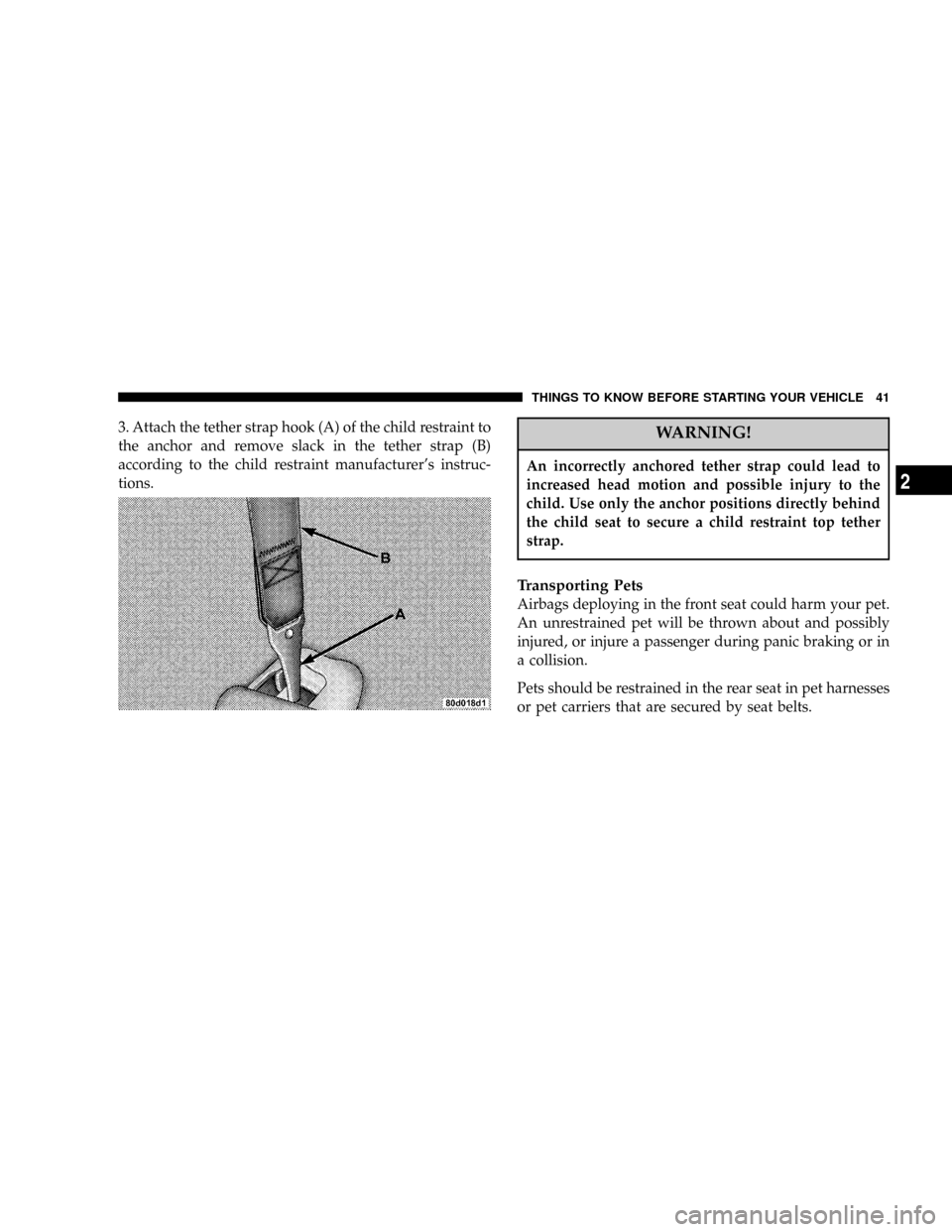
3. Attach the tether strap hook (A) of the child restraint to
the anchor and remove slack in the tether strap (B)
according to the child restraint manufacturer's instruc-
tions.WARNING!
An incorrectly anchored tether strap could lead to
increased head motion and possible injury to the
child. Use only the anchor positions directly behind
the child seat to secure a child restraint top tether
strap.
Transporting Pets
Airbags deploying in the front seat could harm your pet.
An unrestrained pet will be thrown about and possibly
injured, or injure a passenger during panic braking or in
a collision.
Pets should be restrained in the rear seat in pet harnesses
or pet carriers that are secured by seat belts.
THINGS TO KNOW BEFORE STARTING YOUR VEHICLE 41
2
Page 46 of 271

NInterior Lights........................64
NMulti-Function Control Lever..............66
NHeadlights, Parking Lights, Instrument Panel
Lights..............................66
NDaytime Running Lights (Canada Only)......66
NLights-On Reminder....................67
NFog Lights Ð If Equipped................67
NTurn Signals..........................67
NHeadlight Beam Select Switch.............67
NPassing Light.........................67
NHeadlight Time Delay...................67
mWindshield Wipers And Washers...........68
NMist................................68
NSpeed Sensitive Intermittent Wiper System....69
mTilt Steering Column.....................69
mTraction ControlÐ If Equipped.............70
mElectronic Speed ControlÐ If Equipped......70
NTo Activate...........................71
NTo Set At A Desired Speed................71
NTo Deactivate.........................71
NTo Resume Speed......................71
NTo Vary The Speed Setting................71
NTo Accelerate For Passing................72
NUsing Speed Control On Hills.............72
mGarage Door Opener Ð If Equipped.........73
NProgramming The Universal Transceiver......74
NªRolling Codeº Programming.............75
NCanadian Programming/Gate Programming . . .77
NOperation............................77
NReprogramming A Single Button...........77
NSecurity.............................77
mElectrical Power Outlet...................78
46 UNDERSTANDING THE FEATURES OF YOUR VEHICLE
Page 54 of 271
5. Snap the remaining top cover flap to the inner trim
panel snap.6. Press down on the forward portion of the top cover to
engage the hook and loop fasteners.
Top Cover Removal
Unsnap the snaps and disengage the hook and loop
fasteners, slide the tabs from the rear seat and then from
the rear of the top storage area. Remove the top cover,
fold, and store in the trunk or a dry secure area.
54 UNDERSTANDING THE FEATURES OF YOUR VEHICLE
Page 63 of 271
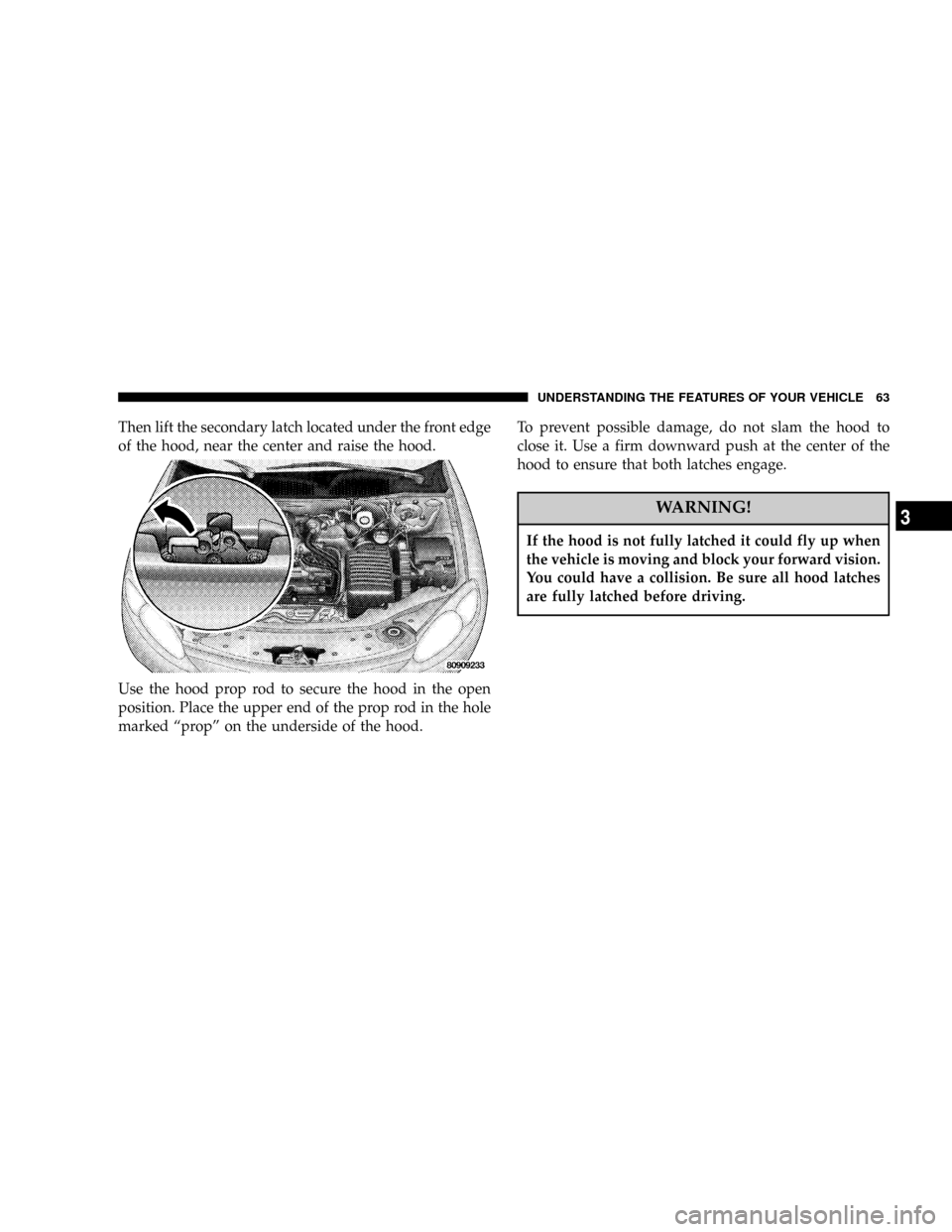
Then lift the secondary latch located under the front edge
of the hood, near the center and raise the hood.
Use the hood prop rod to secure the hood in the open
position. Place the upper end of the prop rod in the hole
marked ªpropº on the underside of the hood.To prevent possible damage, do not slam the hood to
close it. Use a firm downward push at the center of the
hood to ensure that both latches engage.
WARNING!
If the hood is not fully latched it could fly up when
the vehicle is moving and block your forward vision.
You could have a collision. Be sure all hood latches
are fully latched before driving.
UNDERSTANDING THE FEATURES OF YOUR VEHICLE 63
3
Page 77 of 271

Canadian Programming/Gate Programming
Canadian frequency laws, and the technology of some
entry gates, require you to press and release the hand
held transmitter button every two seconds during pro-
gramming
Continue to press and hold the Universal Transceiver
button while you press and release the hand held trans-
mitter button until the frequency signal has been learned.
The Universal Transceiver light will flash slowly and
then rapidly when the programming is successful.
NOTE:When programming such a garage door opener
or gate, unplug the device to prevent possible damage to
the garage door or gate motor.
Operation
Press and hold the desired button on the Universal
Transceiver until the garage door or other device begins
to operate. The light in the display shows that the signal
is being transmitted. The hand held transmitter may also
be used at any time.
Reprogramming A Single Button
1. Press and hold the Universal Transceiver button to be
reprogrammed. Do not release until step 4 has been
completed.
2. When the indicator light begins to flash slowly (after
20 seconds) position the hand held transmitter one to
three inches away from the button to be trained.
3. Press and hold the hand held transmitter button.
4. The Universal Transceiver indicator light will begin to
flash, first slowly, then rapidly. When the indicator lights
begin to flash rapidly, release both buttons.
Security
If you sell your vehicle, be sure to erase the frequencies.
To erase all of the previously trained frequencies, hold
down both outside buttons until the green light begins to
flash.
This device complies with part 15 of FCC rules and with
RS-210 of Industry Canada. Operation is subject to the
following conditions:
UNDERSTANDING THE FEATURES OF YOUR VEHICLE 77
3