Page 210 of 273

Exhaust System
The best protection against carbon monoxide entry into
the vehicle body is a properly maintained engine exhaust
system.
If you notice a change in the sound of the exhaust system;
or if exhaust fumes can be detected inside the vehicle; or
when the underside or rear of the vehicle is damaged;
have a competent mechanic inspect the complete exhaust
system and adjacent body areas for broken, damaged,
deteriorated, or mispositioned parts. Open seams or
loose connections could permit exhaust fumes to seep
into the passenger compartment. In addition, inspect the
exhaust system each time the vehicle is raised for lubri-
cation or oil change. Replace as required.
WARNING!
Exhaust gases can injure or kill. They contain carbon
monoxide which is colorless and odorless. Breathing
it can make you unconscious and can eventually
poison you. Follow the above precautions to keep
your exhaust system as safe as possible.
Cooling System
WARNING!
•When working near the radiator cooling fan, dis-
connect the fan motor lead or turn the ignition key
to the OFF position. The fan is temperature con-
trolled and can start at any time the ignition key is
in the ON position.
•You or others can be badly burned by hot coolant
or steam from your radiator. If you see or hear
steam coming from under the hood, don’t open
the hood until the radiator has had time to cool.
Never try to open a cooling system pressure cap
when the radiator is hot.
Coolant Checks
Check coolant protection every 12 months (before the
onset of freezing weather, where applicable). If coolant is
dirty or rusty in appearance, the system should be
drained, flushed and refilled with fresh coolant.
210 MAINTAINING YOUR VEHICLE
Page 215 of 273

WARNING!
Riding the brakes can lead to brake failure and
possibly an accident. Driving with your foot resting
or riding on the brake pedal can result in abnormally
high brake temperatures, excessive lining wear, and
possible brake damage. You wouldn’t have your full
braking capacity in an emergency.
Brake and Power Steering System Hoses
When servicing the vehicle for scheduled maintenance,
inspect surface of hoses for evidence of heat and me-
chanical damage. Hard and brittle rubber, cracking,
checking, tears, cuts, abrasion, and excessive swelling
suggest deterioration of the rubber. Particular attention
should be made to examining those hose surfaces nearest
to high heat sources, such as the exhaust manifold.
Inspect all hose clamps and couplings to make sure they
are secure and no leaks are present.
NOTE:Often, fluids such as oil, power steering fluid,
and brake fluid are used during assembly plant opera-
tions to ease the assembly of hoses to couplings. There-
fore, oil wetness at the hose-coupling area is not neces-
sarily an indication of leakage. Actual dripping of hot
fluid when systems are under pressure (during vehicle
operation) should be noted before hose is replaced based
on leakage.
NOTE:Inspection of brake hoses should be done
whenever the brake system is serviced and every engine
oil change.
WARNING!
Worn brake hoses can burst and cause brake failure.
You could have an accident. If you see any signs of
cracking, scuffing, or worn spots, have the brake
hoses replaced immediately.
MAINTAINING YOUR VEHICLE 215
7
Page 216 of 273

Brake Master Cylinder
The fluid level in the master cylinder should be checked
when performing under hood services, or immediately if
the brake system warning lamp shows system failure.
Be sure to clean the top of the master cylinder area before
removing the cap. If necessary, add fluid to bring the
fluid level up to the requirements described on the brake
fluid reservoir. With disc brakes, fluid level can be
expected to fall as the brake pads wear. However, low
fluid level may be caused by a leak and a checkup may be
needed.Use only manufacturer’s recommended brake fluid. Re-
fer to the Recommended Fluids, Lubricants and Genuine
Parts section for the correct fluid type.
WARNING!
Use of a brake fluid that may have a lower initial
boiling point or unidentified as to specification, may
result in sudden brake failure during hard pro-
longed braking. You could have an accident.
Use only brake fluid that has been in a tightly closed
container to avoid contamination from foreign matter.
Do not allow petroleum base fluid to contaminate the
brake fluid as seal damage will result!
216 MAINTAINING YOUR VEHICLE
Page 221 of 273

CAUTION!
Do not use abrasive or strong cleaning materials
such as steel wool or scouring powder, which will
scratch metal and painted surfaces.
Special Care
•
If you drive on salted or dusty roads or if you drive
near the ocean, hose off the undercarriage at least once
a month.
•It is important that the drain holes in the lower edges
of the doors, rocker panels and rear deck lid be kept
clear and open.
•If you detect any stone chips or scratches in the paint,
touch them up immediately. The cost of such repairs is
considered the responsibility of the owner.
•Use Mopar touch up paint on scratches or chips as
soon as possible. Your dealer has touch up paint to
match the color of your vehicle.
•If your vehicle is damaged due to an accident or
similar cause which destroys the paint and protective
coating have your vehicle repaired as soon as possible.
The cost of such repairs is considered the responsibil-
ity of the owner.
•Aluminum wheels should be cleaned regularly with
mild soap and water to prevent corrosion. To remove
heavy soil, select a non abrasive, non-acidic cleaner.
Do not use scouring pads or metal polishes. Avoid
automatic car washes that use acidic solutions or harsh
brushes that may damage the wheels’ protective fin-
ish.
•If you carry special cargo such as chemicals, fertilizers,
deicer salt, etc., be sure that such materials are well
packaged and sealed.
•If a lot of driving is done on gravel roads, consider
mud or stone shields behind each wheel.
Interior Care
Use Mopar Fabric Cleaner to clean fabric upholstery and
carpeting.
MAINTAINING YOUR VEHICLE 221
7
Page 222 of 273

Use a mild soap and warm water solution to clean vinyl
or leather upholstery. For stubborn stains, use Mopar
Vinyl Cleaner.
Mopar Vinyl Cleaner is specifically recommended for
vinyl trim.
WARNING!
Do not use volatile solvents for cleaning purposes.
Many are potentially flammable, and if used in
closed areas they may cause respiratory harm.
CAUTION!
The use of vinyl, leather or plastic protectants may
cause excessive gloss and/or discoloration of interior
trim parts.
Leather Seat Care and Cleaning
Leather is best preserved by regular cleaning with a
damp soft cloth. Small particles of dirt can act as anabrasive and damage the leather surface and should be
removed immediately with a damp cloth. Stubborn soils
can be removed easily with a soft cloth and Mopar Total
Clean. Care should be taken to avoid soaking the leather
with any liquid. Please do not use polishes, oils, cleaning
fluids, solvents, detergents, or ammonia based cleaners
to clean the leather. Application of a leather conditioner is
not required to maintain the original condition.
Wooden Steering Wheel Care — If Equipped
If your vehicle is equipped with a wood steering wheel,
it is finished with a clear topcoat. Please take care to
avoid scratching the surface with sharp or abrasive
materials.
Cleaning Headlights
Your vehicle has plastic headlights that are lighter and
less susceptible to stone breakage than glass headlights.
Plastic is not as scratch resistant as glass and therefore
different lens cleaning procedures must be followed.
222 MAINTAINING YOUR VEHICLE
Page 229 of 273
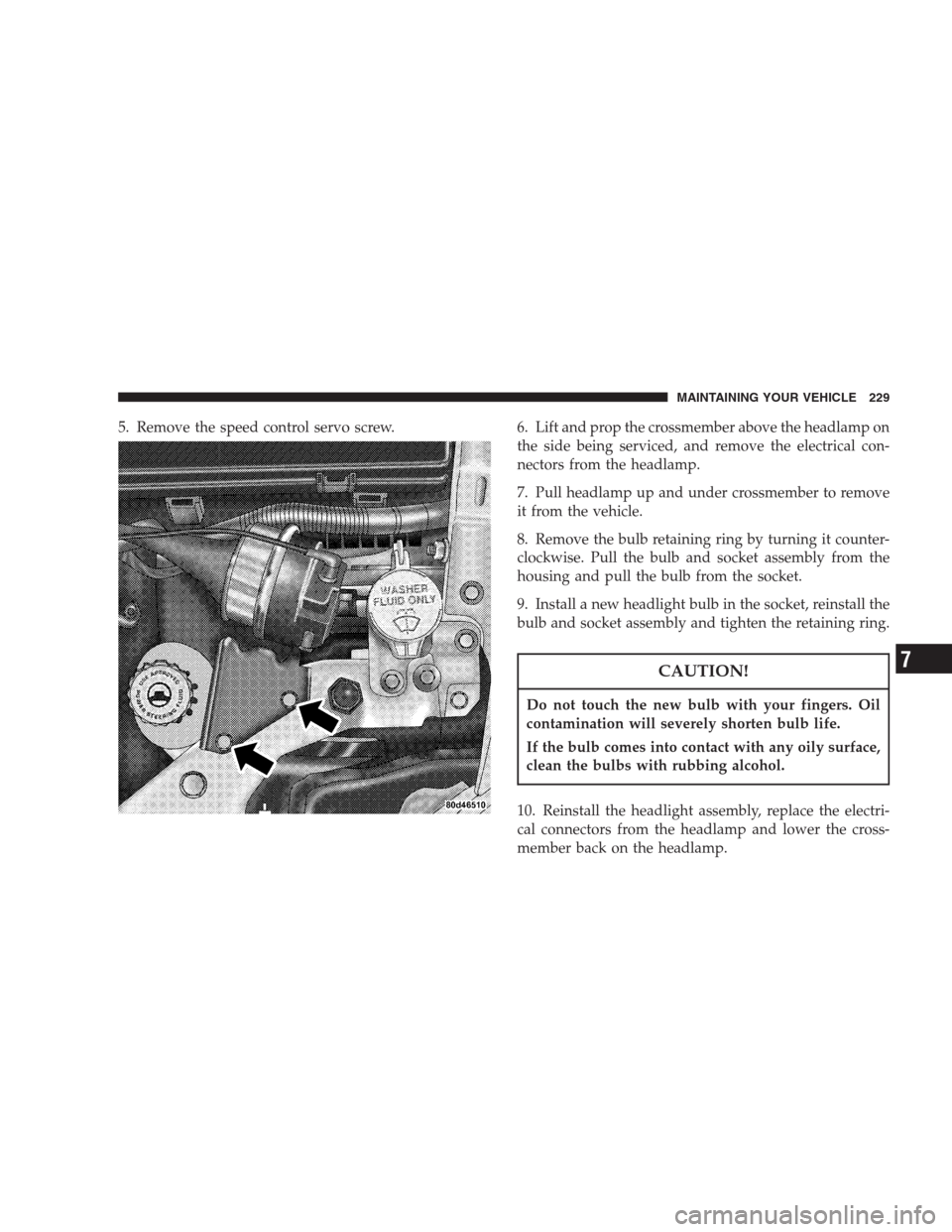
5. Remove the speed control servo screw. 6. Lift and prop the crossmember above the headlamp on
the side being serviced, and remove the electrical con-
nectors from the headlamp.
7. Pull headlamp up and under crossmember to remove
it from the vehicle.
8. Remove the bulb retaining ring by turning it counter-
clockwise. Pull the bulb and socket assembly from the
housing and pull the bulb from the socket.
9. Install a new headlight bulb in the socket, reinstall the
bulb and socket assembly and tighten the retaining ring.
CAUTION!
Do not touch the new bulb with your fingers. Oil
contamination will severely shorten bulb life.
If the bulb comes into contact with any oily surface,
clean the bulbs with rubbing alcohol.
10. Reinstall the headlight assembly, replace the electri-
cal connectors from the headlamp and lower the cross-
member back on the headlamp.
MAINTAINING YOUR VEHICLE 229
7
Page 232 of 273
License Plate Light
1. Remove the screws securing the light to the rear fascia.
2. Remove the bulb and socket assembly and pull the
bulb from the socket.3. Replace the bulb and reinstall the bulb and socket
assembly.
4. Reattach the light to the rear fascia.
SPECIFICATIONS
ENGINE ALL
Oil Filter Mopar 5281090 or equivalent
Thermostat 180°F (82°C)
Spark Plug See Underhood Label
Spark Plug Gap See Underhood Label
Firing Order 1-2-3-4-5-6
232 MAINTAINING YOUR VEHICLE
Page 233 of 273
FLUID CAPACITIES
U.S. Metric
Fuel (Approximate)17 Gallons 64 Liters
Engine Oil with Filter
2.7 & 3.5 Liter Engine 5 Qts 4.7 Liters
Cooling System*
2.7 Liter Engine 10.5 Qts 10 Liters
3.5 Liter Engine 11 Qts 10.5 Liters
* Includes heater and coolant recovery bottle filled to MAX level.
RECOMMENDED FLUIDS, LUBRICANTS AND GENUINE PARTS
Engine
Component Fluid, Lubricant or Genuine Part
Engine Coolant Mopar�Antifreeze/Coolant 5 Year/100,000 Mile Formula HOAT (Hybrid Or-
ganic Additive Technology)
Engine Oil Use API Certified (GF-3). Refer to oil viscosity chart for correct SAE grade.
Spark Plugs Refer to the Vehicle Emission Control Information label in the engine compart-
ment.
Oil Filter Mopar�Oil Filter
Fuel Selection 89 Octane
MAINTAINING YOUR VEHICLE 233
7