2004 CHEVROLET MONTE CARLO change wheel
[x] Cancel search: change wheelPage 249 of 416

Your vehicle can tow a trailer if it is equipped with the
proper trailer towing equipment. To identify what
the vehicle trailering capacity is for your vehicle, you
should read the information in “Weight of the Trailer” that
appears later in this section. But trailering is different
than just driving your vehicle by itself. Trailering means
changes in handling, durability and fuel economy.
Successful, safe trailering takes correct equipment, and
it has to be used properly.
That’s the reason for this part. In it are many time-tested,
important trailering tips and safety rules. Many of
these are important for your safety and that of your
passengers. So please read this section carefully before
you pull a trailer.
Load-pulling components such as the engine, transaxle,
wheel assemblies and tires are forced to work harder
against the drag of the added weight. The engine
is required to operate at relatively higher speeds and
under greater loads, generating extra heat. What’s more,
the trailer adds considerably to wind resistance,
increasing the pulling requirements.If You Do Decide To Pull A Trailer
If you do, here are some important points:
There are many different laws, including speed limit
restrictions, having to do with trailering. Make sure
your rig will be legal, not only where you live
but also where you’ll be driving. A good source for
this information can be state or provincial police.
Consider using a sway control. You can ask a hitch
dealer about sway controls.
Don’t tow a trailer at all during the rst 1,000 miles
(1 600 km) your new vehicle is driven. Your
engine, axle or other parts could be damaged.
Then, during the rst 500 miles (800 km) that you
tow a trailer, don’t drive over 50 mph (80 km/h)
and don’t make starts at full throttle. This helps your
engine and other parts of your vehicle wear in at
the heavier loads.
Obey speed limit restrictions when towing a trailer.
Don’t drive faster than the maximum posted speed
for trailers, or no more than 55 mph (90 km/h),
to save wear on your vehicle’s parts.
Three important considerations have to do with weight:
the weight of the trailer,
the weight of the trailer tongue
and the total weight on your vehicle’s tires.
4-39
Page 331 of 416
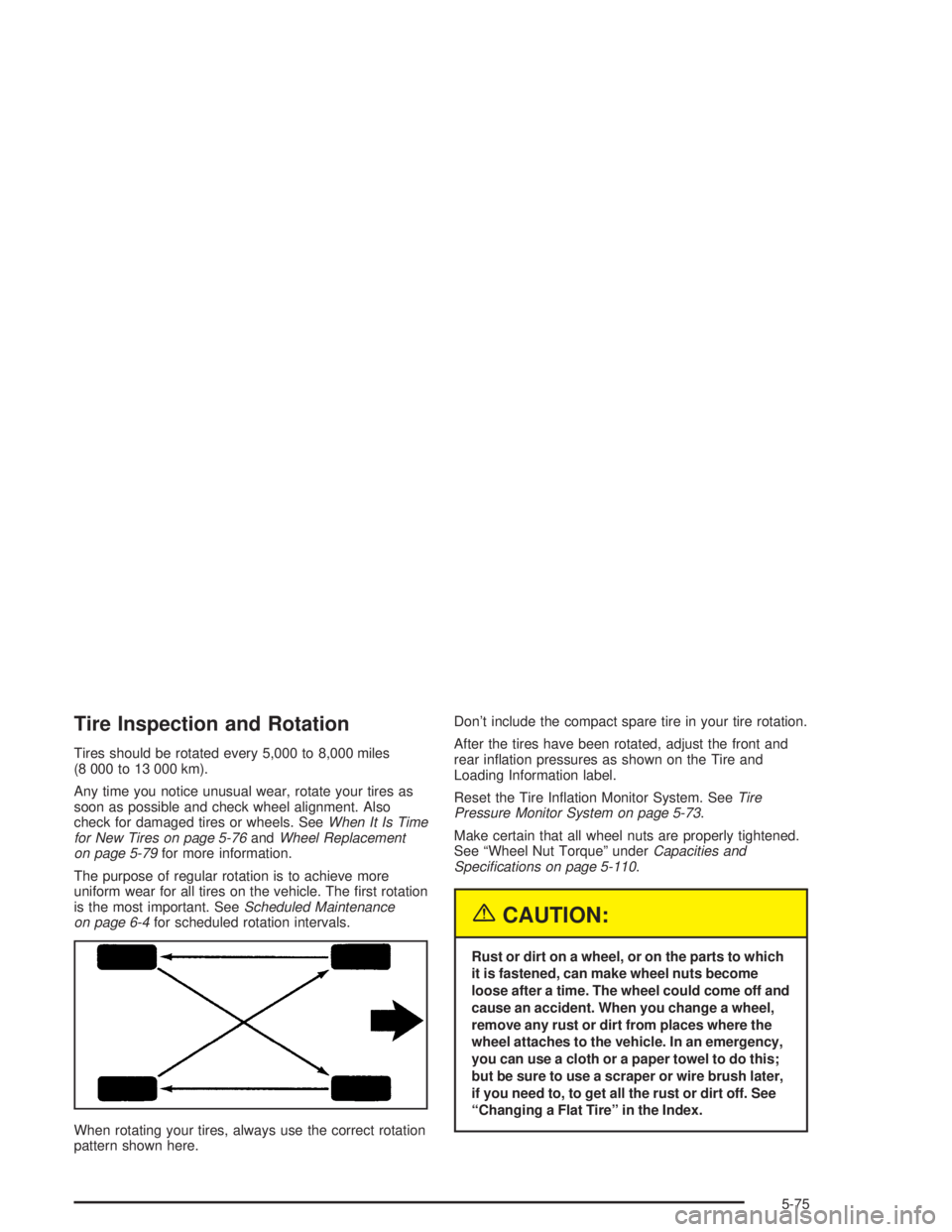
Tire Inspection and Rotation
Tires should be rotated every 5,000 to 8,000 miles
(8 000 to 13 000 km).
Any time you notice unusual wear, rotate your tires as
soon as possible and check wheel alignment. Also
check for damaged tires or wheels. SeeWhen It Is Time
for New Tires on page 5-76andWheel Replacement
on page 5-79for more information.
The purpose of regular rotation is to achieve more
uniform wear for all tires on the vehicle. The rst rotation
is the most important. SeeScheduled Maintenance
on page 6-4for scheduled rotation intervals.
When rotating your tires, always use the correct rotation
pattern shown here.Don’t include the compact spare tire in your tire rotation.
After the tires have been rotated, adjust the front and
rear ination pressures as shown on the Tire and
Loading Information label.
Reset the Tire Ination Monitor System. SeeTire
Pressure Monitor System on page 5-73.
Make certain that all wheel nuts are properly tightened.
See “Wheel Nut Torque” underCapacities and
Specications on page 5-110.
{CAUTION:
Rust or dirt on a wheel, or on the parts to which
it is fastened, can make wheel nuts become
loose after a time. The wheel could come off and
cause an accident. When you change a wheel,
remove any rust or dirt from places where the
wheel attaches to the vehicle. In an emergency,
you can use a cloth or a paper towel to do this;
but be sure to use a scraper or wire brush later,
if you need to, to get all the rust or dirt off. See
“Changing a Flat Tire” in the Index.
5-75
Page 337 of 416

Notice:If your vehicle has a tire size other than
P235/55R17 size tires, use tire chains only where
legal and only when you must. Use only SAE Class
″S″type chains that are the proper size for your
tires. Install them on the front tires and tighten
them as tightly as possible with the ends securely
fastened. Drive slowly and follow the chain
manufacturer’s instructions. If you can hear the
chains contacting your vehicle, stop and retighten
them. If the contact continues, slow down until
it stops. Driving too fast or spinning the wheels
with chains on will damage your vehicle.
If a Tire Goes Flat
It’s unusual for a tire to “blowout” while you’re driving,
especially if you maintain your tires properly. If air goes
out of a tire, it’s much more likely to leak out slowly.
But if you should ever have a “blowout,” here are a few
tips about what to expect and what to do:
If a front tire fails, the at tire will create a drag that
pulls the vehicle toward that side. Take your foot off the
accelerator pedal and grip the steering wheel rmly.
Steer to maintain lane position, and then gently brake
to a stop well out of the traffic lane.A rear blowout, particularly on a curve, acts much like a
skid and may require the same correction you’d use
in a skid. In any rear blowout, remove your foot from the
accelerator pedal. Get the vehicle under control by
steering the way you want the vehicle to go. It may be
very bumpy and noisy, but you can still steer. Gently
brake to a stop, well off the road if possible.
{CAUTION:
Lifting a vehicle and getting under it to do
maintenance or repairs is dangerous without
the appropriate safety equipment and training.
The jack provided with your vehicle is
designed only for changing a at tire. If it is
used for anything else, you or others could be
badly injured or killed if the vehicle slips off
the jack. Use the jack provided with your
vehicle only for changing a at tire.
If a tire goes at, the next part shows how to use your
jacking equipment to change a at tire safely.
5-81
Page 338 of 416

Changing a Flat Tire
If a tire goes at, avoid further tire and wheel damage
by driving slowly to a level place. Turn on your
hazard warning ashers.
{CAUTION:
Changing a tire can cause an injury. The
vehicle can slip off the jack and roll over you
or other people. You and they could be badly
injured. Find a level place to change your tire.
To help prevent the vehicle from moving:
1. Set the parking brake rmly.
2. Put the shift lever in PARK (P).
3. Turn off the engine.
To be even more certain the vehicle won’t
move, you can put blocks at the front and rear
of the tire farthest away from the one being
changed. That would be the tire on the other
side of the vehicle, at the opposite end.The following steps will tell you how to use the jack and
change a tire.
5-82
Page 343 of 416

The diagram shows you where you should place
your jack to change a front tire. Use the bolts (A)
as a guide when positioning the jack lift head (C)
near the rear edge of the front wheel opening (B).
For jacking at the vehicle’s front location, put jack lift
head about 7.5 inches (19 cm) from the rear edge
of the front wheel opening in the cutout of the rocker
panel molding.The diagram shows you where to place your jack to
change a rear tire. Use the notch (B) as a guide
when positioning the jack lift head (A) near the front
edge of the rear wheel opening (C).
For jacking at the vehicle’s rear location, put the
jack lift head about 4 inches (10 cm) from the front
edge of the rear wheel opening in the cutout of
the rocker panel molding.
Put the compact spare tire near you. Jack placement for a front tire
Jack placement for a rear tire
5-87
Page 344 of 416

2. Raise the vehicle by turning the jack handle
clockwise. Raise the vehicle far enough off the
ground for the compact spare tire to t underneath
the wheel well of the vehicle. Remove all wheel
nuts and take off the at tire.
{CAUTION:
Rust or dirt on the wheel, or on the parts to
which it is fastened, can make the wheel nuts
become loose after a time. The wheel could
come off and cause an accident. When you
change a wheel, remove any rust or dirt from
the places where the wheel attaches to the
vehicle. In an emergency, you can use a cloth
or a paper towel to do this; but be sure to use
a scraper or wire brush later, if you need to,
to get all the rust or dirt off.
3. Remove any rust or dirt
from the wheel bolts,
mounting surfaces
and spare wheel.
5-88
Page 403 of 416

Chains, Tires..................................................5-80
Change Engine Oil Message............................3-47
Check
Engine Light...............................................3-39
Check Engine Light.........................................3-39
Checking Coolant............................................5-33
Checking Engine Oil........................................5-18
Checking Things Under the Hood......................5-10
Checking Your Restraint Systems......................1-57
Chemical Paint Spotting.................................5-100
Child Restraints
Child Restraint Systems...............................1-35
Infants and Young Children...........................1-31
Lower Anchorages and Top Tethers for
Children (LATCH System)..........................1-40
Older Children.............................................1-29
Securing a Child Restraint Designed for the
LATCH System........................................1-42
Securing a Child Restraint in a Rear Seat
Position..................................................1-43
Securing a Child Restraint in the Right Front
Seat Position...........................................1-45
Top Strap...................................................1-38
Top Strap Anchor Location............................1-40
Where to Put the Restraint...........................1-38
Chime Level Adjustment..................................3-96
CHIRP (Horn Chirp Timer)...............................2-48
Cigarette Lighter.............................................3-20Cleaning
Inside of Your Vehicle..................................5-94
Outside of Your Vehicle................................5-97
Underbody Maintenance.............................5-100
Weatherstrips..............................................5-97
Cleaning Aluminum Wheels..............................5-99
Cleaning Exterior Lamps/Lenses.......................5-98
Cleaning Fabric/Carpet....................................5-94
Cleaning Glass Surfaces..................................5-96
Cleaning Interior Plastic Components.................5-96
Cleaning Leather............................................5-96
Cleaning the Top of the Instrument Panel...........5-96
Cleaning Tires................................................5-99
Cleaning Vinyl................................................5-96
Cleaning Windshield and Wiper Blades..............5-98
Climate Control System
Air Filter, Passenger Compartment.................3-27
Dual..........................................................3-21
Compact Spare Tire........................................5-93
Compass Variance..........................................3-53
Content Theft-Deferrent....................................2-15
Control of a Vehicle.......................................... 4-6
Convenience Net............................................2-40
Coolant
Engine Temperature Gage............................3-38
Heater, Engine............................................2-20
Hot Temperature Warning Message................3-45
Cooling.........................................................3-23
3
Page 415 of 416

Trip Computer................................................3-54
Trip Odometer................................................3-32
TRNKJAMB (Trunk Jamb)................................2-48
Trunk............................................................2-10
Trunk Ajar Warning Message............................3-48
Trunk Assist Handle........................................2-11
Trunk Lock....................................................2-11
Turn and Lane-Change Signals.......................... 3-8
Turn Signal/Multifunction Lever........................... 3-7
Turn Signals When Towing a Trailer..................4-43
U
Underhood Fuse Block (Lower).......................5-109
Underhood Fuse Block (Upper).......................5-108
Understanding Radio Reception........................3-93
Uniform Tire Quality Grading............................5-77
United States – Customer Assistance.................. 7-5
Used Replacement Wheels..............................5-80
Using Cleaner on Fabric..................................5-95
Using HomeLink
®...........................................2-38
V
Vehicle
Control........................................................ 4-6
Customization Settings.................................3-96
Damage Warnings........................................... iv
Loading......................................................4-33
Service Soon Message.................................3-51
Symbols......................................................... iv
Vehicle Data Collection and Event Data Records....7-10
Vehicle Identication
Number (VIN)............................................5-102
Service Parts Identication Label..................5-102
Vehicle Personalization....................................2-42
Vehicle Storage..............................................5-53
Visor Vanity Mirrors.........................................2-14
Visors...........................................................2-14
Voltmeter Gage..............................................3-35
15