Page 259 of 426
Once you are moving on the freeway, make certain you
allow a reasonable following distance.
Expect to move slightly slower at night.
When you want to leave the freeway, move to the
proper lane well in advance. If you miss your exit, do
not, under any circumstances, stop and back up. Drive
on to the next exit.
The exit ramp can be curved, sometimes quite sharply.
The exit speed is usually posted. Reduce your speed
according to your speedometer, not to your sense
of motion. After driving for any distance at higher
speeds, you may tend to think you are going slower
than you actually are.
Before Leaving on a Long Trip
Make sure you are ready. Try to be well rested. If you
must start when you are not fresh — such as after
a day’s work — do not plan to make too many miles that
rst part of the journey. Wear comfortable clothing
and shoes you can easily drive in.Is your vehicle ready for a long trip? If you keep it
serviced and maintained, it is ready to go. If it needs
service, have it done before starting out. Of course, you
will nd experienced and able service experts in GM
dealerships all across North America. They will be ready
and willing to help if you need it.
Here are some things you can check before a trip:
Windshield Washer Fluid:Is the reservoir full? Are
all windows clean inside and outside?
Wiper Blades:Are they in good shape?
Fuel, Engine Oil, Other Fluids:Have you checked
all levels?
Lamps:Are they all working? Are the lenses clean?
Tires:They are vitally important to a safe,
trouble-free trip. Is the tread good enough for
long-distance driving? Are the tires all inated to the
recommended pressure?
Weather Forecasts:What is the weather outlook
along your route? Should you delay your trip a
short time to avoid a major storm system?
Maps:Do you have up-to-date maps?
4-23
Page 282 of 426
Parking on Hills
{CAUTION:
You really should not park your vehicle, with a
trailer attached, on a hill. If something goes
wrong, your rig could start to move. People
can be injured, and both your vehicle and the
trailer can be damaged.
But if you ever have to park your rig on a hill, here’s
how to do it:
1. Apply your regular brakes, but don’t shift into
PARK (P) yet.
2. Have someone place chocks under the trailer
wheels.
3. When the wheel chocks are in place, release the
regular brakes until the chocks absorb the load.
4. Reapply the regular brakes. Then apply your
parking brake and shift into PARK (P).
5. Release the regular brakes.
When You Are Ready to Leave After
Parking on a Hill
1. Apply your regular brakes and hold the pedal down
while you:
start your engine,
shift into a gear, and
release the parking brake.
2. Let up on the brake pedal.
3. Drive slowly until the trailer is clear of the chocks.
4. Stop and have someone pick up and store the
chocks.
Maintenance When Trailer Towing
Your vehicle will need service more often when you’re
pulling a trailer. Things that are especially important
in trailer operation are automatic transaxle uid (don’t
overll), engine oil, drive belt, cooling system and brake
system. Each of these is covered in this manual, and
the Index will help you nd them quickly. If you’re
trailering, it’s a good idea to review this information
before you start your trip.
Check periodically to see that all hitch nuts and bolts
are tight.
Engine Cooling When Trailer Towing
Your cooling system may temporarily overheat during
severe operating conditions. SeeEngine Overheating on
page 5-27.
4-46
Page 283 of 426
Service............................................................5-3
Doing Your Own Service Work.........................5-4
Adding Equipment to the Outside of Your
Vehicle......................................................5-5
Fuel................................................................5-5
Gasoline Octane............................................5-5
Gasoline Specications....................................5-6
California Fuel...............................................5-6
Additives.......................................................5-7
Fuels in Foreign Countries...............................5-8
Filling Your Tank............................................5-8
Filling a Portable Fuel Container.....................5-11
Checking Things Under the Hood....................5-12
Hood Release..............................................5-12
Engine Compartment Overview.......................5-14
Engine Oil...................................................5-17
Engine Air Cleaner/Filter................................5-22
Automatic Transaxle Fluid..............................5-23
Engine Coolant.............................................5-24
Coolant Surge Tank Pressure Cap..................5-26
Engine Overheating.......................................5-27
Cooling System............................................5-29
Windshield Washer Fluid................................5-34Brakes........................................................5-35
Battery........................................................5-38
Jump Starting...............................................5-39
Bulb Replacement..........................................5-45
Halogen Bulbs..............................................5-45
Headlamps..................................................5-45
Center High-Mounted Stoplamp (CHMSL).........5-47
Taillamps, Turn Signal, Stoplamps and
Back-up Lamps.........................................5-47
Replacement Bulbs.......................................5-49
Windshield Wiper Blade Replacement..............5-49
Tires..............................................................5-50
Ination - Tire Pressure.................................5-57
Tire Inspection and Rotation...........................5-58
When It Is Time for New Tires.......................5-59
Buying New Tires.........................................5-60
Uniform Tire Quality Grading..........................5-61
Wheel Alignment and Tire Balance..................5-62
Wheel Replacement......................................5-62
Tire Chains..................................................5-64
If a Tire Goes Flat........................................5-65
Changing a Flat Tire.....................................5-66
Compact Spare Tire......................................5-77
Section 5 Service and Appearance Care
5-1
Page 290 of 426
Fuels in Foreign Countries
If you plan on driving in another country outside the
United States or Canada, the proper fuel may be hard
to nd. Never use leaded gasoline or any other fuel
not recommended in the previous text on fuel. Costly
repairs caused by use of improper fuel would not
be covered by your warranty.
To check the fuel availability, ask an auto club, or
contact a major oil company that does business in the
country where you will be driving.
Filling Your Tank
{CAUTION:
Fuel vapor burns violently and a fuel re can
cause bad injuries. To help avoid injuries to you
and others, read and follow all the instructions
on the pump island. Turn off your engine when
you are refueling. Do not smoke if you are near
fuel or refueling your vehicle. Keep sparks,
ames and smoking materials away from fuel.
CAUTION: (Continued)
CAUTION: (Continued)
Do not leave the fuel pump unattended when
refueling your vehicle — this is against the law
in some places. Keep children away from the
fuel pump; never let children pump fuel.
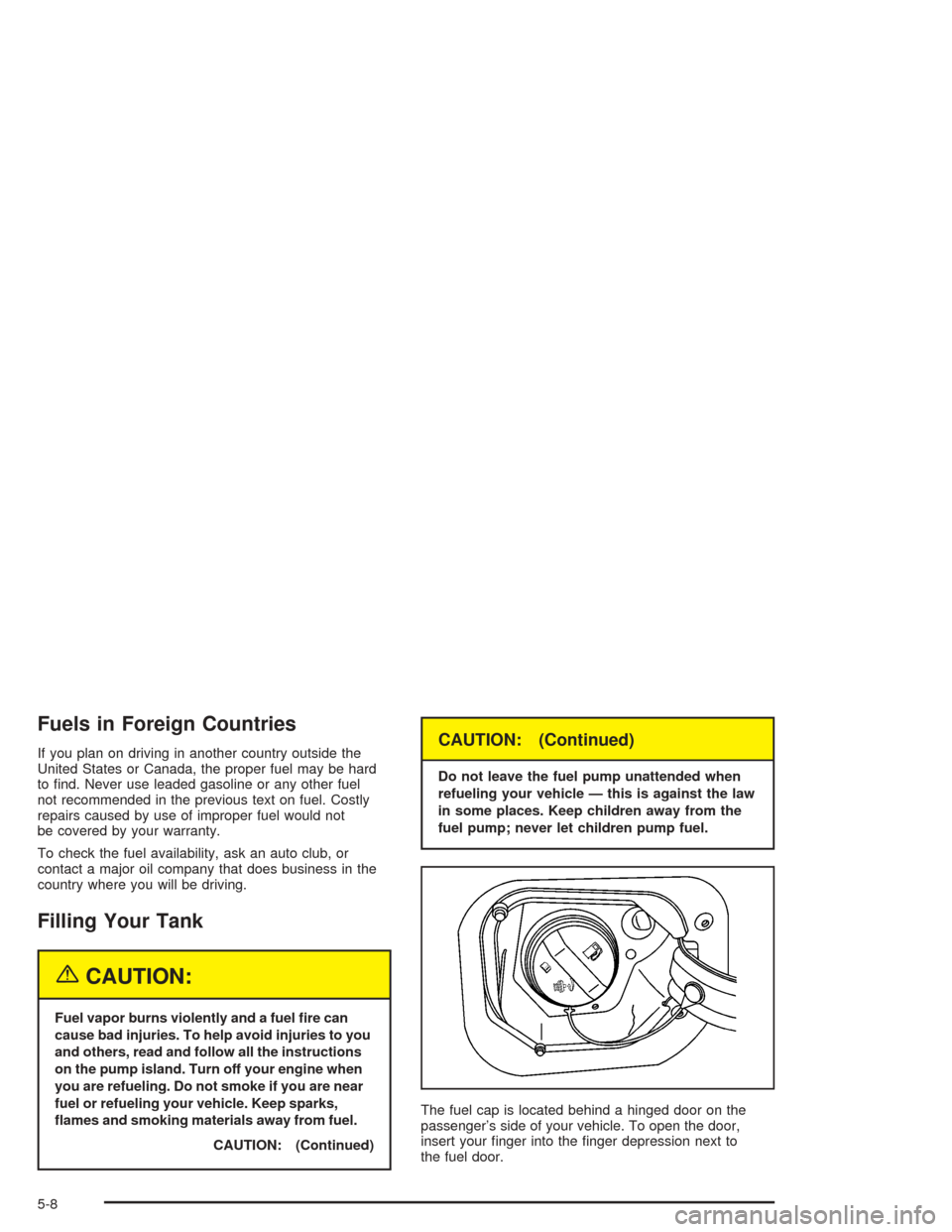
The fuel cap is located behind a hinged door on the
passenger’s side of your vehicle. To open the door,
insert your nger into the nger depression next to
the fuel door.
5-8
Page 297 of 426
A. Engine Air Cleaner/Filter.
SeeEngine Air Cleaner/Filter on page 5-22.
B. Engine Oil Dipstick.
SeeEngine Oil on page 5-17.
C. Engine Oil Fill Cap.
SeeEngine Oil on page 5-17.
D. Engine Coolant Reservoir.
SeeEngine Coolant on page 5-24.
E. Brake Fluid Reservoir.
SeeBrakes on page 5-35.F. Battery.
SeeBattery on page 5-38.
G. Engine Compartment Fuse Block.
See “Engine Compartment Fuse Block”
underFuses on page 5-88.
H. Windshield Washer Fluid Reservoir.
SeeWindshield Washer Fluid on page 5-34.
5-15
Page 299 of 426
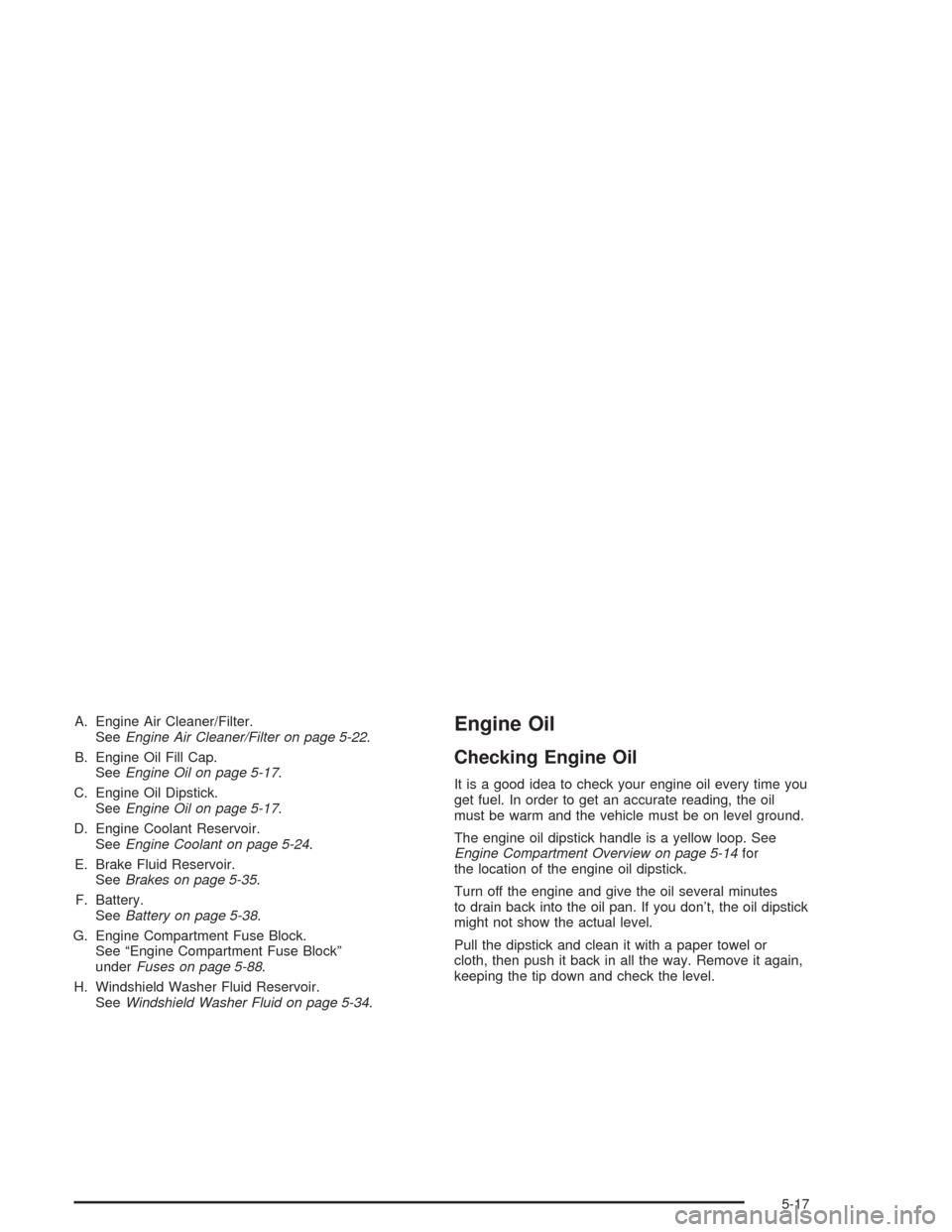
A. Engine Air Cleaner/Filter.
SeeEngine Air Cleaner/Filter on page 5-22.
B. Engine Oil Fill Cap.
SeeEngine Oil on page 5-17.
C. Engine Oil Dipstick.
SeeEngine Oil on page 5-17.
D. Engine Coolant Reservoir.
SeeEngine Coolant on page 5-24.
E. Brake Fluid Reservoir.
SeeBrakes on page 5-35.
F. Battery.
SeeBattery on page 5-38.
G. Engine Compartment Fuse Block.
See “Engine Compartment Fuse Block”
underFuses on page 5-88.
H. Windshield Washer Fluid Reservoir.
SeeWindshield Washer Fluid on page 5-34.Engine Oil
Checking Engine Oil
It is a good idea to check your engine oil every time you
get fuel. In order to get an accurate reading, the oil
must be warm and the vehicle must be on level ground.
The engine oil dipstick handle is a yellow loop. See
Engine Compartment Overview on page 5-14for
the location of the engine oil dipstick.
Turn off the engine and give the oil several minutes
to drain back into the oil pan. If you don’t, the oil dipstick
might not show the actual level.
Pull the dipstick and clean it with a paper towel or
cloth, then push it back in all the way. Remove it again,
keeping the tip down and check the level.
5-17
Page 300 of 426
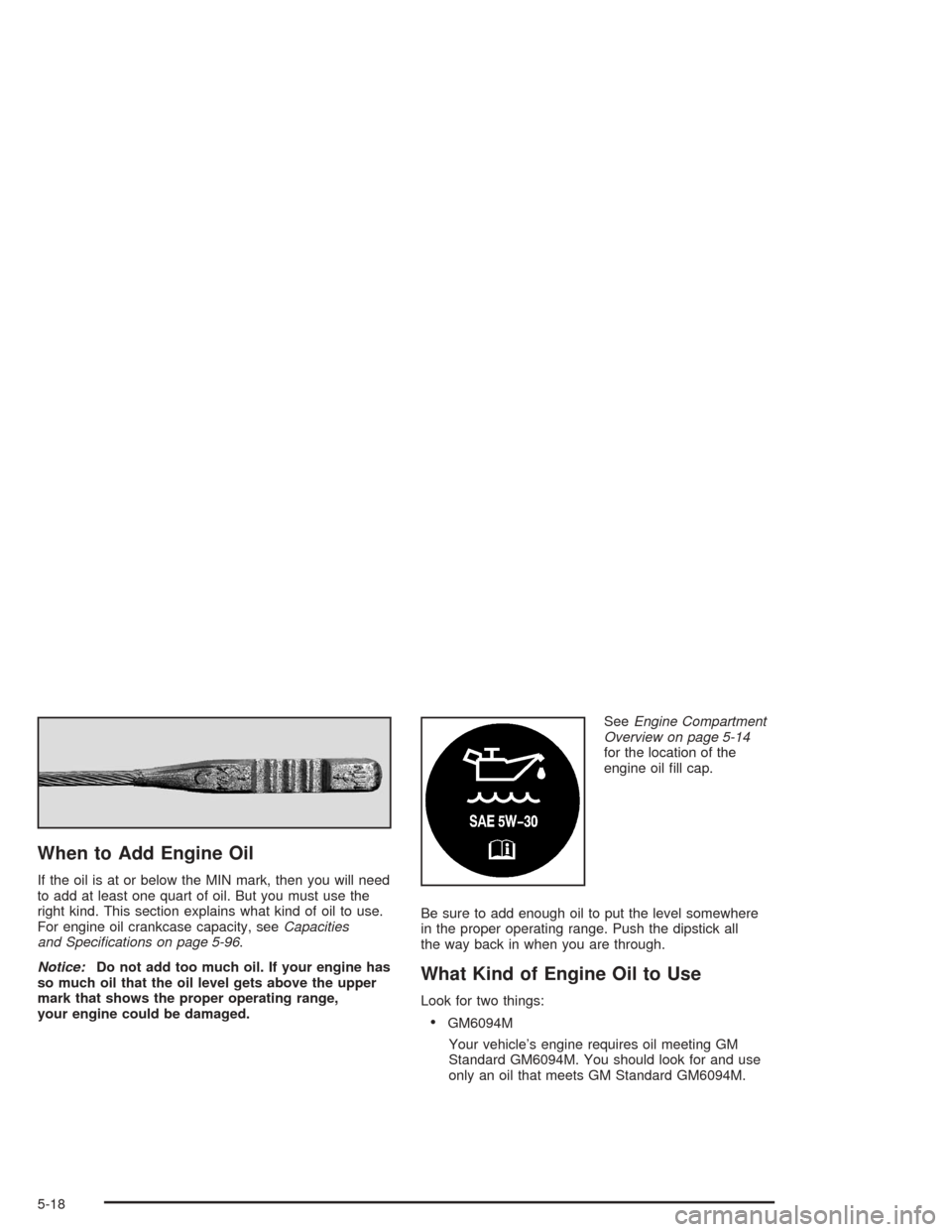
When to Add Engine Oil
If the oil is at or below the MIN mark, then you will need
to add at least one quart of oil. But you must use the
right kind. This section explains what kind of oil to use.
For engine oil crankcase capacity, seeCapacities
and Specications on page 5-96.
Notice:Do not add too much oil. If your engine has
so much oil that the oil level gets above the upper
mark that shows the proper operating range,
your engine could be damaged.SeeEngine Compartment
Overview on page 5-14
for the location of the
engine oil ll cap.
Be sure to add enough oil to put the level somewhere
in the proper operating range. Push the dipstick all
the way back in when you are through.
What Kind of Engine Oil to Use
Look for two things:
GM6094M
Your vehicle’s engine requires oil meeting GM
Standard GM6094M. You should look for and use
only an oil that meets GM Standard GM6094M.
5-18
Page 301 of 426
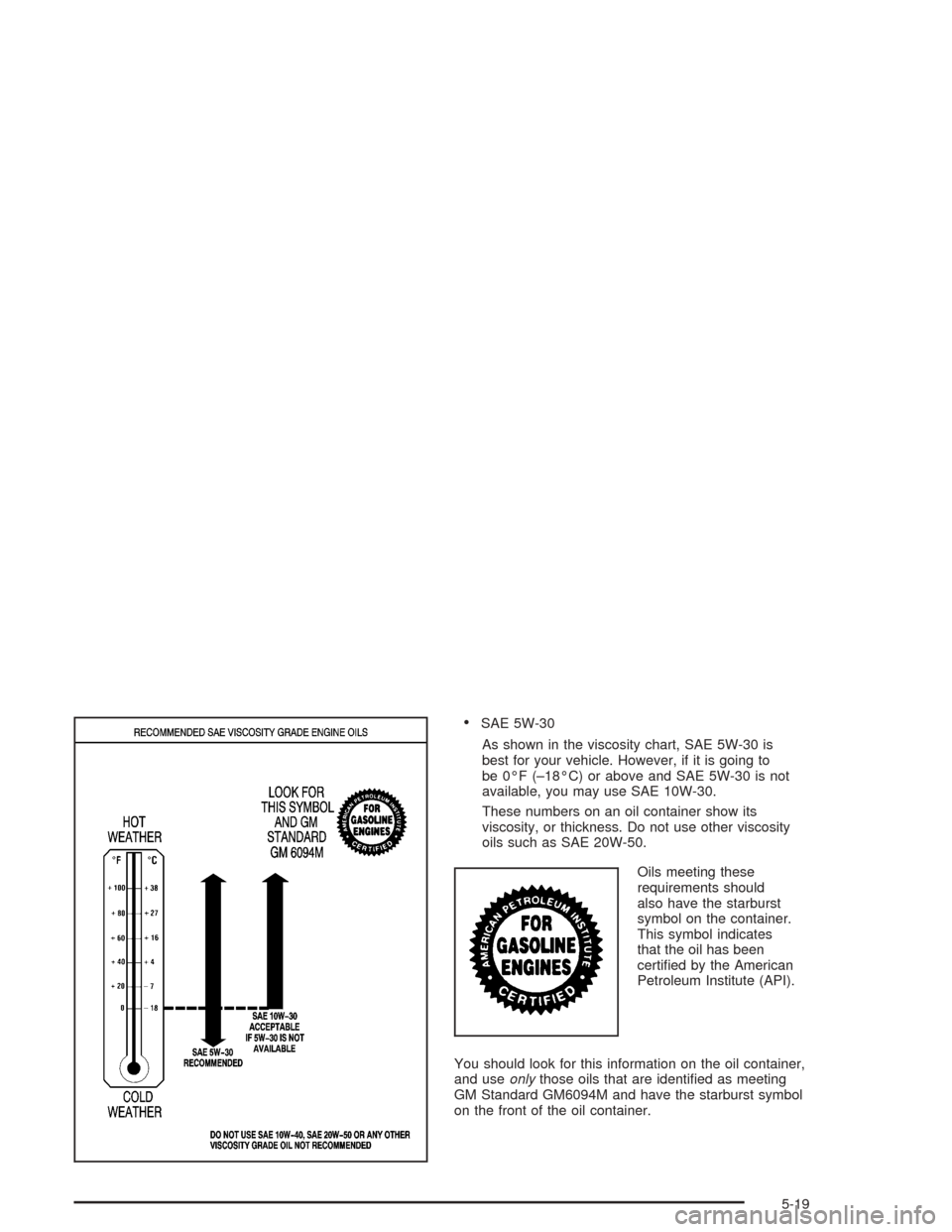
SAE 5W-30
As shown in the viscosity chart, SAE 5W-30 is
best for your vehicle. However, if it is going to
be 0°F (–18°C) or above and SAE 5W-30 is not
available, you may use SAE 10W-30.
These numbers on an oil container show its
viscosity, or thickness. Do not use other viscosity
oils such as SAE 20W-50.
Oils meeting these
requirements should
also have the starburst
symbol on the container.
This symbol indicates
that the oil has been
certied by the American
Petroleum Institute (API).
You should look for this information on the oil container,
and useonlythose oils that are identied as meeting
GM Standard GM6094M and have the starburst symbol
on the front of the oil container.
5-19