2004 CHEVROLET EPICA coolant
[x] Cancel search: coolantPage 223 of 338
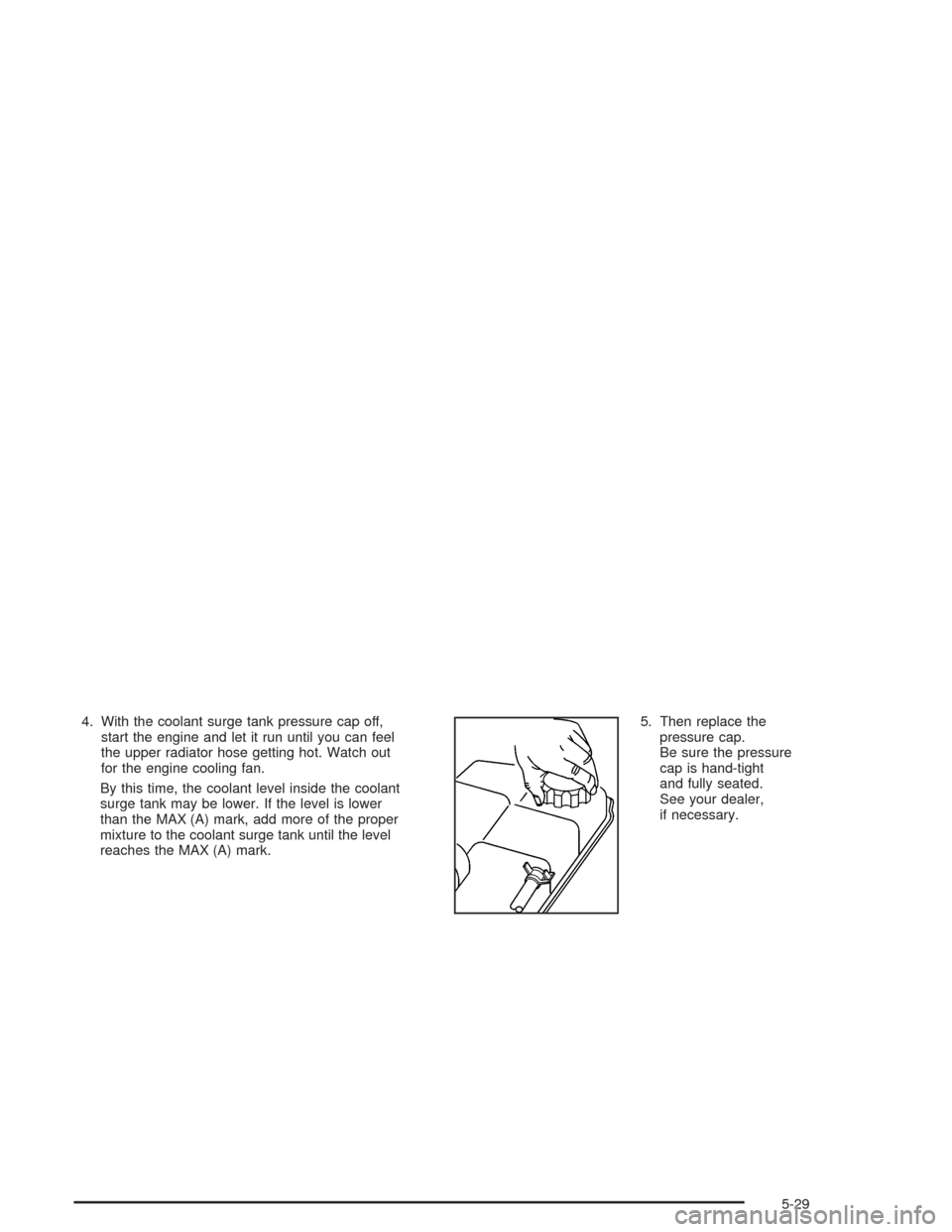
4. With the coolant surge tank pressure cap off,
start the engine and let it run until you can feel
the upper radiator hose getting hot. Watch out
for the engine cooling fan.
By this time, the coolant level inside the coolant
surge tank may be lower. If the level is lower
than the MAX (A) mark, add more of the proper
mixture to the coolant surge tank until the level
reaches the MAX (A) mark.5. Then replace the
pressure cap.
Be sure the pressure
cap is hand-tight
and fully seated.
See your dealer,
if necessary.
5-29
Page 225 of 338
Windshield Washer Fluid
What to Use
When you need windshield washer fluid, be sure to
read the manufacturer’s instructions before use. If you
will be operating your vehicle in an area where the
temperature may fall below freezing, use a fluid that
has sufficient protection against freezing.
Adding Washer Fluid
The windshield washer fluid reservoir is located in the
front of the engine compartment on the passenger’s
side of the vehicle. SeeEngine Compartment Overview
on page 5-12for reservoir location.
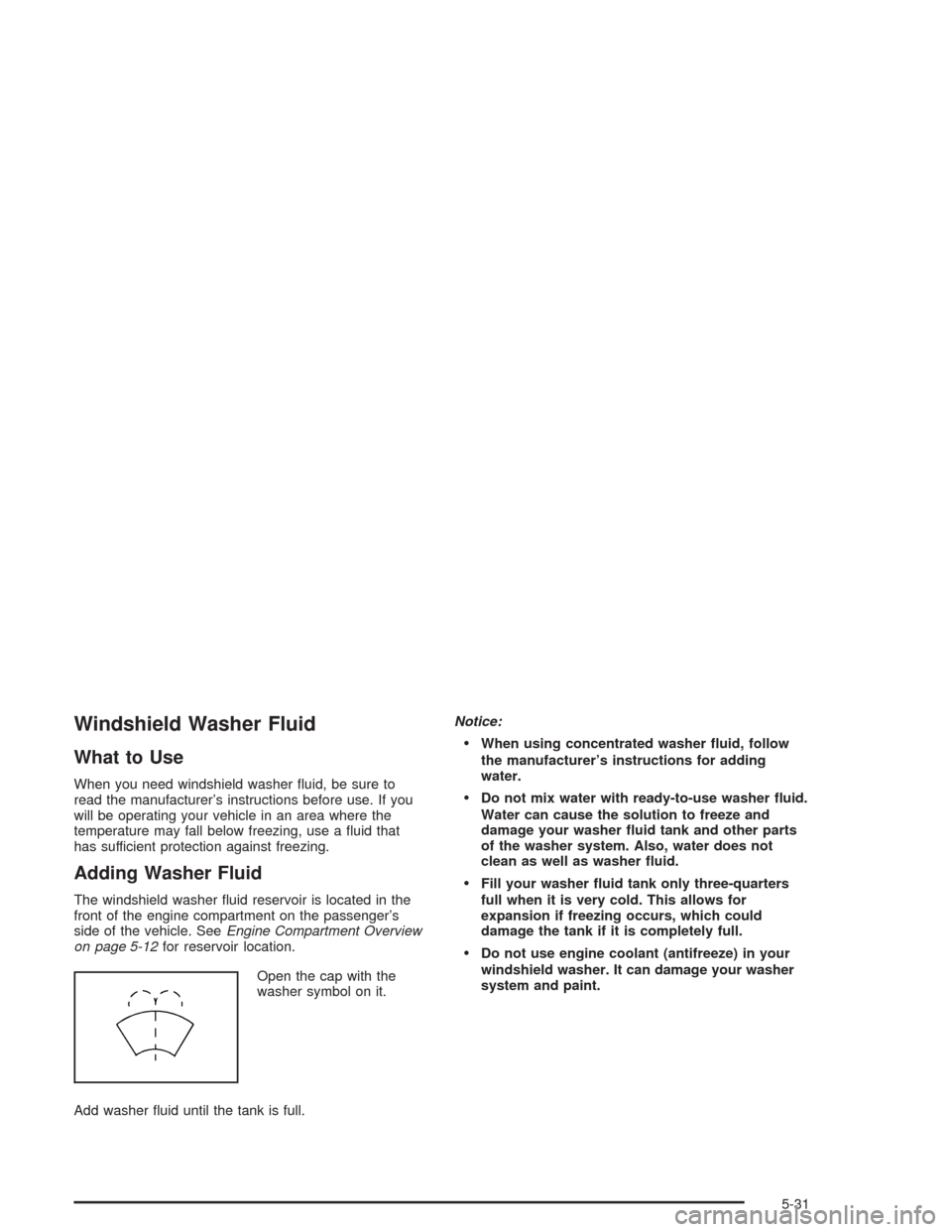
Open the cap with the
washer symbol on it.
Add washer fluid until the tank is full.Notice:
When using concentrated washer uid, follow
the manufacturer’s instructions for adding
water.
Do not mix water with ready-to-use washer uid.
Water can cause the solution to freeze and
damage your washer uid tank and other parts
of the washer system. Also, water does not
clean as well as washer uid.
Fill your washer uid tank only three-quarters
full when it is very cold. This allows for
expansion if freezing occurs, which could
damage the tank if it is completely full.
Do not use engine coolant (antifreeze) in your
windshield washer. It can damage your washer
system and paint.
5-31
Page 245 of 338
Belt:A rubber coated layer of cords that is located
between the plies and the tread. Cords may be made
from steel or other reinforcing materials.
Bead:The tire bead contains steel wires that hold the
tire onto the rim.
Bias Ply Tire:A pneumatic tire in which the plies are
laid at alternate angles, less than 90 degrees to the
centerline of the tread.
Cold Ination Pressure:The amount of air pressure
in a tire, measured in pounds per square inch (psi)
or kilopascal (kPa), before a tire has built up heat from
driving. SeeInflation - Tire Pressure on page 5-53.
Curb Weight:This means the weight of a motor vehicle
with standard and optional equipment including the
maximum capacity of fuel, oil and coolant, but without
passengers and cargo.
DOT Markings:A code molded into the sidewall of a
tire signifying that the tire is in compliance with the
U.S. Department of Transportation motor vehicle safety
standards. The DOT code includes the Tire Identification
Number (TIN), an alphanumeric designator which can
also identify the tire manufacturer, production plant,
brand and date of production.
GVWR:Gross Vehicle Weight Rating, seeLoading
Your Vehicle on page 4-31.GAWR FRT:Gross Axle Weight Rating for the front
axle, seeLoading Your Vehicle on page 4-31.
GAWR RR:Gross Axle Weight Rating for the rear axle,
seeLoading Your Vehicle on page 4-31.
Intended Outboard Sidewall:The side of an
asymmetrical tire that must always face outward when
mounted on a vehicle.
Kilopascal (kPa):The metric unit for air pressure.
There are 6.9 kPa’s to one psi.
Light Truck (LT-Metric) Tire:A tire used on light duty
trucks and some multipurpose passenger vehicles.
Load Index:An assigned number ranging from 1 to 279
that corresponds to the load carrying capacity of a tire.
Maximum Ination Pressure:The maximum cold
inflation pressure to which a tire may be inflated.
Maximum Load Rating:The load rating for a tire at
the maximum permissible inflation pressure for that tire.
Maximum Loaded Vehicle Weight:The sum of
curb weight; accessory weight; vehicle capacity weight;
and production options weight.
Normal Occupant Weight:The number of occupants a
vehicle is designed to seat multiplied by 150 pounds
(68 kg). SeeLoading Your Vehicle on page 4-31.
Occupant Distribution:Designated seating positions.
5-51
Page 288 of 338
21,000 Miles (35 000 km)
❑Change engine oil and filter (or every 3 months,
whichever occurs first).An Emission Control Service.
24,000 Miles (40 000 km)
❑Change engine oil and filter (or every 3 months,
whichever occurs first).An Emission Control Service.
❑Rotate tires. SeeTire Inspection and Rotation
on page 5-54for proper rotation pattern and
additional information.(See footnote +)
27,000 Miles (45 000 km)
❑Change engine oil and filter (or every 3 months,
whichever occurs first).An Emission Control Service.
30,000 Miles (50 000 km)
❑Change engine oil and filter (or every 3 months,
whichever occurs first).An Emission Control Service.
❑Replace passenger compartment air filter. If you drive
regularly under dusty conditions, the filter may
require replacement more often.
❑Replace engine air cleaner filter. SeeEngine Air
Cleaner/Filter on page 5-17for more information.
An Emission Control Service.❑Rotate tires. SeeTire Inspection and Rotation on
page 5-54for proper rotation pattern and additional
information.(See footnote +.)
❑Replace spark plugs.An Emission Control Service.
❑Replace fuel filter.An Emission Control Service.
(See footnote †.)
❑Inspect drive belts.
❑Drain, flush and refill cooling system. SeeEngine
Coolant on page 5-19for what to use. Inspect
hoses. Clean radiator, condenser, pressure cap and
neck. Pressure test the cooling system and
pressure cap.An Emission Control Service.
❑Inspect EVAP canister, vapor lines and solenoid
valve filter.An Emission Control Service.
(See footnote †.)
❑Inspect PCV system.An Emission Control Service.
(See footnote †.)
❑Change brake fluid (or every 24 months, whichever
occurs first).
33,000 Miles (55 000 km)
❑Change engine oil and filter (or every 3 months,
whichever occurs first).An Emission Control Service.
6-8
Page 290 of 338
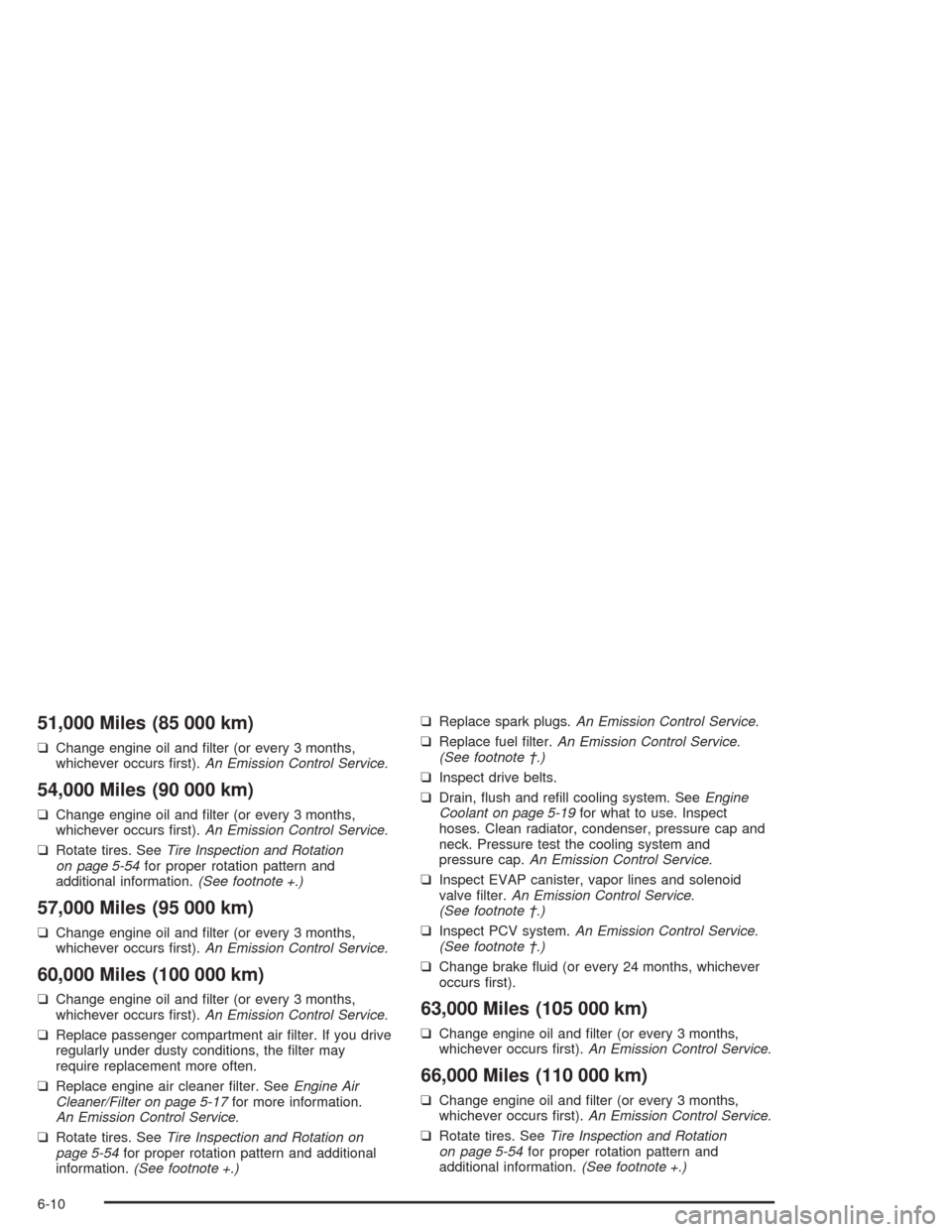
51,000 Miles (85 000 km)
❑Change engine oil and filter (or every 3 months,
whichever occurs first).An Emission Control Service.
54,000 Miles (90 000 km)
❑Change engine oil and filter (or every 3 months,
whichever occurs first).An Emission Control Service.
❑Rotate tires. SeeTire Inspection and Rotation
on page 5-54for proper rotation pattern and
additional information.(See footnote +.)
57,000 Miles (95 000 km)
❑Change engine oil and filter (or every 3 months,
whichever occurs first).An Emission Control Service.
60,000 Miles (100 000 km)
❑Change engine oil and filter (or every 3 months,
whichever occurs first).An Emission Control Service.
❑Replace passenger compartment air filter. If you drive
regularly under dusty conditions, the filter may
require replacement more often.
❑Replace engine air cleaner filter. SeeEngine Air
Cleaner/Filter on page 5-17for more information.
An Emission Control Service.
❑Rotate tires. SeeTire Inspection and Rotation on
page 5-54for proper rotation pattern and additional
information.(See footnote +.)❑Replace spark plugs.An Emission Control Service.
❑Replace fuel filter.An Emission Control Service.
(See footnote †.)
❑Inspect drive belts.
❑Drain, flush and refill cooling system. SeeEngine
Coolant on page 5-19for what to use. Inspect
hoses. Clean radiator, condenser, pressure cap and
neck. Pressure test the cooling system and
pressure cap.An Emission Control Service.
❑Inspect EVAP canister, vapor lines and solenoid
valve filter.An Emission Control Service.
(See footnote †.)
❑Inspect PCV system.An Emission Control Service.
(See footnote †.)
❑Change brake fluid (or every 24 months, whichever
occurs first).63,000 Miles (105 000 km)
❑Change engine oil and filter (or every 3 months,
whichever occurs first).An Emission Control Service.
66,000 Miles (110 000 km)
❑Change engine oil and filter (or every 3 months,
whichever occurs first).An Emission Control Service.
❑Rotate tires. SeeTire Inspection and Rotation
on page 5-54for proper rotation pattern and
additional information.(See footnote +.)
6-10
Page 292 of 338
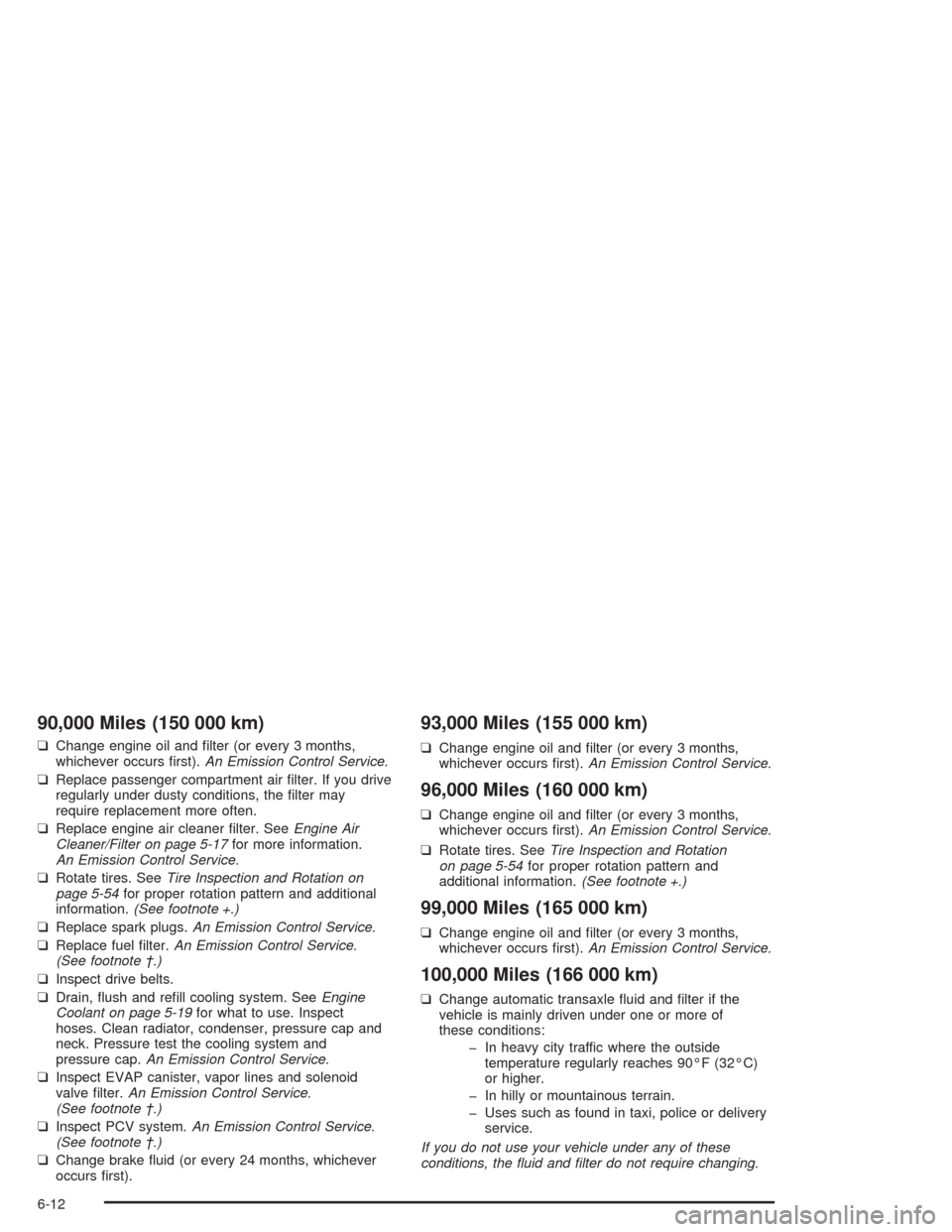
90,000 Miles (150 000 km)
❑Change engine oil and filter (or every 3 months,
whichever occurs first).An Emission Control Service.
❑Replace passenger compartment air filter. If you drive
regularly under dusty conditions, the filter may
require replacement more often.
❑Replace engine air cleaner filter. SeeEngine Air
Cleaner/Filter on page 5-17for more information.
An Emission Control Service.
❑Rotate tires. SeeTire Inspection and Rotation on
page 5-54for proper rotation pattern and additional
information.(See footnote +.)
❑Replace spark plugs.An Emission Control Service.
❑Replace fuel filter.An Emission Control Service.
(See footnote †.)
❑Inspect drive belts.
❑Drain, flush and refill cooling system. SeeEngine
Coolant on page 5-19for what to use. Inspect
hoses. Clean radiator, condenser, pressure cap and
neck. Pressure test the cooling system and
pressure cap.An Emission Control Service.
❑Inspect EVAP canister, vapor lines and solenoid
valve filter.An Emission Control Service.
(See footnote †.)
❑Inspect PCV system.An Emission Control Service.
(See footnote †.)
❑Change brake fluid (or every 24 months, whichever
occurs first).
93,000 Miles (155 000 km)
❑Change engine oil and filter (or every 3 months,
whichever occurs first).An Emission Control Service.
96,000 Miles (160 000 km)
❑Change engine oil and filter (or every 3 months,
whichever occurs first).An Emission Control Service.
❑Rotate tires. SeeTire Inspection and Rotation
on page 5-54for proper rotation pattern and
additional information.(See footnote +.)
99,000 Miles (165 000 km)
❑Change engine oil and filter (or every 3 months,
whichever occurs first).An Emission Control Service.
100,000 Miles (166 000 km)
❑Change automatic transaxle fluid and filter if the
vehicle is mainly driven under one or more of
these conditions:
- In heavy city traffic where the outside
temperature regularly reaches 90°F (32°C)
or higher.
- In hilly or mountainous terrain.
- Uses such as found in taxi, police or delivery
service.
If you do not use your vehicle under any of these
conditions, the fluid and filter do not require changing.
6-12
Page 294 of 338
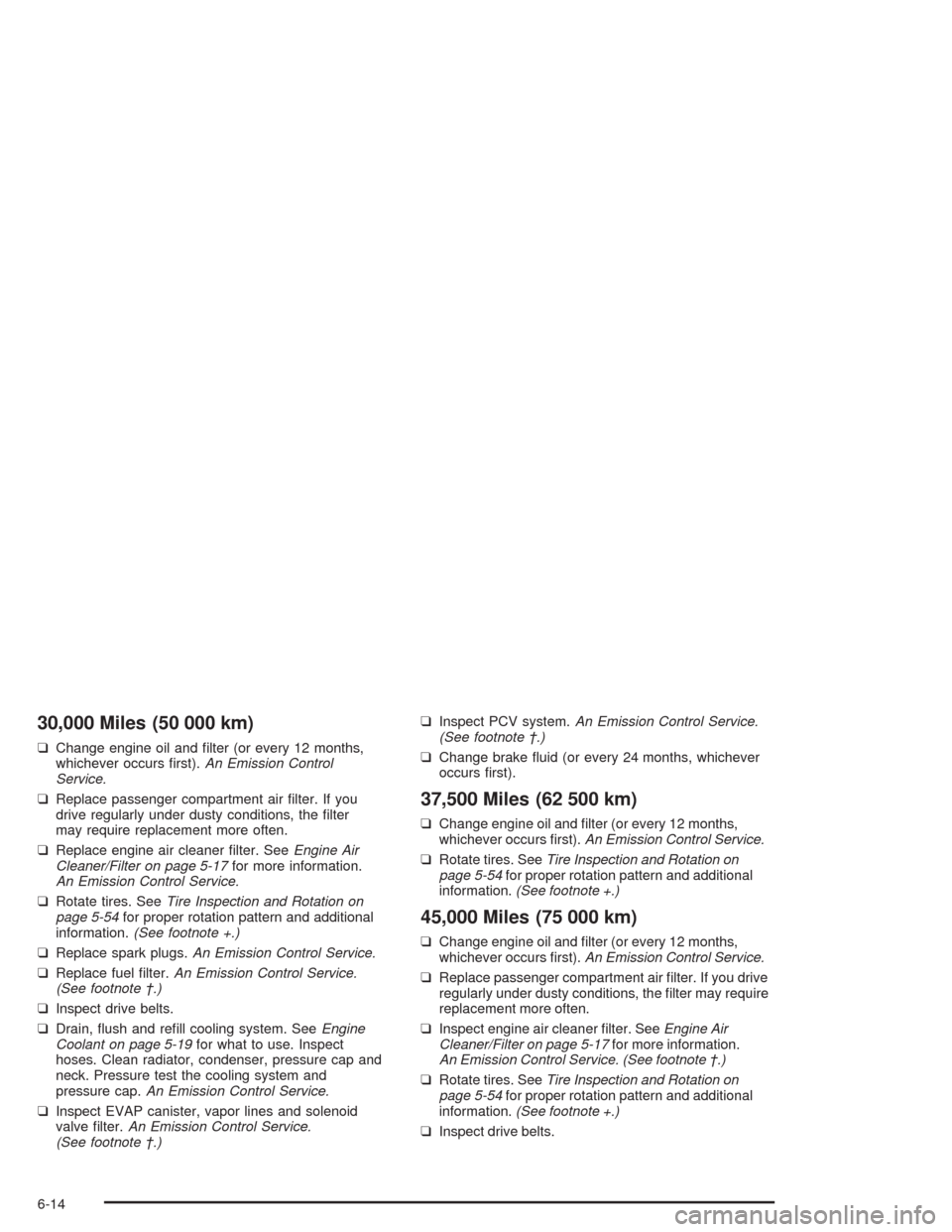
30,000 Miles (50 000 km)
❑Change engine oil and filter (or every 12 months,
whichever occurs first).An Emission Control
Service.
❑Replace passenger compartment air filter. If you
drive regularly under dusty conditions, the filter
may require replacement more often.
❑Replace engine air cleaner filter. SeeEngine Air
Cleaner/Filter on page 5-17for more information.
An Emission Control Service.
❑Rotate tires. SeeTire Inspection and Rotation on
page 5-54for proper rotation pattern and additional
information.(See footnote +.)
❑Replace spark plugs.An Emission Control Service.
❑Replace fuel filter.An Emission Control Service.
(See footnote †.)
❑Inspect drive belts.
❑Drain, flush and refill cooling system. SeeEngine
Coolant on page 5-19for what to use. Inspect
hoses. Clean radiator, condenser, pressure cap and
neck. Pressure test the cooling system and
pressure cap.An Emission Control Service.
❑Inspect EVAP canister, vapor lines and solenoid
valve filter.An Emission Control Service.
(See footnote †.)❑Inspect PCV system.An Emission Control Service.
(See footnote †.)
❑Change brake fluid (or every 24 months, whichever
occurs first).
37,500 Miles (62 500 km)
❑Change engine oil and filter (or every 12 months,
whichever occurs first).An Emission Control Service.
❑Rotate tires. SeeTire Inspection and Rotation on
page 5-54for proper rotation pattern and additional
information.(See footnote +.)
45,000 Miles (75 000 km)
❑Change engine oil and filter (or every 12 months,
whichever occurs first).An Emission Control Service.
❑Replace passenger compartment air filter. If you drive
regularly under dusty conditions, the filter may require
replacement more often.
❑Inspect engine air cleaner filter. SeeEngine Air
Cleaner/Filter on page 5-17for more information.
An Emission Control Service. (See footnote †.)
❑Rotate tires. SeeTire Inspection and Rotation on
page 5-54for proper rotation pattern and additional
information.(See footnote +.)
❑Inspect drive belts.
6-14
Page 295 of 338
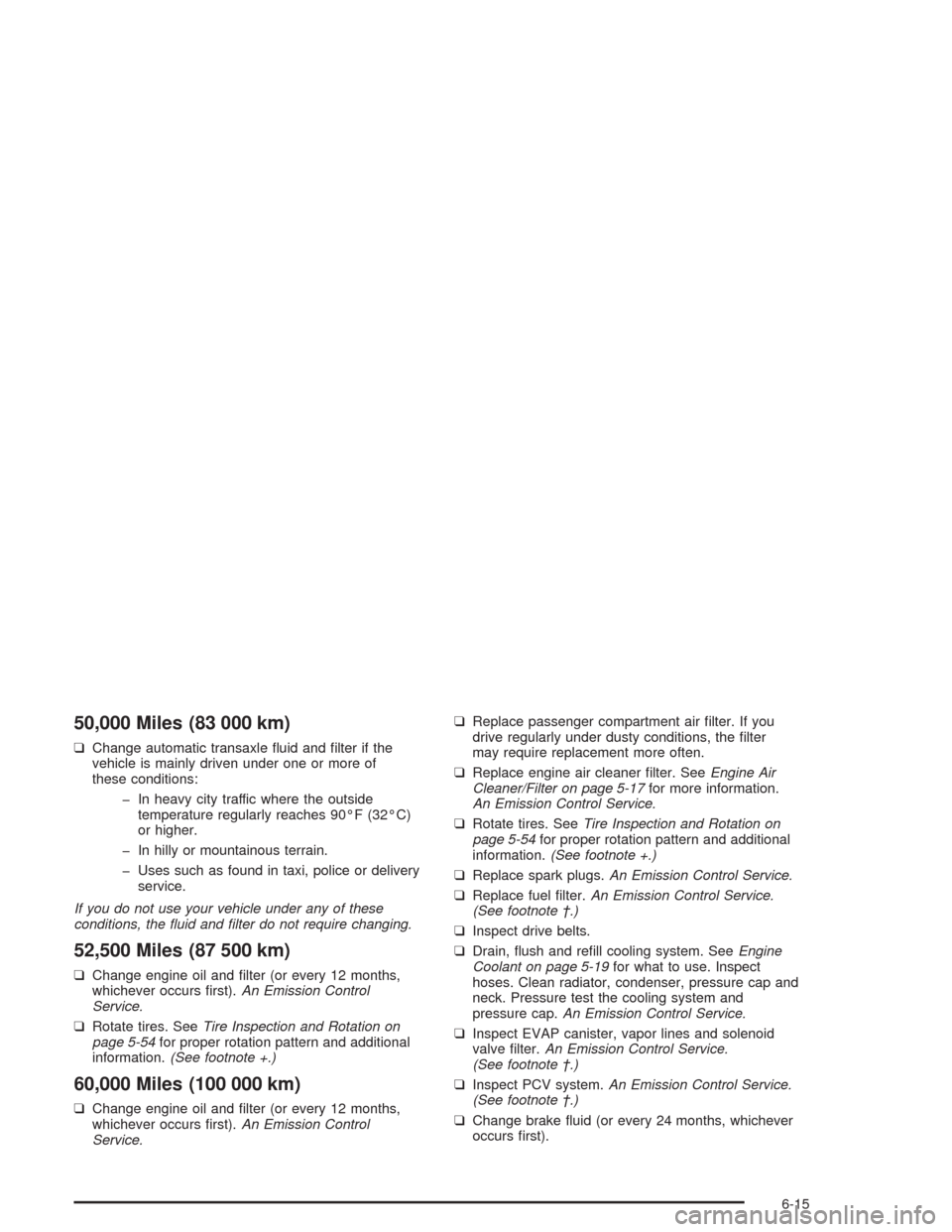
50,000 Miles (83 000 km)
❑Change automatic transaxle fluid and filter if the
vehicle is mainly driven under one or more of
these conditions:
- In heavy city traffic where the outside
temperature regularly reaches 90°F (32°C)
or higher.
- In hilly or mountainous terrain.
- Uses such as found in taxi, police or delivery
service.
If you do not use your vehicle under any of these
conditions, the fluid and filter do not require changing.
52,500 Miles (87 500 km)
❑Change engine oil and filter (or every 12 months,
whichever occurs first).An Emission Control
Service.
❑Rotate tires. SeeTire Inspection and Rotation on
page 5-54for proper rotation pattern and additional
information.(See footnote +.)
60,000 Miles (100 000 km)
❑Change engine oil and filter (or every 12 months,
whichever occurs first).An Emission Control
Service.❑Replace passenger compartment air filter. If you
drive regularly under dusty conditions, the filter
may require replacement more often.
❑Replace engine air cleaner filter. SeeEngine Air
Cleaner/Filter on page 5-17for more information.
An Emission Control Service.
❑Rotate tires. SeeTire Inspection and Rotation on
page 5-54for proper rotation pattern and additional
information.(See footnote +.)
❑Replace spark plugs.An Emission Control Service.
❑Replace fuel filter.An Emission Control Service.
(See footnote †.)
❑Inspect drive belts.
❑Drain, flush and refill cooling system. SeeEngine
Coolant on page 5-19for what to use. Inspect
hoses. Clean radiator, condenser, pressure cap and
neck. Pressure test the cooling system and
pressure cap.An Emission Control Service.
❑Inspect EVAP canister, vapor lines and solenoid
valve filter.An Emission Control Service.
(See footnote †.)
❑Inspect PCV system.An Emission Control Service.
(See footnote †.)
❑Change brake fluid (or every 24 months, whichever
occurs first).
6-15