2004 CHEVROLET EPICA traction control
[x] Cancel search: traction controlPage 168 of 338

Steering
Power Steering
If you lose power steering assist because the engine
stops or the system is not functioning, you can steer
but it will take much more effort.
Steering Tips
Driving on Curves
It is important to take curves at a reasonable speed.
A lot of the “driver lost control” accidents mentioned
on the news happen on curves. Here is why:
Experienced driver or beginner, each of us is subject
to the same laws of physics when driving on curves.
The traction of the tires against the road surface makes
it possible for the vehicle to change its path when
you turn the front wheels. If there is no traction, inertia
will keep the vehicle going in the same direction.
If you have ever tried to steer a vehicle on wet ice,
you will understand this.
The traction you can get in a curve depends on the
condition of your tires and the road surface, the angle at
which the curve is banked, and your speed. While you
are in a curve, speed is the one factor you can control.Suppose you are steering through a sharp curve.
Then you suddenly accelerate. Both control
systems — steering and acceleration — have to do their
work where the tires meet the road. Adding the sudden
acceleration can demand too much of those places.
You can lose control. SeeTraction Control System (TCS)
on page 4-8.
What should you do if this ever happens? Ease up on
the accelerator pedal, steer the vehicle the way you
want it to go, and slow down.
Speed limit signs near curves warn that you should
adjust your speed. Of course, the posted speeds
are based on good weather and road conditions. Under
less favorable conditions you will want to go slower.
If you need to reduce your speed as you approach
a curve, do it before you enter the curve, while your front
wheels are straight ahead.
Try to adjust your speed so you can “drive” through the
curve. Maintain a reasonable, steady speed. Wait to
accelerate until you are out of the curve, and then
accelerate gently into the straightaway.
4-10
Page 172 of 338
Loss of Control
Let us review what driving experts say about what
happens when the three control systems (brakes,
steering and acceleration) do not have enough friction
where the tires meet the road to do what the driver
has asked.
In any emergency, do not give up. Keep trying to steer
and constantly seek an escape route or area of less
danger.
Skidding
In a skid, a driver can lose control of the vehicle.
Defensive drivers avoid most skids by taking reasonable
care suited to existing conditions, and by not “overdriving”
those conditions. But skids are always possible.
The three types of skids correspond to your vehicle’s
three control systems. In the braking skid, your wheels
are not rolling. In the steering or cornering skid, too much
speed or steering in a curve causes tires to slip and lose
cornering force. And in the acceleration skid, too much
throttle causes the driving wheels to spin.
A cornering skid is best handled by easing your foot off
the accelerator pedal.Remember: Any traction control system helps avoid only
the acceleration skid. If your TCS system is off, then
an acceleration skid is also best handled by easing your
foot off the accelerator pedal.
If your vehicle starts to slide, ease your foot off the
accelerator pedal and quickly steer the way you want
the vehicle to go. If you start steering quickly enough,
your vehicle may straighten out. Always be ready
for a second skid if it occurs.
Of course, traction is reduced when water, snow, ice,
gravel or other material is on the road. For safety,
you will want to slow down and adjust your driving to
these conditions. It is important to slow down on slippery
surfaces because stopping distance will be longer and
vehicle control more limited.
While driving on a surface with reduced traction, try your
best to avoid sudden steering, acceleration or braking
(including engine braking by shifting to a lower gear).
Any sudden changes could cause the tires to slide. You
may not realize the surface is slippery until your vehicle is
skidding. Learn to recognize warning clues — such as
enough water, ice or packed snow on the road to make
a “mirrored surface” — and slow down when you have
any doubt.
Remember: Any anti-lock brake system (ABS) helps
avoid only the braking skid.
4-14
Page 183 of 338
Driving on Snow or Ice
Most of the time, those places where your tires meet
the road probably have good traction.
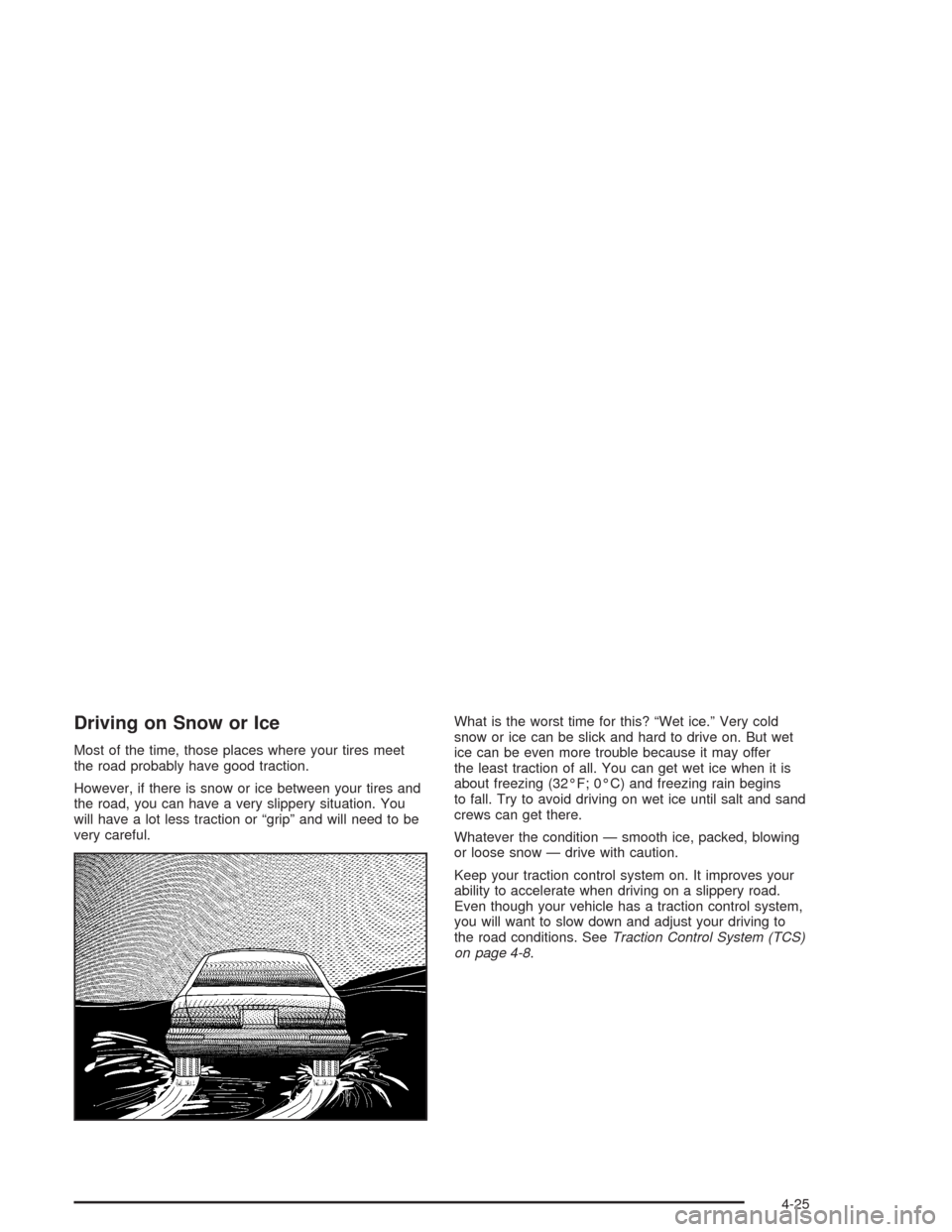
However, if there is snow or ice between your tires and
the road, you can have a very slippery situation. You
will have a lot less traction or “grip” and will need to be
very careful.What is the worst time for this? “Wet ice.” Very cold
snow or ice can be slick and hard to drive on. But wet
ice can be even more trouble because it may offer
the least traction of all. You can get wet ice when it is
about freezing (32°F; 0°C) and freezing rain begins
to fall. Try to avoid driving on wet ice until salt and sand
crews can get there.
Whatever the condition — smooth ice, packed, blowing
or loose snow — drive with caution.
Keep your traction control system on. It improves your
ability to accelerate when driving on a slippery road.
Even though your vehicle has a traction control system,
you will want to slow down and adjust your driving to
the road conditions. SeeTraction Control System (TCS)
on page 4-8.
4-25
Page 251 of 338

Uniform Tire Quality Grading
Quality grades can be found where applicable on the
tire sidewall between tread shoulder and maximum
selection width. For example:
Treadwear 200 Traction AA Temperature A
The following information relates to the system developed
by the Unites States National Highway Traffic Safety
Administration, which grades tires by treadwear, traction
and temperature performance. (This applies only to
vehicles sold in the United States.) The grades are
molded on the sidewalls of most passenger car tires.
The Uniform Tire Quality Grading system does not
apply to deep tread, winter-type snow tires, space-saver
or temporary use spare tires, tires with nominal rim
diameters of 10 to 12 inches (25 to 30 cm), or to some
limited-production tires.
While the tires available on General Motors passenger
cars and light trucks may vary with respect to these
grades, they must also conform to federal safety
requirements.
Treadwear
The treadwear grade is a comparative rating based on
the wear rate of the tire when tested under controlled
conditions on a specified government test course.
For example, a tire graded 150 would wear one and
a half (1
1⁄2) times as well on the government course as
a tire graded 100. The relative performance of tires
depends upon the actual conditions of their use,
however, and may depart significantly from the norm
due to variations in driving habits, service practices and
differences in road characteristics and climate.
Traction — AA, A, B, C
The traction grades, from highest to lowest, are AA, A,
B, and C. Those grades represent the tire’s ability
to stop on wet pavement as measured under controlled
conditions on specified government test surfaces of
asphalt and concrete. A tire marked C may have poor
traction performance. Warning: The traction grade
assigned to this tire is based on straight-ahead braking
traction tests, and does not include acceleration,
cornering, hydroplaning, or peak traction characteristics.
5-57
Page 330 of 338
J
Jump Starting.................................................5-36
K
Key Lock Cylinders Service..............................6-19
Keyless Entry System....................................... 2-4
Keys............................................................... 2-2
LLamps
Exterior......................................................3-13
Interior.......................................................3-15
Lamps On Reminder.......................................3-14
Lap-Shoulder Belt...................................1-16, 1-25
LATCH System
Child Restraints...........................................1-40
Securing a Child Restraint Designed for
the LATCH System...................................1-43
Leaving Your Vehicle.......................................2-11
Leaving Your Vehicle With the Engine Running . . . 2-27
Light
Air Bag Readiness.......................................3-33
Anti-Lock Brake System Warning...................3-36
Brake System Warning.................................3-35Light (cont.)
Charging System.........................................3-34
Cruise Control.............................................3-43
Daytime Running Lamps Indicator..................3-44
Door Ajar...................................................3-47
Highbeam On.............................................3-43
Hold Mode.................................................3-38
Low Fuel Warning.......................................3-45
Malfunction Indicator....................................3-39
Oil Pressure...............................................3-42
Safety Belt Reminder...................................3-33
Safety Belt Reminder Tone...........................3-33
Speed Sensitive Power Steering (SSPS)
Warning Light..........................................3-36
TCS Warning Light......................................3-37
Traction Control System Active......................3-38
Traction Control System (TCS) Warning..........3-37
Trunk Ajar..................................................3-47
Loading Your Vehicle.......................................4-31
Lockout Protection..........................................2-10
Locks
Central Door Unlocking System....................... 2-8
Door........................................................... 2-7
Leaving Your Vehicle....................................2-11
Lockout Protection.......................................2-10
Power Door.................................................. 2-9
Rear Door Security Locks.............................2-10
8
Page 336 of 338
T
Tachometer....................................................3-32
Taillamps
Turn Signal, Stoplamps and Back-up Lamps......5-46
TCS Active Light.............................................3-38
TCS Warning Light..........................................3-37
Theft-Deterrent, Radio.....................................3-58
Theft-Deterrent System....................................2-15
Theft-Deterrent Systems...................................2-15
Immobilizer.................................................2-17
Immobilizer Operation...................................2-17
Throttle System Inspection...............................6-23
Tilt Wheel........................................................ 3-7
Tire Inflation Check.........................................6-18
Tire Sidewall Labeling......................................5-48
Tire Size.......................................................5-50
Tire Terminology and Definitions........................5-50
Tires.............................................................5-48
Buying New Tires........................................5-56
Chains.......................................................5-60
Changing a Flat Tire....................................5-62
If a Tire Goes Flat.......................................5-61
Inflation - Tire Pressure................................5-53
Inspection and Rotation................................5-54
Spare Tire..................................................5-68
Uniform Tire Quality Grading.........................5-57
Wheel Alignment and Tire Balance.................5-58Tires (cont.)
Wheel Replacement.....................................5-59
When It Is Time for New Tires......................5-55
To Use the Engine Coolant Heater....................2-21
Top Strap......................................................1-37
Top Strap Anchor Location...............................1-39
Torque Lock...................................................2-28
Towing
Recreational Vehicle.....................................4-29
Towing a Trailer..........................................4-35
Your Vehicle...............................................4-29
Traction
Control System Active Light..........................3-38
Control System (TCS).................................... 4-8
Control System Warning Light.......................3-37
Transaxle
Fluid, Automatic...........................................5-19
Transaxle Operation, Automatic.........................2-22
Transmission, Transaxle, Transfer Case Unit
Repair Manual............................................7-12
Transportation Options...................................... 7-8
Trip Odometer................................................3-32
Trunk............................................................2-11
Trunk Ajar Light..............................................3-47
Trunk Lamp...................................................3-16
Trunk-Mounted CD Changer.............................3-55
Turn and Lane-Change Signals.......................... 3-8
Turn Signal/Multifunction Lever........................... 3-7
14