Page 318 of 384
Z06 models do not have Extended Mobility Tires. If a
Z06 model tire goes flat, avoid further tire and wheel
damage by driving slowly to a level place and stopping.
Then do this:
1. Turn on the hazard warning flashers.
2. Set the parking brake firmly.
3. Put the shift lever (manual transmission) in
REVERSE (R).
4. Turn off the engine.
5. Inspect the flat tire.
If the tire has been separated from the wheel or has
damaged sidewalls or large tears that allow rapid
air loss, call a tire repair facility. SeeRoadside
Assistance Program on page 7-6.
If the flat tire is due to a slow leak caused by a nail or
other similar road hazard, the tire inflator kit may
be used to repair the damaged tire temporarily. The kit
uses a liquid tire sealant to seal small punctures inthe tread area of the tire. The flat tire is then inflated to
at least 26 psi (179 kPa) and driven to evenly distribute
the tire sealant. The tire pressure is checked after
driving for a maximum of 10 minutes to see if the slow
leak has been stopped. If the tire pressure is 19 psi
(131 kPa) or more, inflate the tire up to the standard
operating pressure as shown on the Tire Pressure Label
found on the rear edge of the driver’s door. See
Ination - Tire Pressure on page 5-62.
You should have the damaged tire repaired as soon as
possible. The tire sealant is a temporary repair only.
For more information regarding the tire inflator kit
see “Tire Inflator Kit (Z06 Only)” following this section.
Notice:If the tire pressure has dropped below
19 psi (131 kPa), the vehicle should not be driven
further. Damage to the tire may be severe and
the sealant will not be effective. Contact Roadside
Assistance. See “Roadside Assistance” in the Index.
5-76
Page 321 of 384
Notice:The car engine must be running to avoid
draining the battery while running the air
compressor.
Follow the proper steps to be sure your vehicle will not
move. SeeParking Your Vehicle (Manual Transmission)
on page 2-35.
{CAUTION:
It can be dangerous to get out of your vehicle
with the engine running, if the shift lever is not
in NEUTRAL (N) with the parking brake rmly
set (manual transmission). Your vehicle can
roll or move suddenly even when on fairly
level ground. To be sure your vehicle won’t
move, always set your parking brake and move
the shift lever to NEUTRAL (N) when you start
or idle your engine.
{CAUTION:
Idling the engine in a closed-in place or with
the climate control system off can cause
deadly carbon monoxide (CO). See “Engine
Exhaust” in the Index.
{CAUTION:
Inating something too much can make it
explode, and you or others could be injured.
Be sure to read the inator instructions, and
inate the tire to its recommended pressure.
Do not exceed 36 psi (248 kPa).
5-79
Page 338 of 384
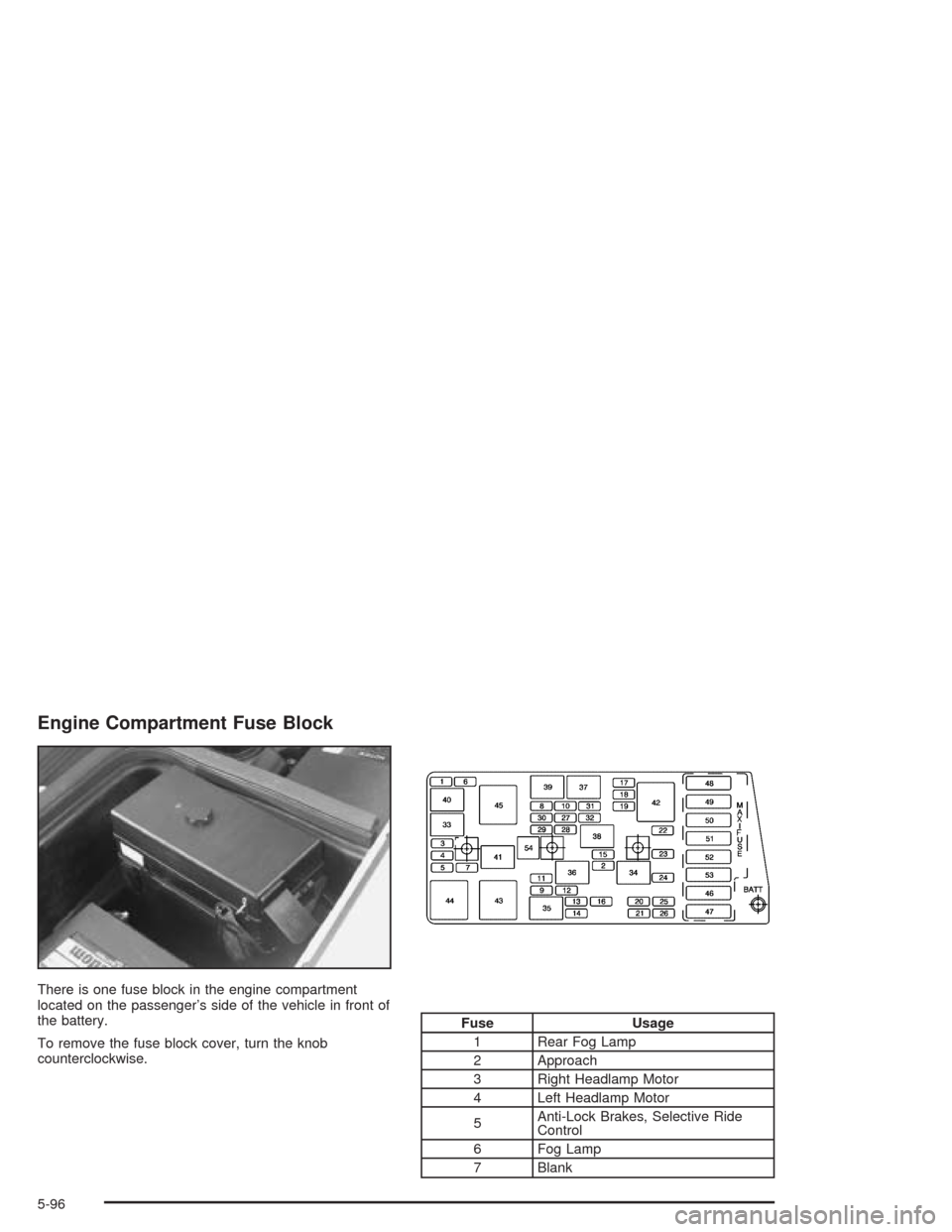
Engine Compartment Fuse Block
There is one fuse block in the engine compartment
located on the passenger’s side of the vehicle in front of
the battery.
To remove the fuse block cover, turn the knob
counterclockwise.
Fuse Usage
1 Rear Fog Lamp
2 Approach
3 Right Headlamp Motor
4 Left Headlamp Motor
5Anti-Lock Brakes, Selective Ride
Control
6 Fog Lamp
7 Blank
5-96
Page 339 of 384
Fuse Usage
8 Headlamp Low-Beam Right
9 Headlamp High-Beam Right
10 Headlamp Low-Beam Left
11 Horn
12 Headlamp High-Beam Left
13 Fuel Pump
14 Cooling Fan – Ignition 3
15 Oxygen Sensor
16 Powertrain Control Module
17 Throttle Control
18 Injector 2
19 Engine Ignition
20 Blank
21 Blank
22 Injector 1
23 Powertrain Control Module
24 Air ConditioningFuse Usage
25 Blank
26 Blank
27 Spare
28 Spare
29 Spare
30 Spare
31 Spare
32 Spare
46 Cooling Fan 2
47 Blank
48 Blank
49 Cooling Fan 1
50 Air Pump
51 Selective Ride Control
52 Anti-Lock Brakes
53 Anti-Lock Brakes Electronics
54 Fuse Puller
5-97
Page 347 of 384
Scheduled Maintenance
Service MaintenanceIMaintenanceII
Change engine oil and filter. Reset oil life system. SeeEngine Oil on
page 5-13.An Emission Control Service.••
Visually check for any leaks or damage.See footnote (g).••
Inspect engine air cleaner filter. If necessary, replace filter. SeeEngine Air
Cleaner/Filter on page 5-18.An Emission Control Service. See footnote †.••
Check tire inflation pressures and tire wear. SeeTires on page 5-55.••
Inspect brake system.See footnote (a).••
Check engine coolant and windshield washer fluid levels and add fluid as
needed.••
Perform any needed additional services. See “Additional Required Services” in
this section.••
Inspect suspension and steering components.See footnote (b).•
Inspect engine cooling system.See footnote (c).•
Inspect wiper blades.See footnote (d).•
Inspect restraint system components.See footnote (e).•
Lubricate body components.See footnote (f).•
6-5
Page 349 of 384
Maintenance Footnotes
†The U.S. Environmental Protection Agency or the
California Air Resources Board has determined that the
failure to perform this maintenance item will not nullify
the emission warranty or limit recall liability prior to
the completion of the vehicle’s useful life. We, however,
urge that all recommended maintenance services be
performed at the indicated intervals and the
maintenance be recorded.
(a)Visually inspect brake lines and hoses for proper
hook-up, binding, leaks, cracks, chang, etc. Inspect
disc brake pads for wear and rotors for surface
condition. Inspect other brake parts, including calipers,
parking brake, etc.
(b)Visually inspect front and rear suspension and
steering system for damaged, loose or missing parts or
signs of wear. Inspect power steering lines and
hoses for proper hook-up, binding, leaks, cracks,
chang, etc.
(c)Visually inspect hoses and have them replaced if
they are cracked, swollen or deteriorated. Inspect all
pipes, ttings and clamps; replace with genuine GM parts
as needed. To help ensure proper operation, a pressure
test of the cooling system and pressure cap and cleaning
the outside of the radiator and air conditioning condenser
is recommended at least once a year.(d)Visually inspect wiper blades for wear or cracking.
Replace blade inserts that appear worn or damaged
or that streak or miss areas of the windshield.
(e)Make sure the safety belt reminder light and all your
belts, buckles, latch plates, retractors and anchorages
are working properly. Look for any other loose or
damaged safety belt system parts. If you see anything
that might keep a safety belt system from doing its
job, have it repaired. Have any torn or frayed safety belts
replaced. Also look for any opened or broken air bag
coverings, and have them repaired or replaced. (The air
bag system does not need regular maintenance.)
(f)Lubricate all key lock cylinders and body door
hinges.Lubricate all hinges and latches, including those
for the hood, rear compartment, console door and
any folding seat hardware. More frequent lubrication
may be required when exposed to a corrosive
environment. Applying silicone grease on weatherstrips
with a clean cloth will make them last longer, seal
better and not stick or squeak.
(g)A uid loss in any vehicle system could indicate a
problem. Have the system inspected and repaired
and the uid level checked. Add uid if needed.
6-7
Page 351 of 384
At Least Once a Month
Tire Inspection and Ination Check
Visually inspect your tires for wear and make sure tires
are inflated to the correct pressures. SeeTires on
page 5-55for further details.
Cassette Tape Player Service
Clean cassette tape player. Cleaning should be done
every 50 hours of tape play. SeeAudio System(s)
on page 3-69for further details.
Power Antenna Service
Clean power antenna mast. SeeAudio System(s) on
page 3-69for further details.
At Least Once a Year
Starter Switch Check
{CAUTION:
When you are doing this inspection, the
vehicle could move suddenly. If the vehicle
moves, you or others could be injured.
1. Before you start, be sure you have enough room
around the vehicle.
2. Firmly apply both the parking brake and the regular
brake. SeeParking Brake on page 2-31if
necessary.
Do not use the accelerator pedal, and be ready to
turn off the engine immediately if it starts.
3. On automatic transmission vehicles, try to start the
engine in each gear. The starter should work only
in PARK (P) or NEUTRAL (N). If the starter works in
any other position, contact your GM Goodwrench
dealer for service.
4. On manual transmission vehicles, put the shift lever
in NEUTRAL (N), push the clutch pedal down
halfway and try to start the engine. The starter
should work only when the clutch pedal is pushed
down all the way to the floor. If the starter works
when the clutch is not pushed all the way down,
contact your GM Goodwrench dealer for service.
6-9
Page 352 of 384
Automatic Transmission Shift Lock
Control System Check
{CAUTION:
When you are doing this inspection, the
vehicle could move suddenly. If the vehicle
moves, you or others could be injured.
1. Before you start, be sure you have enough room
around the vehicle. It should be parked on a level
surface.
2. Firmly apply the parking brake. SeeParking Brake
on page 2-31if necessary.
Be ready to apply the regular brake immediately if
the vehicle begins to move.
3. With the engine off, turn the key to the ON position,
but do not start the engine. Without applying the
regular brake, try to move the shift lever out
of PARK (P) with normal effort. If the shift lever
moves out of PARK (P), contact your GM
Goodwrench dealer for service.
Ignition Automatic Transmission Lock
Check
While parked, and with the parking brake set, try to turn
the ignition key to OFF in each shift lever position.
•The key should turn to OFF only when the shift lever
is in PARK (P).
•The key should come out only in OFF.
Contact your GM Goodwrench dealer if service is
required.
Parking Brake and Automatic
Transmission Park (P) Mechanism Check
{CAUTION:
When you are doing this check, your vehicle
could begin to move. You or others could be
injured and property could be damaged. Make
sure there is room in front of your vehicle in
case it begins to roll. Be ready to apply the
regular brake at once should the vehicle begin
to move.
6-10