2004 CHEVROLET BLAZER mirror
[x] Cancel search: mirrorPage 219 of 446
While driving on a surface with reduced traction, try
your best to avoid sudden steering, acceleration
or braking (including engine braking by shifting to a
lower gear). Any sudden changes could cause the tires
to slide. You may not realize the surface is slippery
until your vehicle is skidding. Learn to recognize warning
clues — such as enough water, ice or packed snow
on the road to make a “mirrored surface” — and slow
down when you have any doubt.
Remember: Any anti-lock brake system (ABS) helps
avoid only the braking skid.
Off-Road Driving with Your
Four-Wheel-Drive Vehicle
This off-road guide is for vehicles that have four-wheel
drive. Also, seeBraking on page 4-7. If your vehicle
does not have four-wheel drive, you should not
drive off-road unless you are on a level, solid surface.
Off-road driving can be great fun. But it does have some
denite hazards. The greatest of these is the terrain itself.
“Off-roading” means you have left the great North
American road system behind. Traffic lanes are not
marked. Curves are not banked. There are no
road signs. Surfaces can be slippery, rough, uphill or
downhill. In short, you have gone right back to nature.Off-road driving involves some new skills. And that is
why it is very important that you read this guide. You will
nd many driving tips and suggestions. These will
help make your off-road driving safer and more
enjoyable.
Before You Go Off-Roading
There are some things to do before you go out. For
example, be sure to have all necessary maintenance
and service work done. Check to make sure all
underbody shields, if so equipped, are properly attached.
Be sure you read all the information about your
four-wheel-drive vehicle in this manual. Is there enough
fuel? Is the spare tire fully inated? Are the uid
levels up where they should be? What are the local
laws that apply to off-roading where you will be driving?
If you do not know, you should check with law
enforcement people in the area. Will you be on
someone’s private land? If so, be sure to get the
necessary permission.
4-15
Page 235 of 446
Here are some tips on night driving.
Drive defensively.
Do not drink and drive.
Except Vehicles with Electrochromic Day/Night
Inside Rearview Mirror: Adjust your inside rearview
mirror to reduce the glare from headlamps
behind you.
Since you can not see as well, you may need to slow
down and keep more space between you and other
vehicles.
Slow down, especially on higher speed roads. Your
headlamps can light up only so much road ahead.
In remote areas, watch for animals.
If you are tired, pull off the road in a safe place
and rest.
No one can see as well at night as in the daytime. But
as we get older these differences increase. A
50-year-old driver may require at least twice as much
light to see the same thing at night as a 20-year-old.
What you do in the daytime can also affect your
night vision. For example, if you spend the day in bright
sunshine you are wise to wear sunglasses. Your
eyes will have less trouble adjusting to night. But if youare driving, do not wear sunglasses at night. They may
cut down on glare from headlamps, but they also
make a lot of things invisible.
You can be temporarily blinded by approaching
headlamps. It can take a second or two, or even
several seconds, for your eyes to readjust to the dark.
When you are faced with severe glare (as from a
driver who does not lower the high beams, or a vehicle
with misaimed headlamps), slow down a little. Avoid
staring directly into the approaching headlamps.
Keep your windshield and all the glass on your vehicle
clean — inside and out. Glare at night is made much
worse by dirt on the glass. Even the inside of the glass
can build up a lm caused by dust. Dirty glass makes
lights dazzle and ash more than clean glass would,
making the pupils of your eyes contract repeatedly.
Remember that your headlamps light up far less of a
roadway when you are in a turn or curve. Keep
your eyes moving; that way, it is easier to pick out dimly
lighted objects. Just as your headlamps should be
checked regularly for proper aim, so should your eyes
be examined regularly. Some drivers suffer from
night blindness — the inability to see in dim light — and
are not even aware of it.
4-31
Page 240 of 446

Freeway Driving
Mile for mile, freeways (also called thruways, parkways,
expressways, turnpikes or superhighways) are the
safest of all roads. But they have their own special rules.The most important advice on freeway driving is: Keep
up with traffic and keep to the right. Drive at the
same speed most of the other drivers are driving.
Too-fast or too-slow driving breaks a smooth traffic ow.
Treat the left lane on a freeway as a passing lane.
At the entrance, there is usually a ramp that leads to the
freeway. If you have a clear view of the freeway as you
drive along the entrance ramp, you should begin to check
traffic. Try to determine where you expect to blend with
the ow. Try to merge into the gap at close to the
prevailing speed. Switch on your turn signal, check your
mirrors and glance over your shoulder as often as
necessary. Try to blend smoothly with the traffic ow.
Once you are on the freeway, adjust your speed to the
posted limit or to the prevailing rate if it is slower. Stay in
the right lane unless you want to pass.
Before changing lanes, check your mirrors. Then use
your turn signal.
Just before you leave the lane, glance quickly over your
shoulder to make sure there is not another vehicle in your
“blind” spot.
Once you are moving on the freeway, make certain you
allow a reasonable following distance. Expect to move
slightly slower at night.
4-36
Page 242 of 446
Highway Hypnosis
Is there actually such a condition as “highway
hypnosis”? Or is it just plain falling asleep at the wheel?
Call it highway hypnosis, lack of awareness, or
whatever.
There is something about an easy stretch of road with
the same scenery, along with the hum of the tires on the
road, the drone of the engine, and the rush of the
wind against the vehicle that can make you sleepy. Do
not let it happen to you! If it does, your vehicle can
leave the road inless than a second,and you could
crash and be injured.
What can you do about highway hypnosis? First, be
aware that it can happen.
Then here are some tips:
Make sure your vehicle is well ventilated, with a
comfortably cool interior.
Keep your eyes moving. Scan the road ahead and
to the sides. Check your mirrors and your
instruments frequently.
If you get sleepy, pull off the road into a rest,
service or parking area and take a nap, get some
exercise, or both. For safety, treat drowsiness
on the highway as an emergency.
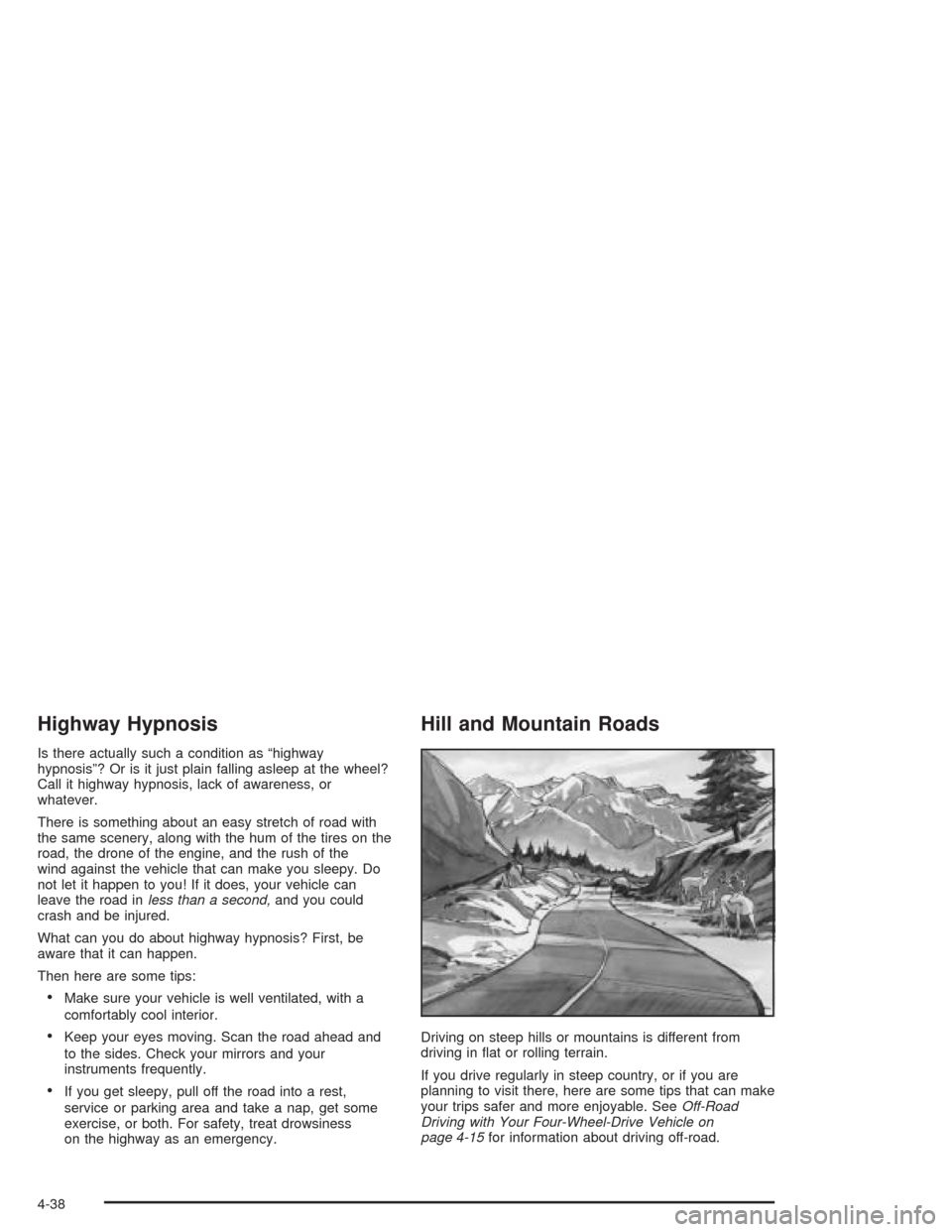
Hill and Mountain Roads
Driving on steep hills or mountains is different from
driving in at or rolling terrain.
If you drive regularly in steep country, or if you are
planning to visit there, here are some tips that can make
your trips safer and more enjoyable. SeeOff-Road
Driving with Your Four-Wheel-Drive Vehicle on
page 4-15for information about driving off-road.
4-38
Page 271 of 446

Driving with a Trailer
{CAUTION:
If you have a rear-most window open and you
pull a trailer with your vehicle, carbon
monoxide (CO) could come into your vehicle.
You can not see or smell CO. It can cause
unconsciousness or death. SeeEngine
Exhaust on page 2-40. To maximize your safety
when towing a trailer:
Have your exhaust system inspected for
leaks, and make necessary repairs before
starting on your trip.
Keep the rear-most windows closed.
If exhaust does come into your vehicle
through a window in the rear or another
opening, drive with your front, main
heating or cooling system on and with the
fan on any speed. This will bring fresh,
outside air into your vehicle. Do not use
the climate control setting for maximum air
because it only recirculates the air inside
your vehicle. See Climate Control System
in the Index.Towing a trailer requires a certain amount of experience.
Before setting out for the open road, you’ll want to get
to know your rig. Acquaint yourself with the feel of
handling and braking with the added weight of the trailer.
And always keep in mind that the vehicle you are
driving is now a good deal longer and not nearly as
responsive as your vehicle is by itself.
Before you start, check all trailer hitch, parts and
attachments, safety chains, electrical connector, lamps,
tires and mirror adjustment. If the trailer has electric
brakes, start your vehicle and trailer moving and then
apply the trailer brake controller by hand to be sure
the brakes are working. This lets you check your
electrical connection at the same time.
During your trip, check occasionally to be sure that the
load is secure, and that the lamps and any trailer
brakes are still working.Following Distance
Stay at least twice as far behind the vehicle ahead as
you would when driving your vehicle without a trailer.
This can help you avoid situations that require
heavy braking and sudden turns.
4-67
Page 379 of 446

Fuse Usage
IGN B Column Feed,Ignition 2, 3, 4
STARTER Starter
RAP Retained Accessory Power
LD LEV Not Used
OXYSEN Oxygen Sensor
IGN E Engine
MIR/LKS Mirrors, Door Locks
FOG LP Fog Lamps
IGN A Starting and Charging Ignition 1
STUD #2 Accessory Feeds, Electric Brake
PARKLP Parking Lamps
LR PRK Left Rear Parking Lamps
LIFTGLASS Liftglass
IGN CStarter Solenoid, Fuel Pump,
PRNDL
HTDSEAT Heated Seat
HVACHeating,Ventilation, Air Cooling
System
TRCHMSLTrailer Center High Mount
Stop Light
RRDFOG Rear Defogger
TBC Truck Body Computer
CRANK Clutch Switch, NSBU Switch
CHMSL Center High Mounted StoplampFuse Usage
HAZLP Hazard Lamps
VECHMSLVehicle Center High-Mounted
Stop Lamp
RR DEFOG Rear Defogger
HTDMIR Heated Mirror
ATC Transfer Case (Four-Wheel Drive)
STOPLP Stop Lamps
RR W/W Rear Window Wiper
Capacities and Specications
Engine Specications
Engine VORTEC™ 4300
VIN Code X
Spark Plug Gap 0.060 inches (1.52 mm)
Firing Order 1–6–5–4–3–2
Wheels and Tires
Wheel Nut Torque 100 lb-ft (140 N·m)
Tire PressureSee the Certication/Tire
label. See “Loading Your
Vehicle” in the Index.
5-103
Page 433 of 446
Center Rear Passenger Position, Safety Belts.....1-26
Center Seat Positions, Child Restraints..............1-51
Certication/Tire Label.....................................4-58
Chains, Tires..................................................5-74
Charging System Light....................................3-26
Check
Engine Light...............................................3-30
Gages Warning Light...................................3-35
Checking Brake Fluid......................................5-40
Checking Coolant............................................5-25
Checking Engine Oil........................................5-13
Checking Things Under the Hood......................5-10
Chemical Paint Spotting...................................5-95
Child Restraints
Center Seat Positions..................................1-51
Child Restraint Systems...............................1-37
Infants and Young Children...........................1-34
Lower Anchorages and Top Tethers
for Children (LATCH System).....................1-44
Older Children.............................................1-31
Securing a Child Restraint Designed
for the LATCH System..............................1-46
Securing a Child Restraint in a Rear
Outside Seat Position...............................1-46
Securing a Child Restraint in the
Right Front Seat Position..........................1-48
Top Strap...................................................1-41
Top Strap Anchor Location............................1-43
Where to Put the Restraint...........................1-40
Cigarette Lighter.............................................3-17Cleaning
Inside of Your Vehicle..................................5-90
Outside of Your Vehicle................................5-92
Underbody Maintenance...............................5-95
Weatherstrips..............................................5-92
Cleaning Aluminum Wheels..............................5-94
Cleaning Exterior Lamps/Lenses.......................5-93
Cleaning Fabric/Carpet....................................5-90
Cleaning Glass Surfaces..................................5-91
Cleaning Interior Plastic Components.................5-91
Cleaning Leather............................................5-91
Cleaning the Mirror.........................................2-43
Cleaning the Photocells...................................2-43
Cleaning the Top of the Instrument Panel...........5-91
Cleaning the Windshield, Backglass and
Wiper Blades..............................................5-94
Cleaning Tires................................................5-94
Cleaning Vinyl................................................5-90
Cleaning Wood Panels....................................5-91
Climate Control System...................................3-17
Outlet Adjustment........................................3-20
Clutch, Hydraulic.............................................5-23
Column Shift Lever.........................................2-36
Compact Spare Tire........................................5-88
Console Shift Lever.........................................2-37
Content Theft-Deterrent....................................2-16
Control of a Vehicle.......................................... 4-7
Convenience Net............................................2-59
Convenience System, Rear..............................2-60
3
Page 440 of 446
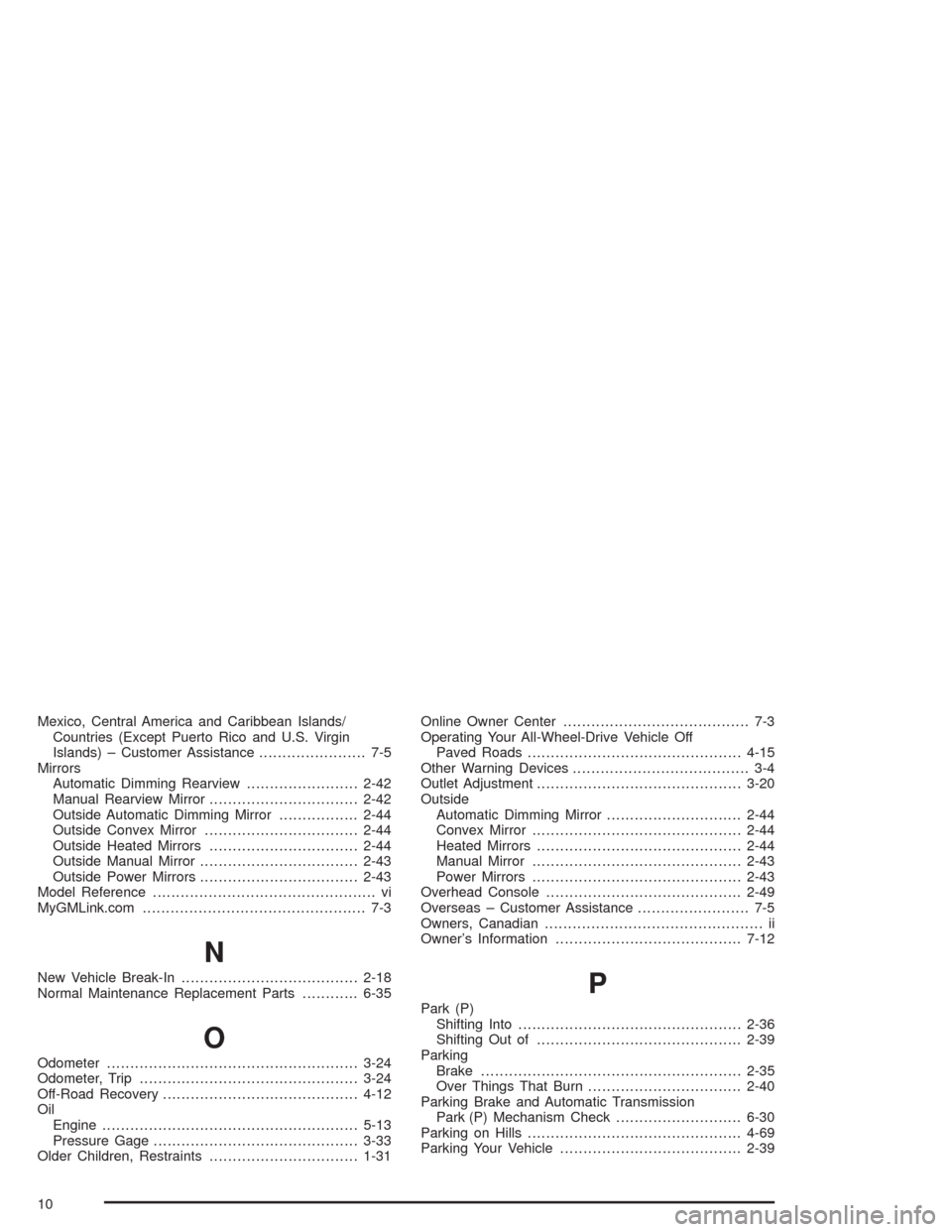
Mexico, Central America and Caribbean Islands/
Countries (Except Puerto Rico and U.S. Virgin
Islands) – Customer Assistance....................... 7-5
Mirrors
Automatic Dimming Rearview........................2-42
Manual Rearview Mirror................................2-42
Outside Automatic Dimming Mirror.................2-44
Outside Convex Mirror.................................2-44
Outside Heated Mirrors................................2-44
Outside Manual Mirror..................................2-43
Outside Power Mirrors..................................2-43
Model Reference................................................ vi
MyGMLink.com................................................ 7-3
N
New Vehicle Break-In......................................2-18
Normal Maintenance Replacement Parts............6-35
O
Odometer......................................................3-24
Odometer, Trip...............................................3-24
Off-Road Recovery..........................................4-12
Oil
Engine.......................................................5-13
Pressure Gage............................................3-33
Older Children, Restraints................................1-31Online Owner Center........................................ 7-3
Operating Your All-Wheel-Drive Vehicle Off
Paved Roads..............................................4-15
Other Warning Devices...................................... 3-4
Outlet Adjustment............................................3-20
Outside
Automatic Dimming Mirror.............................2-44
Convex Mirror.............................................2-44
Heated Mirrors............................................2-44
Manual Mirror.............................................2-43
Power Mirrors.............................................2-43
Overhead Console..........................................2-49
Overseas – Customer Assistance........................ 7-5
Owners, Canadian............................................... ii
Owner’s Information........................................7-12
P
Park (P)
Shifting Into................................................2-36
Shifting Out of............................................2-39
Parking
Brake........................................................2-35
Over Things That Burn.................................2-40
Parking Brake and Automatic Transmission
Park (P) Mechanism Check...........................6-30
Parking on Hills..............................................4-69
Parking Your Vehicle.......................................2-39
10