Page 201 of 334

A. Engine Air Cleaner/Filter. SeeEngine Air
Cleaner/Filter on page 5-20.
B. Engine Oil Fill Cap. See “When to Add Engine Oil”
underEngine Oil on page 5-15.
C. Engine Oil Dipstick. See “Checking Engine Oil”
underEngine Oil on page 5-15.
D. Brake Fluid Reservoir. See “Brake Fluid” under
Brakes on page 5-36.
E. Automatic Transaxle Dipstick. SeeAutomatic
Transaxle Fluid on page 5-21.
F. Engine Coolant Surge Tank. SeeCooling System on
page 5-28.
G. Engine Compartment Fuse Block. See “Engine
Compartment Fuse Block” underFuses and Circuit
Breakers on page 5-85.
H. Battery. SeeBattery on page 5-39.
I. Power Steering Fluid Reservoir. SeePower Steering
Fluid on page 5-34.
J. Windshield Washer Fluid Reservoir. SeeWindshield
Washer Fluid on page 5-35.Engine Oil
If the oil pressure light
appears on the instrument
cluster, it means you
need to check your engine
oil level right away.
For more information, seeOil Pressure Light on
page 3-32.
You should check your engine oil level regularly; this is
an added reminder.
Checking Engine Oil
It is a good idea to check your engine oil every time you
get fuel. In order to get an accurate reading, the oil
must be warm and the vehicle must be on level ground.
The engine oil dipstick handle is a yellow loop.
SeeEngine Compartment Overview on page 5-14for
the location of the engine oil dipstick.
Turn off the engine and give the oil several minutes to
drain back into the oil pan. If you do not do this, the
oil dipstick might not show the actual level.
Pull the dipstick and clean it with a paper towel or cloth,
then push it back in all the way. Remove it again,
keeping the tip down and check the level.
5-15
Page 218 of 334
{CAUTION:
You can be burned if you spill coolant on hot
engine parts. Coolant contains ethylene glycol
and it will burn if the engine parts are hot
enough. Do not spill coolant on a hot engine.
1. Park the vehicle on a level surface.
You can remove the coolant surge tank pressure
cap when the cooling system, including the coolant
surge tank pressure cap and upper radiator
hose, is no longer hot. Turn the pressure cap slowly
counterclockwise (left) about two or two and
one-half turns. If you hear a hiss, wait for that to
stop. This will allow any pressure still left to be
vented out the discharge hose.2. Then keep turning the pressure cap slowly, and
remove it.
5-32
Page 232 of 334
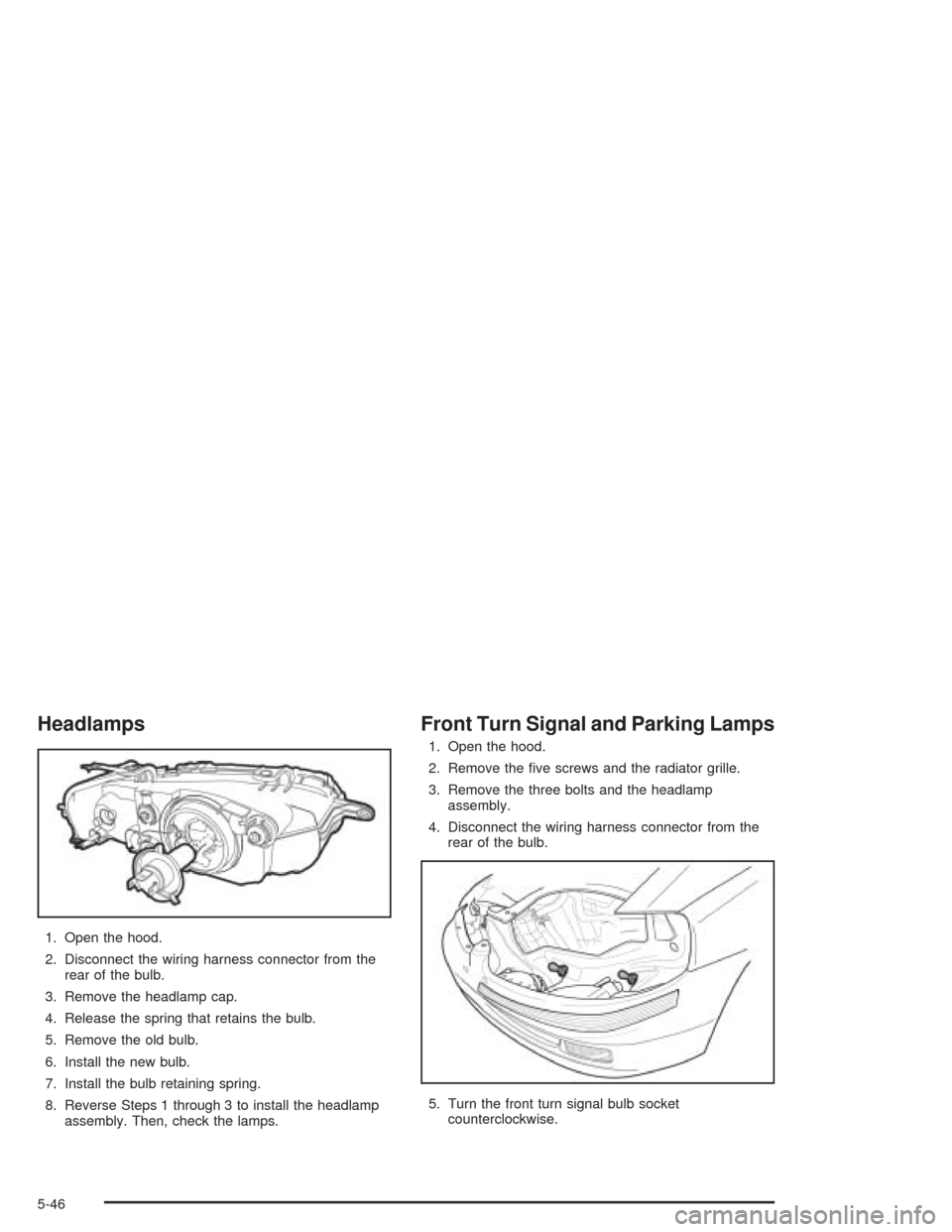
Headlamps
1. Open the hood.
2. Disconnect the wiring harness connector from the
rear of the bulb.
3. Remove the headlamp cap.
4. Release the spring that retains the bulb.
5. Remove the old bulb.
6. Install the new bulb.
7. Install the bulb retaining spring.
8. Reverse Steps 1 through 3 to install the headlamp
assembly. Then, check the lamps.
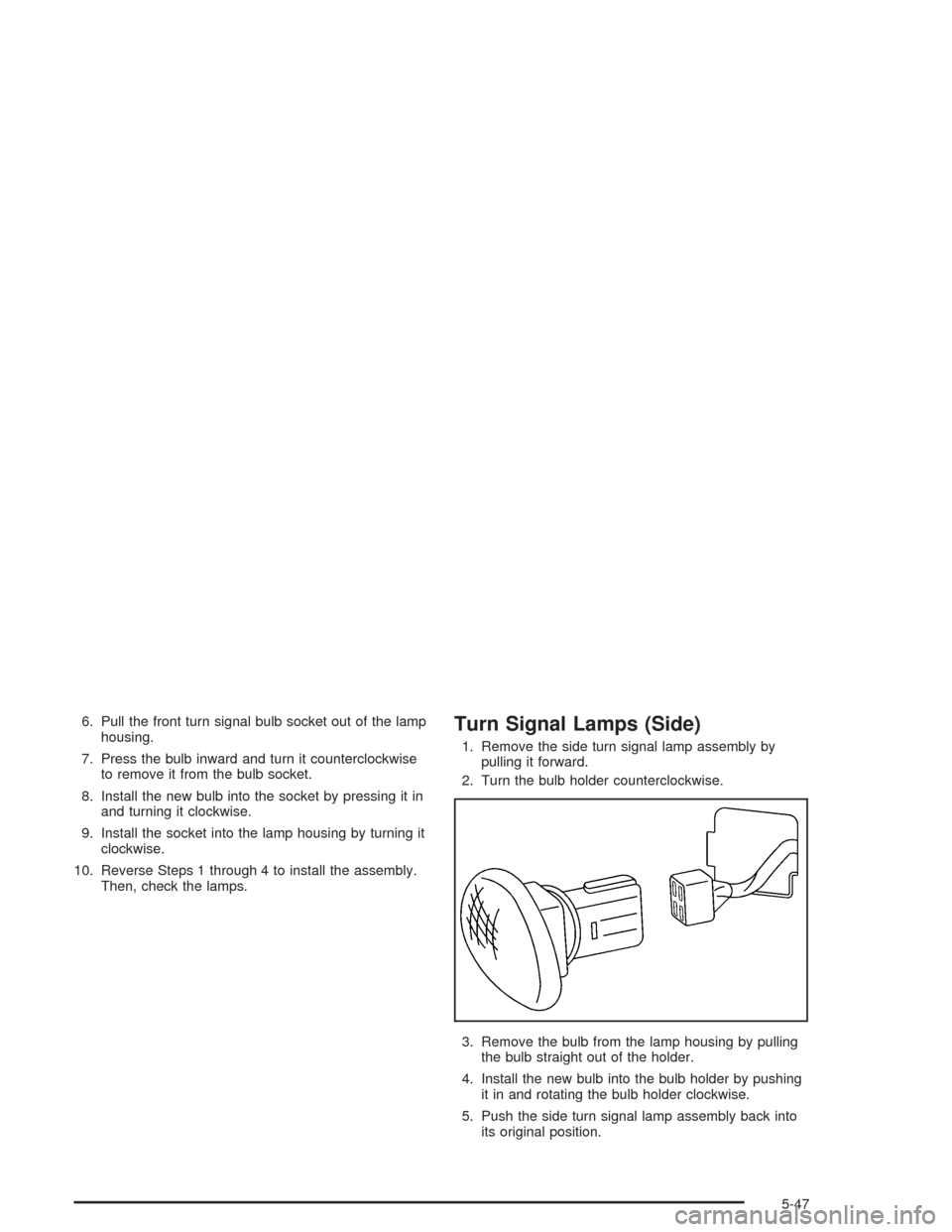
Front Turn Signal and Parking Lamps
1. Open the hood.
2. Remove the five screws and the radiator grille.
3. Remove the three bolts and the headlamp
assembly.
4. Disconnect the wiring harness connector from the
rear of the bulb.
5. Turn the front turn signal bulb socket
counterclockwise.
5-46
Page 233 of 334
6. Pull the front turn signal bulb socket out of the lamp
housing.
7. Press the bulb inward and turn it counterclockwise
to remove it from the bulb socket.
8. Install the new bulb into the socket by pressing it in
and turning it clockwise.
9. Install the socket into the lamp housing by turning it
clockwise.
10. Reverse Steps 1 through 4 to install the assembly.
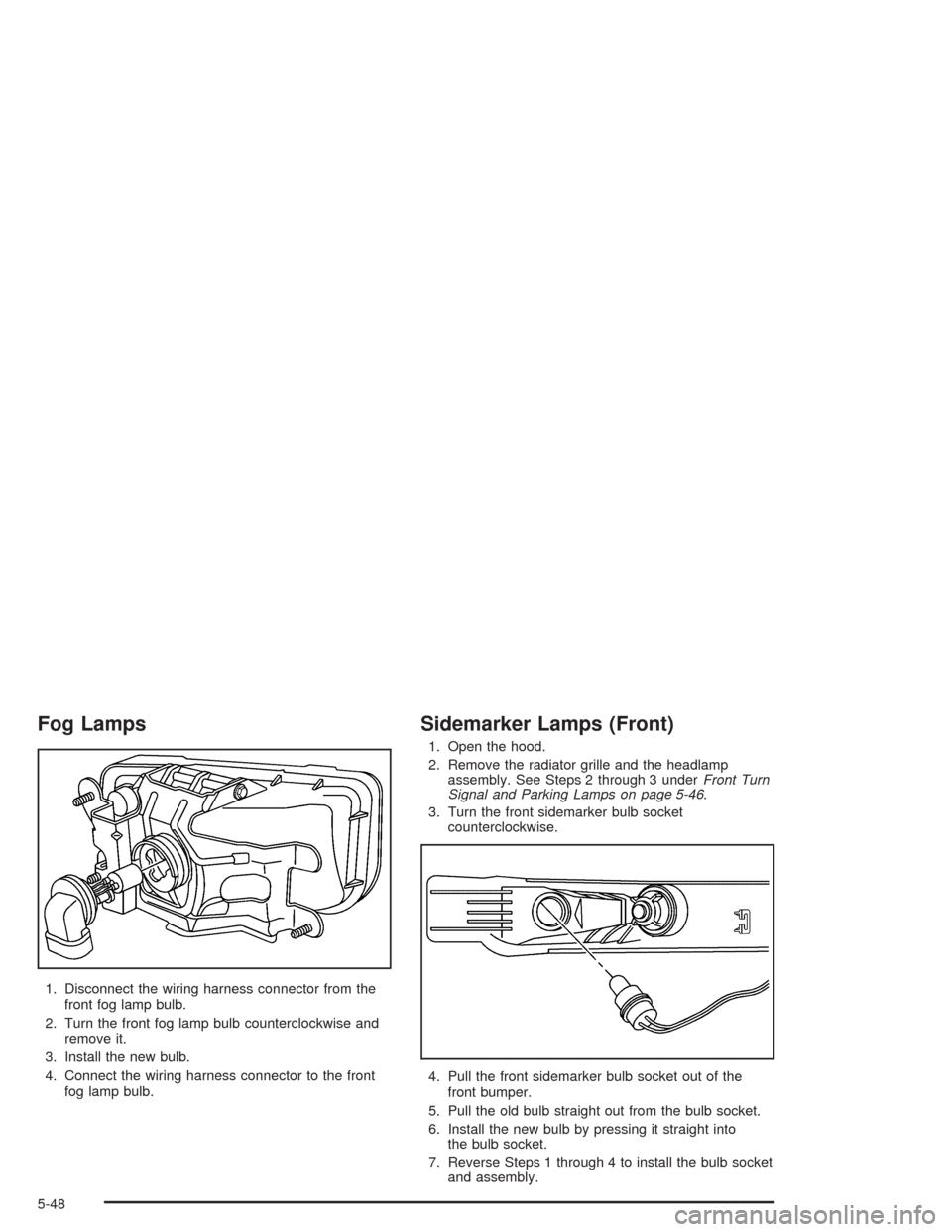
Then, check the lamps.Turn Signal Lamps (Side)
1. Remove the side turn signal lamp assembly by
pulling it forward.
2. Turn the bulb holder counterclockwise.
3. Remove the bulb from the lamp housing by pulling
the bulb straight out of the holder.
4. Install the new bulb into the bulb holder by pushing
it in and rotating the bulb holder clockwise.
5. Push the side turn signal lamp assembly back into
its original position.
5-47
Page 234 of 334
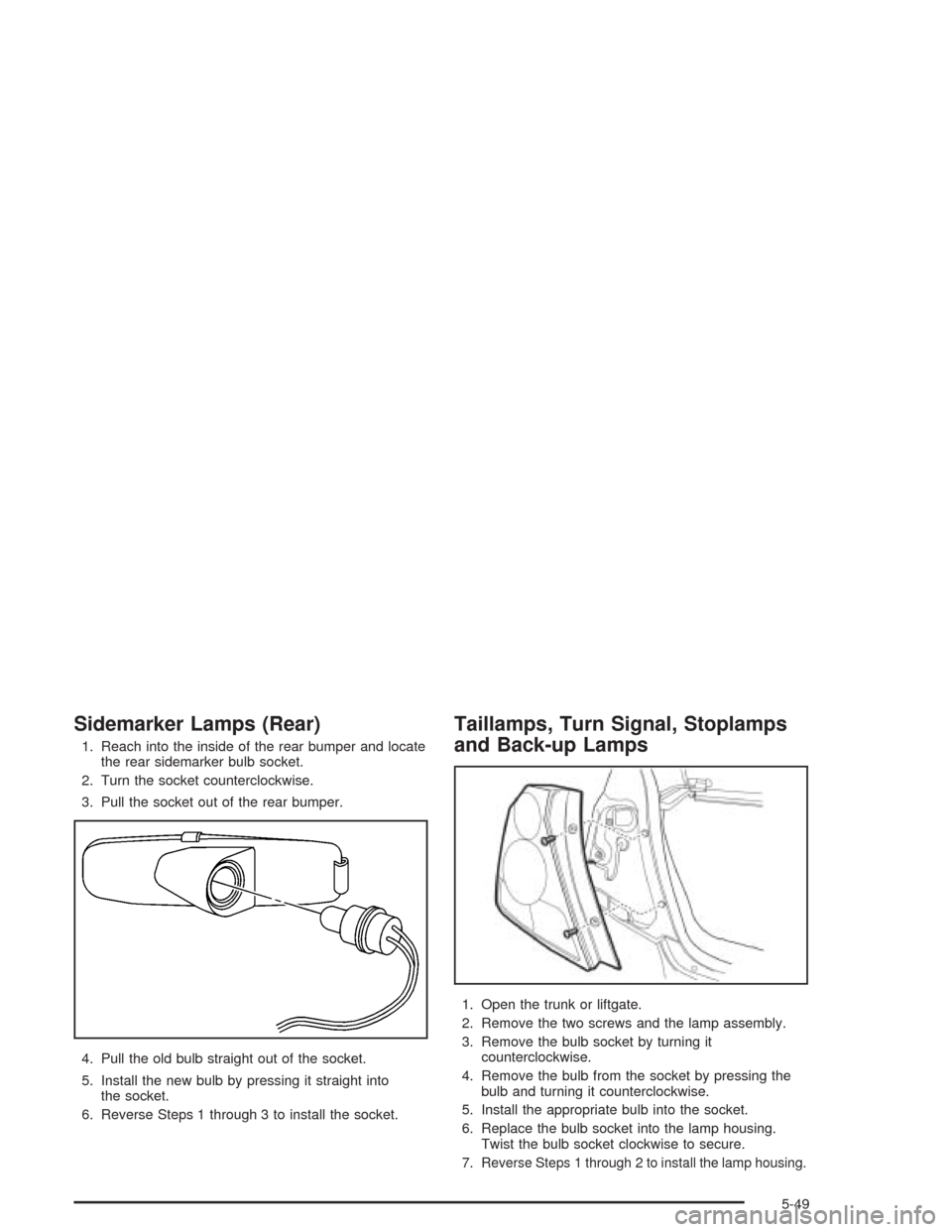
Fog Lamps
1. Disconnect the wiring harness connector from the
front fog lamp bulb.
2. Turn the front fog lamp bulb counterclockwise and
remove it.
3. Install the new bulb.
4. Connect the wiring harness connector to the front
fog lamp bulb.
Sidemarker Lamps (Front)
1. Open the hood.
2. Remove the radiator grille and the headlamp
assembly. See Steps 2 through 3 underFront Turn
Signal and Parking Lamps on page 5-46.
3. Turn the front sidemarker bulb socket
counterclockwise.
4. Pull the front sidemarker bulb socket out of the
front bumper.
5. Pull the old bulb straight out from the bulb socket.
6. Install the new bulb by pressing it straight into
the bulb socket.
7. Reverse Steps 1 through 4 to install the bulb socket
and assembly.
5-48
Page 235 of 334
Sidemarker Lamps (Rear)
1. Reach into the inside of the rear bumper and locate
the rear sidemarker bulb socket.
2. Turn the socket counterclockwise.
3. Pull the socket out of the rear bumper.
4. Pull the old bulb straight out of the socket.
5. Install the new bulb by pressing it straight into
the socket.
6. Reverse Steps 1 through 3 to install the socket.
Taillamps, Turn Signal, Stoplamps
and Back-up Lamps
1. Open the trunk or liftgate.
2. Remove the two screws and the lamp assembly.
3. Remove the bulb socket by turning it
counterclockwise.
4. Remove the bulb from the socket by pressing the
bulb and turning it counterclockwise.
5. Install the appropriate bulb into the socket.
6. Replace the bulb socket into the lamp housing.
Twist the bulb socket clockwise to secure.
7.
Reverse Steps 1 through 2 to install the lamp housing.
5-49
Page 253 of 334
Changing a Flat Tire
If a tire goes flat, avoid further tire and wheel damage
by driving slowly to a level place. Turn on your
hazard warning flashers.
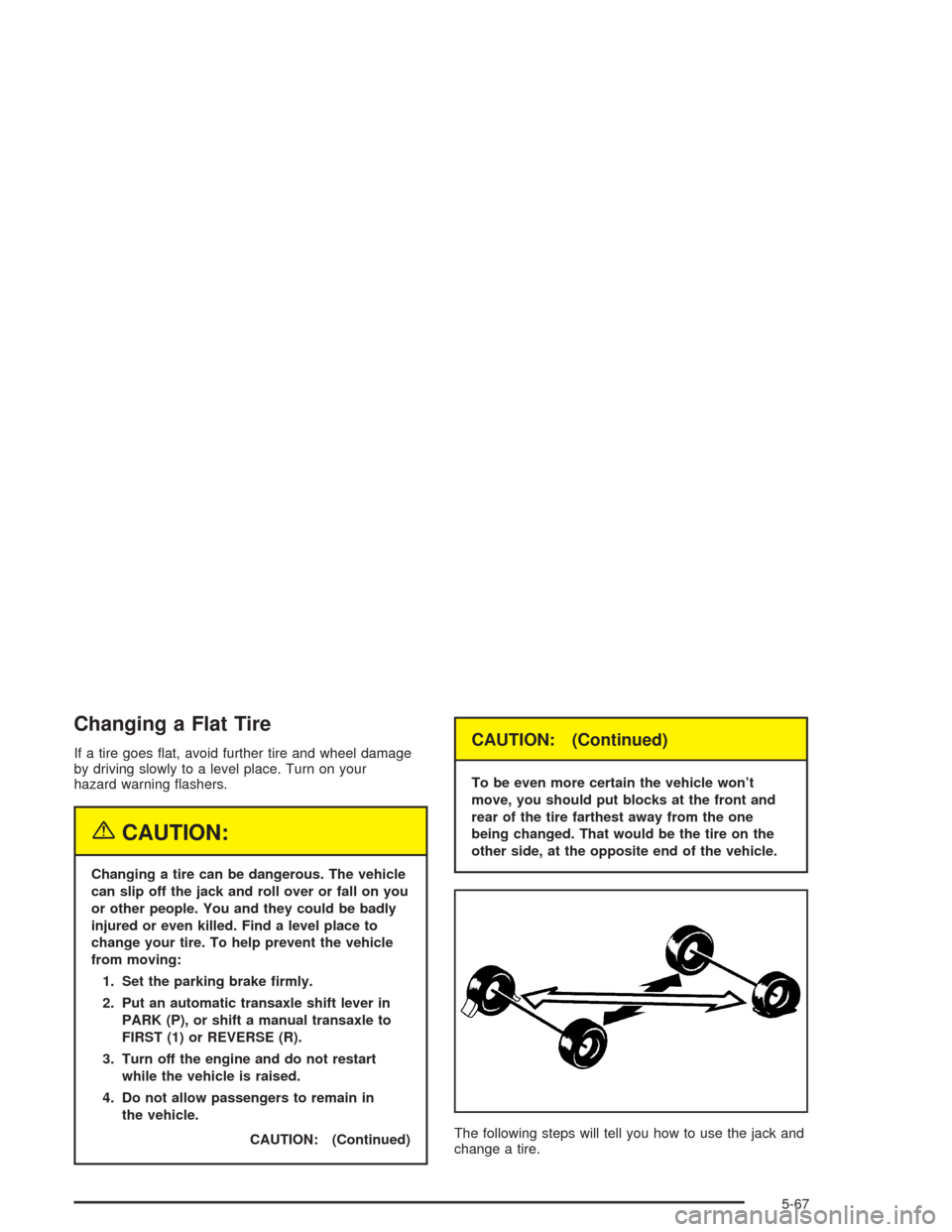
{CAUTION:
Changing a tire can be dangerous. The vehicle
can slip off the jack and roll over or fall on you
or other people. You and they could be badly
injured or even killed. Find a level place to
change your tire. To help prevent the vehicle
from moving:
1. Set the parking brake rmly.
2. Put an automatic transaxle shift lever in
PARK (P), or shift a manual transaxle to
FIRST (1) or REVERSE (R).
3. Turn off the engine and do not restart
while the vehicle is raised.
4. Do not allow passengers to remain in
the vehicle.
CAUTION: (Continued)
CAUTION: (Continued)
To be even more certain the vehicle won’t
move, you should put blocks at the front and
rear of the tire farthest away from the one
being changed. That would be the tire on the
other side, at the opposite end of the vehicle.
The following steps will tell you how to use the jack and
change a tire.
5-67
Page 255 of 334
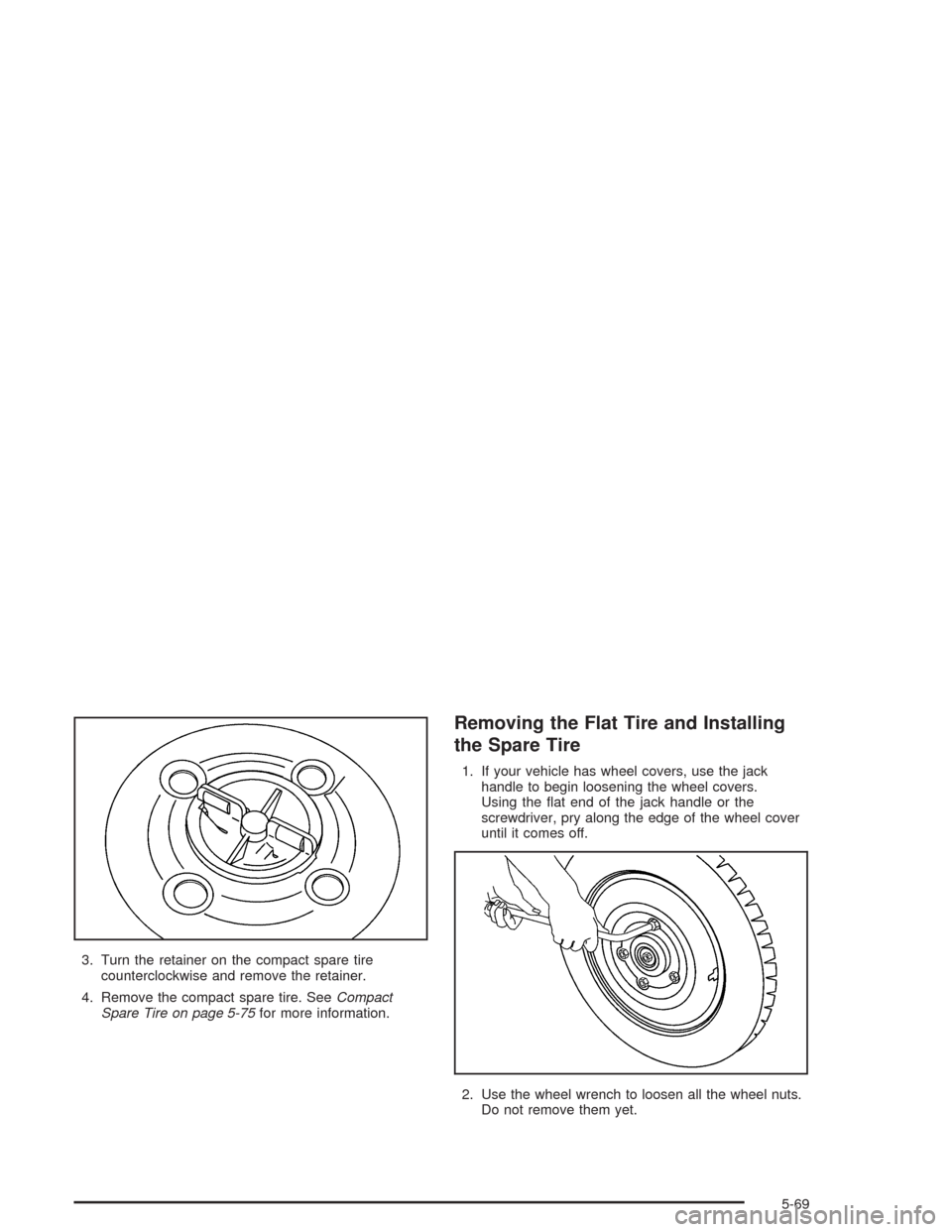
3. Turn the retainer on the compact spare tire
counterclockwise and remove the retainer.
4. Remove the compact spare tire. SeeCompact
Spare Tire on page 5-75for more information.
Removing the Flat Tire and Installing
the Spare Tire
1. If your vehicle has wheel covers, use the jack
handle to begin loosening the wheel covers.
Using the flat end of the jack handle or the
screwdriver, pry along the edge of the wheel cover
until it comes off.
2. Use the wheel wrench to loosen all the wheel nuts.
Do not remove them yet.
5-69