2004 CHEVROLET ASTRO mirror
[x] Cancel search: mirrorPage 190 of 382
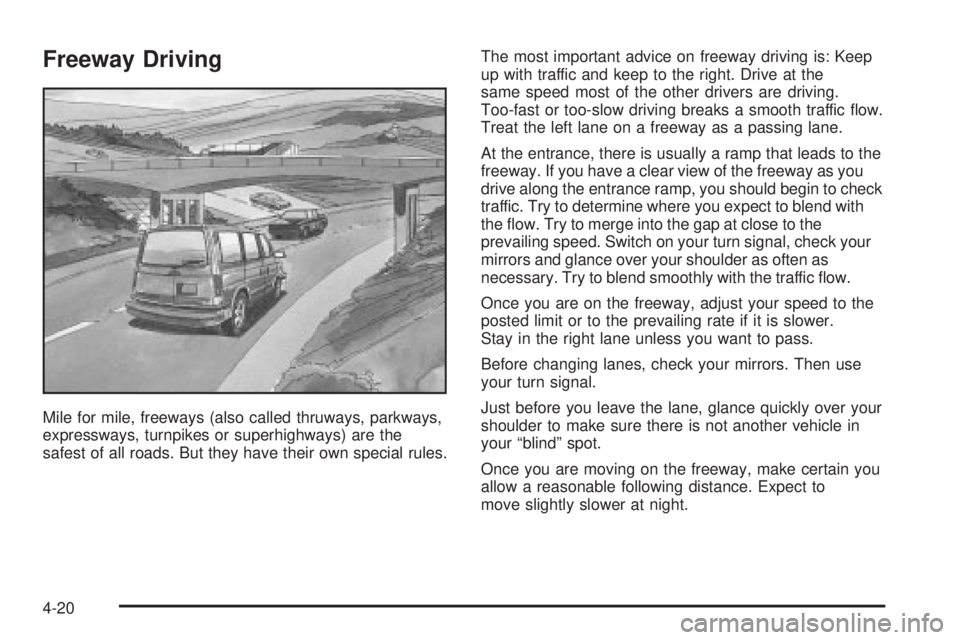
Freeway Driving
Mile for mile, freeways (also called thruways, parkways,
expressways, turnpikes or superhighways) are the
safest of all roads. But they have their own special rules.The most important advice on freeway driving is: Keep
up with traffic and keep to the right. Drive at the
same speed most of the other drivers are driving.
Too-fast or too-slow driving breaks a smooth traffic ¯ow.
Treat the left lane on a freeway as a passing lane.
At the entrance, there is usually a ramp that leads to the
freeway. If you have a clear view of the freeway as you
drive along the entrance ramp, you should begin to check
traffic. Try to determine where you expect to blend with
the ¯ow. Try to merge into the gap at close to the
prevailing speed. Switch on your turn signal, check your
mirrors and glance over your shoulder as often as
necessary. Try to blend smoothly with the traffic ¯ow.
Once you are on the freeway, adjust your speed to the
posted limit or to the prevailing rate if it is slower.
Stay in the right lane unless you want to pass.
Before changing lanes, check your mirrors. Then use
your turn signal.
Just before you leave the lane, glance quickly over your
shoulder to make sure there is not another vehicle in
your ªblindº spot.
Once you are moving on the freeway, make certain you
allow a reasonable following distance. Expect to
move slightly slower at night.
4-20
Page 192 of 382

Highway Hypnosis
Is there actually such a condition as ªhighway
hypnosisº? Or is it just plain falling asleep at the wheel?
Call it highway hypnosis, lack of awareness, or
whatever.
There is something about an easy stretch of road with
the same scenery, along with the hum of the tires on the
road, the drone of the engine, and the rush of the
wind against the vehicle that can make you sleepy. Do
not let it happen to you! If it does, your vehicle can
leave the road in
less than a second,and you could
crash and be injured.
What can you do about highway hypnosis? First, be
aware that it can happen.
Then here are some tips:
·Make sure your vehicle is well ventilated, with a
comfortably cool interior.
·Keep your eyes moving. Scan the road ahead and
to the sides. Check your mirrors and your
instruments frequently.
·If you get sleepy, pull off the road into a rest,
service or parking area and take a nap, get some
exercise, or both. For safety, treat drowsiness
on the highway as an emergency.
Hill and Mountain Roads
Driving on steep hills or mountains is different from
driving in ¯at or rolling terrain.
4-22
Page 211 of 382

Driving with a Trailer
{CAUTION:
If you have a rear-most window open and you
pull a trailer with your vehicle, carbon
monoxide (CO) could come into your vehicle.
You can not see or smell CO. It can cause
unconsciousness or death. See
Engine
Exhaust on page 2-26
. To maximize your safety
when towing a trailer:
·Have your exhaust system inspected for
leaks, and make necessary repairs before
starting on your trip.
·Keep the rear-most windows closed.
·If exhaust does come into your vehicle
through a window in the rear or another
opening, drive with your front, main
heating or cooling system on and with the
fan on any speed. This will bring fresh,
outside air into your vehicle. Do not use
the climate control setting for maximum air
because it only recirculates the air inside
your vehicle. See Climate Control System
in the Index.Towing a trailer requires a certain amount of experience.
Before setting out for the open road, you'll want to get
to know your rig. Acquaint yourself with the feel of
handling and braking with the added weight of the trailer.
And always keep in mind that the vehicle you are
driving is now a good deal longer and not nearly as
responsive as your vehicle is by itself.
Before you start, check the trailer hitch and platform
(and attachments), safety chains, electrical connector,
lamps, tires and mirror adjustment. If the trailer has
electric brakes, start your vehicle and trailer moving and
then apply the trailer brake controller by hand to be
sure the brakes are working. This lets you check your
electrical connection at the same time.
During your trip, check occasionally to be sure that the
load is secure, and that the lamps and any trailer
brakes are still working.Following Distance
Stay at least twice as far behind the vehicle ahead as
you would when driving your vehicle without a trailer.
This can help you avoid situations that require
heavy braking and sudden turns.
4-41
Page 312 of 382

Fuse/Circuit
Breaker Usage
3 Courtesy Lamps, Glove Box Lamp,
Dome Reading Lamps, Vanity Mirror
Lamps, Courtesy Lamps
4 Daytime Running Lamps Relay,
Instrument Panel Cluster
5 Rear Defogger
6 Cruise Module, Truck Body Control
Module, Instrument Panel Cluster,
Cruise Control Switch,
Electrochromic Mirror
7 Power Outlets, Subwoofer Ampli®er
8 Crank Circuit Fuse, Park/Neutral
Switch, Starter Enabler Relay
9 License Plate Lamp, Tailamps,
Parking Lamps, Ashtray Lamp,
Panel Lights, Trailer Taillamps, Front
and Rear Sidemarker Lamps, Door
Switch Illumination, Headlamp
Switch Illumination, Rear Seat Audio
Illumination, Truck Body Control
Module
10 Air Bag System
11 Not UsedFuse/Circuit
Breaker Usage
12 Blower Motor, Rear Air Conditioning
Relay Coil, Front Cont. Temp. Door
Motor, HI Blower Relay, Defogger
Timer Coil
13 Cigarette Lighter, Door Lock
Switches, Dutch Door Release
Module
14 Cluster Illumination, Climate
Controls, Chime Module, Radio
Illumination, Rear Heat Switch
Illumination, Rear Wiper/Washer
Switch Illumination, Rear Liftgate
Switch Illumination, Remote
Cassette Illumination, Overhead
Console, Truck Body Control
Illumination
15 Truck Body Module, Headlamp
Relay
16 Front Turn Signals, Rear Turn
Signals, Trailer Turn Signals,
Back-Up Lamps, Brake
Transmission Shift Interlock Solenoid
17 Front Wipers, Front Washer Pump
5-98
Page 313 of 382

Fuse/Circuit
Breaker Usage
18 VCM-Ign 3, VCM-Brake, Cruise
Stepper Motor Signal, ATC Module
19 Instrument Panel Radio: ATC (Main
Feed), 2000 Series (Standby)
20 PRNDL/Odometer, Shift A and Shift
B Solenoids, 3±2 Downshift
Solenoid, Instrument Panel Cluster,
VCM Module
21 Powr Adjust Mirrors
22 Not Used
23 Rear Wiper, Rear Washer Pump
24 Not Used
A (Circuit Breaker) Power Door Lock
Relay, 6±Way Power Seats
B (Circuit Breaker) Power WindowsUnderhood Fuse Block
The underhood fuse block is located toward the rear of
the engine compartment on the driver's side of the
vehicle.
Lift the hood and open the cover to gain access to this
fuse block.
A fuse puller is included in the underhood fuse block.
You will also ®nd spare fuses.
5-99
Page 315 of 382

Fuse/Circuit
BreakerUsage
A/C COMPAir Conditioning Enable Relay and
Compressor
RR HTR/AC Rear Heater and Air Conditioning
ATC Active Transfer Case-L Van
FRT HVAC Front Heater and Air Conditioning
ENG-IOxygen Sensors, Camshaft Position
Sensor, Mass Air Flow Sensor,
Evaporative Emission Canister Vent
Solenoid
IGN-E Air Conditioning Enable Relay Coil
ECM-IFuel Injectors 1±6, Crankshaft
Position Sensot, VCM, Coil Driver
Module (EST), Ignition Coil
Blank Not Used
RH HDLMP Right Headlamp
LH Headlamp Left Headlamp
Blank Not Used
Blank Not UsedFuse/Circuit
BreakerUsage
DIODE-1 Air Conditioning
Blank Not Used
Blank Not Used
Blank Not Used
LIGHTINGCourtesy Fuse, Power Adjust
Mirrors Fuse, Truck Body Control
Battery Fuse
BATTPower Accessory Circuit Breaker,
Stop/Hazard Fuse, Auxiliary Power
Fuse, Cigarette Lighter Fuse, Radio
Battery Fuse
IGN A Starter Relay, Ignition Switch
IGN B Ignition Switch
ABSElectronic Brake
Control Module
Blank Not Used
RAP Radio Accessory, Power Windows
HTD MIR/RR
DEFOGRear Window Defogger,Climate
Control Head
5-101
Page 376 of 382

Manual Seats................................................... 1-2
Manual Windows............................................2-14
Matching Transmitter(s) to Your Vehicle............... 2-4
Mexico, Central America and Caribbean Islands/
Countries (Except Puerto Rico and U.S. Virgin
Islands) ± Customer Assistance....................... 7-5
Mirrors
Manual Rearview Mirror................................2-30
Outside Convex Mirror.................................2-31
Outside Manual Mirror..................................2-30
Outside Power Mirrors..................................2-30
Model Reference................................................ vi
MyGMLink.com................................................ 7-3
N
New Vehicle Break-In......................................2-17
Normal Maintenance Replacement Parts...........5-104
O
Odometer......................................................3-25
Off-Road Recovery..........................................4-11
Oil
Engine.......................................................5-13
Pressure Gage............................................3-34Older Children, Restraints................................1-35
Online Owner Center........................................ 7-3
Operation Tips................................................3-20
Other Warning Devices...................................... 3-5
Outlet Adjustment............................................3-20
Outside
Convex Mirror.............................................2-31
Manual Mirror.............................................2-30
Power Mirrors.............................................2-30
Overhead Console..........................................2-36
Overseas ± Customer Assistance........................ 7-4
Owners, Canadian............................................... ii
Owner's Information........................................7-12
P
Park (P)
Shifting Into................................................2-25
Shifting Out of............................................2-27
Parking
Brake........................................................2-24
Over Things That Burn.................................2-28
Parking Brake and Automatic Transmission
Park (P) Mechanism Check...........................6-27
Parking on Hills..............................................4-43
Part A - Scheduled Maintenance Services............ 6-4
Part B - Owner Checks and Services................6-24
10
Page 377 of 382

Part C - Periodic Maintenance Inspections..........6-28
Part D - Recommended Fluids and Lubricants....6-30
Part E - Maintenance Record...........................6-32
Passenger Van Models....................................1-51
Passing.................................................4-12, 4-42
Passlock
ž......................................................2-16
Payload.........................................................4-35
Plan Ahead When Possible................................ 7-7
Playing a CD.................................................3-43
Playing the Radio...................................3-39, 3-41
Power
Accessory Outlets........................................3-16
Door Locks.................................................. 2-7
Electrical System.........................................5-96
Seat............................................................ 1-3
Steering Fluid.............................................5-37
Windows....................................................2-15
Power Steering................................................ 4-9
Programmable Automatic Door Locks.................. 2-7
Programming the HomeLink
žTransmitter...........2-31
Q
Questions and Answers About Safety Belts.........1-17
R
Radiator Pressure Cap....................................5-27
Radios..........................................................3-38AM-FM Radio.............................................3-39
Care of Your CD Player...............................3-50
Care of Your CDs........................................3-50
Radio with CD............................................3-41
Rear Seat Audio..........................................3-46
Setting the Time for Radios with HR and
MN Buttons.............................................3-38
Setting the Time for Radios with the
Set Button..............................................3-38
Theft-Deterrent............................................3-47
Understanding Reception..............................3-50
Reading Lamps..............................................2-36
Rear Air Conditioning System...........................3-21
Rear Axle......................................................5-48
Locking........................................................ 4-9
Rear Doors....................................................2-11
Rear Heating System......................................3-21
Rear Safety Belt Comfort Guides......................1-32
Rear Seat Audio (RSA)....................................3-46
Rear Seat Operation......................................... 1-7
Rear Seat Outside Passenger Positions.............1-29
Rear Seat Passengers, Safety Belts..................1-29
Rear Window Defogger....................................3-19
Rearview Mirrors.............................................2-30
Reclining Seatbacks.......................................... 1-4
Recreational Vehicle Towing.............................4-29
Reinstalling the Engine Cover...........................5-21
Remote Keyless Entry System, Operation............ 2-4
Removing the Engine Cover.............................5-17
11