Page 289 of 382
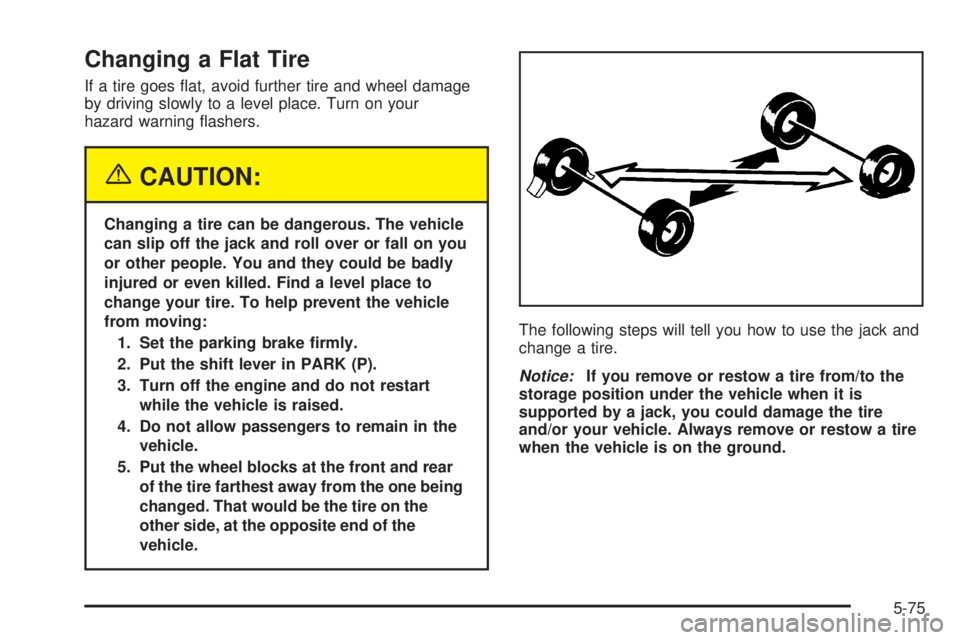
Changing a Flat Tire
If a tire goes ¯at, avoid further tire and wheel damage
by driving slowly to a level place. Turn on your
hazard warning ¯ashers.
{CAUTION:
Changing a tire can be dangerous. The vehicle
can slip off the jack and roll over or fall on you
or other people. You and they could be badly
injured or even killed. Find a level place to
change your tire. To help prevent the vehicle
from moving:
1. Set the parking brake ®rmly.
2. Put the shift lever in PARK (P).
3. Turn off the engine and do not restart
while the vehicle is raised.
4. Do not allow passengers to remain in the
vehicle.
5. Put the wheel blocks at the front and rear
of the tire farthest away from the one being
changed. That would be the tire on the
other side, at the opposite end of the
vehicle.The following steps will tell you how to use the jack and
change a tire.
Notice:If you remove or restow a tire from/to the
storage position under the vehicle when it is
supported by a jack, you could damage the tire
and/or your vehicle. Always remove or restow a tire
when the vehicle is on the ground.
5-75
Page 309 of 382

Vehicle Identi®cation
Vehicle Identi®cation Number (VIN)
This is the legal identi®er for your vehicle. It appears on
a plate in the front corner of the instrument panel, on
the driver's side. You can see it if you look through the
windshield from outside your vehicle. The VIN also
appears on the Vehicle Certi®cation and Service Parts
labels and the certi®cates of title and registration.
Engine Identi®cation
The 8th character in your VIN is the engine code. This
code will help you identify your engine, speci®cations
and replacement parts.
Service Parts Identi®cation Label
You'll ®nd this label on the front passenger door frame.
It's very helpful if you ever need to order parts. On
this label is:
·your VIN,
·the model designation,
·paint information and
·a list of all production options and special
equipment.
Be sure that this label is not removed from the vehicle.
Electrical System
Add-On Electrical Equipment
Notice:Don't add anything electrical to your
vehicle unless you check with your dealer ®rst.
Some electrical equipment can damage your vehicle
and the damage wouldn't be covered by your
warranty. Some add-on electrical equipment can
keep other components from working as they
should.
Your vehicle has an air bag system. Before attempting
to add anything electrical to your vehicle, see
Servicing Your Air Bag-Equipped Vehicle on page 1-69.
5-95
Page 310 of 382

Headlamp Wiring
The headlamp wiring is protected by a circuit breaker in
the lamp switch. An electrical overload will cause the
lamps to ¯icker on and off, or in some cases to remain
off. If this happens, have your headlamp wiring
checked right away.
Windshield Wiper Fuses
The windshield wiper motor is protected by a circuit
breaker and a fuse. If the motor overheats due to heavy
snow, etc., the wiper will stop until the motor cools.
Although the circuit is protected from electrical overload,
overload due to heavy snow, etc., may cause wiper
linkage damage. Always clear ice and heavy snow from
the windshield before using the windshield wipers. If
the overload is caused by some electrical problem and
not snow, etc., be sure to get it ®xed.
Power Windows and Other Power
Options
Circuit breakers in the fuse panel protect the power
windows and other power accessories. When the current
load is too heavy, the circuit breaker opens and
closes, protecting the circuit until the problem is ®xed or
goes away.
Fuses and Circuit Breakers
The wiring circuits in your vehicle are protected from
short circuits by a combination of fuses, circuit breakers
and fusible thermal links. This greatly reduces the
chance of ®res caused by electrical problems.
Look at the silver-colored band inside the fuse. If the
band is broken or melted, replace the fuse. Be sure you
replace a bad fuse with a new one of the identical
size and rating.
Spare fuses and a fuse puller are located in the
underhood fuse block. You can remove fuses with the
fuse puller. Remember to replace any of the spare fuses
you use, so you will have some if you ever need them
again.
If you ever have a problem on the road and don't have
a spare fuse, you can borrow one that has the same
amperage. Just pick some feature of your vehicle
that you can get along without ± like the radio or
cigarette lighter ± and use its fuse, if it is the correct
amperage. Replace it as soon as you can.
There are two fuse blocks in your vehicle: one is inside
the vehicle and one is in the engine compartment.
5-96
Page 313 of 382
Fuse/Circuit
Breaker Usage
18 VCM-Ign 3, VCM-Brake, Cruise
Stepper Motor Signal, ATC Module
19 Instrument Panel Radio: ATC (Main
Feed), 2000 Series (Standby)
20 PRNDL/Odometer, Shift A and Shift
B Solenoids, 3±2 Downshift
Solenoid, Instrument Panel Cluster,
VCM Module
21 Powr Adjust Mirrors
22 Not Used
23 Rear Wiper, Rear Washer Pump
24 Not Used
A (Circuit Breaker) Power Door Lock
Relay, 6±Way Power Seats
B (Circuit Breaker) Power WindowsUnderhood Fuse Block
The underhood fuse block is located toward the rear of
the engine compartment on the driver's side of the
vehicle.
Lift the hood and open the cover to gain access to this
fuse block.
A fuse puller is included in the underhood fuse block.
You will also ®nd spare fuses.
5-99
Page 316 of 382
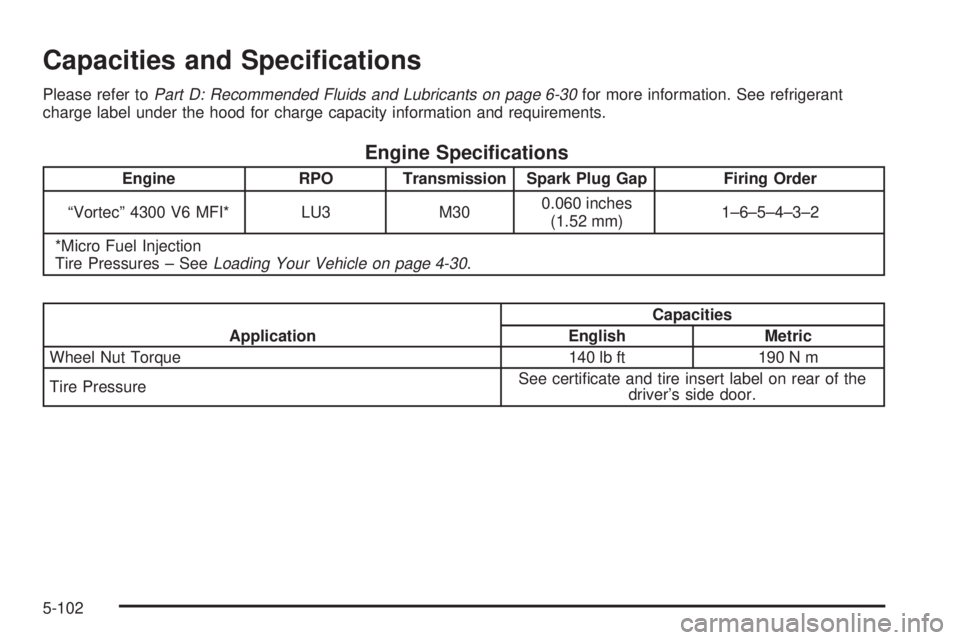
Capacities and Speci®cations
Please refer toPart D: Recommended Fluids and Lubricants on page 6-30for more information. See refrigerant
charge label under the hood for charge capacity information and requirements.
Engine Speci®cations
Engine RPO Transmission Spark Plug Gap Firing Order
ªVortecº 4300 V6 MFI* LU3 M300.060 inches
(1.52 mm)1±6±5±4±3±2
*Micro Fuel Injection
Tire Pressures ± See
Loading Your Vehicle on page 4-30.
ApplicationCapacities
English Metric
Wheel Nut Torque 140 lb ft 190 N m
Tire PressureSee certi®cate and tire insert label on rear of the
driver's side door.
5-102
Page 317 of 382
Capacities and Speci®cations
ApplicationCapacities
English Metric
Cooling Capacities
Quantity without Rear Heater
Quantity with Rear Heater13.5 quarts
16.5 quarts12.8 L
15.6 L
Engine Oil with Filter 4.5 quarts 4.3 L
Fuel Tank 27.0 gallons 101.8 L
Transmission Fluid (Drain and Re®ll) 5.0 quarts 4.7 L
Differential Fluid
Front Axle
Rear Axle2.6 pints
3.5 pints1.2 L
1.7 L
Refrigerant Type 134a
Front A/C
Front and Rear A/C2.25 lbs.
3.0 lbs.1.02 kg
1.36 kg
All capacities are approximate. When adding, be sure to ®ll to the appropriate level, as recommended in this
manual. recheck the ¯uid level after ®lling. See
Part D: Recommended Fluids and Lubricants on page 6-30for
more information.
5-103
Page 318 of 382
Normal Maintenance Replacement Parts
Replacement parts identi®ed below by name, part number, or speci®cation can be obtained from your dealer.
PartEngine (VIN Code) GM Part Number ACDelcožPart Number
Engine Air Cleaner/Filter 25098463 A1163C
Engine Oil Filter 25010792 PF47
Fuel Filter 15050894 GF481
PCV Valve 6487532 CV 769-C
Spark Plugs 25162556 41±932
Wiper Blades
Front
Rear22110158
22154396Ð
Ð
Wiper Blade Length
Front
Rear18 inches (45.7 cm)
14 inches (35.5 cm)
Wiper Blade Type Trico
5-104
Page 319 of 382
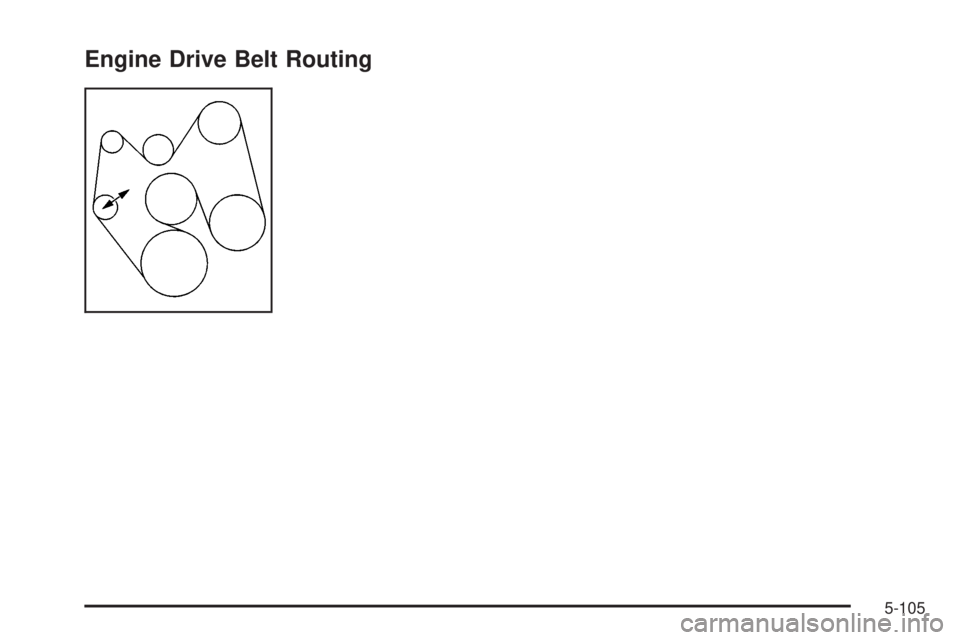
Engine Drive Belt Routing
5-105