2004 CADILLAC SEVILLE display
[x] Cancel search: displayPage 286 of 410
Adding Coolant
If you need more coolant, add the proper DEX-COOL®
coolant mixtureat the surge tank, but only when the
engine is cool.
{CAUTION:
You can be burned if you spill coolant on hot
engine parts. Coolant contains ethylene glycol,
and it will burn if the engine parts are hot
enough. Do not spill coolant on a hot engine.
When replacing the pressure cap, make sure it is
hand-tight.
Coolant Surge Tank Pressure Cap
Notice:If the pressure cap is not tightly installed,
coolant loss and possible engine damage may
occur. Be sure the cap is properly and tightly
secured.
Engine Overheating
You will find an ENGINE COOLANT HOT, IDLE
ENGINE message or an ENGINE OVERHEATED,
STOP ENGINE message displayed in the Driver
Information Center (DIC). You will also hear a chime.
There is also an engine temperature warning light and/or
gage on the instrument panel cluster. SeeEngine
Coolant Temperature Warning Light on page 3-45and
Engine Coolant Temperature Gage on page 3-45.
Overheated Engine Protection
Operating Mode
If an overheated engine condition exists and the
message ENGINE OVERHEATED, STOP ENGINE is
displayed, an overheat protection mode which alternates
firing groups of cylinders helps prevent engine damage.
In this mode, you will notice a loss in power and
engine performance. This operating mode allows your
vehicle to be driven to a safe place in an emergency;
you may drive up to 50 miles (80 km). Driving extended
miles (km) and/or towing a trailer in the overheat
protection mode should be avoided.
5-26
Page 298 of 410
Brakes
Brake Fluid
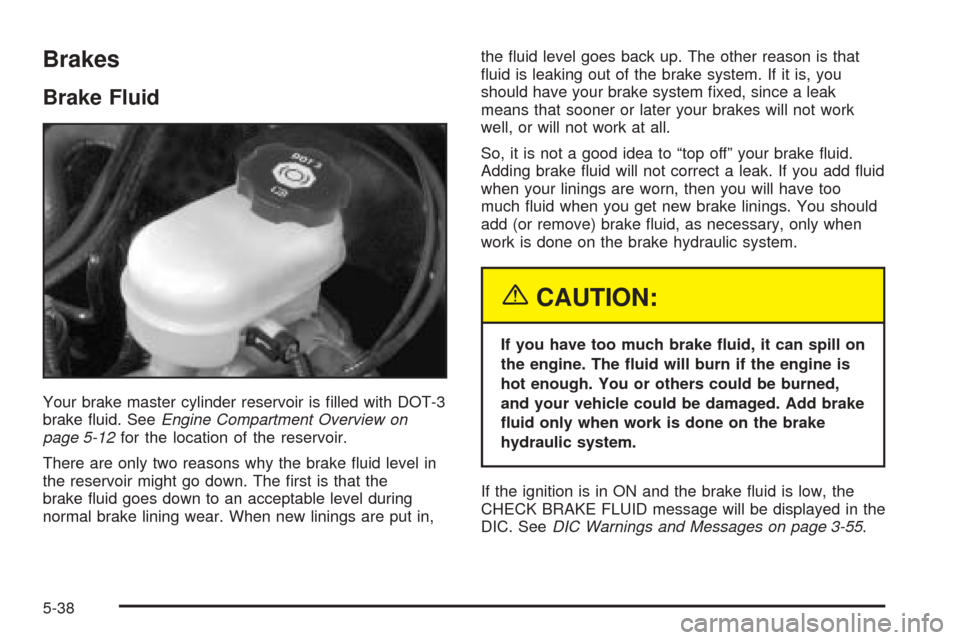
Your brake master cylinder reservoir is filled with DOT-3
brake fluid. SeeEngine Compartment Overview on
page 5-12for the location of the reservoir.
There are only two reasons why the brake fluid level in
the reservoir might go down. The first is that the
brake fluid goes down to an acceptable level during
normal brake lining wear. When new linings are put in,the fluid level goes back up. The other reason is that
fluid is leaking out of the brake system. If it is, you
should have your brake system fixed, since a leak
means that sooner or later your brakes will not work
well, or will not work at all.
So, it is not a good idea to “top off” your brake fluid.
Adding brake fluid will not correct a leak. If you add fluid
when your linings are worn, then you will have too
much fluid when you get new brake linings. You should
add (or remove) brake fluid, as necessary, only when
work is done on the brake hydraulic system.
{CAUTION:
If you have too much brake fluid, it can spill on
the engine. The fluid will burn if the engine is
hot enough. You or others could be burned,
and your vehicle could be damaged. Add brake
fluid only when work is done on the brake
hydraulic system.
If the ignition is in ON and the brake fluid is low, the
CHECK BRAKE FLUID message will be displayed in the
DIC. SeeDIC Warnings and Messages on page 3-55.
5-38
Page 329 of 410
How to Check
Use a good quality pocket-type gage to check tire
pressure. You can’t tell if your tires are properly inflated
simply by looking at them. Radial tires may look
properly inflated even when they’re underinflated. Check
tire inflation pressure when the tire is cold. Cold
means your vehicle has been sitting for at least three
hours or driven no more than 1 mile (1.6 km).
Remove the valve cap from the tire valve stem. Press
the tire gage firmly onto the valve to get a pressure
measurement. If the cold tire inflation pressure matches
the recommended pressure on the Tire and Loading
Information label, no further adjustment is necessary. If
the inflation pressure is low, add air until you reach
the recommended amount.
If you overfill the tire, release air by pushing on the
metal stem in the center of the tire valve. Recheck the
tire pressure with the tire gage.
Be sure to put the valve caps back on the valve stems.
They help prevent leaks by keeping out dirt and
moisture.Your vehicle has a Tire Pressure Monitor (TPM) that
sends tire pressure information to the Driver Information
Center (DIC). Using the DIC control buttons, the
driver is able to check tire pressure levels in all four
road tires. SeeTire Pressure Monitor Operation
on page 5-69andDIC Controls and Displays on
page 3-52for additional information.
Tire Pressure Monitor Operation
Your vehicle may have a Tire Pressure Monitor
System (TPM). The TPM system uses radio and sensor
technology to check tire pressure levels. Sensors,
mounted on each road wheel, transmit tire pressure
readings to a receiver located in the trunk. Tire pressure
status and tire pressure warnings are shown on the
Driver Information Center (DIC) display. SeeDriver
Information Center (DIC) on page 3-52, for details
regarding DIC controls and displays.
The system operates on a radio frequency subject to
Federal Communications Commission (FCC) Rules and
with Industry and Science Canada.
5-69
Page 330 of 410
This device complies with Part 15 of the FCC Rules.
Operation is subject to the following two conditions:
(1) this device may not cause harmful interference, and
(2) this device must accept any interference received,
including interference that may cause undesired
operation.
This device complies with RSS-210 of Industry and
Science Canada. Operation is subject to the following
two conditions: (1) this device may not cause
interference, and (2) this device must accept any
interference received, including interference that may
cause undesired operation of the device.
Changes or modifications to this system by anyone
other than an authorized service facility could void
authorization to use this equipment.
If the TPM system detects low tire pressure, below
25 psi (172 kPa), or high tire pressure, above 38 psi
(262 kPa), a message, CHECK TIRE PRESSURE, will
appear on the Driver Information Center (DIC)
display. By pressing the INFO button, the DIC screen
will show which tire(s) has the low or high pressure
condition. SeeInation - Tire Pressure on page 5-68for
information regarding correct tire inflation. If a tire is
low, you should stop as soon as possible and check all
your tires for damage. If a tire is flat, seeIf a Tire
Goes Flat on page 5-77.Notice:Do not use a tire sealant if your vehicle is
equipped with Tire Pressure Monitors. The liquid
sealant can damage the tire pressure monitor
sensors.
Once a low or high tire pressure condition is detected,
the TPM system will display the CHECK TIRE
MESSAGE each time the engine is started, until the
tire(s) are set to the correct inflation pressure.
The Tire-Loading Information Label, which is located on
the rear edge of the driver’s door, shows the correct
inflation pressure for the tires on your vehicle.
The TPM system also allows the driver to check the air
pressure status of each road tire using the Driver
Information Center (DIC). Each tire’s air pressure will be
listed individually, in the following order: LF (left front
or driver’s side front tire), RF (right front or passenger’s
side front tire), RR (right rear or passenger’s side
rear tire) and LR (left rear or driver’s side rear tire). See
Ination - Tire Pressure on page 5-68for information
regarding correct tire inflation. Also, seeDriver
Information Center (DIC) on page 3-52for information
on the DIC controls and displays.
If the DIC display does not show tire pressures or the
SERVICE TPM SYSTEM message appears, see
your dealer for service. The TPM system may not work
properly while the compact spare tire is installed.
5-70
Page 376 of 410
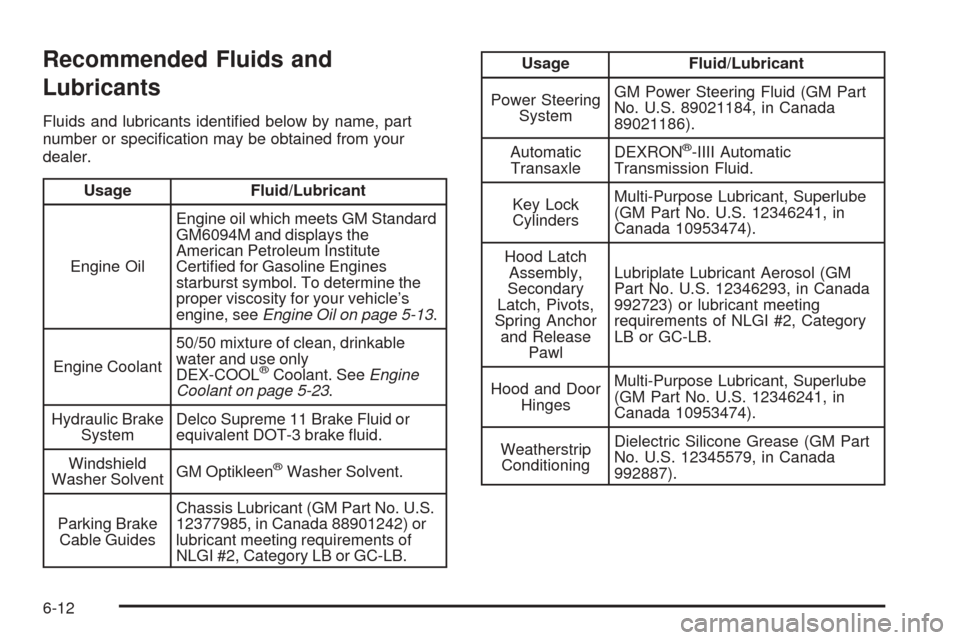
Recommended Fluids and
Lubricants
Fluids and lubricants identified below by name, part
number or specification may be obtained from your
dealer.
Usage Fluid/Lubricant
Engine OilEngine oil which meets GM Standard
GM6094M and displays the
American Petroleum Institute
Certified for Gasoline Engines
starburst symbol. To determine the
proper viscosity for your vehicle’s
engine, seeEngine Oil on page 5-13.
Engine Coolant50/50 mixture of clean, drinkable
water and use only
DEX-COOL
®Coolant. SeeEngine
Coolant on page 5-23.
Hydraulic Brake
SystemDelco Supreme 11 Brake Fluid or
equivalent DOT-3 brake fluid.
Windshield
Washer SolventGM Optikleen
®Washer Solvent.
Parking Brake
Cable GuidesChassis Lubricant (GM Part No. U.S.
12377985, in Canada 88901242) or
lubricant meeting requirements of
NLGI #2, Category LB or GC-LB.
Usage Fluid/Lubricant
Power Steering
SystemGM Power Steering Fluid (GM Part
No. U.S. 89021184, in Canada
89021186).
Automatic
TransaxleDEXRON
®-IIII Automatic
Transmission Fluid.
Key Lock
CylindersMulti-Purpose Lubricant, Superlube
(GM Part No. U.S. 12346241, in
Canada 10953474).
Hood Latch
Assembly,
Secondary
Latch, Pivots,
Spring Anchor
and Release
PawlLubriplate Lubricant Aerosol (GM
Part No. U.S. 12346293, in Canada
992723) or lubricant meeting
requirements of NLGI #2, Category
LB or GC-LB.
Hood and Door
HingesMulti-Purpose Lubricant, Superlube
(GM Part No. U.S. 12346241, in
Canada 10953474).
Weatherstrip
ConditioningDielectric Silicone Grease (GM Part
No. U.S. 12345579, in Canada
992887).
6-12
Page 398 of 410
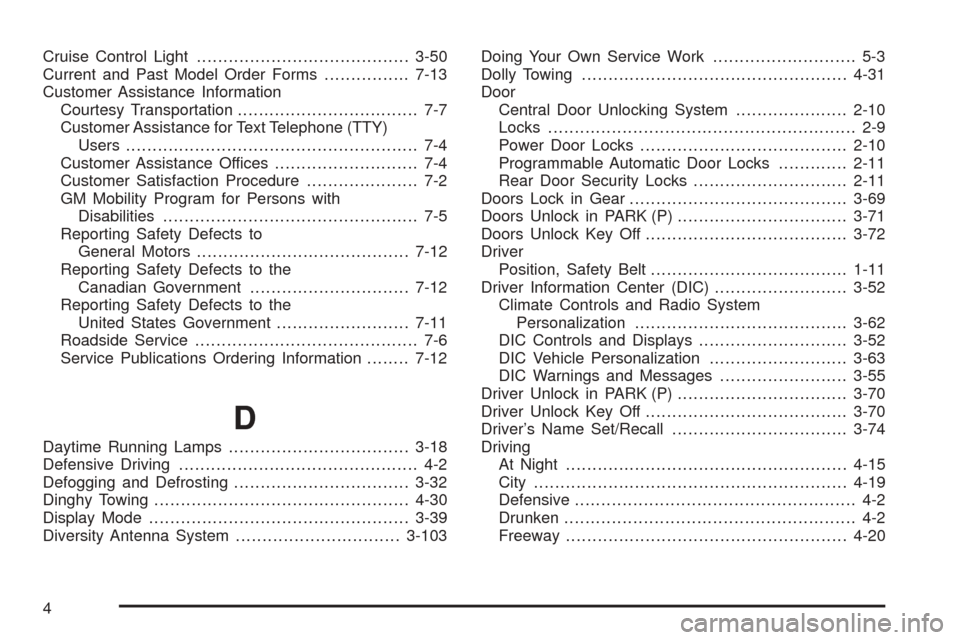
Cruise Control Light........................................3-50
Current and Past Model Order Forms................7-13
Customer Assistance Information
Courtesy Transportation.................................. 7-7
Customer Assistance for Text Telephone (TTY)
Users....................................................... 7-4
Customer Assistance Offices........................... 7-4
Customer Satisfaction Procedure..................... 7-2
GM Mobility Program for Persons with
Disabilities................................................ 7-5
Reporting Safety Defects to
General Motors........................................7-12
Reporting Safety Defects to the
Canadian Government..............................7-12
Reporting Safety Defects to the
United States Government.........................7-11
Roadside Service.......................................... 7-6
Service Publications Ordering Information........7-12
D
Daytime Running Lamps..................................3-18
Defensive Driving............................................. 4-2
Defogging and Defrosting.................................3-32
Dinghy Towing................................................4-30
Display Mode.................................................3-39
Diversity Antenna System...............................3-103Doing Your Own Service Work........................... 5-3
Dolly Towing..................................................4-31
Door
Central Door Unlocking System.....................2-10
Locks.......................................................... 2-9
Power Door Locks.......................................2-10
Programmable Automatic Door Locks.............2-11
Rear Door Security Locks.............................2-11
Doors Lock in Gear.........................................3-69
Doors Unlock in PARK (P)................................3-71
Doors Unlock Key Off......................................3-72
Driver
Position, Safety Belt.....................................1-11
Driver Information Center (DIC).........................3-52
Climate Controls and Radio System
Personalization........................................3-62
DIC Controls and Displays............................3-52
DIC Vehicle Personalization..........................3-63
DIC Warnings and Messages........................3-55
Driver Unlock in PARK (P)................................3-70
Driver Unlock Key Off......................................3-70
Driver’s Name Set/Recall.................................3-74
Driving
At Night.....................................................4-15
City...........................................................4-19
Defensive..................................................... 4-2
Drunken....................................................... 4-2
Freeway.....................................................4-20
4
Page 399 of 410
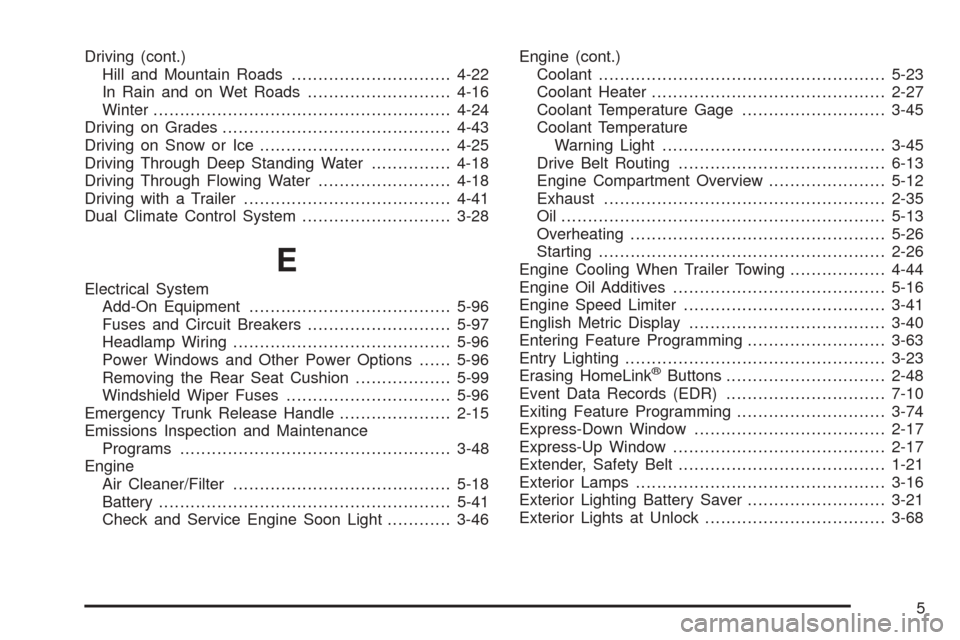
Driving (cont.)
Hill and Mountain Roads..............................4-22
In Rain and on Wet Roads...........................4-16
Winter........................................................4-24
Driving on Grades...........................................4-43
Driving on Snow or Ice....................................4-25
Driving Through Deep Standing Water...............4-18
Driving Through Flowing Water.........................4-18
Driving with a Trailer.......................................4-41
Dual Climate Control System............................3-28
E
Electrical System
Add-On Equipment......................................5-96
Fuses and Circuit Breakers...........................5-97
Headlamp Wiring.........................................5-96
Power Windows and Other Power Options......5-96
Removing the Rear Seat Cushion..................5-99
Windshield Wiper Fuses...............................5-96
Emergency Trunk Release Handle.....................2-15
Emissions Inspection and Maintenance
Programs...................................................3-48
Engine
Air Cleaner/Filter.........................................5-18
Battery.......................................................5-41
Check and Service Engine Soon Light............3-46Engine (cont.)
Coolant......................................................5-23
Coolant Heater............................................2-27
Coolant Temperature Gage...........................3-45
Coolant Temperature
Warning Light..........................................3-45
Drive Belt Routing.......................................6-13
Engine Compartment Overview......................5-12
Exhaust.....................................................2-35
Oil .............................................................5-13
Overheating................................................5-26
Starting......................................................2-26
Engine Cooling When Trailer Towing..................4-44
Engine Oil Additives........................................5-16
Engine Speed Limiter......................................3-41
English Metric Display.....................................3-40
Entering Feature Programming..........................3-63
Entry Lighting.................................................3-23
Erasing HomeLink
®Buttons..............................2-48
Event Data Records (EDR)..............................7-10
Exiting Feature Programming............................3-74
Express-Down Window....................................2-17
Express-Up Window........................................2-17
Extender, Safety Belt.......................................1-21
Exterior Lamps...............................................3-16
Exterior Lighting Battery Saver..........................3-21
Exterior Lights at Unlock..................................3-68
5
Page 408 of 410
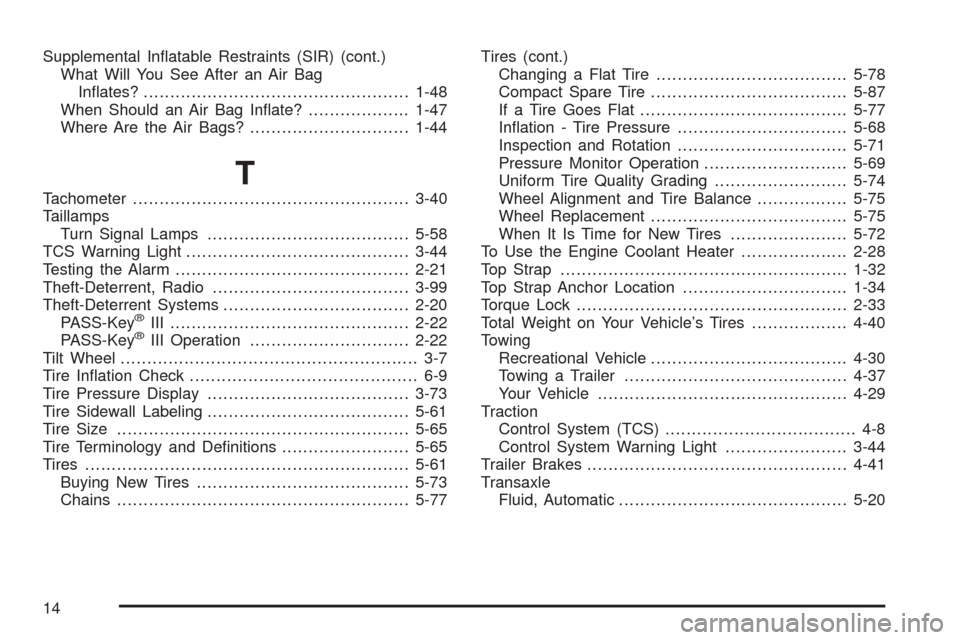
Supplemental Inflatable Restraints (SIR) (cont.)
What Will You See After an Air Bag
Inflates?..................................................1-48
When Should an Air Bag Inflate?...................1-47
Where Are the Air Bags?..............................1-44
T
Tachometer....................................................3-40
Taillamps
Turn Signal Lamps......................................5-58
TCS Warning Light..........................................3-44
Testing the Alarm............................................2-21
Theft-Deterrent, Radio.....................................3-99
Theft-Deterrent Systems...................................2-20
PASS-Key
®III .............................................2-22
PASS-Key®III Operation..............................2-22
Tilt Wheel........................................................ 3-7
Tire Inflation Check........................................... 6-9
Tire Pressure Display......................................3-73
Tire Sidewall Labeling......................................5-61
Tire Size.......................................................5-65
Tire Terminology and Definitions........................5-65
Tires.............................................................5-61
Buying New Tires........................................5-73
Chains.......................................................5-77Tires (cont.)
Changing a Flat Tire....................................5-78
Compact Spare Tire.....................................5-87
If a Tire Goes Flat.......................................5-77
Inflation - Tire Pressure................................5-68
Inspection and Rotation................................5-71
Pressure Monitor Operation...........................5-69
Uniform Tire Quality Grading.........................5-74
Wheel Alignment and Tire Balance.................5-75
Wheel Replacement.....................................5-75
When It Is Time for New Tires......................5-72
To Use the Engine Coolant Heater....................2-28
Top Strap......................................................1-32
Top Strap Anchor Location...............................1-34
Torque Lock...................................................2-33
Total Weight on Your Vehicle’s Tires..................4-40
Towing
Recreational Vehicle.....................................4-30
Towing a Trailer..........................................4-37
Your Vehicle...............................................4-29
Traction
Control System (TCS).................................... 4-8
Control System Warning Light.......................3-44
Trailer Brakes.................................................4-41
Transaxle
Fluid, Automatic...........................................5-20
14