Page 339 of 460

Brake Wear
Your vehicle has four-wheel disc brakes.
Disc brake pads have built-in wear indicators that make
a high-pitched warning sound when the brake pads
are worn and new pads are needed. The sound
may come and go or be heard all the time your vehicle
is moving (except when you are pushing on the
brake pedal rmly).
{CAUTION:
The brake wear warning sound means that
soon your brakes will not work well. That
could lead to an accident. When you hear the
brake wear warning sound, have your vehicle
serviced.Notice:Continuing to drive with worn-out brake
pads could result in costly brake repair.
Some driving conditions or climates may cause a brake
squeal when the brakes are rst applied or lightly
applied. This does not mean something is wrong with
your brakes.
Properly torqued wheel nuts are necessary to help
prevent brake pulsation. When tires are rotated, inspect
brake pads for wear and evenly tighten wheel nuts in
the proper sequence to GM torque specications.
Brake linings should always be replaced as complete
axle sets.
5-45
Page 349 of 460
Headlamp Aiming
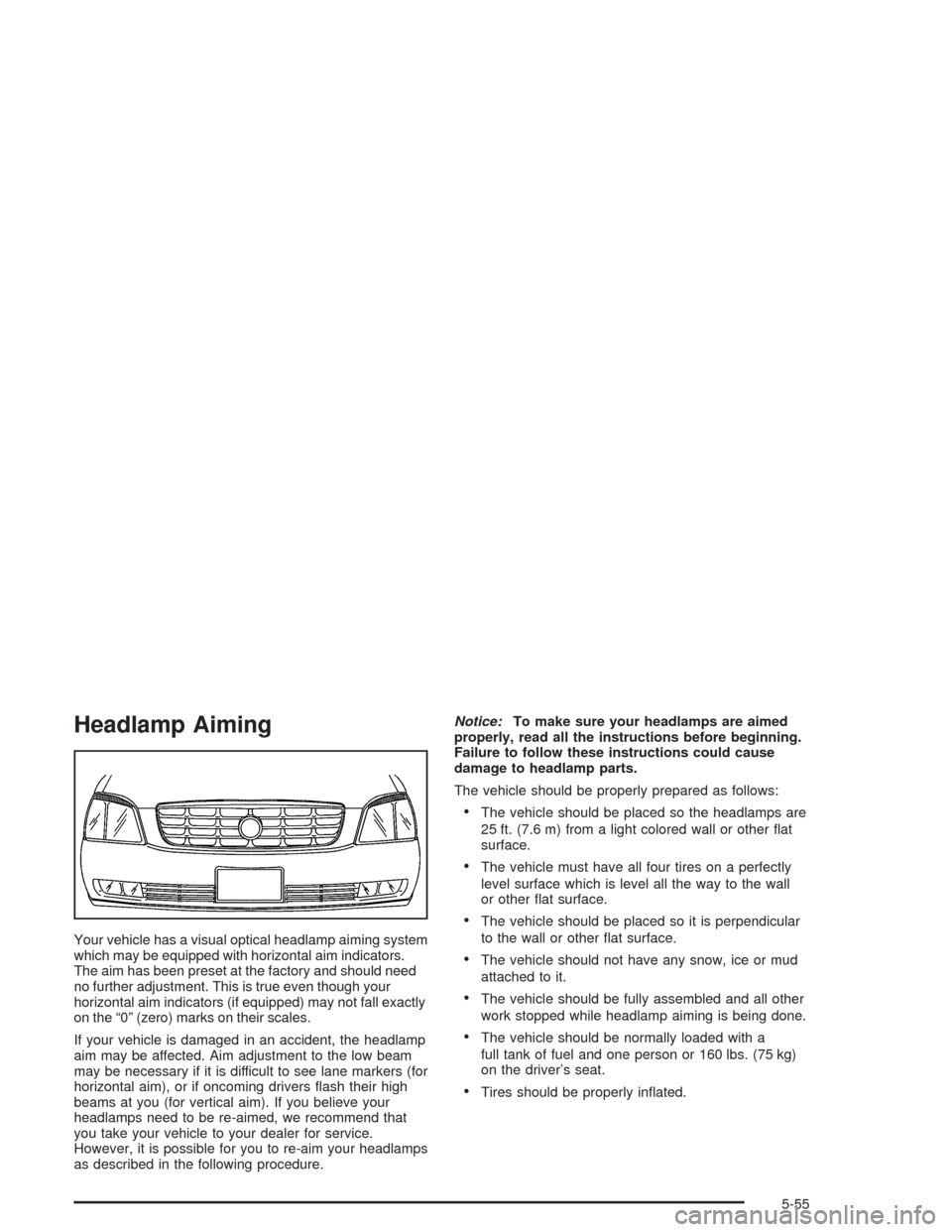
Your vehicle has a visual optical headlamp aiming system
which may be equipped with horizontal aim indicators.
The aim has been preset at the factory and should need
no further adjustment. This is true even though your
horizontal aim indicators (if equipped) may not fall exactly
on the “0” (zero) marks on their scales.
If your vehicle is damaged in an accident, the headlamp
aim may be affected. Aim adjustment to the low beam
may be necessary if it is difficult to see lane markers (for
horizontal aim), or if oncoming drivers ash their high
beams at you (for vertical aim). If you believe your
headlamps need to be re-aimed, we recommend that
you take your vehicle to your dealer for service.
However, it is possible for you to re-aim your headlamps
as described in the following procedure.Notice:To make sure your headlamps are aimed
properly, read all the instructions before beginning.
Failure to follow these instructions could cause
damage to headlamp parts.
The vehicle should be properly prepared as follows:
The vehicle should be placed so the headlamps are
25 ft. (7.6 m) from a light colored wall or other at
surface.
The vehicle must have all four tires on a perfectly
level surface which is level all the way to the wall
or other at surface.
The vehicle should be placed so it is perpendicular
to the wall or other at surface.
The vehicle should not have any snow, ice or mud
attached to it.
The vehicle should be fully assembled and all other
work stopped while headlamp aiming is being done.
The vehicle should be normally loaded with a
full tank of fuel and one person or 160 lbs. (75 kg)
on the driver’s seat.
Tires should be properly inated.
5-55
Page 360 of 460
Tires
Your new vehicle comes with high-quality tires made by
a leading tire manufacturer. If you ever have questions
about your tire warranty and where to obtain service,
see your GM Warranty booklet for details. For additional
information refer to the tire manufacturer’s booklet
included with your vehicle’s Owner’s Manual.
{CAUTION:
Poorly maintained and improperly used
tires are dangerous.
Overloading your tires can cause
overheating as a result of too much
friction. You could have an air-out and a
serious accident. SeeLoading Your
Vehicle on page 4-35.
Underinated tires pose the same danger
as overloaded tires. The resulting accident
could cause serious injury. Check all tires
frequently to maintain the recommended
pressure. Tire pressure should be checked
when your tires are cold.
CAUTION: (Continued)
CAUTION: (Continued)
Overinated tires are more likely to be
cut, punctured or broken by a sudden
impact— such as when you hit a pothole.
Keep tires at the recommended pressure.
Worn, old tires can cause accidents. If
your tread is badly worn, or if your tires
have been damaged, replace them.
SeeInflation - Tire Pressure on page 5-74, for
ination pressure adjustment for higher speed
driving.
Tire Sidewall Labeling
Useful information about a tire is molded into its
sidewall. The examples below show a typical passenger
car tire and a compact spare tire sidewall.
5-66
Page 361 of 460

(A) Tire Size:The tire size code is a combination of
letters and numbers used to dene a particular
tire’s width, height, aspect ratio, construction type and
service description. See the “Tire Size” illustration
later in this section for more detail.
(B) Tire Performance Criteria Specication (TPC
Spec):Original equipment tires designed to GM’s
specic tire performance criteria have a TPC specication
code molded onto the sidewall. GM’s TPC specications
meet or exceed all federal safety guidelines.
(C) Department of Transportation (DOT):The
Department of Transportation (DOT) code indicates that
the tire is in compliance with the U.S. Department of
Transportation Motor Vehicle Safety Standards.
(D) Tire Identication Number (TIN):The letters and
numbers following DOT code are the Tire Identication
Number (TIN). The TIN shows the manufacturer and
plant code, tire size, and date the tire was manufactured.
The TIN is molded onto both sides of the tire, although
only one side may have the date of manufacture.
Passenger Car Tire Example
5-67
Page 362 of 460
(E) Tire Ply Material:The type of cord and number of
plies in the sidewall and under the tread.
(F) Uniform Tire Quality Grading (UTQG):Tire
manufacturers are required to grade tires based on three
performance factors: treadwear, traction and
temperature resistance. For more information see
Uniform Tire Quality Grading on page 5-81.
(G) Maximum Cold Ination Load Limit:Maximum
load that can be carried and the maximum pressure
needed to support that load. For more information on
recommended tire pressure seeInation - Tire Pressure
on page 5-74andLoading Your Vehicle on page 4-35.
Compact Spare Tire Example
5-68
Page 363 of 460

(A) Temporary Use Only:The compact spare tire or
temporary use tire has a tread life of approximately
3,000 miles (5 000 km) and should not be driven
at speeds over 65 mph (105 km/h). The compact spare
tire is for emergency use when a regular road tire
has lost air and gone at. SeeCompact Spare Tire on
page 5-96andIf a Tire Goes Flat on page 5-85.
(B) Tire Ply Material:The type of cord and number of
plies in the sidewall and under the tread.
(C) Tire Identication Number (TIN):The Tire
Identication Number (TIN). The TIN shows the
manufacturer and plant code, tire size, and date the tire
was manufactured. The TIN is molded onto both
sides of the tire, although only one side may have the
date of manufacture.
(D) Maximum Cold Ination Load Limit:Maximum
load that can be carried and the maximum pressure
needed to support that load. SeeCompact Spare Tire
on page 5-96andLoading Your Vehicle on page 4-35.(E) Tire Ination:The temporary use tire or compact
spare tire should be inated to 60 psi (420 kPa).
For more information on tire pressure and ination see
Ination - Tire Pressure on page 5-74.
(F) Tire Size:A combination of letters and numbers
dene a tire’s width, height, aspect ratio, construction
type and service description. The letter “T” as the
rst character in the tire size means the tire is for
temporary use only.
(G) Tire Performance Criteria Specication (TPC
Spec):Original equipment tires designed to GM’s
specic tire performance criteria have a TPC specication
code molded onto the sidewall. GM’s TPC specications
meet or exceed all federal safety guidelines.
5-69
Page 367 of 460

Sidewall:The portion of a tire between the tread and
the bead.
Speed Rating:An alphanumeric code assigned to a
tire indicating the maximum speed at which a tire
can operate.
Traction:The friction between the tire and the road
surface. The amount of grip provided.
Tread:The portion of a tire that comes into contact
with the road.
Treadwear Indicators:Narrow bands, sometimes
called “wear bars,” that show across the tread of a tire
when only 2/32 inch of tread remains. SeeWhen It
Is Time for New Tires on page 5-79.
UTQGS:Uniform Tire Quality Grading Standards, a tire
information system that provides consumers with
ratings for a tire’s traction, temperature and treadwear.
Ratings are determined by tire manufacturers using
government testing procedures. The ratings are molded
into the sidewall of the tire. SeeUniform Tire Quality
Grading on page 5-81.Vehicle Capacity Weight:The number of designated
seating positions multiplied by 150 lbs. (68 kg) plus
the rated cargo load. SeeLoading Your Vehicle
on page 4-35.
Vehicle Maximum Load on the Tire:Load on an
individual tire due to curb weight, accessory weight,
occupant weight and cargo weight.
Vehicle Placard:A label permanently attached to a
vehicle showing the original equipment tire size
and recommended ination pressure. SeeLoading Your
Vehicle on page 4-35.
5-73
Page 368 of 460

Ination - Tire Pressure
The Tire and Loading Information label, shows the correct
ination pressures for your tires when they’re cold. “Cold”
means your vehicle has been sitting for at least three
hours or driven no more than 1 mile (1.6 km). See
Loading Your Vehicle on page 4-35for more information
on the Tire and Loading Information label.
If you’ll be driving at high speeds (e.g., speeds of
100 mph (160 km/h) or higher), where it is legal, set the
cold ination pressure to the maximum ination
pressure shown on the tire sidewall, or to 38 psi
(265 kPa), whichever is lower. See the example below.
When you end this high-speed driving, return to the
cold ination pressure shown on the Tire and Loading
Information label.
Example:
You’ll nd maximum load and ination pressure molded
on the tire’s sidewall, in small letters, near the rim
ange. It will read something like this: Maximum load
690 kg (1521 lbs) 300 kPa (44 psi) Max. Press.
For this example, you would set the ination pressure
for high-speed driving at 38 psi (265 kPa).Notice:Don’t let anyone tell you that underination
or overination is all right. It’s not. If your tires
don’t have enough air (underination), you can get
the following:
Too much exing
Too much heat
Tire overloading
Bad wear
Bad handling
Bad fuel economy
If your tires have too much air (overination), you
can get the following:
Unusual wear
Bad handling
Rough ride
Needless damage from road hazards
5-74
