2004 BMW 325I 122
[x] Cancel search: 122Page 7 of 182
7
Notes
Service and warranty
This manual is supplemented by a Ser-
vice and Warranty Information Booklet
for US models or a Warranty and Ser-
vice Guide Booklet for Canadian mod-
els.
We recommend that you read this pub-
lication thoroughly.
Your BMW is covered by the following
warranties:
>
New Vehicle Limited Warranty
> Rust Perforation Limited Warranty >
Federal Emissions System Defect
Warranty
>
Federal Emissions Performance War-
ranty
>
California Emission Control System
Limited Warranty.
Detailed information about these war-
ranties is listed in the Service and War-
ranty Information Booklet for US mod-
els or in the Warranty and Service
Guide Booklet for Canadian models.
Reporting safety defects
The following only applies to vehicles
owned and operated in the US.
If you believe that your vehicle has a
defect which could cause a crash or
could cause injury or death, you should
immediately inform the National High-
way Traffic Safety Administration
NHTSA in addition to notifying BMW of
North America, LLC, P.O. Box 1227,
Westwood, New Jersey 07675-1227,
telephone toll-free 1-800-831-1117.
If NHTSA receives similar complaints, it
may open an investigation, and if it
finds that a safety defect exists in a
group of vehicles, it may order a recall
and remedy campaign. However,
NHTSA cannot become involved in indi-
vidual problems between you, your
dealer, or BMW of North America, LLC.
To contact NHTSA, you may either call
the Auto Safety Hotline toll-free at
1-800-424-9393 or 366-0123 in the
Washington, D.C. area, or write to:
NHTSA, U.S. Department of Transpor-
tation, Washington, D.C. 20590. You
can also obtain other information about
motor vehicle safety from the Hotline.
Page 10 of 182
Contents
Operation, maintenance
Special operating instructions:
Break-in procedures120
General driving notes121
Antilock Brake System
(ABS)121
Brake system122
Wheels and tires:
Tire inflation pressure124
Tire condition124
Tire replacement125
Wheel and tire
combinations127
Winter tires127
In the engine compartment:
Hood129
Engine compartment
essentials130
Washer fluids132
Engine oil132
Coolant134
Brake fluid134
Maintenance:
The BMW Maintenance
System136
Laws and regulations:
California Proposition 65
warning138
OBD interface socket138
Owner service procedures
Replacement procedures:
Onboard tool kit142
Windshield wiper blades142
Lamps and bulbs143
Changing a wheel147
Run Flat tires*150
Battery151
Fuses151
Giving and receiving
assistance: Receiving assistance152
Jump-starting153
Towing the vehicle154
Technical data
Engine data160
Dimensions161
Weights162
Capacities163
Page 18 of 182
18
Indicator and warning lamps
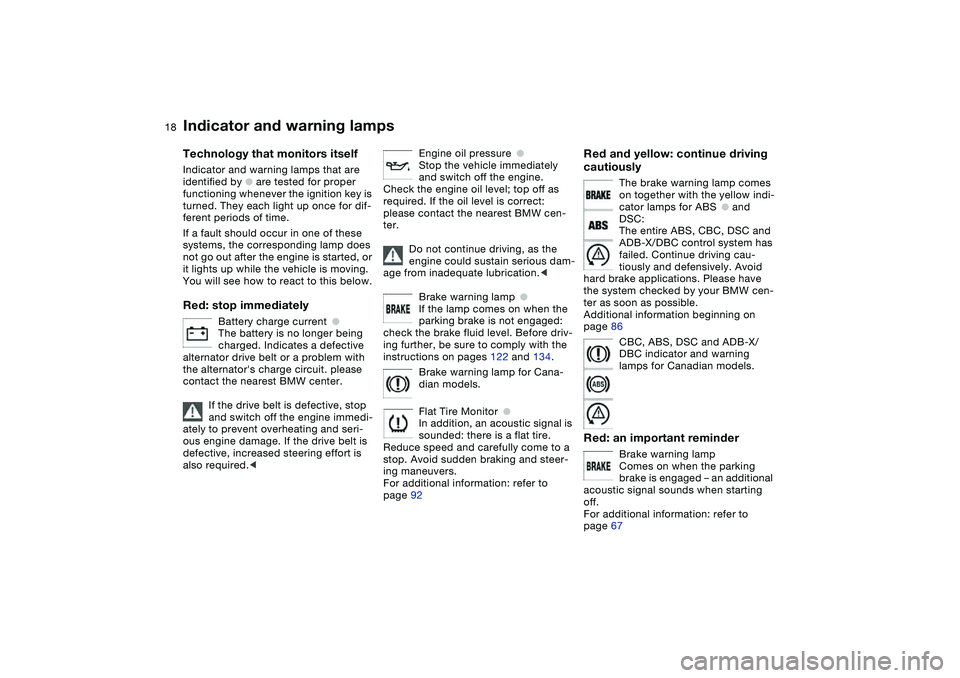
Technology that monitors itself
Indicator and warning lamps that are
identified by
●
are tested for proper
functioning whenever the ignition key is
turned. They each light up once for dif-
ferent periods of time.
If a fault should occur in one of these
systems, the corresponding lamp does
not go out after the engine is started, or
it lights up while the vehicle is moving.
You will see how to react to this below.
Red: stop immediately
Battery charge current
●
The battery is no longer being
charged. Indicates a defective
alternator drive belt or a problem with
the alternator's charge circuit. please
contact the nearest BMW center.
If the drive belt is defective, stop
and switch off the engine immedi-
ately to prevent overheating and seri-
ous engine damage. If the drive belt is
defective, increased steering effort is
also required.
<
Engine oil pressure
●
Stop the vehicle immediately
and switch off the engine.
Check the engine oil level; top off as
required. If the oil level is correct:
please contact the nearest BMW cen-
ter.
Do not continue driving, as the
engine could sustain serious dam-
age from inadequate lubrication.
<
Brake warning lamp
●
If the lamp comes on when the
parking brake is not engaged:
check the brake fluid level. Before driv-
ing further, be sure to comply with the
instructions on pages 122 and 134.
Brake warning lamp for Cana-
dian models.
Flat Tire Monitor
●
In addition, an acoustic signal is
sounded: there is a flat tire.
Reduce speed and carefully come to a
stop. Avoid sudden braking and steer-
ing maneuvers.
For additional information: refer to
page 92
Red and yellow: continue driving
cautiously
The brake warning lamp comes
on together with the yellow indi-
cator lamps for ABS
●
and
DSC:
The entire ABS, CBC, DSC and
ADB-X/DBC control system has
failed. Continue driving cau-
tiously and defensively. Avoid
hard brake applications. Please have
the system checked by your BMW cen-
ter as soon as possible.
Additional information beginning on
page 86
CBC, ABS, DSC and ADB-X/
DBC indicator and warning
lamps for Canadian models.
Red: an important reminder
Brake warning lamp
Comes on when the parking
brake is engaged – an additional
acoustic signal sounds when starting
off.
For additional information: refer to
page 67
Page 19 of 182
19
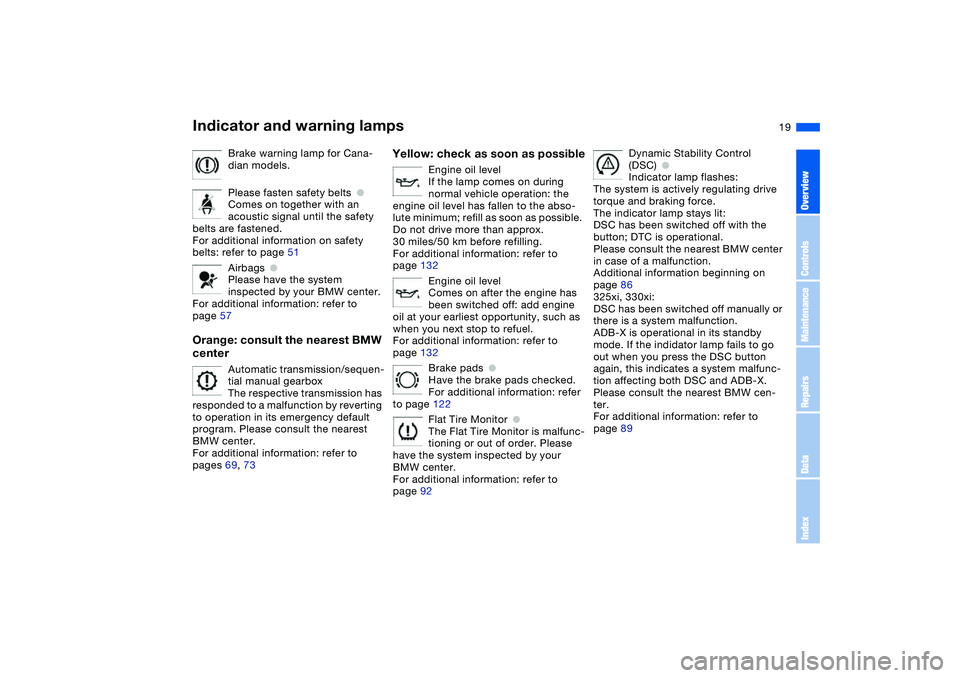
Brake warning lamp for Cana-
dian models.
Please fasten safety belts
●
Comes on together with an
acoustic signal until the safety
belts are fastened.
For additional information on safety
belts: refer to page 51
Airbags
●
Please have the system
inspected by your BMW center.
For additional information: refer to
page 57
Orange: consult the nearest BMW
center
Automatic transmission/sequen-
tial manual gearbox
The respective transmission has
responded to a malfunction by reverting
to operation in its emergency default
program. Please consult the nearest
BMW center.
For additional information: refer to
pages 69, 73
Yellow: check as soon as possible
Engine oil level
If the lamp comes on during
normal vehicle operation: the
engine oil level has fallen to the abso-
lute minimum; refill as soon as possible.
Do not drive more than approx.
30 miles/50 km before refilling.
For additional information: refer to
page 132
Engine oil level
Comes on after the engine has
been switched off: add engine
oil at your earliest opportunity, such as
when you next stop to refuel.
For additional information: refer to
page 132
Brake pads
●
Have the brake pads checked.
For additional information: refer
to page 122
Flat Tire Monitor
●
The Flat Tire Monitor is malfunc-
tioning or out of order. Please
have the system inspected by your
BMW center.
For additional information: refer to
page 92
Dynamic Stability Control
(DSC)
●
Indicator lamp flashes:
The system is actively regulating drive
torque and braking force.
The indicator lamp stays lit:
DSC has been switched off with the
button; DTC is operational.
Please consult the nearest BMW center
in case of a malfunction.
Additional information beginning on
page 86
325xi, 330xi:
DSC has been switched off manually or
there is a system malfunction.
ADB-X is operational in its standby
mode. If the indidator lamp fails to go
out when you press the DSC button
again, this indicates a system malfunc-
tion affecting both DSC and ADB-X.
Please consult the nearest BMW cen-
ter.
For additional information: refer to
page 89
Indicator and warning lamps
OverviewControlsMaintenanceRepairsDataIndex
Page 122 of 182
122
Brake systemBrake fluid levelLow brake fluid level in the reservoir
combined with longer than usual pedal
travel may indicate a defect in one of
the brake system's hydraulic circuits.
Proceed to the nearest BMW cen-
ter. It may be necessary to apply
higher levels of pressure to the pedal
when stopping and braking distances
may also be longer. Please remember
to adapt your driving style accord-
ingly.
the vehicle is not used at all, and in
operating conditions where brake appli-
cations are less frequent, there is an
increased tendency for corrosion of the
rotors and accumulation of contamina-
tion on the brake pads. This occurs
because the minimal pressure that must
be exerted by the pads to clean the
rotors by brake applications is not
reached.
Corrosion on brake rotors is signaled by
a running or pulsation during braking;
even extended subsequent braking will
not cure this phenomenon.
It is a good idea to periodically dry the
brakes with a gentle application when
driving in rain and on wet roads. Watch
traffic conditions to ensure that this
maneuver does not endanger other
road users. The heat generated in this
process helps dry the pads and rotors
to ensure that your brake system will
respond with undiminished efficiency
when you need it.
When descending steep hills and
extended grades, downshift to a gear
that will allow you to continue safely
with only a minimal amount of braking.
This helps avoid placing excessive
loads on the brake system. Use care to
avoid exceeding the approved engine-
speed range, refer to page 80.Do not coast with the clutch
depressed or with the transmis-
sion or selector lever in Neutral. Do not
coast with the engine shut off. The
engine provides no braking effect when
the clutch is depressed and there is no
power-assist for braking or steering
when the engine is not running.
325xi, 330xi: always refer all brake
inspection and service work to your
BMW center, as failure to observe the
special procedures could result in dam-
age to components of the all-wheel
drive.
Never allow floor mats, carpets or any
other objects to protrude into the area
around the accelerator, clutch and
brake pedals and obstruct their move-
ment.<
Brake pads
For your own safety: use only
brake pads which BMW has
approved for your specific vehicle
model. BMW cannot evaluate non-
approved brake pads to determine if
they are suitable for use, and therefore
cannot ensure the operating safety of
the vehicle if they are installed.<
Page 134 of 182
134
Coolant
Do not add coolant to the cooling
system when the engine is hot. If
you attempt to do so, escaping coolant
can cause burns.
Antifreeze and anti-corrosion agents
are hazardous to health. You should
always store them in closed original
containers and in a location which is
out of reach of children. Antifreeze and
anti-corrosion agents are inflammable.
For this reason, do not spill them on hot
engine parts. They could ignite and
cause serious burns. Comply with the
instructions on the containers.<
Comply with the applicable envi-
ronmental laws regulating the dis-
posal of antifreeze agents with corro-
sion inhibitor.<
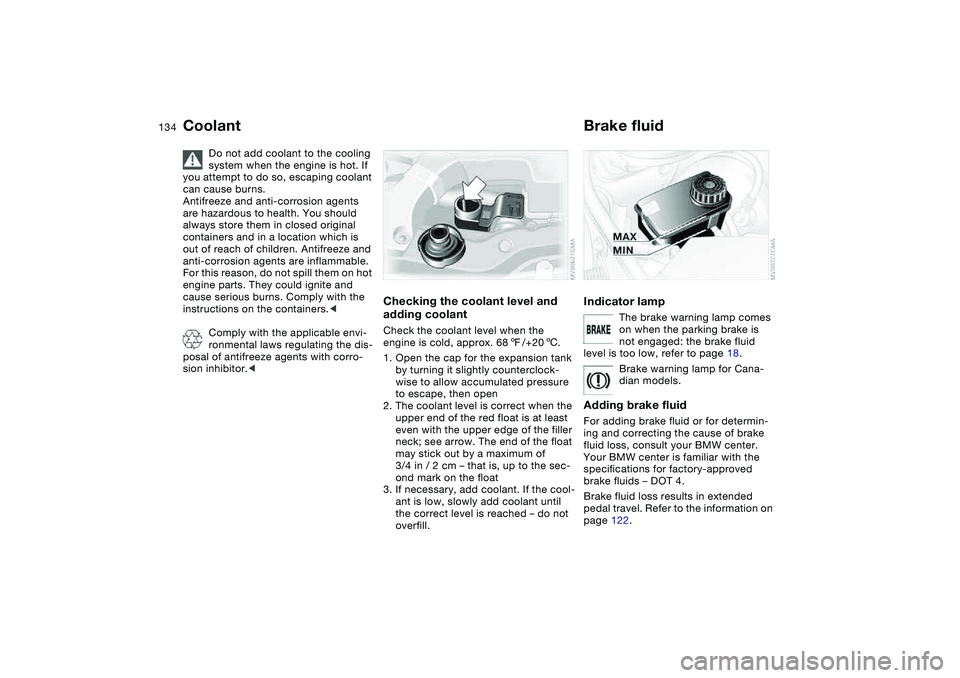
Checking the coolant level and
adding coolantCheck the coolant level when the
engine is cold, approx. 687/+206.
1. Open the cap for the expansion tank
by turning it slightly counterclock-
wise to allow accumulated pressure
to escape, then open
2. The coolant level is correct when the
upper end of the red float is at least
even with the upper edge of the filler
neck; see arrow. The end of the float
may stick out by a maximum of
3/4 in / 2 cm – that is, up to the sec-
ond mark on the float
3. If necessary, add coolant. If the cool-
ant is low, slowly add coolant until
the correct level is reached – do not
overfill.
Brake fluidIndicator lamp
The brake warning lamp comes
on when the parking brake is
not engaged: the brake fluid
level is too low, refer to page 18.
Brake warning lamp for Cana-
dian models.
Adding brake fluidFor adding brake fluid or for determin-
ing and correcting the cause of brake
fluid loss, consult your BMW center.
Your BMW center is familiar with the
specifications for factory-approved
brake fluids – DOT 4.
Brake fluid loss results in extended
pedal travel. Refer to the information on
page 122.
Page 167 of 182
Everything from A to Z
167
Belts, refer to Safety
belts 51
Beverage holders 108, 109
Blower
air conditioning 100
automatic climate
control 104
BMW High Performance
Synthetic Oils 133
BMW Maintenance
System 136
BMW sports seat 49
Bore, refer to Engine
data 160
Bottle holders, see Bever-
age holders 108, 109
Brake fluid 134
indicator lamp 18, 134
level 134
Brake force display 93
Brake hydraulic system 122
Brake lamps
bulb replacement 145
indicator lamp, defective
lamp 82
Brake lights
brake force display 93
Brake pads
brake fluid level
18, 122, 134
breaking in 120
disc brakes 122Brake rotors
brake system 122
breaking in 120
Brake system
brake pads, indicator
lamp 19
Brake wear warning
indicator lamp 19
Brakes
ABS 121
brake fluid 134
breaking in 120
indicator/warning lamp
18, 19
parking brake 67
Break-in procedures 120
Bulb replacement, refer to
Lamps and bulbs 143
Bulb, replacing 143
Buttons in steering wheel 22
C
California Proposition 65
warning 138
Can holders, see Beverage
holders 108, 109
Capacities 163
Car battery 151
Car care, refer to the Caring
for your vehicle brochure
Car keys, refer to Keys 32Car radio, refer to Owner's
Manual for Radio/Onboard
Computer
Car telephone
preparation 110
Car telephone, refer to the
separate Owner's Manual
Car vacuum cleaner, con-
necting 110
Car wash, refer to the Caring
for your vehicle brochure
Carpet care, refer to the
Caring for your vehicle
brochure
Cassette operation, refer to
the Owner's Manual for
Radio/Onboard Computer
CBC Cornering Brake Con-
trol 121
warning lamp 18
CD changer, refer to the
Owner's Manual for
Radio/Onboard Computer
CD operation, refer to the
Owner's Manual for
Radio/Onboard Computer
Cellular phone 110
Center high-mount brake
lamp
bulb replacement 146Central locking system 32
button 37
passenger
compartment 37
Changing a wheel 147
Charge indicator lamp 18
Check Control 82
Check Gas Cap
indicator lamp 19
Child safety locks 63
Child seats 60
Child-restraint systems 60
Chock 148
Cigarette lighter 110
Cigarette lighter socket 110
Cleaning chrome parts, refer
to the Caring for your vehi-
cle brochure
Cleaning light alloy wheels,
refer to the Caring for your
vehicle brochure
Cleaning the vehicle, refer to
the Caring for your vehicle
brochure
Cleaning windshield 78
Clock 83
12-/24-hour mode 83
setting, refer also to the
Owner's Manual for
Radio/Onboard Computer
OverviewControlsMaintenanceRepairsDataIndex
Page 168 of 182
Everything from A to ZClosing
from inside 37
from outside 33
Clothes hooks 121
Clutch
breaking in 120
Cockpit 14
Code, refer to the Owner's
Manual for Radio/Onboard
Computer
Coin box 108
Cold start, refer to Starting
the engine 65
Compact disc operation,
refer to the Owner's Man-
ual for Radio/Onboard
Computer
Compartments 108
Compression ratio, refer to
Engine data 160
Computer 84
Condensation, refer to Air
conditioning mode
100, 104
Configuring settings, refer to
Vehicle Memory, Key
Memory 64
Connecting a vacuum
cleaner, refer to Cigarette
lighter 110
Consumption
display 80Consumption, refer to Aver-
age fuel consumption 85
Control elements, refer to
Cockpit 14
Convenience operation
from outside 36
glass sunroof 34
windows 34
Coolant 134
indicator lamp 19, 81
level 134
temperature gauge 81
Coolant water, refer to Cool-
ant 134
Cooling, refer to Tempera-
ture 100, 104
Copyright 4
Cornering Brake Control
(CBC) 121
warning lamp 18
Correct tires 127
Cruise control 78
indicator lamp 20
Cup holders, see Beverage
holders 108, 109
Curb weight, refer to
Weights 162
Current consumption, refer
to Energy control 80
Cylinders, refer to Engine
data 160D
Dashboard, refer to
Cockpit 14
Data
capacities 163
dimensions 161
engine 160
technical 160
weights 162
Daytime driving lamps 94
DBC Dynamic Brake Control
19, 121
Deep water, refer to Water
on roadways 121
Defrost position, refer
to Defrosting windows
101, 104
Defrosting and demisting
windows
air conditioning 101
automatic climate
control 104
Defrosting windows
101, 104
Defrosting windshield, refer
to Defrosting windows
101, 104
Demisting windows
air conditioning 101
automatic climate
control 104Determining the maximum
load 115
Differential
breaking in 120
Digital clock 83
Dimensions 161
Dipstick, engine oil 132
Disc brakes 122
Displacement, refer to
Engine data 160
Display lighting, refer to
Instrument lighting 95
Displays, refer to Instrument
cluster 16
Disposal
oil 133
vehicle battery 151
Distance warning, refer to
Park Distance Control
(PDC) 86
Divided rear backrest 112
Door key 32
Door lock 36
Doors
emergency operation 36
Draft-free ventilation
101, 105
Driving light, refer to Parking
lamps/Low beams 94
Driving notes 121
Dry air, refer to Air condi-
tioning mode 100, 104