2004 BMW 325I Brake system
[x] Cancel search: Brake systemPage 120 of 182
120Special operating instructions
Break-in proceduresTo ensure that your vehicle provides
maximum economy throughout a long
service life, we request that you
observe the following suggestions.Engine and differentialUp to 1,250 miles/2,000 km:
Constantly vary both vehicle and engine
speeds, remembering not to exceed
4,500 rpm or vehicle speeds of over
100 mph / 160 km/h:
Obey your local and state maximum
speed limits.
Do not use full throttle, and avoid
pressing the accelerator beyond the
kickdown point during these initial
miles.
You can then proceed to increase
engine or vehicle speeds once the ini-
tial 1,250 miles/2,000 km have elapsed.
Please remember to observe these
same break-in procedures if either the
engine or the differential should have to
be replaced later in the course of the
vehicle's service life.
TiresDue to technical factors associated
with their manufacture, tires do not
achieve their full traction potential until
an initial break-in period has elapsed.
Thus drive with extra care during the
initial 200 miles/300 km.
Obey your local and state maximum
speed limits.
When the vehicle is operated on
wet or slushy roads, a wedge of
water may form between the tire and
the road surface. This phenomenon is
referred to as hydroplaning, and can
lead to partial or complete loss of trac-
tion, as well as loss of vehicle control
and braking effectiveness. Reduce your
speed on wet roads.
achieve the optimal pad-surface and
wear patterns required for trouble-free
operation and long service life later on.
To break in the separate parking brake
drums, apply the parking brake lightly
when coasting to a standstill – at a traf-
fic signal, for instance – use caution to
avoid posing a danger to other road
users.
To avoid corrosion, repeat this proce-
dure from time to time.
The brake lamps do not come on
when the parking brake is set.
Vacuum for the brake system servo unit
on your BMW is available only when the
engine is running. When you move the
vehicle with the engine off – when tow-
ing, for example – substantially higher
levels of pedal force will be required to
brake the vehicle.
optimum efficiency. Remember to
engage the clutch carefully during this
initial period.
Page 121 of 182
121
General driving notes
Brakes: do not rest your foot on
the brake pedal while driving.
Even light but consistent pedal pres-
sure can lead to high temperatures,
brake wear and possibly even brake
failure.
Hydroplaning: when driving on wet or
slushy roads, reduce road speed. If you
do not, a wedge of water can form
between tires and road surface. This
phenomenon can lead to partial or
complete loss of contact between the
tires and road surface, as well as loss of
vehicle control and braking ability.
Driving through water: do not drive
through water on the road if it is deeper
than 1 ft/30 cm, and then only at walk-
ing speed. Otherwise, the vehicle's
engine, the electrical systems and the
transmission may be damaged.
Rear parcel tray: never use it to store
heavy or hard objects; otherwise, occu-
pants could be injured if the vehicle is
braked hard.
Clothes hooks: when hanging clothing
from the hooks, be sure that they will
not obstruct the driver's vision. Do not
hang heavy objects on the hooks. If you
do so, they could cause personal injury
during braking or evasive maneuvers.<
Antilock Brake System (ABS)The conceptABS keeps the wheels from locking
during braking, thereby enhancing
active driving safety.Braking with ABSIf you are in a situation that requires full
braking, you will exploit the full benefits
of the ABS system if you apply maxi-
mum pedal pressure – panic stop.
Since the vehicle maintains steering
responsiveness, you can avoid possible
obstacles with a minimum of steering
effort, despite the full brake application.
Pulsation at the brake pedal combined
with sounds from the hydraulic circuits
indicates to the driver that ABS is in its
active mode.Dynamic Brake Control (DBC)DBC is included in the DSC, refer to
page 87.
The system responds to sudden, high-
intensity applications of force to the
brake pedal by automatically braking
the vehicle with maximum boost to
achieve the shortest possible braking
distances during panic stops. This sys-
tem exploits all the benefits of ABS.Do not reduce the pressure exerted
against the brake pedal until the brak-
ing maneuver has been completed.
DBC is deactivated when you release
the brake pedal.
Cornering Brake Control (CBC)CBC is an advanced engineering
design of the ABS. When braking while
cornering at high speed or braking dur-
ing high lateral acceleration, or when
braking during a lane change, vehicle
stability is improved and steering
response is enhanced.
OverviewControlsMaintenanceRepairsDataIndex
Page 122 of 182
122
Brake systemBrake fluid levelLow brake fluid level in the reservoir
combined with longer than usual pedal
travel may indicate a defect in one of
the brake system's hydraulic circuits.
Proceed to the nearest BMW cen-
ter. It may be necessary to apply
higher levels of pressure to the pedal
when stopping and braking distances
may also be longer. Please remember
to adapt your driving style accord-
ingly.
the vehicle is not used at all, and in
operating conditions where brake appli-
cations are less frequent, there is an
increased tendency for corrosion of the
rotors and accumulation of contamina-
tion on the brake pads. This occurs
because the minimal pressure that must
be exerted by the pads to clean the
rotors by brake applications is not
reached.
Corrosion on brake rotors is signaled by
a running or pulsation during braking;
even extended subsequent braking will
not cure this phenomenon.
It is a good idea to periodically dry the
brakes with a gentle application when
driving in rain and on wet roads. Watch
traffic conditions to ensure that this
maneuver does not endanger other
road users. The heat generated in this
process helps dry the pads and rotors
to ensure that your brake system will
respond with undiminished efficiency
when you need it.
When descending steep hills and
extended grades, downshift to a gear
that will allow you to continue safely
with only a minimal amount of braking.
This helps avoid placing excessive
loads on the brake system. Use care to
avoid exceeding the approved engine-
speed range, refer to page 80.Do not coast with the clutch
depressed or with the transmis-
sion or selector lever in Neutral. Do not
coast with the engine shut off. The
engine provides no braking effect when
the clutch is depressed and there is no
power-assist for braking or steering
when the engine is not running.
325xi, 330xi: always refer all brake
inspection and service work to your
BMW center, as failure to observe the
special procedures could result in dam-
age to components of the all-wheel
drive.
Never allow floor mats, carpets or any
other objects to protrude into the area
around the accelerator, clutch and
brake pedals and obstruct their move-
ment.<
Brake pads
For your own safety: use only
brake pads which BMW has
approved for your specific vehicle
model. BMW cannot evaluate non-
approved brake pads to determine if
they are suitable for use, and therefore
cannot ensure the operating safety of
the vehicle if they are installed.<
Page 123 of 182
123
Portable phone in the vehicleBMW recommends using mobile com-
munications devices, e.g. portable
phones, inside the vehicle with a suit-
able outside antenna. Otherwise, it can-
not be ruled out that the vehicle elec-
tronics and portable phone may
interfere with each other.Brake system
OverviewControlsMaintenanceRepairsDataIndex
Page 131 of 182
131
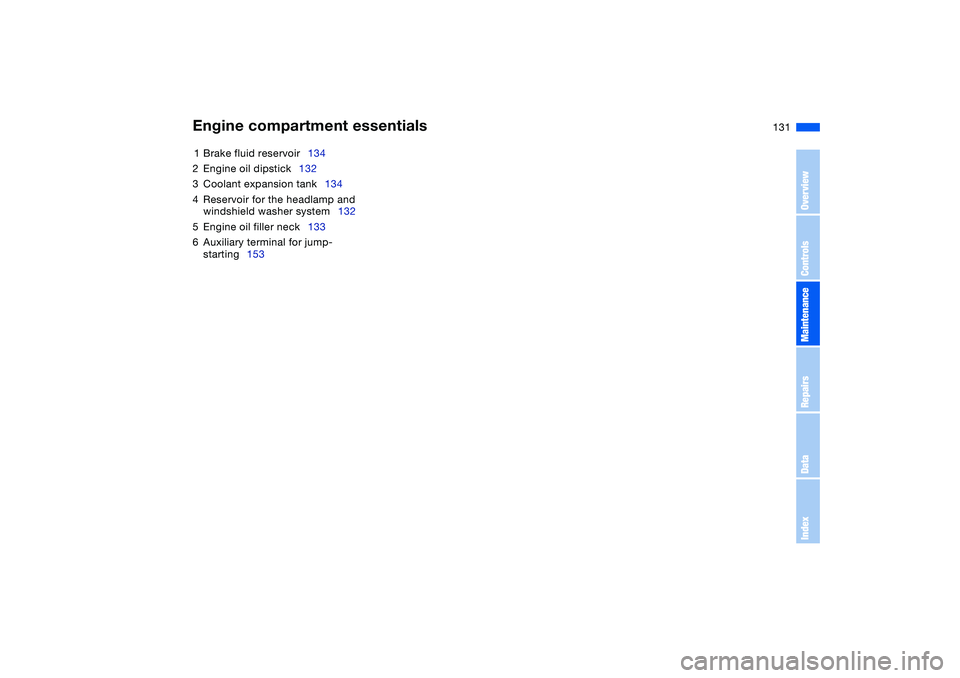
1Brake fluid reservoir134
2Engine oil dipstick132
3Coolant expansion tank134
4Reservoir for the headlamp and
windshield washer system132
5Engine oil filler neck133
6Auxiliary terminal for jump-
starting153Engine compartment essentials
OverviewControlsMaintenanceRepairsDataIndex
Page 134 of 182
134
Coolant
Do not add coolant to the cooling
system when the engine is hot. If
you attempt to do so, escaping coolant
can cause burns.
Antifreeze and anti-corrosion agents
are hazardous to health. You should
always store them in closed original
containers and in a location which is
out of reach of children. Antifreeze and
anti-corrosion agents are inflammable.
For this reason, do not spill them on hot
engine parts. They could ignite and
cause serious burns. Comply with the
instructions on the containers.<
Comply with the applicable envi-
ronmental laws regulating the dis-
posal of antifreeze agents with corro-
sion inhibitor.<
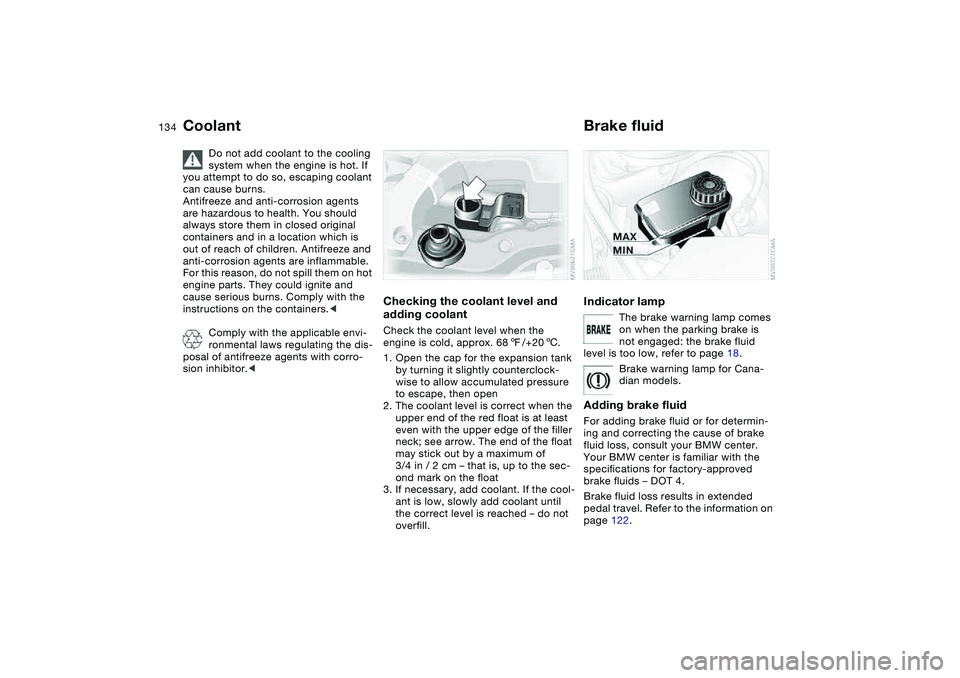
Checking the coolant level and
adding coolantCheck the coolant level when the
engine is cold, approx. 687/+206.
1. Open the cap for the expansion tank
by turning it slightly counterclock-
wise to allow accumulated pressure
to escape, then open
2. The coolant level is correct when the
upper end of the red float is at least
even with the upper edge of the filler
neck; see arrow. The end of the float
may stick out by a maximum of
3/4 in / 2 cm – that is, up to the sec-
ond mark on the float
3. If necessary, add coolant. If the cool-
ant is low, slowly add coolant until
the correct level is reached – do not
overfill.
Brake fluidIndicator lamp
The brake warning lamp comes
on when the parking brake is
not engaged: the brake fluid
level is too low, refer to page 18.
Brake warning lamp for Cana-
dian models.
Adding brake fluidFor adding brake fluid or for determin-
ing and correcting the cause of brake
fluid loss, consult your BMW center.
Your BMW center is familiar with the
specifications for factory-approved
brake fluids – DOT 4.
Brake fluid loss results in extended
pedal travel. Refer to the information on
page 122.
Page 135 of 182
135
Brake fluid is hygroscopic, that is,
it absorbs moisture from the air
over time.
In order to ensure the brake system's
safety and reliability, have the brake
fluid changed every two years by a
BMW center. Refer to the Service and
Warranty Information Booklet for US
models or the Warranty and Service
Guide Booklet for Canadian models.
Brake fluid is toxic and damages the
vehicle's paint. You should always store
it in its closed original container and in
a location which is out of reach of chil-
dren.
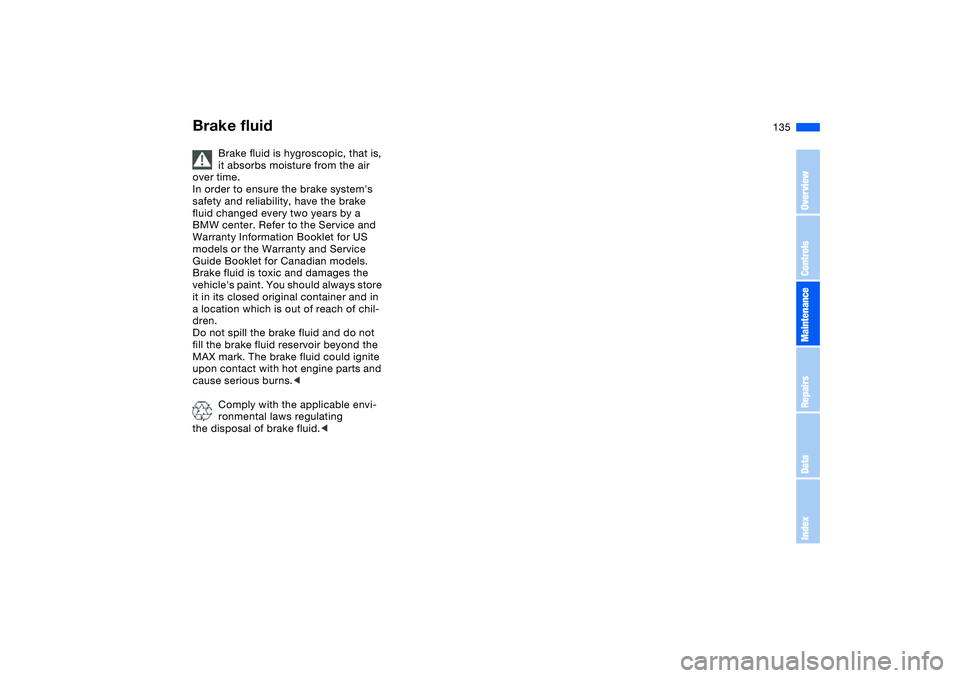
Do not spill the brake fluid and do not
fill the brake fluid reservoir beyond the
MAX mark. The brake fluid could ignite
upon contact with hot engine parts and
cause serious burns.<
Comply with the applicable envi-
ronmental laws regulating
the disposal of brake fluid.<
Brake fluid
OverviewControlsMaintenanceRepairsDataIndex
Page 166 of 182
Everything from A to ZA
ABS Antilock Brake
System 121
indicator lamp 18
Acceleration assistant 72
Accessories, refer to For
your own safety 5
Accident, refer to Emer-
gency call 152
Activated-charcoal filter 106
ADB-X Automatic Differen-
tial Brake, all-wheel 89
Adding brake fluid 134
Additional sources of infor-
mation 4
Air conditioning 98
Air conditioning mode 100
automatic climate
control 104
Air distribution
air conditioning 100
automatic climate
control 104
Air distribution,
individual 104
Air outlets, refer to Ventila-
tion 98, 102
Air pressure, refer to Tire
inflation pressure 25, 124
Air recirculation, refer to
Recirculated-air mode
100, 105Air supply
air conditioning 100
automatic climate
control 104
Air, drying, refer to Air con-
ditioning mode 100, 104
Airbags 57
indicator lamp 18, 59
sitting safely 47
Airing out, refer to Ventila-
tion 98, 102
Alarm system 41
avoiding unintentional
alarms 42
All-season tires, refer to
Winter tires 127
Antifreeze 134
coolant 134
washer fluid 132
Antilock Brake System
(ABS) 121
indicator lamp 18
Anti-theft system 32
Anti-theft warning system,
refer to Alarm system 41
Approved axle loads, refer
to Weights 162
Approved gross weight,
refer to Weights 162
Armrest
front 108
rear 109Artificial leather, refer to the
Caring for your vehicle
brochure
Ashtray
front 110
rear 111
Assistant systems, refer to
Dynamic Stability Control
(DSC) 87
AUC Automatic recircu-
lated-air control 105
AUTO program, refer
to Automatic air distribu-
tion 104
Automatic
air distribution 104
air supply 104
cruise control 78
headlamp control 94
Automatic car wash, refer to
the Caring for your vehicle
brochure
Automatic climate
control 102
Automatic curb monitor 54
Automatic Differential Brake,
all-wheel ADB-X 89
Automatic dimming, interior
rearview mirror 56
Automatic recirculated-air
control (AUC) 105Automatic transmission with
Steptronic 73
indicator lamp 19, 75
interlock 65
selector lever lock 73
shiftlock 73
Automatic windshield
washer, refer to Rain sen-
sor 77
Average fuel
consumption 85
Average speed 85
Avoiding unintentional
alarms 42
Axle loads, refer to
Weights 162
B
Backrest, adjusting 49
Backrest, refer to Seat
adjustment 48, 50
Backup lamps 68
bulb replacement 145
Bandages, refer to First-aid
kit 23
Battery 151
charge 151
disposal 151
indicator lamp 18
jump-starting 153
remote control 32, 33
Battery charge current 18