Page 117 of 174
117
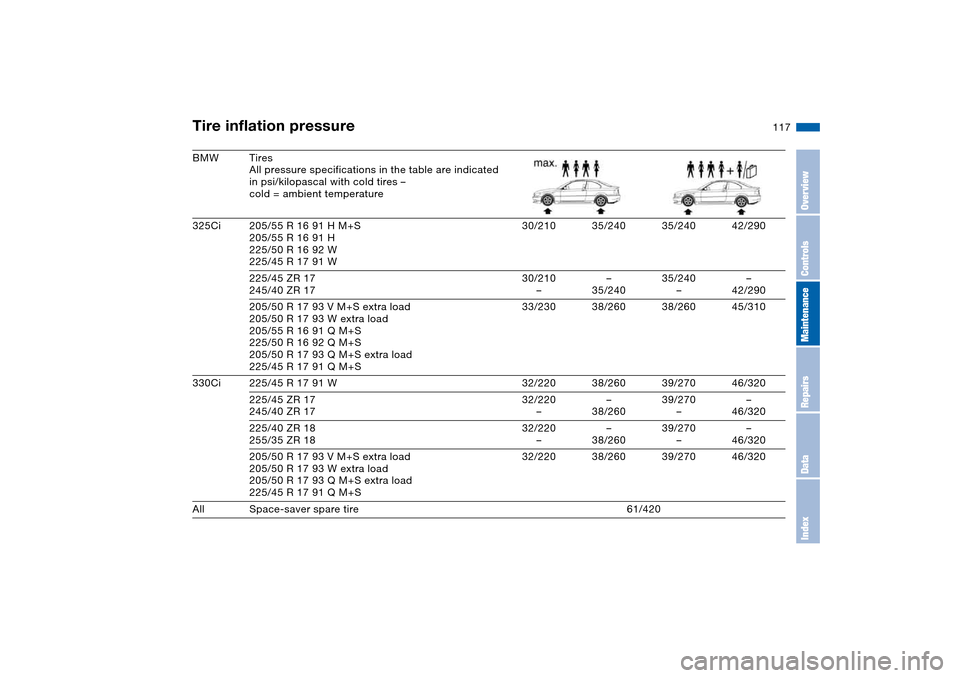
BMW Tires
All pressure specifications in the table are indicated
in psi/kilopascal with cold tires –
cold = ambient temperature
325Ci 205/55 R 16 91 H M+S
205/55 R 16 91 H
225/50 R 16 92 W
225/45 R 17 91 W30/210 35/240 35/240 42/290
225/45 ZR 17
245/40 ZR 1730/210
––
35/24035/240
––
42/290
205/50 R 17 93 V M+S extra load
205/50 R 17 93 W extra load
205/55 R 16 91 Q M+S
225/50 R 16 92 Q M+S
205/50 R 17 93 Q M+S extra load
225/45 R 17 91 Q M+S33/230 38/260 38/260 45/310
330Ci 225/45 R 17 91 W 32/220 38/260 39/270 46/320
225/45 ZR 17
245/40 ZR 1732/220
––
38/26039/270
––
46/320
225/40 ZR 18
255/35 ZR 1832/220
––
38/26039/270
––
46/320
205/50 R 17 93 V M+S extra load
205/50 R 17 93 W extra load
205/50 R 17 93 Q M+S extra load
225/45 R 17 91 Q M+S32/220 38/260 39/270 46/320
All Space-saver spare tire 61/420Tire inflation pressure
OverviewControlsMaintenanceRepairsDataIndex
Page 119 of 174

119
Those grades represent the tire's ability
to stop on wet pavement as measured
under controlled conditions on speci-
fied government test surfaces of
asphalt and concrete. A tire marked C
may have poor traction performance.
The traction grade assigned to
this tire is based on straight-
ahead braking traction tests, and does
not include acceleration, cornering,
hydroplaning, or peak traction charac-
teristics.
highest, B, and C, representing the
tire's resistance to the generation of
heat and its ability to dissipate heat
when tested under controlled condi-
tions on a specified indoor laboratory
test wheel.
Sustained high temperature can cause
the material of the tire to degenerate
and reduce tire life, and excessive tem-
perature can lead to sudden tire failure.
The grade C corresponds to a level of
performance which all passenger car
tires must meet under the Federal
Motor Vehicle Safety Standard No. 109.
Grades B and A represent higher levels
of performance on the laboratory test
wheel than the minimum required by
law.
The temperature grade for this tire
is established for a tire that is
properly inflated and not overloaded.
Excessive speed, underinflation, or
excessive loading, either separately or
in combination, can cause heat buildup
and possible tire failure.
wall with a circular symbol containing
the letters RSC, refer to page 120.M+SWinter and all-season tires. These have
better winter driving properties than
summer tires.
Tire conditionWheel/tire damageInspect your tires frequently for signs of
damage, foreign objects and tread
wear, and check tread depth.
Due to low-profile tires, please
note that wheels, tires and sus-
pension parts are more susceptible to
road hazard and consequential dam-
ages.
Unusual vibrations encountered during
normal vehicle operation can indicate a
flat tire or some other vehicle malfunc-
tion. This type of problem can be
caused by contact with curbs, etc. This
is also true for irregularities in the vehi-
cle's handling characteristics, such as a
pronounced tendency to pull to the left
or right.
Should this occur, respond by immedi-
ately reducing your speed. Proceed
carefully to the nearest BMW center or
professional tire center, or have the
vehicle towed there. Tire damage, up to
and including blowouts, can endanger
the lives of both the vehicle occupants
and other road users.<
Tire code
OverviewControlsMaintenanceRepairsDataIndex
Page 121 of 174

121
If there is a total loss of tire inflation
pressure, 0 psi/0 kPa, or obvious tire
damage, you can determine the dis-
tance you may continue driving based
on the following values:
>With a light load:
1 to 2 persons without luggage:
approx. 155 miles/250 km
>With a medium load:
2 persons, luggage compartment full;
or 4 persons without luggage:
approx. 90 miles/150 km
>With a full load:
4 persons or more, luggage compart-
ment full:
approx. 30 miles/50 km
Drive cautiously. Do not exceed a
speed of 50 mph / 80 km/h. Be
aware that vehicle handling will be
altered when there is a loss in inflation
pressure. Anticipate, e.g., reduced
tracking during braking, longer braking
distances and changed steering char-
acteristics.
For safety reasons, BMW recommends
not having damaged Run Flat tires
repaired. In this case, consult your
BMW center.<
New wheels and tires
Have new wheels and tires
mounted only by a skilled profes-
sional. Work that is improperly carried
out could result in consequential dam-
age and pose safety hazards.<
Ask your BMW center for details con-
cerning the correct wheel and tire com-
bination. Have the wheels balanced
each time a wheel or tire has been
replaced.
The correct wheel and tire combination
also affects different systems such as
ABS or DSC. The function of these sys-
tems is impaired if improper wheel and
tire combinations are used.
BMW advises against using
retreaded tires, as driving safety
could otherwise be impaired. This is
due to the possible variations in casing
structures and, in some cases, to their
extreme age, which can lead to a
decrease in their durability.<
The correct wheels and tires
BMW recommends using only
wheels and tires that have been
tested and approved by BMW for the
particular vehicle model, as otherwise
body contact and serious accidents can
result despite the use of the same nom-
inal size, e.g. due to manufacturing tol-
erances. BMW cannot evaluate all tires
and wheels on the market, and is thus
unable to guarantee that the vehicle will
continue to perform safely if unap-
proved tires and/or wheels are
mounted.<
To maintain good handling and vehicle
response, use only tires of a single
brand and tread configuration. After a
flat tire, have the previous wheel and
tire combination restored as soon as
possible.
Recommended tire sizes and
brandsFor each tire size, certain tire brands
have been tested, classified as road-
safe and approved by BMW. You can
find out about these from a professional
Run Flat tires*
OverviewControlsMaintenanceRepairsDataIndex
Page 123 of 174
123 In the engine compartment
HoodTo releasePull the lever located under the left-
hand side of the instrument panel.
Do not attempt to service your
vehicle if you do not have the
required technical background. If you
are not familiar with the regulations to
be observed, have your vehicle ser-
viced only by a BMW center or a shop
that works according to BMW require-
ments with the appropriately trained
personnel. Work that is improperly car-
ried out could result in consequential
damage and pose safety hazards.<
To openPull the release handle and open the
hood.
To closeAllow the hood to fall from a height of
about 1 ft/30 cm so that it audibly
engages.
To avoid injuries, be sure that the
travel path of the hood is clear
when it is closed, following the same
safety precautions used in all closing
procedures.
If you notice while driving that the hood
is not completely closed, stop immedi-
ately and close it securely.<
OverviewControlsMaintenanceRepairsDataIndex
Page 125 of 174
125
1Brake fluid reservoir128
2Engine oil dipstick126
3Coolant expansion tank128
4Reservoir for the headlamp and
windshield washer system126
5Engine oil filler neck127
6Auxiliary terminal for jump-
starting147Engine compartment essentials
OverviewControlsMaintenanceRepairsDataIndex
Page 127 of 174
127
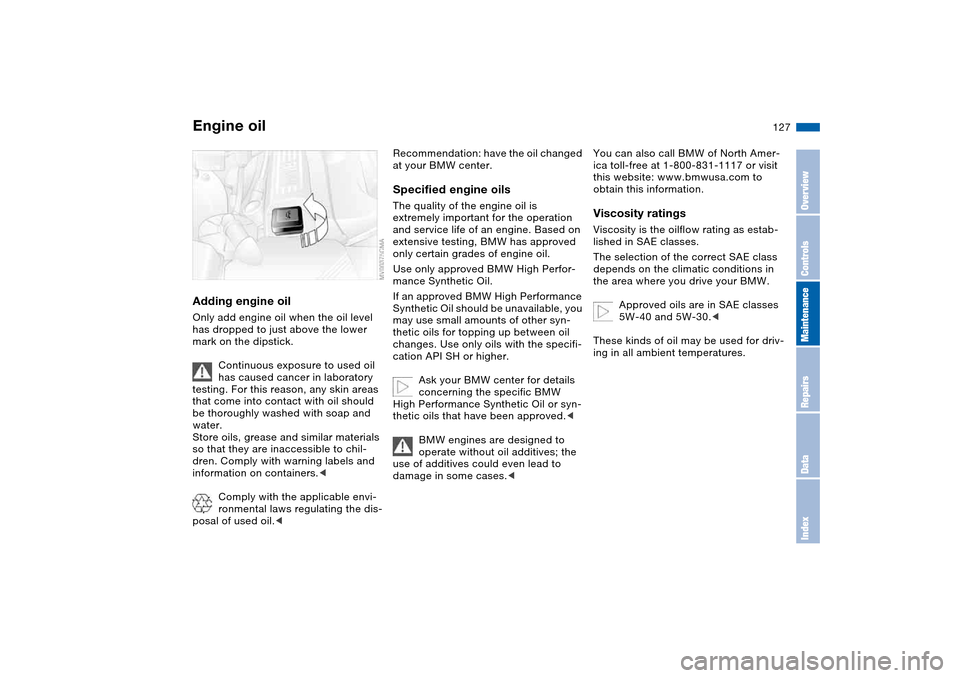
Adding engine oilOnly add engine oil when the oil level
has dropped to just above the lower
mark on the dipstick.
Continuous exposure to used oil
has caused cancer in laboratory
testing. For this reason, any skin areas
that come into contact with oil should
be thoroughly washed with soap and
water.
Store oils, grease and similar materials
so that they are inaccessible to chil-
dren. Comply with warning labels and
information on containers.<
Comply with the applicable envi-
ronmental laws regulating the dis-
posal of used oil.<
Recommendation: have the oil changed
at your BMW center.Specified engine oilsThe quality of the engine oil is
extremely important for the operation
and service life of an engine. Based on
extensive testing, BMW has approved
only certain grades of engine oil.
Use only approved BMW High Perfor-
mance Synthetic Oil.
If an approved BMW High Performance
Synthetic Oil should be unavailable, you
may use small amounts of other syn-
thetic oils for topping up between oil
changes. Use only oils with the specifi-
cation API SH or higher.
Ask your BMW center for details
concerning the specific BMW
High Performance Synthetic Oil or syn-
thetic oils that have been approved.<
BMW engines are designed to
operate without oil additives; the
use of additives could even lead to
damage in some cases.<
You can also call BMW of North Amer-
ica toll-free at 1-800-831-1117 or visit
this website: www.bmwusa.com to
obtain this information.Viscosity ratingsViscosity is the oilflow rating as estab-
lished in SAE classes.
The selection of the correct SAE class
depends on the climatic conditions in
the area where you drive your BMW.
Approved oils are in SAE classes
5W-40 and 5W-30.<
These kinds of oil may be used for driv-
ing in all ambient temperatures.
Engine oil
OverviewControlsMaintenanceRepairsDataIndex
Page 129 of 174
129
Adding brake fluidFor adding brake fluid or for determin-
ing and correcting the cause of brake
fluid loss, consult your BMW center.
Your BMW center is familiar with the
specifications for factory-approved
brake fluids – DOT 4.
Brake fluid loss may result in extended
brake pedal travel.
Brake fluid is hygroscopic, that is,
it absorbs moisture from the air
over time.
In order to ensure the brake system's
safety and reliability, have the brake
fluid changed every two years by a
BMW center. Refer to the Service and
Warranty Information Booklet for US
models or the Warranty and Service
Guide Booklet for Canadian models.
Brake fluid is toxic and damages the
vehicle's paint. You should always store
it in its closed original container and in
a location which is out of reach of chil-
dren.
Do not spill the brake fluid and do not
fill the brake fluid reservoir beyond the
MAX mark. The brake fluid could ignite
upon contact with hot engine parts and
cause serious burns.<
Comply with the applicable envi-
ronmental laws regulating
the disposal of brake fluid.<
Brake fluid
OverviewControlsMaintenanceRepairsDataIndex
Page 131 of 174
131
Have your BMW center perform
maintenance and repair.
Be sure that all maintenance work is
recorded in the Service and Warranty
Information Booklet for US models, or
in the Warranty and Service Guide
Booklet for Canadian models. These
entries are your verification of regular
maintenance on your vehicle and are
required for the performance of war-
ranty repairs.<
CareYou can find everything you need to
know on this topic by consulting the
separate Caring for your vehicle bro-
chure.BMW Maintenance System
OverviewControlsMaintenanceRepairsDataIndex