Page 37 of 283

Only a rear-f acing child seat provides
proper support f or a baby’s head,
neck, and back.
An inf ant must be properly
restrained in a rear-f acing, reclining
child seat until the child reaches the
seat maker’s weight or height limit
f or the seat, and the child is at least
one year old.Two types of seats may be used: a
seat designed exclusively f or inf ants,
or a convertible seat used in the rear-
f acing, reclining mode.
If placed
f acing f orward, an inf ant could be
very seriously injured during a
f rontal collision. In this vehicle, a rear-f acing child
seatcanbeplacedinanyseating
position in the back seat, but not in
the front.
When properly installed, a rear-
f acing child seat may prevent the
driver or a f ront passenger f rom
moving the seat as far back as
recommended, or f rom locking the
seat-back in the desired position.
If the passenger’s
f ront airbag inf lates, it can hit the
back of the child seat with enough
f orce to kill or seriously injure an
inf ant.
In either of these situations, we
strongly recommend that you install
the child seat in a dif f erent back
seating position or get a smaller rear-
f acing child seat.
Protecting Inf ants and Small Children
Protecting Inf ants
Child Seat T ype
Do not put a rear-f acing child seat ina f orward-f acing position. Child Seat Placement
Never put a rear-f acing child seat inthe front seat.
Driver and Passenger Saf ety34
Placing a rear-facing child seat
in the front seat can result in
serious injury or death if the
passenger’s front airbag inflates.
Always place a rear-facing child
seat in the back seat, not the
front.
Page 43 of 283
When not using the LATCH system,
all child seats must be secured to the
vehicle with the lap part of a lap/
shoulder belt.
In addition, the lap/shoulder belts in
the back seating positions, and in the
f ront passenger seat, have a locking
mechanism that must be activated to
secure a child seat.With the child seat in the desired
seating position, route the belt
through the child seat according
to the seat maker’s instructions,
then insert the latch plate into the
buckle.To activate the lockable retractor,
slowly pull the shoulder part of the
belt all the way out until it stops,
then let the belt f eed back into the
retractor.
Af ter the belt has retracted, tug on
it. If the belt is locked, you will not
be able to pull it out. If you can pull
thebeltout,itisnotlocked,and
you will need to repeat these steps.
1.
2.
3.
Installing a Child Seat
Driver and Passenger Saf ety
Installing a Child Seat with a L ap/
Shoulder Belt
40
Page 44 of 283
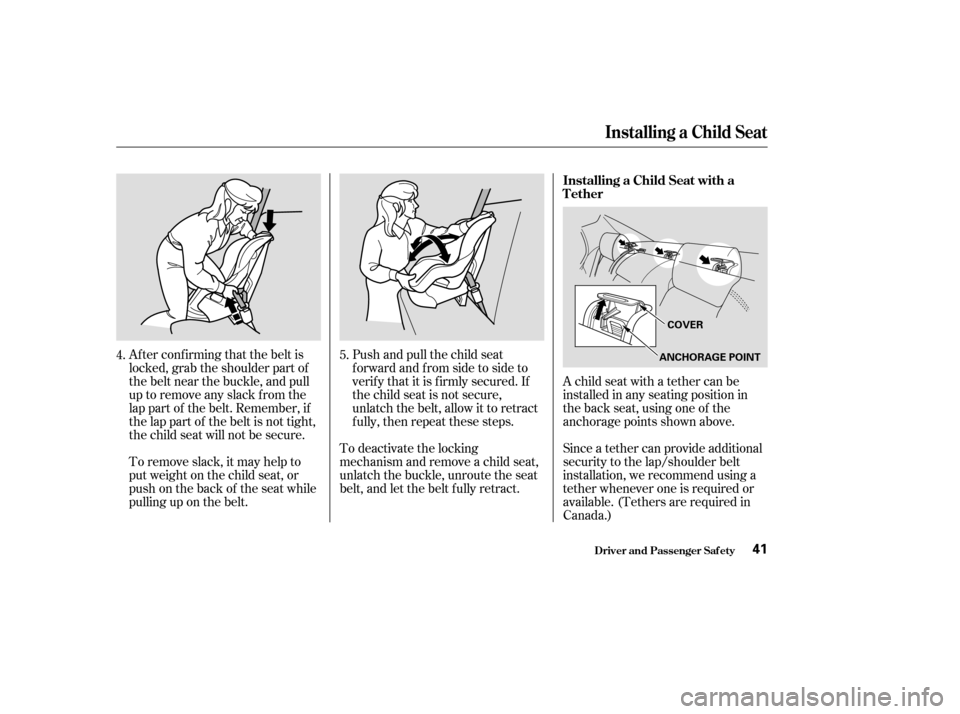
Push and pull the child seat
f orward and f rom side to side to
verif y that it is f irmly secured. If
the child seat is not secure,
unlatch the belt, allow it to retract
f ully, then repeat these steps.
To deactivate the locking
mechanism and remove a child seat,
unlatch the buckle, unroute the seat
belt, and let the belt f ully retract. A child seat with a tether can be
installed in any seating position in
the back seat, using one of the
anchorage points shown above.
Since a tether can provide additional
security to the lap/shoulder belt
installation, we recommend using a
tether whenever one is required or
available. (Tethers are required in
Canada.)
Af ter conf irming that the belt is
locked, grab the shoulder part of
the belt near the buckle, and pull
up to remove any slack from the
lap part of the belt. Remember, if
the lap part of the belt is not tight,
the child seat will not be secure.
To remove slack, it may help to
putweightonthechildseat,or
push on the back of the seat while
pulling up on the belt.
4.
5.
Installing a Child Seat
Driver and Passenger Saf ety
Installing a Child Seat with a
Tether
41
COVER
ANCHORAGE POINT
Page 52 of 283

This section gives inf ormation about
the controls and displays that
contribute to the daily operation of
your Acura. All the essential controls
are within easy reach............................
Control Locations .50
............................
Instrument Panel .51
..........
Instrument Panel Indicators . 52
.............................................
Gauges .57
...................
Temperature Gauge . 57
..................................
Fuel Gauge .57
.............
Multi-Inf ormation Display . 58
......
Controls Near Steering Wheel . 72
.
Windshield Wipers and Washers . 73
...........
Turn Signal and Headlights . 74
........................................
Fog Lights .75
........
Instrument Panel Brightness . 75
..................
Automatic Lighting Off . 76
.................
Hazard Warning Button . 76
.................
Rear Window Def ogger . 77
..........
Steering Wheel Adjustment . 78
..................................................
Keys .79
................................
Ignition Switch .80
........................
Immobilizer System .81
......................................
Door Locks .82
................................................
Trunk .83
............
Emergency Trunk Opener . 84
..................
Childproof Door Locks . 84
.......................
Remote Transmitter .85
.................................................
Seats .90
............
Trunk Pass-through Cover . 90.............................................
Mirrors .91
Driving Position Memory ..........................................
System .93
....................................
Seat Heaters .96
..............................
Power Windows .97
.......................................
Moonroof .100
..............................................
Clock .103
...............................
Parking Brake .103
...............................
Interior Lights .104
.........
Interior Convenience Items . 105
.......................
Beverage Holder .106
.........
Accessory Power Socket . 106
..................................
Glove Box .107
.............
Console Compartment . 107
....................
Front Door Pocket . 108
Instruments and Controls
Inst rument s and Cont rols49
Page 53 of 283
Control L ocations
Inst rument s and Cont rols50
DRIVING POSITION
MEMORYPOWER DOOR LOCKS
POWER WINDOW
SWITCHES MIRROR
CONTROLS
TRUNK RELEASE
BUTTON CLOCK
CLIMATE CONTROL
SYSTEM
AUDIO SYSTEM
HOOD RELEASE
HANDLE
FUEL FILL DOOR
RELEASE HANDLE
(P.93)
(P.82)
(P.97)
(P.83) (P.91)
(P.165) (P.103)
(P.166) (P.110)
(P.117)
Page 54 of 283
Inst rument s and Cont rols
Instrument Panel
51
HIGH BEAM INDICATOR
CHARGING SYSTEM
INDICATOR
SUPPLEMENTAL
RESTRAINT
SYSTEM INDICATOR
LIGHTS ON
INDICATOR
CRUISE MAIN
INDICATOR
SEAT BELT REMINDER
INDICATOR
CRUISE CONTROL
INDICATOR
VEHICLE
STABILITY
ASSIST (VSA)
SYSTEM
INDICATOR
LOW OIL PRESSURE
INDICATOR MULTI-INFORMATION
DISPLAY
SIDE AIRBAG OFF
INDICATOR
ANTI-LOCK BRAKE
SYSTEM INDICATOR LOW FUEL INDICATORPARKING BRAKE AND
BRAKE SYSTEM INDICATOR
VSA ACTIVATION
INDICATOR
FOG LIGHT
INDICATOR
MALFUNCTION INDICATOR LAMP
IMMOBILIZER SYSTEM
INDICATOR
(P.54)
(P.52)
(P.53) (P.55)
(P.54) (P.55)
(P.54)
(P.52, 240)
(P.56) (P.52,
240) (P.56) (P.52,
243) (P.53)
(P.59)
(P.56)
(P.52)
(P.53)
(P.54)
Page 56 of 283

This indicator normally comes on f or
a f ew seconds when you turn the
ignition switch to ON (II), and when
the ignition switch is turned to
START (III). If this indicator comes
on at any other time, there is a
problem in the ABS. If this happens,
take the vehicle to your dealer to
have it checked. With the indicator
on, your vehicle still has normal
braking ability but no anti-lock. For
more inf ormation, see page .This indicator comes on brief ly when
you turn the ignition switch to ON
(II). If it comes on at any other time,
it indicates a potential problem with
your f ront airbags. This light will
also alert you to a potential problem
with your side airbags, passenger’s
side airbag automatic cutoff system,
automatic seat belt tensioners, or
side curtain airbags. For more
inf ormation, see page .
This indicator comes on when you
turn the ignition switch to ON (II). If
it comes on at any other time, it
indicates that the passenger’s side
airbag has automatically shut off.
For more inf ormation, see page .
27
26
189
Instrument Panel Indicators
Inst rument s and Cont rols
Anti-lock Brake System
(A BS) Indicator Supplemental Restraint
System IndicatorSide A irbag Cutof f
Indicator
53
Page 58 of 283

The lef t or right turn signal light
blinks when you signal a lane change
or turn. If the indicators do not blink
or blinks rapidly, it usually means
one of the turn signal bulbs is
burned out (see page ). Replace
the bulb as soon as possible, since
other drivers cannot see that you are
signaling.
When you press the Hazard Warning
button, both turn signals blink. All
turn signals on the outside of the
vehicle should f lash.This indicator reminds you that the
exterior lights are on. It comes on
when the light switch is in either the
or position. If you turn the
ignition switch to ACCESSORY (I)
or LOCK (0) without turning of f the
light switch, this indicator will
remain on. A reminder chime will
also sound when you open the driver’s
door.
This indicator comes on when you
turn the ignition switch to ON (II)
with the headlight switch off and the
parking brake set. It should go of f if
youturnontheheadlightsorrelease
the parking brake. If it comes on at
any other time, it means there is a
problem with the DRL.
This indicator comes on with the
high beam headlights. See page
f or inf ormation on the headlight
controls.
214
74
Canadian models only
Instrument Panel Indicators
Inst rument s and Cont rols
Turn Signal and
Hazard Warning
Indicators ‘‘Daytime Running
Lights’’ Indicator
Lights On Indicator
High Beam Indicator
55


