Page 50 of 90

Torque specifications
Use a torque wrench to tighten these items. It is
recommended that these items be checked occasionally,
specially before a long trip. Always check the tightness of
these items whenever they are loosened for any reason.
!�
Torque
Nm
kgf.m Item
Spark plug
Engine oil drain plug
Oil check bolt
Front wheel axle nut
Rear wheel axle nut
12,5
20
7
59
911,25
2,0
0,7
5,9
9,1
A
(Nut)
10 mm
12 mm
14 mm
17 mm
19 mm
22 mmB
(Bolt)
6 mm
8 mm
10 mm
12 mm
14 mm
16 mmGeneral torque especifications
Nm
6
15
30
55
85
130kgf.m
0,6
1,5
3,0
5,5
8,5
13,0lbf. ft
4,3
11
22
40
61
94
lbf.ft
9.0
14.5
5.0
43
66
Torque specifications
Use a torque wrench to tighten these items. It is
recommended that these items be checked occasionally,
specially before a long trip. Always check the tightness of
these items whenever they are loosened for any reason.
!�
Torque
Nm
kgf.m Item
Spark plug
Engine oil drain plug
Oil check bolt
Front wheel axle nut
Rear wheel axle nut
12,5
20
7
59
911,25
2,0
0,7
5,9
9,1
A
(Nut)
10 mm
12 mm
14 mm
17 mm
19 mm
22 mmB
(Bolt)
6 mm
8 mm
10 mm
12 mm
14 mm
16 mmGeneral torque especifications
Nm
6
15
30
55
85
130kgf.m
0,6
1,5
3,0
5,5
8,5
13,0lbf. ft
4,3
11
22
40
61
94
lbf.ft
9.0
14.5
5.0
43
66
Page 61 of 90

!��!
Rear brake adjustment
A
a. Free play: 20 ~ 30 mm (0.8 ~ 1.2 in)
Check the free play the rear brake pedal free play should
be adjusted to 20 ~ 30 mm (0.8 ~ 1.2 in) at the brake pedal
end.
Turn the adjusting nut in direction � to increase free play
and in direction � to decrease free play.
Press the brake pedal several times and check if the wheel
turns free when the pedal is released.
For brake pedal adjustment, be sure to proceed as
follows (it is advisable to have a Yamaha dealer make
this adjustment.)
Check the operation of the brake light after adjusting
the rear brake.
1. Adjusting nut
CAUTION:
!��!
Rear brake adjustment
A
a. Free play: 20 ~ 30 mm (0.8 ~ 1.2 in)
Check the free play the rear brake pedal free play should
be adjusted to 20 ~ 30 mm (0.8 ~ 1.2 in) at the brake pedal
end.
Turn the adjusting nut in direction � to increase free play
and in direction � to decrease free play.
Press the brake pedal several times and check if the wheel
turns free when the pedal is released.
For brake pedal adjustment, be sure to proceed as
follows (it is advisable to have a Yamaha dealer make
this adjustment.)
Check the operation of the brake light after adjusting
the rear brake.
1. Adjusting nut
CAUTION:
Page 66 of 90
!���
�
Drive chain slack check NOTE:
Spin the wheel several times and find the tightest position
of the chain. Check and/or adjust the chain slack while it is
in this tightest position.
To check the chain slack the motorcycle must be held
straight up with both wheels on the ground and without rider.
Check the slack at the position shown in the illustration.
Normal slack is approximately 20 ~ 30 mm ( 0.8 ~ 1.2
in). If the slack exceeds 30 mm ( 1.2 in), adjust.
a. 20 ~ 30 mm (0.8 ~ 1.2 in)
!���
�
Drive chain slack check NOTE:
Spin the wheel several times and find the tightest position
of the chain. Check and/or adjust the chain slack while it is
in this tightest position.
To check the chain slack the motorcycle must be held
straight up with both wheels on the ground and without rider.
Check the slack at the position shown in the illustration.
Normal slack is approximately 20 ~ 30 mm ( 0.8 ~ 1.2
in). If the slack exceeds 30 mm ( 1.2 in), adjust.
a. 20 ~ 30 mm (0.8 ~ 1.2 in)
Page 67 of 90
!���
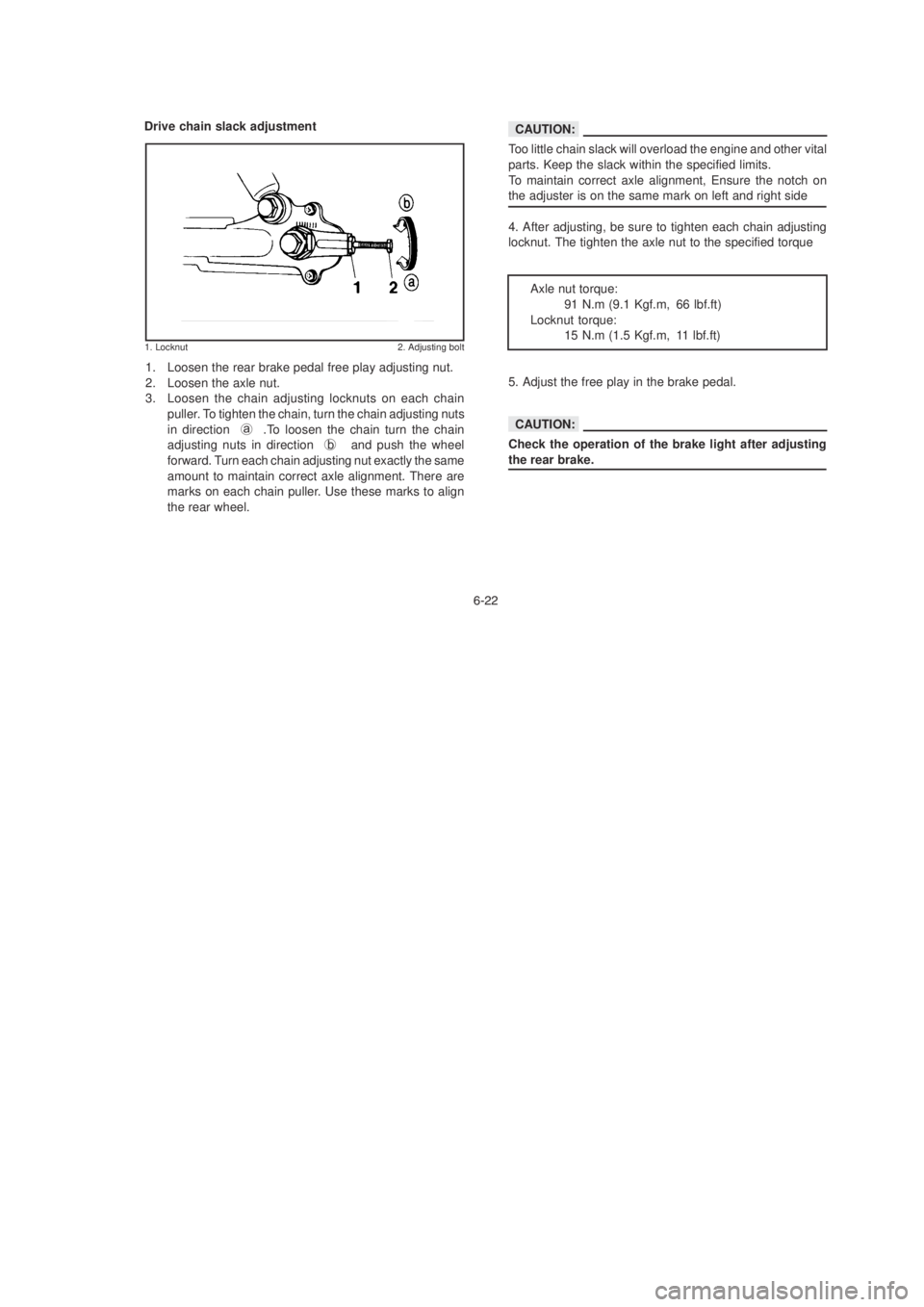
Drive chain slack adjustment
1. Locknut 2. Adjusting bolt
1. Loosen the rear brake pedal free play adjusting nut.
2. Loosen the axle nut.
3. Loosen the chain adjusting locknuts on each chainpuller. To tighten the chain, turn the chain adjusting nuts
in direction � .To loosen the chain turn the chain
adjusting nuts in direction �� and push the wheel
forward. Turn each chain adjusting nut exactly the same
amount to maintain correct axle alignment. There are
marks on each chain puller. Use these marks to align
the rear wheel. Too little chain slack will overload the engine and other vital
parts. Keep the slack within the specified limits.
To maintain correct axle alignment, Ensure the notch on
the adjuster is on the same mark on left and right side
4. After adjusting, be sure to tighten each chain adjusting
locknut. The tighten the axle nut to the specified torque
Axle nut torque: 91 N.m (9.1 Kgf.m, 66 lbf.ft)
Locknut torque: 15 N.m (1.5 Kgf.m, 11 lbf.ft)
5. Adjust the free play in the brake pedal.
Check the operation of the brake light after adjusting
the rear brake.
CAUTION:
CAUTION:
!���
Drive chain slack adjustment
1. Locknut 2. Adjusting bolt
1. Loosen the rear brake pedal free play adjusting nut.
2. Loosen the axle nut.
3. Loosen the chain adjusting locknuts on each chain puller. To tighten the chain, turn the chain adjusting nuts
in direction � .To loosen the chain turn the chain
adjusting nuts in direction �� and push the wheel
forward. Turn each chain adjusting nut exactly the same
amount to maintain correct axle alignment. There are
marks on each chain puller. Use these marks to align
the rear wheel. Too little chain slack will overload the engine and other vital
parts. Keep the slack within the specified limits.
To maintain correct axle alignment, Ensure the notch on
the adjuster is on the same mark on left and right side
4. After adjusting, be sure to tighten each chain adjusting
locknut. The tighten the axle nut to the specified torque
Axle nut torque: 91 N.m (9.1 Kgf.m, 66 lbf.ft)
Locknut torque: 15 N.m (1.5 Kgf.m, 11 lbf.ft)
5. Adjust the free play in the brake pedal.
Check the operation of the brake light after adjusting
the rear brake.
CAUTION:
CAUTION:
Page 71 of 90

6-26
Periodically inspect the condition of the steering. Worn out
or loose steering bearings may be dangerous. Place a stand
under the engine to raise the front wheel off the ground.
Hold the lower end of the front forks and try to move them
forward and backward. If any free play can be felt, ask a
Yamaha dealer to inspect and adjust the steering. Inspection
is easier if the front wheel is removed.
Securely support the motorcycle so there is no danger
of it falling over.Wheel bearings
If there is play in the front or rear wheel hub or if the wheel
does not turn smoothly, have a Yamaha dealer inspect the
wheel bearings. The wheel bearings should be inspected
according to the Maintenance Schedule.
Steering inspection
WARNING:
6-26
Periodically inspect the condition of the steering. Worn out
or loose steering bearings may be dangerous. Place a stand
under the engine to raise the front wheel off the ground.
Hold the lower end of the front forks and try to move them
forward and backward. If any free play can be felt, ask a
Yamaha dealer to inspect and adjust the steering. Inspection
is easier if the front wheel is removed.
Securely support the motorcycle so there is no danger
of it falling over. Wheel bearings
If there is play in the front or rear wheel hub or if the wheel
does not turn smoothly, have a Yamaha dealer inspect the
wheel bearings. The wheel bearings should be inspected
according to the Maintenance Schedule.
Steering inspection
WARNING:
Page 78 of 90
6-33
It is advisable to have a Yamaha dealer service the
wheel.
Securely support the motorcycle so there is no danger
of it falling over. Front wheel removal
1. Place the motorcycle on the centerstand.
2. Remove the speedometer cable.
3. Remove the axle nut and axle.
NOTE:
Do not depress the brake lever when the disc is off the
caliper as the brake pads will be forced shut.
1. Axle nut 2. Speedometer cable
CAUTION:
6-33
It is advisable to have a Yamaha dealer service the
wheel.
Securely support the motorcycle so there is no danger
of it falling over. Front wheel removal
1. Place the motorcycle on the centerstand.
2. Remove the speedometer cable.
3. Remove the axle nut and axle.
NOTE:
Do not depress the brake lever when the disc is off the
caliper as the brake pads will be forced shut.
1. Axle nut 2. Speedometer cable
CAUTION:
Page 79 of 90
6-34
Front wheel installationWhen installing the front wheel, reverse the removal
procedures.
Pay attention to the following points:
1. Make sure that wheel boss and speedometer gear be installed with their projection fitted on their respective
slits. Axle nut torque:
59 N.m (5.9 Kgf.m, 43 lb.ft)
2. Make sure the slot inthe brake shoe plate fits over the
stopper on the front fork outer tube.
3. Make sure the axle nut is properly torqued.
6-34
Front wheel installation
When installing the front wheel, reverse the removal
procedures.
Pay attention to the following points:
1. Make sure that wheel boss and speedometer gear be installed with their projection fitted on their respective
slits. Axle nut torque:
59 N.m (5.9 Kgf.m, 43 lb.ft)
2. Make sure the slot inthe brake shoe plate fits over the
stopper on the front fork outer tube.
3. Make sure the axle nut is properly torqued.
Page 80 of 90

6-35
3
21
Rear wheel removal
It is advisable to have a Yamaha dealer service the
wheel.
Securely support the motorcycle so there is no danger
of it falling over.
1. Place the motorcycle on the centerstand.
2. Remove the cotter pin and nut. Then remove the tension
bar from the brake shoe plate.3. Remove the brake adjusting nut and brake rod from
the brake cam lever.
4. Remove the axle nut and axle.
5. Remove the wheel assembly.
1. Nut 2. Cotter pin3. Tension bar
CAUTION:
1. Adjusting Nut 2. Brake Rod 3. Axle Nut
6-35
3
21
Rear wheel removal
It is advisable to have a Yamaha dealer service the
wheel.
Securely support the motorcycle so there is no danger
of it falling over.
1. Place the motorcycle on the centerstand.
2. Remove the cotter pin and nut. Then remove the tension
bar from the brake shoe plate.3. Remove the brake adjusting nut and brake rod from
the brake cam lever.
4. Remove the axle nut and axle.
5. Remove the wheel assembly.
1. Nut 2. Cotter pin3. Tension bar
CAUTION:
1. Adjusting Nut 2. Brake Rod 3. Axle Nut


