Page 44 of 102
OPERATION AND IMPORTANT RIDING POINTS
5-5
5
EAU00460
Parking When parking, stop the engine, and
then remove the key from the main
switch.
EW000058
WARNING
_ �
Since the engine and exhaust
system can become very hot,
park in a place where pedestri-
ans or children are not likely to
touch them.
�
Do not park on a slope or on
soft ground, otherwise the
motorcycle may overturn.
_U5WME0.book Page 5 Monday, July 29, 2002 10:25 AM
Page 46 of 102

6-1
6
EAU00462
6-PERIODIC MAINTENANCE AND MINOR REPAIR
EAU00464
Safety is an obligation of the owner.
Periodic inspection, adjustment and lu-
brication will keep your vehicle in the
safest and most efficient condition pos-
sible. The most important points of in-
spection, adjustment, and lubrication
are explained on the following pages.
The intervals given in the periodic
maintenance and lubrication chart
should be simply considered as a gen-
eral guide under normal riding condi-
tions. However, DEPENDING ON THE
WEATHER, TERRAIN, GEOGRAPHI-
CAL LOCATION, AND INDIVIDUAL
USE, THE MAINTENANCE INTER-
VALS MAY NEED TO BE SHORT-
ENED.
EW000060
WARNING
_ If you are not familiar with motor-
cycle maintenance work, have a
Yamaha dealer do it for you. _
EAU03758
Owner’s tool kit The owner’s tool kit is located under
the seat. (See page 3-11 for seat re-
moval and installation procedures.)
The service information included in this
manual and the tools provided in the
owner’s tool kit are intended to assist
you in the performance of preventive
maintenance and minor repairs. How-
ever, additional tools such as a torque
wrench may be necessary to perform
certain maintenance work correctly.
NOTE:_ If you do not have the tools or experi-
ence required for a particular job, have
a Yamaha dealer perform it for you. _
EW000063
WARNING
_ Modifications not approved by
Yamaha may cause loss of perfor-
mance and render the vehicle un-
safe for use. Consult a Yamaha
dealer before attempting any chang-
es. _
1. Owner’s tool kit
U5WME0.book Page 1 Monday, July 29, 2002 10:25 AM
Page 55 of 102

PERIODIC MAINTENANCE AND MINOR REPAIR
6-10
6
ECA00133
CAUTION:_ �
In order to prevent clutch slip-
page (since the engine oil also
lubricates the clutch), do not
mix any chemical additives. Do
not use oils with a diesel speci-
fication of “CD” or oils of a
higher quality than specified. In
addition, do not use oils labeled
“ENERGY CONSERVING II” or
higher.
�
Make sure that no foreign mate-
rial enters the crankcase.
_
11. Start the engine, and then let it idle
for several minutes while checking
it for oil leakage. If oil is leaking,
immediately turn the engine off
and check for the cause.NOTE:_ After the engine is started, the engine
oil level warning light should go off if the
oil level is sufficient. _
EC000067
CAUTION:_ If the oil level warning light flickers
or remains on, immediately turn the
engine off and have a Yamaha deal-
er check the vehicle. _12. Turn the engine off, and then
check the oil level and correct it if
necessary. Recommended engine oil:
See page 8-1.
Oil quantity:
Without oil filter element replace-
ment:
3.0 L
With oil filter element replace-
ment:
3.35 L
Total amount (dry engine):
4.2 L
U5WME0.book Page 10 Monday, July 29, 2002 10:25 AM
Page 59 of 102

PERIODIC MAINTENANCE AND MINOR REPAIR
6-14
6
EAU00637
Adjusting the valve clearance The valve clearance changes with use,
resulting in improper air-fuel mixture
and/or engine noise. To prevent this
from occurring, the valve clearance
must be adjusted by a Yamaha dealer
at the intervals specified in the periodic
maintenance and lubrication chart.
EAU00658
Tires To maximize the performance, durabil-
ity, and safe operation of your motor-
cycle, note the following points
regarding the specified tires.
Tire air pressure
The tire air pressure should be
checked and, if necessary, adjusted
before each ride.
EW000082
WARNING
_ �
The tire air pressure must be
checked and adjusted on cold
tires (i.e., when the temperature
of the tires equals the ambient
temperature).
�
The tire air pressure must be
adjusted in accordance with the
riding speed and with the total
weight of rider, passenger, car-
go, and accessories approved
for this model.
_
CE-01E
CE-07E
Tire air pressure
(measured on cold tires)
Load* Front Rear
Up to 90 kg250 kPa
(2.50 kgf/cm
2,
2.50 bar)250 kPa
(2.50 kgf/cm
2,
2.50 bar)
90 kg–maximum250 kPa
(2.50 kgf/cm
2,
2.50 bar)290 kPa
(2.90 kgf/cm
2,
2.90 bar)
High-speed riding250 kPa
(2.50 kgf/cm
2,
2.50 bar)290 kPa
(2.90 kgf/cm
2,
2.90 bar)
Maximum load* 203 kg
* Total weight of rider, passenger, cargo and
accessories
U5WME0.book Page 14 Monday, July 29, 2002 10:25 AM
Page 60 of 102

PERIODIC MAINTENANCE AND MINOR REPAIR
6-15
6
EWA00012
WARNING
_ Because loading has an enormous
impact on the handling, braking,
performance and safety characteris-
tics of your motorcycle, you should
keep the following precautions in
mind. �
NEVER OVERLOAD THE
MOTORCYCLE! Operation of an
overloaded motorcycle may re-
sult in tire damage, loss of con-
trol, or severe injury. Make sure
that the total weight of rider,
passenger, cargo, and accesso-
ries does not exceed the speci-
fied maximum load for the
vehicle.
�
Do not carry along loosely
packed items, which can shift
during a ride.
�
Securely pack the heaviest
items close to the center of the
motorcycle and distribute the
weight evenly on both sides.
�
Adjust the suspension and tire
air pressure with regard to the
load.
�
Check the tire condition and air
pressure before each ride.
_
Tire inspection
The tires must be checked before each
ride. If the center tread depth reaches
the specified limit, if the tire has a nail
or glass fragments in it, or if the side-
wall is cracked, have a Yamaha dealer
replace the tire immediately.CE-08ENOTE:_ The tire tread depth limits may differ
from country to country. Always comply
with the local regulations. _1. Tire sidewall
a. Tire tread depthMinimum tire tread depth
(front and rear)1.6 mm
U5WME0.book Page 15 Monday, July 29, 2002 10:25 AM
Page 61 of 102

PERIODIC MAINTENANCE AND MINOR REPAIR
6-16
6
EW000079
WARNING
_ �
Have a Yamaha dealer replace
excessively worn tires. Besides
being illegal, operating the
motorcycle with excessively
worn tires decreases riding sta-
bility and can lead to loss of
control.
�
The replacement of all wheel-
and brake-related parts, includ-
ing the tires, should be left to a
Yamaha dealer, who has the
necessary professional knowl-
edge and experience.
_
Tire information
This motorcycle is equipped with cast
wheels and tubeless tires with valves.
EW000080
WARNING
_ �
The front and rear tires should
be of the same make and de-
sign, otherwise the handling
characteristics of the motor-
cycle cannot be guaranteed.
�
After extensive tests, only the
tires listed below have been ap-
proved for this model by
Yamaha Motor Co., Ltd.
�
Always make sure that the valve
caps are securely installed to
prevent air pressure leakage.
�
Use only the tire valves and
valve cores listed below to
avoid tire deflation during a
high-speed ride.
_CE-10E
CE-14E
1. Tire air valve
2. Tire air valve core
3. Tire air valve cap with seal
FRONT
Manufacturer Size Model
Dunlop120/70 ZR17 (58W)
D220F ST M
120/70 ZR17 M/C (58W)
Michelin120/70 ZR17 (58W)
MACADAM90X E
120/70 ZR17 M/C (58W)
REAR
Manufacturer Size Model
Dunlop180/55 ZR17 (73W)
D220 ST M
180/55 ZR17 M/C (73W)
Michelin180/55 ZR17 (73W)
MACADAM90X E
180/55 ZR17 M/C (73W)FRONT & REAR
Tire air valve TR412
Valve core #9000A (original)
U5WME0.book Page 16 Monday, July 29, 2002 10:25 AM
Page 62 of 102
PERIODIC MAINTENANCE AND MINOR REPAIR
6-17
6
EAU00684
WARNING
_ This motorcycle is fitted with su-
per-high-speed tires. Note the fol-
lowing points in order to make the
most efficient use of these tires.�
Use only the specified replace-
ment tires. Other tires may run
the danger of bursting at super
high speeds.
�
Brand-new tires can have a rela-
tively poor grip on certain road
surfaces until they have been
“broken in”. Therefore, it is ad-
visable before doing any
high-speed riding to ride con-
servatively for approximately
100 km after installing a new
tire.
�
The tires must be warmed up
before a high-speed run.
�
Always adjust the tire air pres-
sure according to the operating
conditions.
_
EAU03773
Cast wheels To maximize the performance, durabil-
ity, and safe operation of your motor-
cycle, note the following points
regarding the specified wheels.�
The wheel rims should be checked
for cracks, bends or warpage be-
fore each ride. If any damage is
found, have a Yamaha dealer re-
place the wheel. Do not attempt
even the smallest repair to the
wheel. A deformed or cracked
wheel must be replaced.
�
The wheel should be balanced
whenever either the tire or wheel
has been changed or replaced. An
unbalanced wheel can result in
poor performance, adverse han-
dling characteristics, and a short-
ened tire life.
�
Ride at moderate speeds after
changing a tire since the tire sur-
face must first be “broken in” for it
to develop its optimal characteris-
tics.
EAU00695
Clutch lever free play Since this model is equipped with a hy-
draulic clutch, adjusting the clutch lever
free play is not needed. However, it is
necessary to check the clutch fluid lev-
el and check the hydraulic system for
leakage before each ride. If the clutch
lever free play does become exces-
sive, and shifting becomes rough or
clutch slippage occurs, causing poor
acceleration, there may be air in the
clutch system. If there is air in the hy-
draulic system, have a Yamaha dealer
bleed the system before operating the
motorcycle.
U5WME0.book Page 17 Monday, July 29, 2002 10:25 AM
Page 63 of 102
PERIODIC MAINTENANCE AND MINOR REPAIR
6-18
6
EAU00712
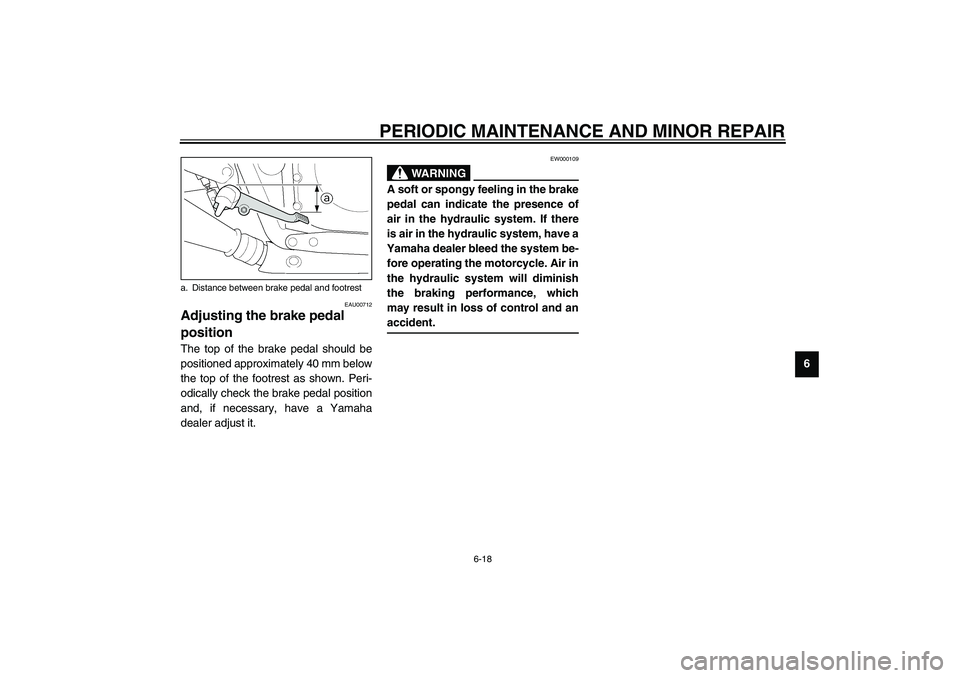
Adjusting the brake pedal
position The top of the brake pedal should be
positioned approximately 40 mm below
the top of the footrest as shown. Peri-
odically check the brake pedal position
and, if necessary, have a Yamaha
dealer adjust it.
EW000109
WARNING
_ A soft or spongy feeling in the brake
pedal can indicate the presence of
air in the hydraulic system. If there
is air in the hydraulic system, have a
Yamaha dealer bleed the system be-
fore operating the motorcycle. Air in
the hydraulic system will diminish
the braking performance, which
may result in loss of control and an
accident. _
a. Distance between brake pedal and footrest
U5WME0.book Page 18 Monday, July 29, 2002 10:25 AM