Page 92 of 134
3-35
E
EJU01256
Transporting
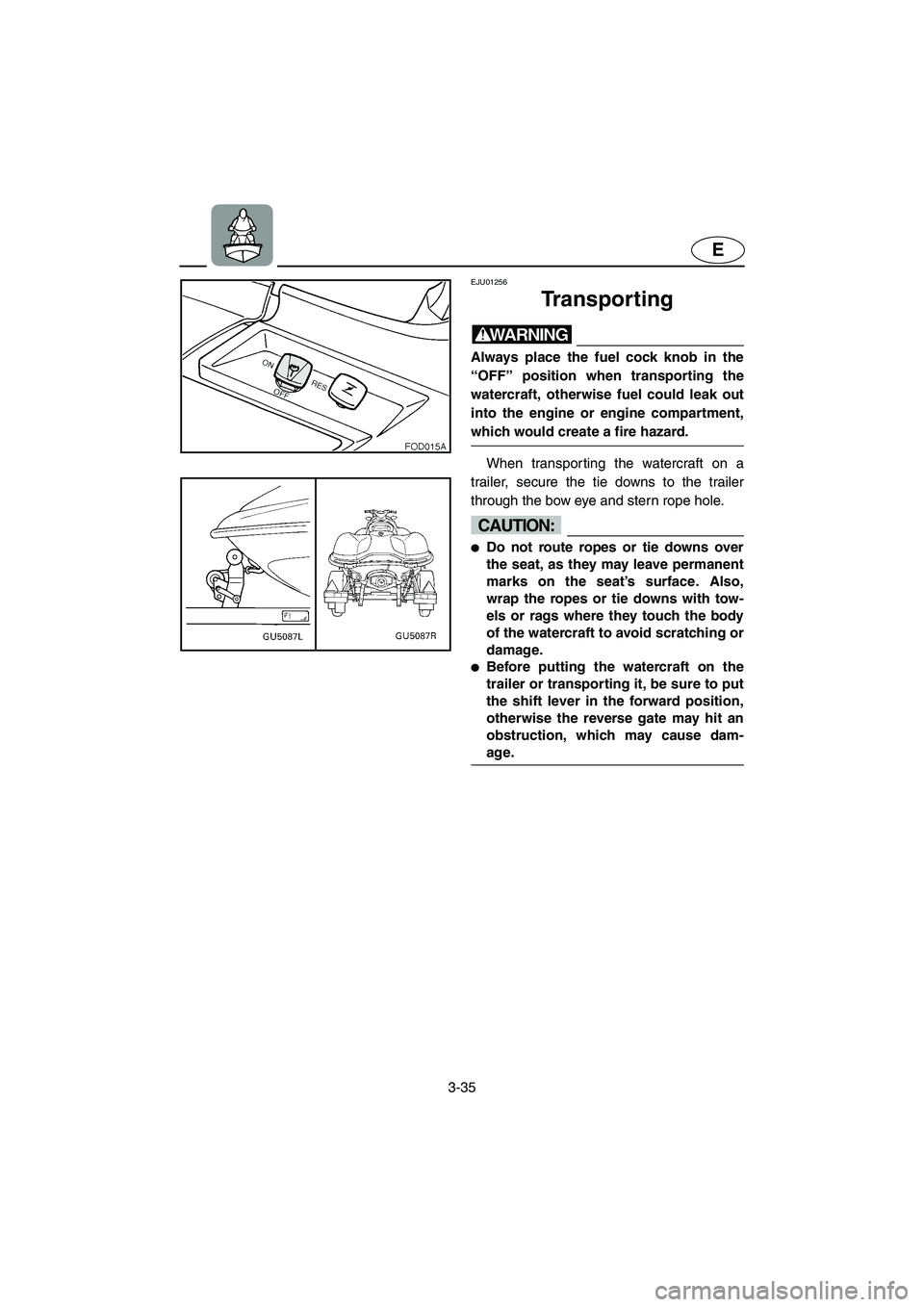
WARNING@ Always place the fuel cock knob in the
“OFF” position when transporting the
watercraft, otherwise fuel could leak out
into the engine or engine compartment,
which would create a fire hazard.
@
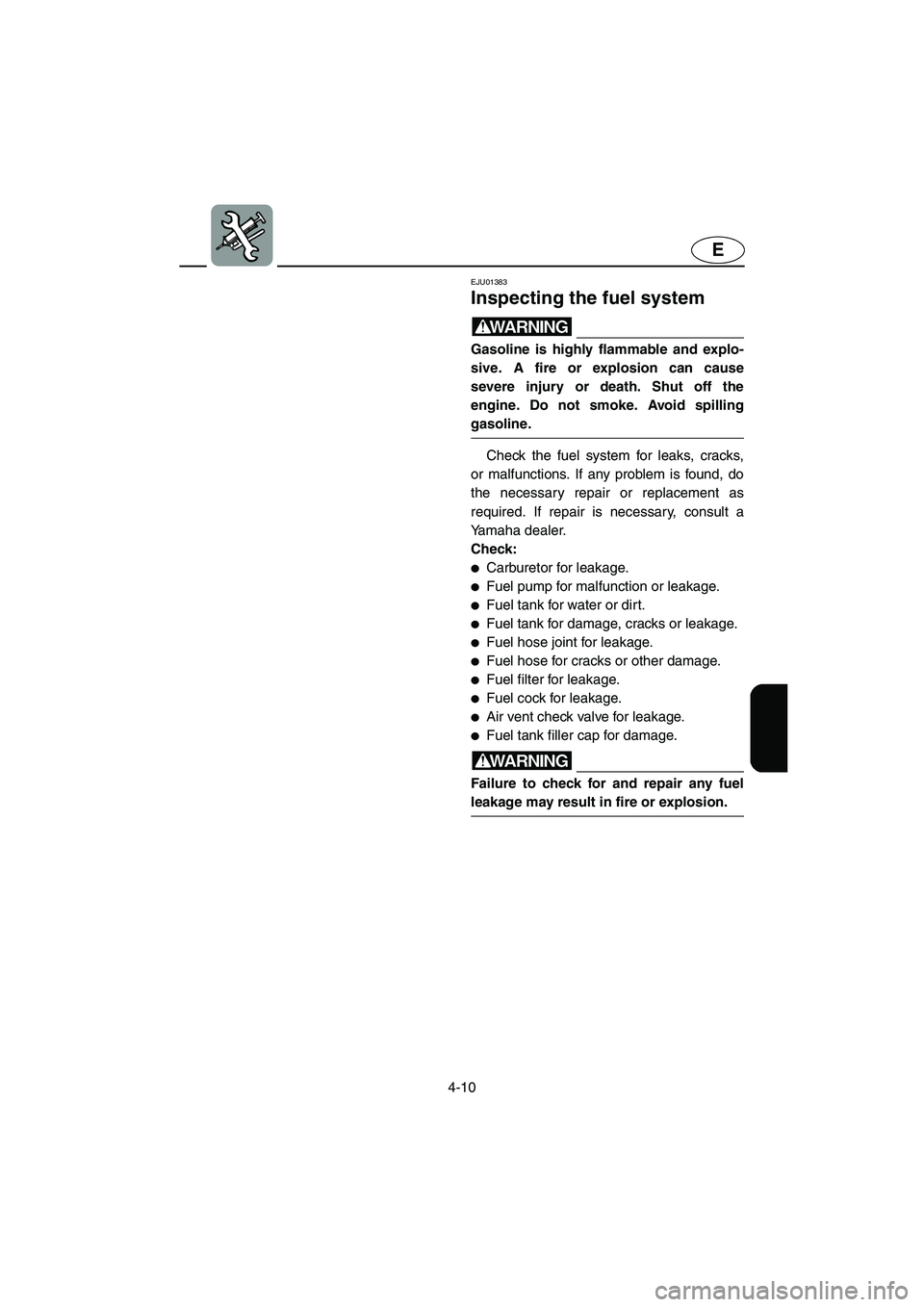
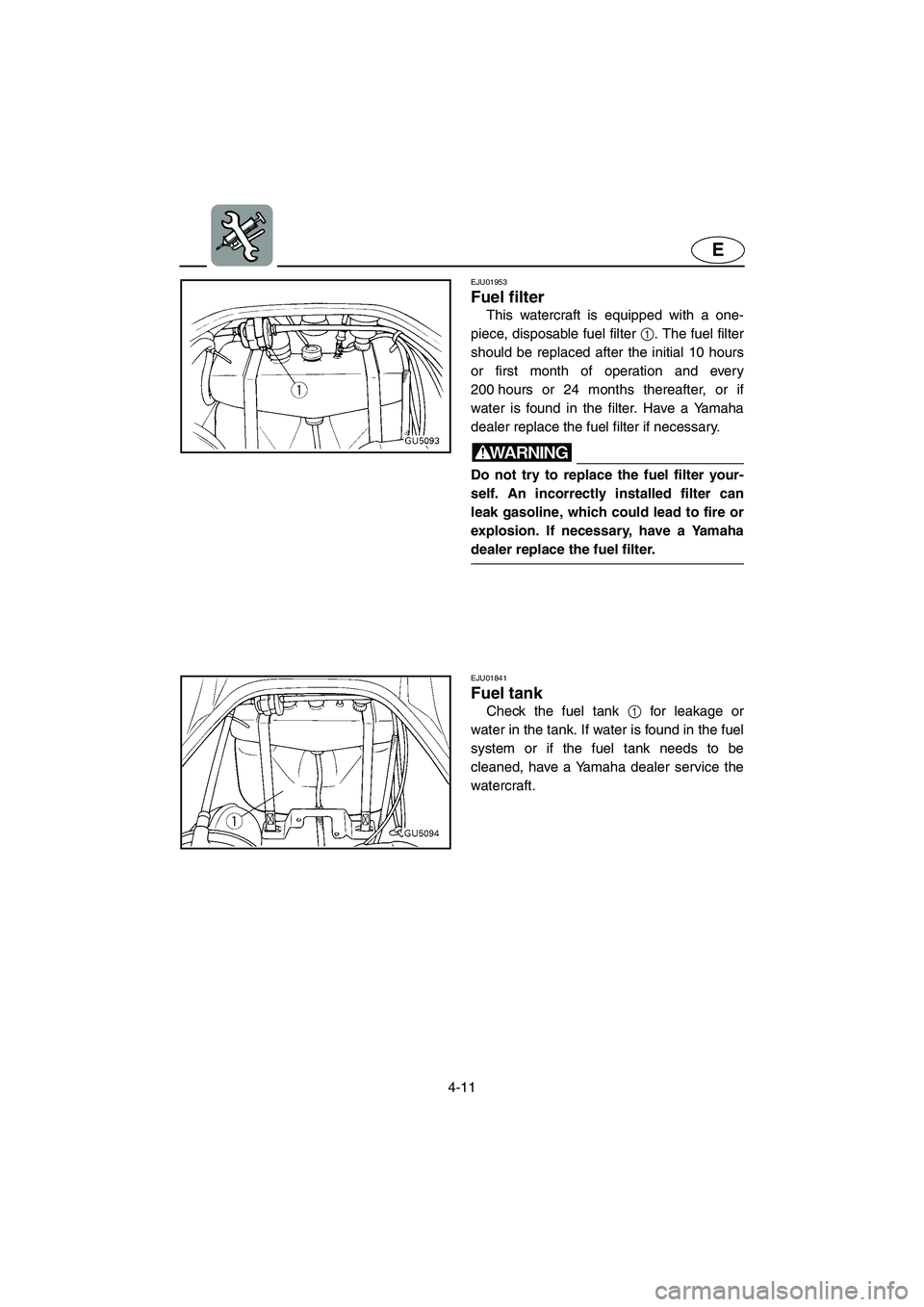
When transporting the watercraft on a
trailer, secure the tie downs to the trailer
through the bow eye and stern rope hole.
CAUTION:@ �Do not route ropes or tie downs over
the seat, as they may leave permanent
marks on the seat’s surface. Also,
wrap the ropes or tie downs with tow-
els or rags where they touch the body
of the watercraft to avoid scratching or
damage.
�Before putting the watercraft on the
trailer or transporting it, be sure to put
the shift lever in the forward position,
otherwise the reverse gate may hit an
obstruction, which may cause dam-
age.
@
UGU572.book Page 35 Wednesday, August 28, 2002 1:31 PM
Page 93 of 134
E
4
EJU01086
MAINTENANCE AND
CARE
Storage ...................................................... 4-1
Flushing the cooling system .................. 4-1
Lubrication .............................................. 4-3
Fuel system ............................................ 4-4
Battery .................................................... 4-5
Cleaning the watercraft .......................... 4-6
Maintenance and adjustments .............. 4-7
Owner’s/Operator’s Manual and
tool kit ..................................................... 4-8
Periodic maintenance chart ................... 4-9
Inspecting the fuel system ................... 4-10
Inspecting the oil injection system ....... 4-12
Inspecting the jet thrust nozzle
angle ..................................................... 4-13
Inspecting the shift cable ..................... 4-13
Inspecting and adjusting the throttle
cable ..................................................... 4-13
Inspecting the QSTS mechanism ....... 4-14
Cleaning and adjusting the spark
plugs ..................................................... 4-15
Lubrication points ................................. 4-16
Adjusting the choke cable .................... 4-19
Inspecting the battery .......................... 4-20
Adjusting the carburetor ...................... 4-22
Replacing the fuse ............................... 4-23
Bleeding the oil injection pump ............ 4-23
Specifications ........................................ 4-24
UGU572.book Page 1 Wednesday, August 28, 2002 1:31 PM
Page 94 of 134

4-1
E
EJU01087
Storage
WARNING@ Always place the fuel cock knob in the
“OFF” position when storing the water-
craft, otherwise fuel could leak out into
the engine or engine compartment,
which would create a fire hazard.
@
Storage for prolonged periods of time,
such as winter storage, requires preventa-
tive maintenance to ensure against deterio-
ration. It is advisable to have the watercraft
serviced by a Yamaha dealer prior to stor-
age. However, the following procedures can
be performed by the owner.
EJU01088
Flushing the cooling system
Flushing the cooling system is essential
to prevent the cooling system from being
clogged with salt, sand, or dirt.
CAUTION:@ �Do not supply water to the cooling
water passages when the engine is not
running. The water could flow back
through the muffler into the crankcase
causing severe engine damage.
�Do not run the engine for more 15 sec-
onds without supplying water, other-
wise the engine may overheat.
@
UGU572.book Page 1 Wednesday, August 28, 2002 1:31 PM
Page 97 of 134
4-4
E
EJU01964
Fuel system
Draining the fuel system prevents buildup
of varnishes and other harmful deposits that
result when gasoline sits for a prolonged
period of time.
WARNING@ GASOLINE AND ITS VAPORS ARE
HIGHLY FLAMMABLE AND EXPLOSIVE!
�Do not smoke when refueling, and
keep away from sparks, flames, or
other sources of ignition.
�Stop engine before refueling.
�Refuel in a well-ventilated area with
the watercraft in a horizontal position.
�Do not stand or sit on the watercraft
while refueling in case of fire.
�Take care not to spill gasoline. If gaso-
line spills, wipe it up immediately with
dry rags. Always properly dispose of
gasoline-soaked rags.
�Avoid overfilling the fuel tank. Stop fill-
ing when the fuel level just reaches the
bottom of the filler tube. Do not fill up
the filler tube because fuel expands as
it warms up and could overflow. If tem-
porarily leaving the watercraft with a
full fuel tank, do not leave it in direct
sunlight. Leave it in a well-ventilated
area with the watercraft in a horizontal
position.
�Tighten the filler cap securely after
refueling.
�If you should swallow some gasoline,
inhale a lot of gasoline vapor, or get
gasoline in your eyes, get immediate
medical attention.
�If any gasoline spills onto your skin,
immediately wash with soap and
water. Change clothing if gasoline
spills on it.
@
UGU572.book Page 4 Wednesday, August 28, 2002 1:31 PM
Page 98 of 134
4-5
E
To drain the fuel system:
1. Place the fuel cock knob in the “OFF”
position.
2. Drain the fuel tank using a siphon.
EJU01970
Battery
If the watercraft will not be used for more
than a month, disconnect the negative (–)
lead first, then the positive (+) lead and
breather hose, and then remove the battery
from the watercraft.
Clean the battery casing using fresh
water.
If the battery terminals are dirty or cor-
roded, clean them with a wire brush.
Fully charge the battery, and then store it
in a cool, dark place.
Apply Yamaha marine grease or Yamaha
grease A to the battery terminals.
Check the battery at least every 2 months
and fully charge it if necessary.
WARNING@ Be sure to connect the breather hose to
the battery. Fire or explosion could result
if the breather hose is damaged,
obstructed, or not connected properly.
@
CAUTION:@ The battery may not be usable again if
you store it for a long period without
charging it. Charge the battery periodi-
cally.
@
UGU572.book Page 5 Wednesday, August 28, 2002 1:31 PM
Page 102 of 134

4-9
E
EJU01355
Periodic maintenance chart
The following chart gives general guidelines for periodic maintenance. However, depend-
ing on your operating conditions maintenance may need to be performed more frequently.
(
�) This mark indicates maintenance that you may do yourself.
(
❍) This mark indicates work to be done by a Yamaha dealer.
*1: Grease capacity: 33.0–35.0 cm3 (1.11–1.18 oz)
*2: Grease capacity: 6.0–8.0 cm3 (0.20–0.27 oz)
*3: Grease capacity: 8.0 cm3 (0.27 oz)
*4: Grease capacity: 2.0 cm3 (0.07 oz)
*5: After every use
*6: Before every use
*7: Inspect fluid level before every use
MAINTENANCE INTERVAL
INITIALTHEREAFTER
EVERYPA G E
10
hours50
hours100
hours100
hours200
hours
ITEM
6
months12
months12
months24
months
Spark plug Inspect, clean, adjust����
4-15
Lubrication points Lubricate��
4-16
Intermediate housing Lubricate❍
*1�
*2�
*2 4-19
Starter motor idle gear Lubricate❍
*3�
*4�
*4 4-19
Fuel system Inspect❍❍
4-10
Fuel filter Check, clean, replace❍❍
4-11
Fuel tank Clean❍
4-11
Oil injection system Inspect, clean❍❍
—
Carburetor setting Inspect, adjust❍❍❍
4-22
Trolling speed Inspect, adjust��
4-22
Carburetor throttle shaft Inspect❍❍
—
Cooling water passages Flush
�*5 4-1
Water inlet strainer Inspect, clean❍❍
—
Bilge strainer Clean��
—
Impeller Inspect
�*6❍❍
5-4
Jet thrust nozzle angle Inspect��
4-13
Steering master Inspect❍❍❍
—
QSTS mechanism Inspect
�*6❍❍
4-14
Shift cable and mechanism Inspect, adjust
�*6❍❍
4-13
Throttle lever Check operation
�*6 4-13
Throttle cable Inspect, adjust��
4-13
Choke knob Check operation
�*6 4-19
Choke cable Inspect, adjust❍❍
4-19
Stern drain plugs Inspect, replace
�*6❍❍
3-7
Battery Inspect
�*7❍❍
4-20
Rubber coupling Inspect❍
—
Engine mount Inspect❍
—
Nuts and bolts Inspect❍❍❍
—
UGU572.book Page 9 Wednesday, August 28, 2002 1:31 PM
Page 103 of 134
4-10
E
EJU01383
Inspecting the fuel system
WARNING@ Gasoline is highly flammable and explo-
sive. A fire or explosion can cause
severe injury or death. Shut off the
engine. Do not smoke. Avoid spilling
gasoline.
@
Check the fuel system for leaks, cracks,
or malfunctions. If any problem is found, do
the necessary repair or replacement as
required. If repair is necessary, consult a
Yamaha dealer.
Check:
�Carburetor for leakage.
�Fuel pump for malfunction or leakage.
�Fuel tank for water or dirt.
�Fuel tank for damage, cracks or leakage.
�Fuel hose joint for leakage.
�Fuel hose for cracks or other damage.
�Fuel filter for leakage.
�Fuel cock for leakage.
�Air vent check valve for leakage.
�Fuel tank filler cap for damage.
WARNING@ Failure to check for and repair any fuel
leakage may result in fire or explosion.
@
UGU572.book Page 10 Wednesday, August 28, 2002 1:31 PM
Page 104 of 134
4-11
E
EJU01953
Fuel filter
This watercraft is equipped with a one-
piece, disposable fuel filter 1. The fuel filter
should be replaced after the initial 10 hours
or first month of operation and every
200 hours or 24 months thereafter, or if
water is found in the filter. Have a Yamaha
dealer replace the fuel filter if necessary.
WARNING@ Do not try to replace the fuel filter your-
self. An incorrectly installed filter can
leak gasoline, which could lead to fire or
explosion. If necessary, have a Yamaha
dealer replace the fuel filter.
@
EJU01841
Fuel tank
Check the fuel tank 1 for leakage or
water in the tank. If water is found in the fuel
system or if the fuel tank needs to be
cleaned, have a Yamaha dealer service the
watercraft.
UGU572.book Page 11 Wednesday, August 28, 2002 1:31 PM