Page 45 of 104
3-12
E
EJU01835
Switches
Check the start switch 1, the engine stop
switch 2, and the engine shut-off switch 3
for proper operation.
To check these switches, place the water-
craft in the water to provide adequate cool-
ing. Start the engine, and then pull the
engine shut-off cord 5 to remove the clip 4
from the engine shut-off switch. Verify that
the engine stops immediately. (See pages
2-5 to 2-6 for information on proper opera-
tion of the start switch, the engine stop
switch and the engine shut-off switch.)
EJU01320
Cooling water pilot outlet
Check that water comes out from the out-
let while the engine is running and the
watercraft is in the water.
UF1N71.book Page 12 Tuesday, June 4, 2002 3:34 PM
Page 46 of 104
3-13
E
EJU01283
Operation
WARNING@ Before operating your watercraft,
become familiar with all controls. Con-
sult your Yamaha dealer about any con-
trols or functions you do not fully
understand. Failure to understand how
controls work could cause an accident or
prevent you from avoiding an accident.
@
EJU01284
Engine break-in
The engine break-in period is essential to
allow the various components of the engine
to wear and polish themselves to the correct
operating clearances. This ensures proper
performance and promotes longer compo-
nent life.
CAUTION:@ �For the first 5 hours or 2 tankfuls of
operation, premix fuel and oil in a 25:1
ratio.
�After break-in, premix fuel and oil in a
50:1 ratio for normal operation.
@
1. Launch the watercraft and start the
engine, and then board the watercraft.
2. Run the engine at the lowest possible
speed for 5 minutes.
UF1N71.book Page 13 Tuesday, June 4, 2002 3:34 PM
Page 47 of 104
3-14
E
3. Gradually open the throttle lever to 3/4 or
less.
4. Continue operation at 3/4 throttle or less
until the first tankful of fuel has been
used.
5. Fill the tank once more with a fuel-to-oil
ratio of 25:1, and proceed with normal
operation.
CAUTION:@ Failure to follow the engine break-in pro-
cedure properly can result in severe
damage to the engine.
@
UF1N71.book Page 14 Tuesday, June 4, 2002 3:34 PM
Page 48 of 104
3-15
E
EJU01137
Starting the engine
WARNING@ Never start the engine or let it run for any
length of time in an enclosed area.
Exhaust fumes contain carbon monox-
ide, a colorless, odorless gas that may
cause loss of consciousness and death
within a short time. Always operate the
watercraft in an open area.
@
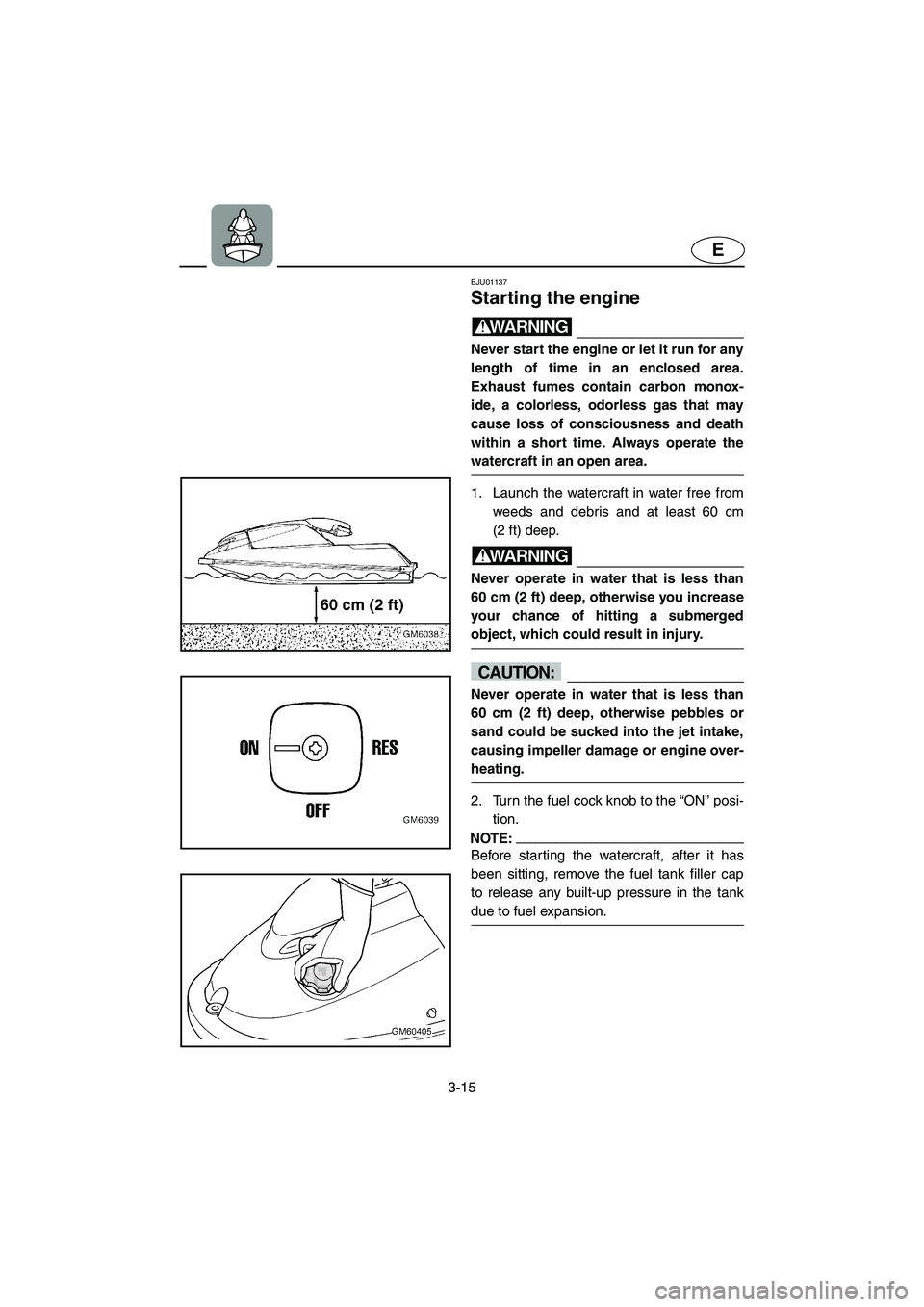
1. Launch the watercraft in water free from
weeds and debris and at least 60 cm
(2 ft) deep.
WARNING@ Never operate in water that is less than
60 cm (2 ft) deep, otherwise you increase
your chance of hitting a submerged
object, which could result in injury.
@
CAUTION:@ Never operate in water that is less than
60 cm (2 ft) deep, otherwise pebbles or
sand could be sucked into the jet intake,
causing impeller damage or engine over-
heating.
@
2. Turn the fuel cock knob to the “ON” posi-
tion.
NOTE:@ Before starting the watercraft, after it has
been sitting, remove the fuel tank filler cap
to release any built-up pressure in the tank
due to fuel expansion.
@
UF1N71.book Page 15 Tuesday, June 4, 2002 3:34 PM
Page 49 of 104

3-16
E
3. Attach the clip 1 to the engine shut-off
switch 2. Also, attach the engine
shut-off cord 3 to your left wrist.
WARNING@ Check that the engine shut-off cord is not
frayed or broken, and keep it free from
the handlebars so the engine stops if the
operator falls off. The engine shut-off
cord may not pull free if wrapped around
the handlebars when the operator falls
off, allowing the watercraft to continue to
run and cause an accident.
@
NOTE:@ It is not possible to start the engine with the
clip removed from the engine shut-off
switch.
@
4. Pull and hold the choke knob all the way
out to start a cold engine.
NOTE:@ The choke should not be used when the
engine is warm.
@
5. While lightly squeezing the throttle lever,
push the start switch (green button).
WARNING@ On this watercraft, the engine is con-
nected directly to the jet pump. Starting
the engine immediately generates some
thrust. Apply only enough throttle to
keep the engine running.
@
UF1N71.book Page 16 Tuesday, June 4, 2002 3:34 PM
Page 50 of 104
3-17
E
6. Release the start switch as soon as the
engine starts to run.
CAUTION:@ �Never push the start switch while the
engine is running.
�Do not operate the start switch for
more than 5 seconds, otherwise the
battery will be discharged and the
engine will not start. Also, the starter
motor may be damaged. If the engine
does not start in 5 seconds, release
the start switch, wait 15 seconds, and
try again.
@
7. After the engine has warmed up, push
the choke knob in to its original position.
NOTE:@ If the choke knob is left pulled out, the
engine will stall.
@
UF1N71.book Page 17 Tuesday, June 4, 2002 3:34 PM
Page 51 of 104
3-18
E
EJU01066
Stopping the engine
To stop the engine, release the throttle
lever, and then push the engine stop switch
(red button).
WARNING@ You need throttle to steer. Shutting off
the engine can cause you to hit an obsta-
cle you are attempting to avoid. A colli-
sion could result in severe injury or
death.
@
EJU01067
Leaving the watercraft
If leaving the watercraft, remove the
engine shut-off cord to reduce the chance of
accidental starting or unauthorized use by
children or others.
UF1N71.book Page 18 Tuesday, June 4, 2002 3:34 PM
Page 52 of 104

3-19
E
EJU01068
Operating your watercraft
EJU01285
Getting to know your
watercraft
Operating your watercraft requires skills
acquired through practice over a period of
time. Take the time to learn the basic tech-
niques well before attempting more difficult
maneuvers.
Operating your new watercraft can be a
very enjoyable activity, providing you with
hours of pleasure. However, it is essential to
familiarize yourself with the operation of the
watercraft to achieve the skill necessary to
enjoy riding safely. Before operating this
watercraft, read this Owner’s/Operator’s
Manual, the Riding Practice Guide, and all
warning and caution labels on the water-
craft. Pay particular attention to the safety
information on pages 1-6 to 1-12. These
materials should give you an understanding
of the watercraft and its operation.
Remember: This watercraft is designed to
carry the operator only. Never have more
than one person on the watercraft at any
time.
EJU01286
Learning to operate your
watercraft
Before operating, always perform the
pre-operation checks listed on page 3-5.
The short time spent checking the watercraft
will reward you with added safety and reli-
ability.
Check all local laws before operating your
watercraft.
Operate defensively at safe speeds and
keep a safe distance away from people,
objects and other watercraft. Select a wide
area to learn in, where you have good visi-
bility and light boat traffic.
Use the buddy system—operate with
someone nearby. Scan constantly for peo-
ple, objects and other watercraft. Be alert for
conditions that limit your visibility or block
your vision of others.
Attach the engine shut-off cord (lanyard)
to your wrist and keep it free from the han-
dlebars so that the engine stops if the opera-
tor falls off.
Wear a personal flotation device (PFD).
All riders must wear a PFD that is approved
by the appropriate authorities and suitable
for personal watercraft use.
UF1N71.book Page 19 Tuesday, June 4, 2002 3:34 PM