Page 47 of 120
E
3
EJU10400
OPERATION
Fuel and oil ............................................... 3-1
Gasoline ................................................. 3-1
2-stroke engine oil .................................. 3-3
Filling the fuel tank ................................. 3-4
Filling the oil tank ................................... 3-5
Pre-operation checks .............................. 3-6
Pre-operation check list ......................... 3-6
Pre-operation check points .................... 3-7
Operation ................................................ 3-14
Engine break-in .................................... 3-14
Starting the engine ............................... 3-16
Stopping the engine ............................. 3-18
Leaving the watercraft ......................... 3-18
Operating your watercraft .................... 3-19
Getting to know your watercraft ........... 3-19
Learning to operate your watercraft .... 3-19
Riding watercraft with a passenger ..... 3-20
Starting the watercraft .......................... 3-21
Boarding and starting in deep water ... 3-23
Capsized watercraft ............................. 3-25
Turning the watercraft .......................... 3-27
Stopping the watercraft ........................ 3-29
Beaching the watercraft ....................... 3-30
Docking the watercraft ......................... 3-30
Rough water operation ........................ 3-30
Post-operation checks ......................... 3-31
Transporting .......................................... 3-33
UF1G70.book Page 1 Wednesday, December 18, 2002 3:35 PM
Page 48 of 120

3-1
E
EJU20060
Fuel and oil
This engine uses Yamaha’s oil injection
system, which provides superior lubrication
by ensuring the proper oil ratio for all operat-
ing conditions. No fuel premixing is neces-
sary except during the engine break-in
period. Simply pour gasoline into the fuel
tank and oil into the oil tank.
The engine utilizes an electronic fuel
injection system to deliver the optimal air-
fuel mixture ratio required by the engine.
With optimal combustion conditions, this
system is able to increase startability and
improve fuel economy.
EJU19122
Gasoline
WARNING@ GASOLINE AND ITS VAPORS ARE
HIGHLY FLAMMABLE AND EXPLOSIVE!
�Do not smoke when refueling, and
keep away from sparks, flames, or
other sources of ignition.
�Stop engine before refueling.
�Refuel in a well-ventilated area with
the watercraft in a horizontal position.
�Do not stand or sit on the watercraft
while refueling in case of fire.
�Take care not to spill gasoline. If gaso-
line spills, wipe it up immediately with
dry rags. Always properly dispose of
gasoline-soaked rags.
UF1G70.book Page 1 Wednesday, December 18, 2002 3:35 PM
Page 50 of 120
3-3
E
EJU18320
Gasohol
There are two types of gasohol: gasohol
containing ethanol and that containing meth-
anol.
Gasohol containing ethanol can be used
if ethanol content does not exceed 10% and
the fuel meets minimum octane ratings.
Gasohol containing methanol is not rec-
ommended by Yamaha because it can
cause fuel system damage or engine perfor-
mance problems.
EJU11870
2-stroke engine oil
CAUTION:@ Use only YAMALUBE 2-W oil. Using
another oil can seriously damage the cat-
alytic converter and other engine compo-
nents.
@
NOTE:@ YAMALUBE 2-W is developed for this water-
craft and available from a Yamaha dealer.
@
Recommended engine oil:
YAMALUBE 2-W oil only
UF1G70.book Page 3 Wednesday, December 18, 2002 3:35 PM
Page 52 of 120
3-5
E
EJU10460
Filling the oil tank
WARNING@ �Do not add gasoline to the oil tank.
Fire or explosion could result.
�Oil in the bilge is a serious fire hazard.
Wipe up any spilled oil immediately.
@
CAUTION:@ Do not allow the oil tank to become com-
pletely empty. If the oil tank becomes
empty the oil injection pump must be
bled to ensure proper oil flow, otherwise
engine damage may occur. If bleeding of
the oil pump is necessary, have a
Yamaha dealer bleed it.
@
1. Remove the seat to watch the oil level.
(See page 2-5 for seat.)
2. Open the oil tank filler cap, and very
slowly add engine oil to the oil tank.
3. Stop filling when the oil just reaches the
top of oil tank visible.
Oil tank capacity:
5.5 L (1.5 US gal, 1.2 Imp gal)
UF1G70.book Page 5 Wednesday, December 18, 2002 3:35 PM
Page 53 of 120

3-6
E
EJU13460
Pre-operation checks
EJU13470
Pre-operation check list
Before operating this watercraft, perform the checks in the following check list. See the
accompanying text in this chapter for details on how to perform the checks.
WARNING@ If any item in the pre-operation check list is not working properly, have it inspected
and repaired before operating the watercraft, otherwise an accident could occur.
@
POC-***
NOTE:@ Pre-operation checks should be made thoroughly each time the watercraft is used. This pro-
cedure can be completed in a short time. It is worth the time spent to assure safety and reli-
ability.
@
ITEM ROUTINE PAGE
Engine compartment Remove the seat and front storage compartment
to ventilate engine compartment. Check for fuel
vapors or loose electrical connections3-7
Bilge Check for water and fuel residue and remove if
necessary3-8
Throttle Check that the throttle lever springs back 3-11
Steering system Check for proper steering system operation 3-11
Fuel and oil Check fuel and oil level and add if necessary
Check hoses and tanks for leakage3-7
Water separator Check for water and drain if necessary 3-8
Battery Check electrolyte level and battery condition 3-9
Hood Check that the hood is properly secured 2-6
Seat Check that the seat is properly secured 2-5
Hull/Deck Check the hull and deck for cracks or other dam-
age—
Jet unit Check for debris and remove if necessary 3-12
Fire extinguisher Check the condition and replace if necessary 3-10
Engine shut-off cord Check condition and replace is frayed or broken 3-12
Switches Check the start switch, engine stop switch and
engine shut-off switch for proper operation when
the watercraft is in the water3-13
Cooling water pilot outlet Check that water is discharged while the engine
is running and the watercraft is in the water3-13
Multifunction information center Check for warning indications and proper opera-
tion3-13
UF1G70.book Page 6 Wednesday, December 18, 2002 3:35 PM
Page 54 of 120

3-7
E
EJU10480
Pre-operation check points
EJU10500
Engine compartment
Ventilate the engine compar tment before
each use.
To ventilate the engine compartment,
remove seat and front storage compart-
ment. (See page 2-5 for seat, and 2-20 for
front storage compartment.) Allow the
engine compartment to remain open for a
few minutes to allow any fuel vapors to
escape. Also, check for loose electrical con-
nections.
WARNING@ Failure to ventilate the engine compart-
ment could result in fire or explosion. Do
not start the engine if there is a fuel leak
or a loose electrical connection.
@
EJU20071
Fuel and oil systems
Check the fuel system for leakage, cracks
or malfunctions before each use. (See page
4-10 for check points and correct proce-
dures.)
1. Remove the fuel tank filler cap to release
any pressure that might have built up in
the fuel tank.
2. Remove seat and front storage compart-
ment. (See page 2-5 for seat, and 2-20
for front storage compartment.)
3. Check the fuel and oil levels in the tanks
and replenish if necessary. (See pages
3-4 and 3-5 for filling instructions.)
UF1G70.book Page 7 Wednesday, December 18, 2002 3:35 PM
Page 61 of 120
3-14
E
EJU18360
Operation
WARNING@ Before operating your watercraft,
become familiar with all controls. Con-
sult your Yamaha dealer about any con-
trol or function you do not fully
understand. Failure to understand how
controls work could cause an accident or
prevent you from avoiding an accident.
@
CAUTION:@ Make sure that the stern drain plugs are
securely tightened before launching the
watercraft.
@
EJU18810
Engine break-in
The engine break-in period is essential to
allow the various components of the engine
to wear and polish themselves to the correct
operating clearances. This ensures proper
performance and promotes longer compo-
nent life.
CAUTION:@ �For the first tankful of operation, pre-
mix a 50:1 mixture of fuel and oil (in
addition to the oil in the oil tank).
�After break-in, use straight gasoline
for normal operation.
@
UF1G70.book Page 14 Wednesday, December 18, 2002 3:35 PM
Page 73 of 120
3-26
E
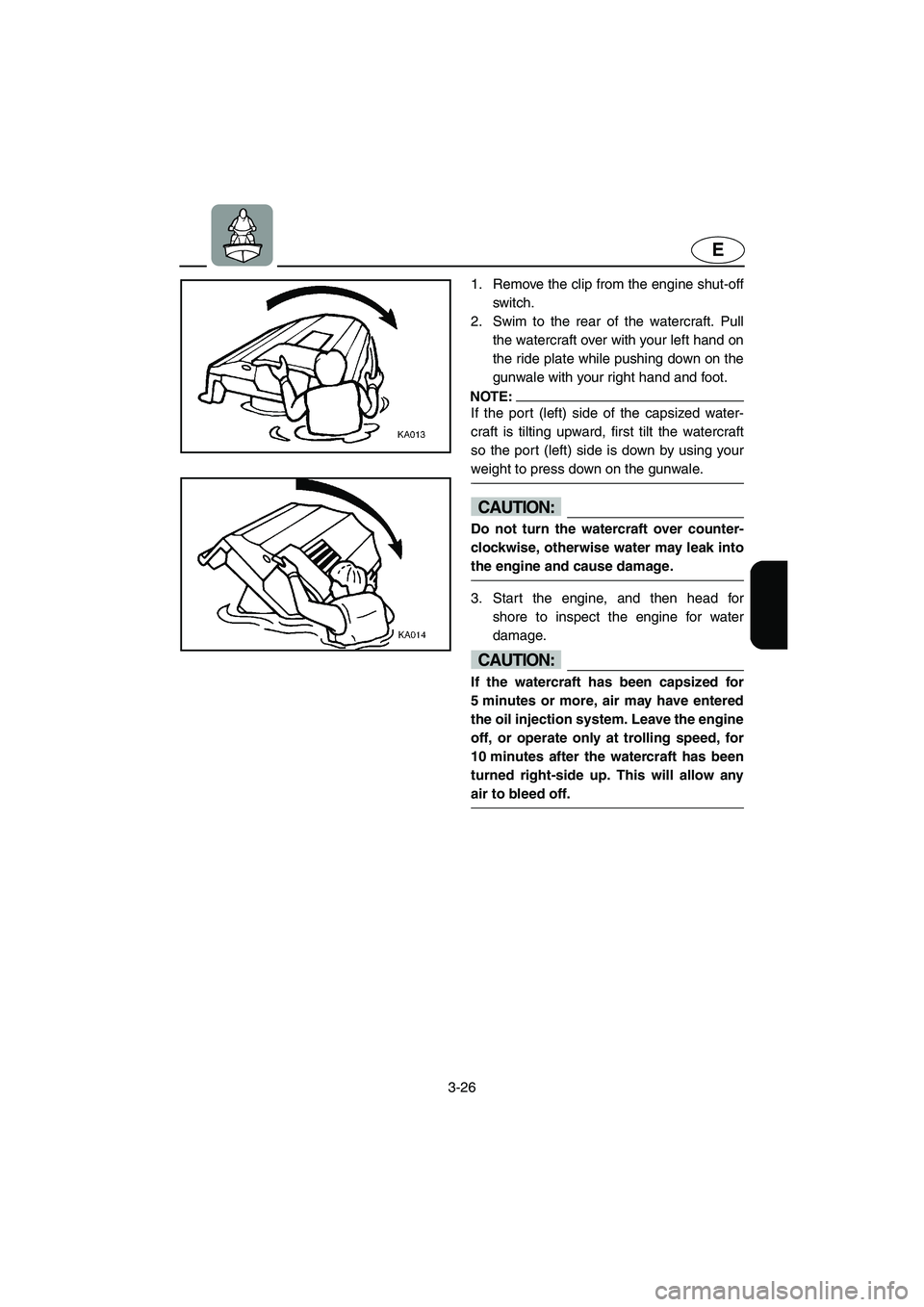
1. Remove the clip from the engine shut-off
switch.
2. Swim to the rear of the watercraft. Pull
the watercraft over with your left hand on
the ride plate while pushing down on the
gunwale with your right hand and foot.
NOTE:@ If the port (left) side of the capsized water-
craft is tilting upward, first tilt the watercraft
so the port (left) side is down by using your
weight to press down on the gunwale.
@
CAUTION:@ Do not turn the watercraft over counter-
clockwise, otherwise water may leak into
the engine and cause damage.
@
3. Start the engine, and then head for
shore to inspect the engine for water
damage.
CAUTION:@ If the watercraft has been capsized for
5 minutes or more, air may have entered
the oil injection system. Leave the engine
off, or operate only at trolling speed, for
10 minutes after the watercraft has been
turned right-side up. This will allow any
air to bleed off.
@
UF1G70.book Page 26 Wednesday, December 18, 2002 3:35 PM