Page 54 of 120

3-7
E
EJU10480
Pre-operation check points
EJU10500
Engine compartment
Ventilate the engine compar tment before
each use.
To ventilate the engine compartment,
remove seat and front storage compart-
ment. (See page 2-5 for seat, and 2-20 for
front storage compartment.) Allow the
engine compartment to remain open for a
few minutes to allow any fuel vapors to
escape. Also, check for loose electrical con-
nections.
WARNING@ Failure to ventilate the engine compart-
ment could result in fire or explosion. Do
not start the engine if there is a fuel leak
or a loose electrical connection.
@
EJU20071
Fuel and oil systems
Check the fuel system for leakage, cracks
or malfunctions before each use. (See page
4-10 for check points and correct proce-
dures.)
1. Remove the fuel tank filler cap to release
any pressure that might have built up in
the fuel tank.
2. Remove seat and front storage compart-
ment. (See page 2-5 for seat, and 2-20
for front storage compartment.)
3. Check the fuel and oil levels in the tanks
and replenish if necessary. (See pages
3-4 and 3-5 for filling instructions.)
UF1G70.book Page 7 Wednesday, December 18, 2002 3:35 PM
Page 55 of 120

3-8
E
EJU19610
Water separator
Check the water separator 1 for water.
Normally the water separator is empty. The
water separator retains any water entering
through the fuel tank breather hose if the
watercraft is capsized.
If water remains in the water separator,
drain it by removing the drain screw 2.
Place a drain pan under the water separator
to catch the draining water or use a dry cloth
to soak up any water that could spill into the
watercraft. If any water spills into the water-
craft, be sure to wipe it up with a dry cloth.
Be sure to install the drain screw after drain-
ing the water separator.
EJU20200
Bilge
Check for moisture and fuel residue in the
bilge.
This watercraft is equipped with a conven-
tional jet vacuum bilge draining system and
an electric bilge draining system. The elec-
tric bilge draining system is operated when
the engine is running. When excess water
reaches the water inlet of the electric bilge
pump, the water is discharged via the
exhaust passage from the jet thrust nozzle.
A small quantity of water will remain in the
bilge and should be removed manually. To
remove any residual water, perform the fol-
lowing procedure.
To remove water from the bilge:
1. Remove the stern drain plugs.
2. Raise the bow of the watercraft until the
water drains.
3. After the water has drained, wipe the
bilge with dry rags to make sure that the
bilge is thoroughly dry.
4. Install the drain plugs.
UF1G70.book Page 8 Wednesday, December 18, 2002 3:35 PM
Page 85 of 120

4-4
E
�Take care not to spill gasoline. If gaso-
line spills, wipe it up immediately with
dry rags. Always properly dispose of
gasoline-soaked rags.
�Avoid overfilling the fuel tank. Stop fill-
ing when the fuel level just reaches the
bottom of the filler tube. Do not fill up
the filler tube because fuel expands as
it warms up and could overflow. If tem-
porarily leaving the watercraft with a
full fuel tank, do not leave it in direct
sunlight. Leave it in a well-ventilated
area with the watercraft in a horizontal
position.
�Tighten the filler cap securely after
refueling.
�If you should swallow some gasoline,
inhale a lot of gasoline vapor, or get
gasoline in your eyes, get immediate
medical attention.
�If any gasoline spills onto your skin,
immediately wash with soap and
water. Change clothing if gasoline
spills on it.
Fill the fuel tank with fresh gasoline and
add 470 ml (15.9 US oz, 16.5 Imp oz) of
Yamaha Fuel Stabilizer and Conditioner.
CAUTION:Use only Yamaha Fuel Stabilizer and
Conditioner. Using another stabilizer can
damage the catalytic converter.
Recommended fuel stabilizer:
Yamaha Fuel Stabilizer and
Conditioner
UF1G70.book Page 4 Wednesday, December 18, 2002 3:35 PM
Page 90 of 120
4-9
E
EJU13550
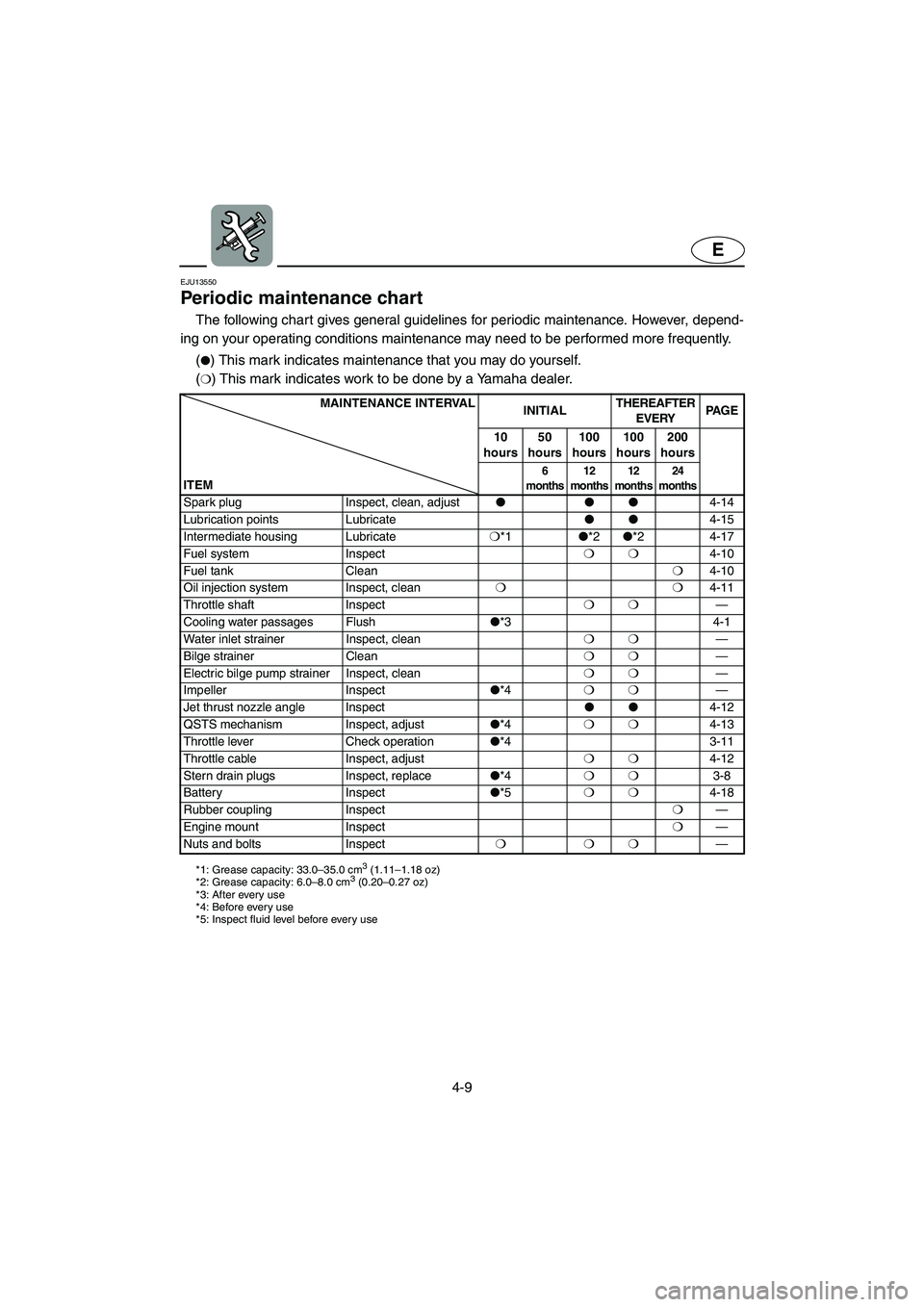
Periodic maintenance chart
The following chart gives general guidelines for periodic maintenance. However, depend-
ing on your operating conditions maintenance may need to be performed more frequently.
PMC-*** (�) This mark indicates maintenance that you may do yourself.
(
❍) This mark indicates work to be done by a Yamaha dealer.
MAINTENANCE INTERVAL
INITIALTHEREAFTER
EVERYPA G E
10
hours50
hours100
hours100
hours200
hours
ITEM
6
months12
months12
months24
months
Spark plug Inspect, clean, adjust���
4-14
Lubrication points Lubricate��
4-15
Intermediate housing Lubricate❍
*1�
*2�
*2 4-17
Fuel system Inspect❍❍
4-10
Fuel tank Clean❍
4-10
Oil injection system Inspect, clean❍❍
4-11
Throttle shaft Inspect❍❍
—
Cooling water passages Flush �
*3 4-1
Water inlet strainer Inspect, clean❍❍
—
Bilge strainer Clean❍❍
—
Electric bilge pump strainer Inspect, clean❍❍
—
Impeller Inspect�
*4❍❍
—
Jet thrust nozzle angle Inspect��
4-12
QSTS mechanism Inspect, adjust�
*4❍❍
4-13
Throttle lever Check operation�
*4 3-11
Throttle cable Inspect, adjust❍❍
4-12
Stern drain plugs Inspect, replace�
*4❍❍
3-8
Battery Inspect �
*5❍❍
4-18
Rubber coupling Inspect❍
—
Engine mount Inspect❍
—
Nuts and bolts Inspect❍❍❍
—
*1: Grease capacity: 33.0–35.0 cm3 (1.11–1.18 oz)
*2: Grease capacity: 6.0–8.0 cm3 (0.20–0.27 oz)
*3: After every use
*4: Before every use
*5: Inspect fluid level before every use
UF1G70.book Page 9 Wednesday, December 18, 2002 3:35 PM
Page 91 of 120

4-10
E
EJU18160
Inspecting the fuel system
WARNING@ Gasoline is highly flammable and explo-
sive. Failure to check for and repair any
fuel leakage could result in fire or explo-
sion. A fire or explosion can cause
severe injury or death. Shut off the
engine. Do not smoke. Avoid spilling
gasoline.
Fuel in hose is pressurized.
Fuel can spray out and cause injury or a
fire hazard if fuel line is disconnected.
Do not attempt to run engine with fuel
line disconnected.
@
Check the fuel system for leaks, cracks,
or malfunctions. If any problem is found,
consult a Yamaha dealer.
Check:
�Fuel tank for water or dirt.
�Fuel tank cap (seal) for damage.
�Fuel tank for damage, cracks or leakage.
�Fuel hose joint for leakage.
�Fuel hose for cracks or other damage.
�Air bleeding passages for leakage.
EJU18410
Fuel tank
Check the fuel tank 1 for leakage or
water in the tank. If water is found in the fuel
system or if the fuel tank needs to be
cleaned, have a Yamaha dealer service the
watercraft.
UF1G70.book Page 10 Wednesday, December 18, 2002 3:35 PM
Page 104 of 120

4-23
E
EJU13590
Specifications
SPC-*** MODEL
ITEMUnit GP1300R
WATERCRAFT CAPACITY
Maximum people on board Number of people 2
Maximum load capacity kg (lb) 160 (353)
DIMENSIONS
Length mm (in) 2,930 (115.4)
Width mm (in) 1,150 (45.3)
Height mm (in) 1,020 (40.2)
Dry weight kg (lb) 297 (653)
PERFORMANCE
Maximum output kW (PS) @ r/min 121.4 (165) @ 7,000
Maximum fuel consumption L/h (US gal/h, Imp gal/h) 63.0 (16.6, 13.9)
Cruising range at full throttle hr. 1.0
Trolling speed r/min 1,250–1,450
ENGINE
Engine type 2-stroke
Number of cylinders 3
Engine displacement
cm
3 (cu in)1,297 (79.1)
Bore & stroke mm (in) 84 ×
78 (3.31 ×
3.07)
Compression ratio 5.9:1
Lubrication system Variable oil injection
Cooling system Water cooled
Starting system Electric starter
Ignition system Digital CDI
Spark plug BR8ES-11 (NGK)
Spark plug gap mm (in) 1.0–1.1 (0.039–0.043)
Battery capacity V-AH 12-19
Charging system Flywheel magneto
DRIVE UNIT
Propulsion system Jet pump
Jet pump type Axial flow, single stage
Impeller rotation Counterclockwise (viewed from rear)
Transmission Direct drive from engine
Jet thrust nozzle angle Degree 23 + 23
Trim nozzle angle Degree -5, 0, 5, 10, 15
FUEL AND OIL
Recommended fuel Regular unleaded gasoline
Minimum octane rating PON
RON86
90
Recommended engine oil YAMALUBE 2-W only
Fuel tank capacity
Total L (US gal, Imp gal) 60 (15.9, 13.2)
Oil tank capacity L (US gal, Imp gal) 5.5 (1.5, 1.2)
UF1G70.book Page 23 Wednesday, December 18, 2002 3:35 PM
Page 106 of 120

5-1
E
EJU11160
Troubleshooting
If you have any trouble with your watercraft, use this section to check for the possible
cause.
If you cannot find the cause, or if the procedure for replacement or repair is not described
in this Owner’s/Operator’s Manual, have a Yamaha dealer perform the necessary service.
EJU13670
Troubleshooting chart
TBC-*** TROUBLE POSSIBLE CAUSE REMEDY PAGE
Engine does not
startStarter motor does not turn over
Engine shut-
off switchClip not in place Install clip
2-7
Fuse Burned out Replace the fuse and
check wiring4-21
Battery Run down Recharge 4-18
Poor terminal connec-
tionsTighten as required
4-18
Terminal corroded Clean—
Starter motor Faulty Have serviced by
Yamaha dealer—
War ning
systemOverheat mode Cool down engine
2-12
Starter motor turns over
Throttle lever Squeezed Release 2-7
Fuel Empty Refill as soon as possi-
ble3-4
Stale or contaminated Have serviced by
Yamaha dealer4-10
Fuel tank Water or dirt present Have serviced by
Yamaha dealer4-10
Spark plug Fouled or defective Clean or replace 4-14
Spark plug cap Not connected or loose Connect properly 4-14
Crankcase Filled with water Crank engine with plug
out until clean5-8
Fuel injection
systemFuel pump faulty Have serviced by
Yamaha dealer—
Water
temperature
sensorFailed Have serviced by
Yamaha dealer 2-12
UF1G70.book Page 1 Wednesday, December 18, 2002 3:35 PM
Page 107 of 120
5-2
E
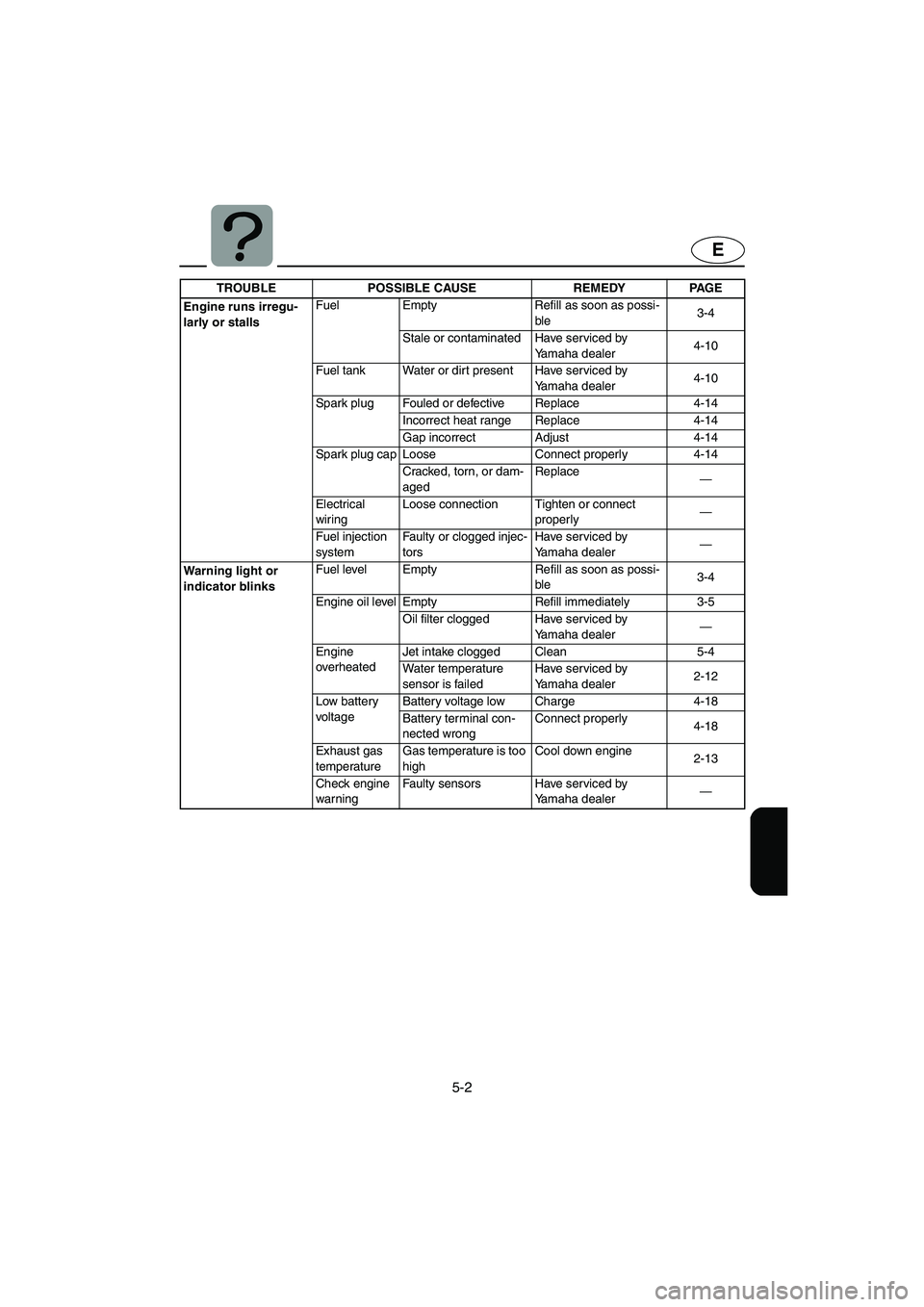
Engine runs irregu-
larly or stallsFuel Empty Refill as soon as possi-
ble3-4
Stale or contaminated Have serviced by
Yamaha dealer4-10
Fuel tank Water or dirt present Have serviced by
Yamaha dealer4-10
Spark plug Fouled or defective Replace 4-14
Incorrect heat range Replace 4-14
Gap incorrect Adjust 4-14
Spark plug cap Loose Connect properly 4-14
Cracked, torn, or dam-
agedReplace
—
Electrical
wiringLoose connection Tighten or connect
properly—
Fuel injection
systemFaulty or clogged injec-
torsHave serviced by
Yamaha dealer—
Warning light or
indicator blinksFuel level Empty Refill as soon as possi-
ble3-4
Engine oil level Empty Refill immediately 3-5
Oil filter clogged Have serviced by
Yamaha dealer—
Engine
overheatedJet intake clogged Clean 5-4
Water temperature
sensor is failedHave serviced by
Yamaha dealer2-12
Low battery
voltageBattery voltage low Charge 4-18
Battery terminal con-
nected wrongConnect properly
4-18
Exhaust gas
temperatureGas temperature is too
highCool down engine
2-13
Check engine
warningFaulty sensors Have serviced by
Yamaha dealer— TROUBLE POSSIBLE CAUSE REMEDY PAGE
UF1G70.book Page 2 Wednesday, December 18, 2002 3:35 PM