Page 214 of 388
7-41
TURNING YOUR ATV
To achieve maximum traction while riding off-road,
the two rear wheels are mounted solidly on one
axle and turn together at the same speed. There-
fore, unless the wheel on the inside of the turn is
allowed to slip or lose some traction, the ATV will
resist turning. A special turning technique must be
used to allow the ATV to make turns quickly and
easily. It is essential that this skill be learned first at
low speed.
WARNING
Always follow proper procedures for turning
as described in this Owner’s Manual.
Practice turning at low speeds before attempt-
ing to turn at faster speeds. Do not turn at
speeds too fast for your skills or the condi-
tions.
EE.book Page 41 Monday, June 18, 2001 10:18 AM
Page 220 of 388
7-47
CLIMBING UPHILL
Use proper riding techniques to avoid vehicle
overturns on hills. Be sure that you can maneuver
your ATV well on flat ground before attempting any
incline and then practice riding first on gentle
slopes. Try more difficult climbs only after you
have developed your skill. In all cases avoid in-
clines with slippery or loose surfaces, or obstacles
that might cause you to lose control.
WARNING
Never operate the ATV on hills too steep for
the ATV or for your abilities. The vehicle can
overturn more easily on extremely steep hills
than on level surfaces or small hills. Practice
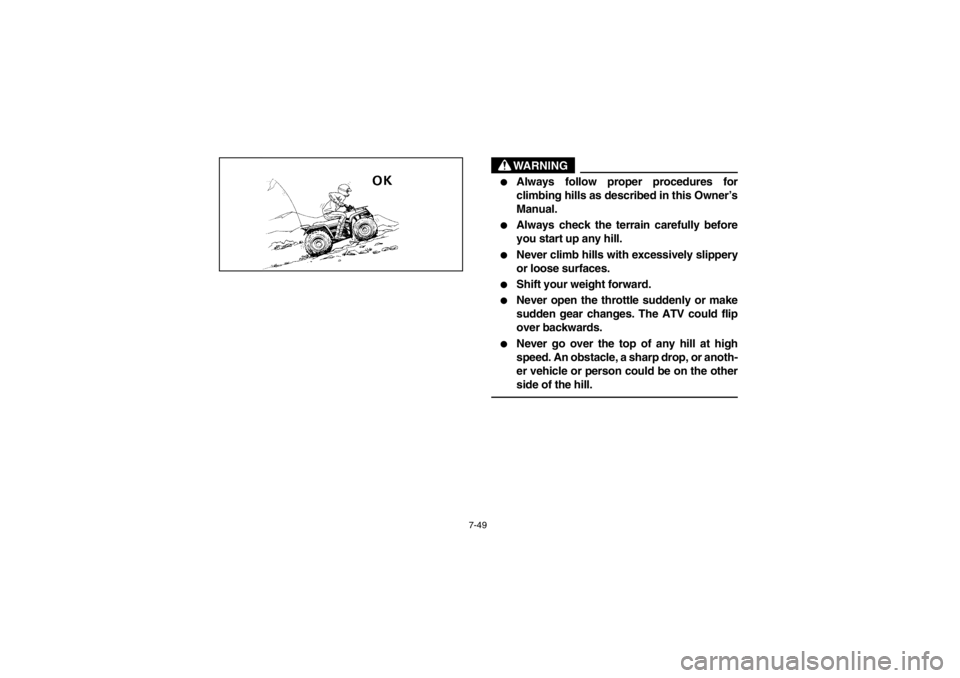
on smaller hills before attempting large hills.It is important when climbing a hill to make sure
that your weight is transferred forward on the ATV.
This can be accomplished by leaning forward and,
on steeper inclines, standing on the footboards
and leaning forward over the handlebars.
EE.book Page 47 Monday, June 18, 2001 10:18 AM
Page 222 of 388
7-49
WARNING
�
Always follow proper procedures for
climbing hills as described in this Owner’s
Manual.
�
Always check the terrain carefully before
you start up any hill.
�
Never climb hills with excessively slippery
or loose surfaces.
�
Shift your weight forward.
�
Never open the throttle suddenly or make
sudden gear changes. The ATV could flip
over backwards.
�
Never go over the top of any hill at high
speed. An obstacle, a sharp drop, or anoth-
er vehicle or person could be on the other
side of the hill.
EE.book Page 49 Monday, June 18, 2001 10:18 AM
Page 224 of 388
7-51
If you are climbing a hill and you find that you have
not properly judged your ability to make it to the
top, you should turn the ATV around while you still
have forward motion (provided you have the room
to do so) and go down the hill.
WARNING
Never attempt to turn the ATV around on any
hill until you have mastered the turning tech-
nique as described in the Owner’s Manual on
level ground. Be very careful when turning on
any hill. Avoid crossing the side of a steep hill
if possible.
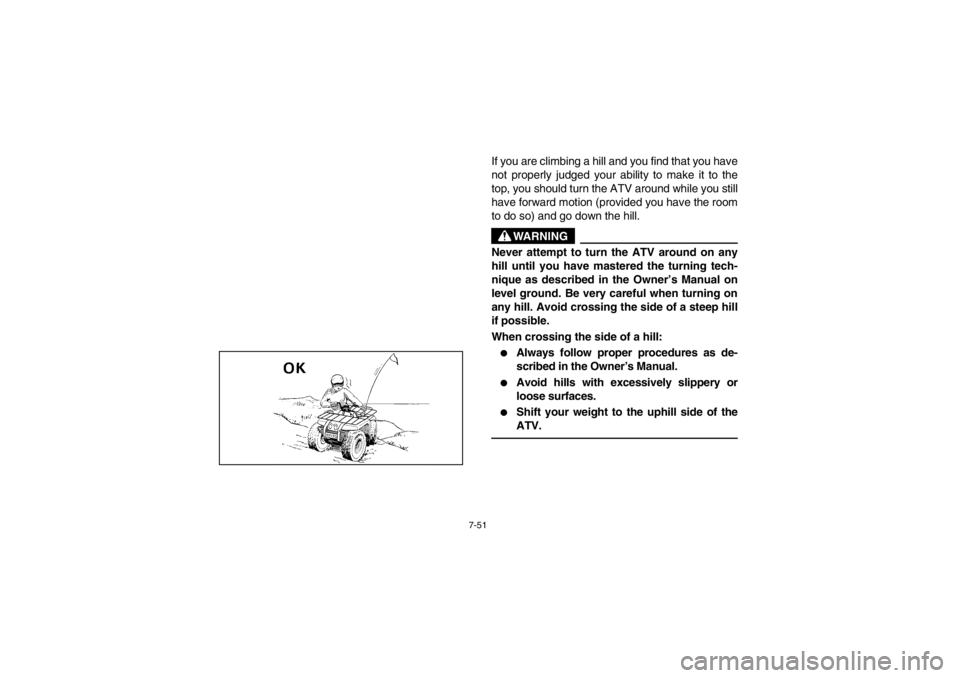
When crossing the side of a hill:�
Always follow proper procedures as de-
scribed in the Owner’s Manual.
�
Avoid hills with excessively slippery or
loose surfaces.
�
Shift your weight to the uphill side of the
ATV.
EE.book Page 51 Monday, June 18, 2001 10:18 AM
Page 228 of 388
7-55
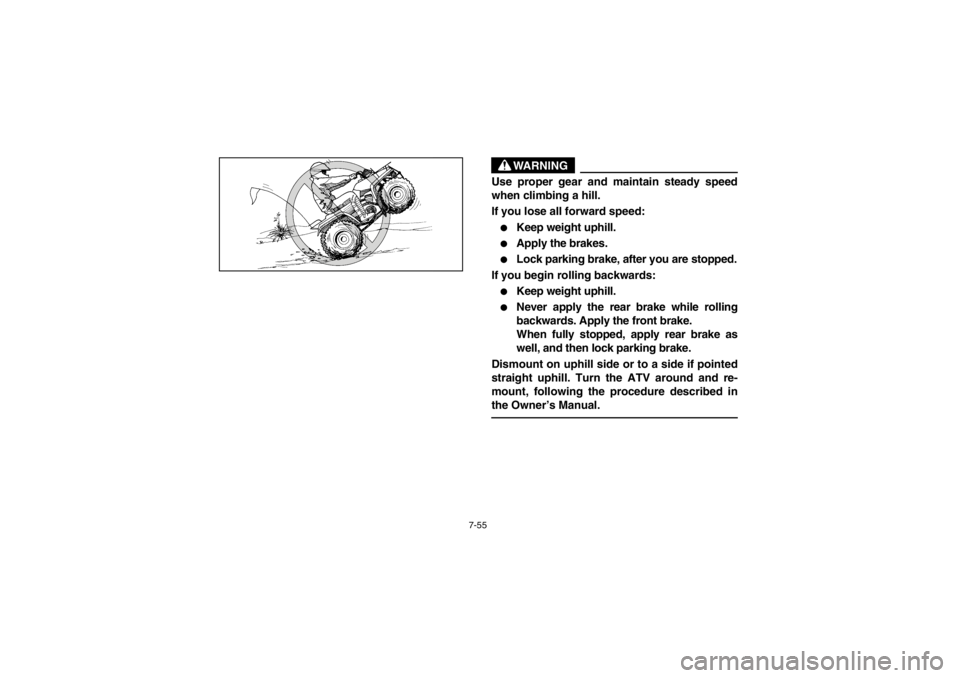
WARNING
Use proper gear and maintain steady speed
when climbing a hill.
If you lose all forward speed:�
Keep weight uphill.
�
Apply the brakes.
�
Lock parking brake, after you are stopped.
If you begin rolling backwards:
�
Keep weight uphill.
�
Never apply the rear brake while rolling
backwards. Apply the front brake.
When fully stopped, apply rear brake as
well, and then lock parking brake.
Dismount on uphill side or to a side if pointed
straight uphill. Turn the ATV around and re-
mount, following the procedure described in
the Owner’s Manual.
EE.book Page 55 Monday, June 18, 2001 10:18 AM
Page 232 of 388
7-59
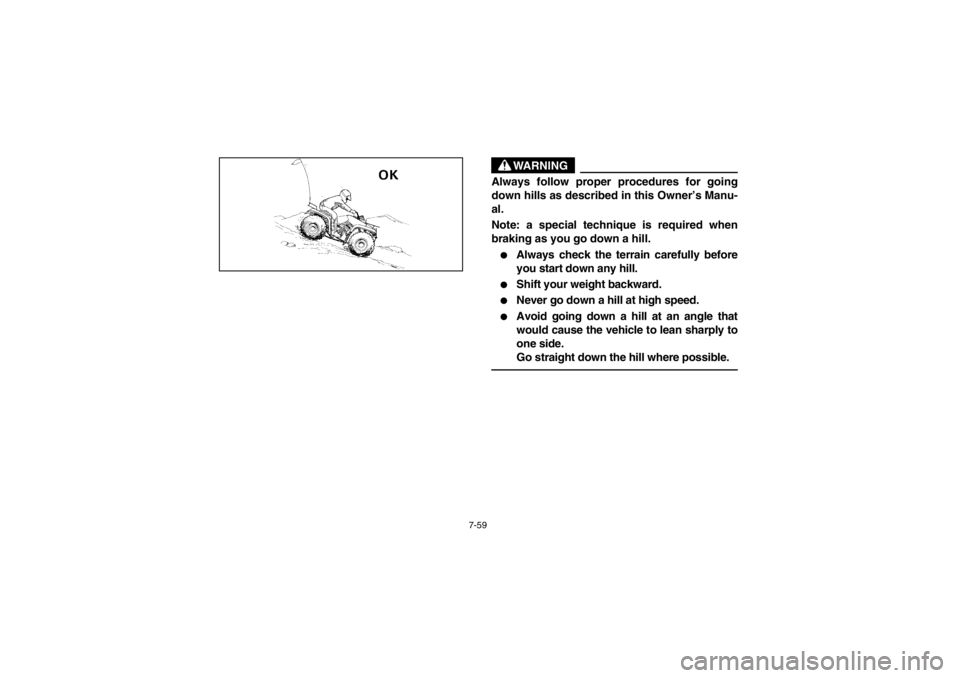
WARNING
Always follow proper procedures for going
down hills as described in this Owner’s Manu-
al.
Note: a special technique is required when
braking as you go down a hill.�
Always check the terrain carefully before
you start down any hill.
�
Shift your weight backward.
�
Never go down a hill at high speed.
�
Avoid going down a hill at an angle that
would cause the vehicle to lean sharply to
one side.
Go straight down the hill where possible.
EE.book Page 59 Monday, June 18, 2001 10:18 AM
Page 236 of 388
7-63
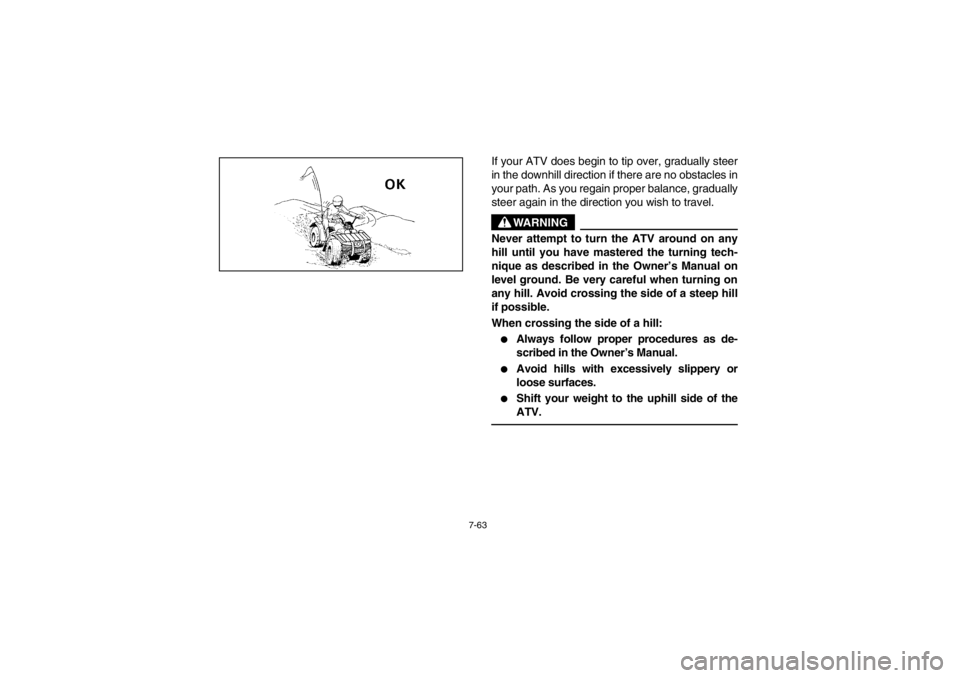
If your ATV does begin to tip over, gradually steer
in the downhill direction if there are no obstacles in
your path. As you regain proper balance, gradually
steer again in the direction you wish to travel.
WARNING
Never attempt to turn the ATV around on any
hill until you have mastered the turning tech-
nique as described in the Owner’s Manual on
level ground. Be very careful when turning on
any hill. Avoid crossing the side of a steep hill
if possible.
When crossing the side of a hill:�
Always follow proper procedures as de-
scribed in the Owner’s Manual.
�
Avoid hills with excessively slippery or
loose surfaces.
�
Shift your weight to the uphill side of the
ATV.
EE.book Page 63 Monday, June 18, 2001 10:18 AM
Page 238 of 388
7-65
CROSSING THROUGH SHALLOW WATER
The ATV can be used to cross slow moving, shal-
low water of up to a maximum of 35 cm in depth.
Before entering the water, choose your path care-
fully. Enter where there is no sharp drop off, and
avoid rocks or other obstacles which may be slip-
pery or upset the ATV. Drive slowly and carefully.
WARNING
Never operate this ATV in fast flowing water or
in water deeper than that specified in your
Owner’s Manual. Remember that wet brakes
may have reduced stopping ability. Test your
brakes after leaving water. If necessary, apply
them several times to let friction dry out the lin-
ings. If the ATV is operated through deep or
fast flowing water, the tires may float, causing
loss of traction and loss of control, which
could lead to an accident.
EE.book Page 65 Monday, June 18, 2001 10:18 AM