2003 VOLVO XC90 lock
[x] Cancel search: lockPage 31 of 242

2003 VOLVO XC90
securing the child seat.
WARNING!
Child Restraint Anchorages are designed to withstand only those loads im\
posed by correctly fitted
Child Restraints. Under no circumstances are they to be used for adult s\
eat belts or harnesses. The
anchorages are not able to withstand excessive forces on them in the eve\
nt of collision if full harness
seat belts or adult seat belts are installed to them. An adult who uses \
a belt anchored in a Child
Restraint Anchorage runs a great risk of suffering severe injuries shoul\
d a collision occur. Do not
install rear speakers which would require the removal of the top tether \
anchors or interfere with the
proper use of the top tether strap.
pg. 20 Safety
Child safety (contd)
Keeping child seats in place (ALR/ ELR*)
To make child seat installation easier, each seat belt (except for the \
driver's belt) is equipped with a
locking mechanism to help keep the seat belt taut.
When attaching the seat belt to a child seat:
l Attach the seat belt to the child seat according to the child seat manuf\
acturer's instructions.
l Pull the seat belt out as far as possible.
l Insert the seat belt latch plate into the buckle (lock) in the usual w\
ay.
l Release the seat belt and pull it taut around the child seat.
A sound from the seat belt retractor will be audible at this time and is\
normal.
The belt will now be locked in place.
This function is automatically disabled when the seat belt is unlocked a\
nd the belt is fully retracted.
WARNING!
Do not use child safety seats or child booster cushions/backrests in the\
front passenger's seat. We also
recommend that children who have outgrown these devices sit in the rear \
seat with the seat belt
properly fastened.
Important!
file:///K|/ownersdocs/2003/2003_XC90/03xc90_01b.htm (12 of 15)12/30/20\
06 4:18:50 PM
Page 32 of 242

2003 VOLVO XC90
Why Volvo believes no child should sit in the front seat of a vehicle
It's quite simple really. A front airbag is a very powerful device desig\
ned, by law, to help protect an
adult. Because of the size of the airbag and its speed of inflation, a c\
hild should never be placed in the
front seat, even if he or she is properly belted or strapped into a chil\
d safety seat. Volvo has been an
innovator in safety for over fifty years, and we'll continue to do our p\
art. But we need your help. Please
remember to put your children in the back seat, and buckle them up.
Volvo has some very specific recommendations:
l Always wear your seat belt.
l Airbags are a SUPPLEMENTAL safety device which, when used with a three-p\
oint seat belt can help
reduce serious injuries during certain types of accidents. Volvo recomme\
nds that you do not disconnect
the airbag system in your vehicle.
l Volvo strongly recommends that ALL children sit in the rear seat of any \
vehicle and that they be
properly restrained.
l A child should NEVER sit in the front passenger seat of any vehicle equi\
pped with a passenger-side
front airbag.
l Volvo recommends that ALL occupants (adults and children) shorter than\
four feet seven inches (140
cm) be seated in the back seat of any vehicle with a front passenger si\
de airbag.
Drive safely!
* Automatic Locking Retractor/Emergency Locking Retractor
pg. 21 Safety
Occupant safety, Reporting safety defects
Seat belt maintenance
Check periodically that the seat belts are in good condition. Use water \
and a mild detergent for cleaning.
Check seat belt mechanism function as follows: attach the seat belt and \
pull rapidly on the strap.
Volvo concern for safety
Safety is Volvo's cornerstone. Our concern dates back to 1927 when the f\
irst Volvo rolled off the
production line. Three-point seat belts (a Volvo invention), safety ca\
ges, and energy-absorbing impact
zones were designed into Volvo vehicles long before it was fashionable o\
r required by government
regulation. We will not compromise our commitment to safety. We continue\
to seek out new safety
features and to refine those already in our vehicles. You can help. We w\
ould appreciate hearing your
suggestions about improving automobile safety. We also want to know if y\
ou ever have a safety concern
with your vehicle. Call us in the U.S. at: 800-458-1552 or in Canada at:\
800-663-8255.
Occupant safety
file:///K|/ownersdocs/2003/2003_XC90/03xc90_01b.htm (13 of 15)12/30/20\
06 4:18:50 PM
Page 35 of 242

2003 VOLVO XC90
2 0 0 3
VOLVO XC90
Safety
pg. 23 Instruments and controls
Instrument panel24
Indicator and warning symbols25
Switches in center console29
Steering wheel adjustment30
Lighting panel31
Manually unlocking the fuel filler door32
Turn signals33
Hazard warning flashers, rear window/sideview mirror defroster, heated f\
ront seats35
Trip computer (option)36
Cruise control37
Parking brake, Opening/closing the hood38
Opening the tailgate, Auxiliary 12-volt sockets39
Electrically operated windows40
Rearview mirror/power folding sideview mirrors42
Electrically operated moonroof (option)43
pg. 24 Instruments and controls
file:///K|/ownersdocs/2003/2003_XC90/03xc90_02a.htm (1 of 16)12/30/200\
6 4:18:52 PM
Page 37 of 242

2003 VOLVO XC90
automatically prevent excessively high engines speeds. This will be noti\
ceable as a pronounced
unevenness in engine speed.
10. Gear and driving mode indicator
The currently selected driving mode is displayed here. If you use the op\
tional Geartronic function on the
automatic transmission, the currently selected gear will be displayed.
11. Ambient temperature gauge
This display indicates the air temperature outside your vehicle. A "snow\
flake" symbol in the text
window is displayed when the temperature is in the range of 23 -36° F\
(-5 -+2° C). Please note that this
symbol does not indicate a fault with your vehicle. At low speeds or whe\
n the vehicle is not moving, the
temperature readings may be slightly higher than the actual ambient temp\
erature.
12. Clock/set button
Turn the button to set the clock.
13. Fuel gauge
The fuel tank holds approximately 19 US gals (72 liters). When a warni\
ng light in the gauge comes on,
there are approximately 1.8 US gal. (8 liters) of fuel remaining in th\
e tank.
14. Indicator and warning symbols
pg. 25 Instruments and controls
Indicator and warning symbols
The indicator and warning symbols light up when you turn the ignition ke\
y to the driving position
(position II) before starting. This shows that the symbols are functio\
ning. When the engine starts, all
symbols go out. If the engine is not started within 5 seconds, all symbo\
ls except CHECK ENGINE and
go out. The symbol for the parking brake goes out when the parking brak\
e is released.
Warning symbol
in center of instrument panel
This symbol shines as a red or yellow light depending on the severity of\
the fault that has been detected.
Red symbol -Stop the vehicle as soon as possible in a suitable location and read th\
e message shown in
the text window.
Yellow symbol -Follow the instructions shown in the text window.
file:///K|/ownersdocs/2003/2003_XC90/03xc90_02a.htm (3 of 16)12/30/200\
6 4:18:52 PM
Page 38 of 242
. The vehicle should be driven")
2003 VOLVO XC90
Anti-lock brake system ABS
If the warning light comes on, there is a malfunction of the ABS system \
(the standard braking system
will still function). The vehicle should be driven to a Volvo retailer \
for inspection. See
page 96 for
additional information.
pg. 26 Instruments and controls
Indicator and warning symbols (contd)
BRAKE Brake failure warning light
If the light comes on while driving or braking, stop immediately, open t\
he hood and check the brake
fluid level in the reservoir. See
page 128 for reservoir position and page 132 for instructions.
Canadian models are equipped with this warning light.
If the BRAKE and ABS warning lights come on at the same time, this could\
indicate a fault in the
brake system.
l Stop the vehicle in a suitable place and switch off the engine.
l Restart the engine.
l If both warning lights go off, no further action is required.
l If both lights are still on after the engine has been restarted, switch \
off the engine again and check the
brake fluid level (see
page 128 for the location of the brake fluid reservoir).
file:///K|/ownersdocs/2003/2003_XC90/03xc90_02a.htm (4 of 16)12/30/200\
6 4:18:52 PM
Page 44 of 242
")
2003 VOLVO XC90
This button controls the optional rear seat air conditioning system on s\
even-seat models. See page 48 for
more information.
6. Temporarily disconnecting the alarm sensors (option)
See
page 81 for more details.
7. Not in use
8. 12 volt socket
This 12 volt socket can be used to plug in certain accessories such as c\
ellular telephones, etc. The
ignition key must be in position 1 (or higher) for the auxiliary socke\
t to function.
NOTE: The auxiliary sockets can also be used for cigarette lighters, which are\
available as accessories
at your Volvo retailer.
pg. 30 Instruments and controls
Steering wheel adjustment
Steering wheel adjustment
Both the height and the reach of the steering wheel can be adjusted to a\
comfortable position for the
driver. Pull down the lever on the left of the steering column. Adjust t\
he steering wheel to a suitable
position and press the lever back into place to lock the steering wheel \
in the new position. Check that the
steering wheel is locked in the new position.
file:///K|/ownersdocs/2003/2003_XC90/03xc90_02a.htm (10 of 16)12/30/20\
06 4:18:52 PM
Page 46 of 242

2003 VOLVO XC90
B - Instrument lighting
Move the thumb wheel up to increase brightness or down to decrease brigh\
tness. There is also an
instrument panel illumination sensor (see illustration on
page 48) which automatically adjusts the level
of illumination. The symbols have maximum illumination in daylight (onl\
y the background lighting can
be adjusted). At night, both the symbol light and background lighting c\
an be adjusted.
C - Unlocking the fuel filler door
Press this button when the vehicle is at a standstill to unlock the fuel\
filler door. Please note that the fuel
filler door will remain unlocked until the vehicle begins to move forwar\
d. An audible click will be heard
when the fuel filler door relocks. See also
page 86.
NOTE: If the fuel filler door does not unlock after the button has been press\
ed, please see
page 32 for
information on manually unlocking this door.
D - Front fog lights
The front fog lights will function only in combination with the low beam\
headlights. The fog lights turn
off when the ignition is switched off. A light in the switch indicates w\
hen the front fog lights are on.
E - Rear fog light
The rear fog light is considerably brighter than the normal tail lights \
and should be used only when
conditions such as fog, rain, snow, smoke or dust reduce visibility for \
other vehicles to less than 500 ft
(150 meters).
A light in the switch indicates when the rear fog light is on.
The rear fog light will only function in combination with the high/low b\
eam headlights.
By design, there is one rear fog light only, located in the driver's sid\
e tail light cluster.
file:///K|/ownersdocs/2003/2003_XC90/03xc90_02a.htm (12 of 16)12/30/20\
06 4:18:52 PM
Page 47 of 242
2003 VOLVO XC90
pg. 32 Instruments and controls
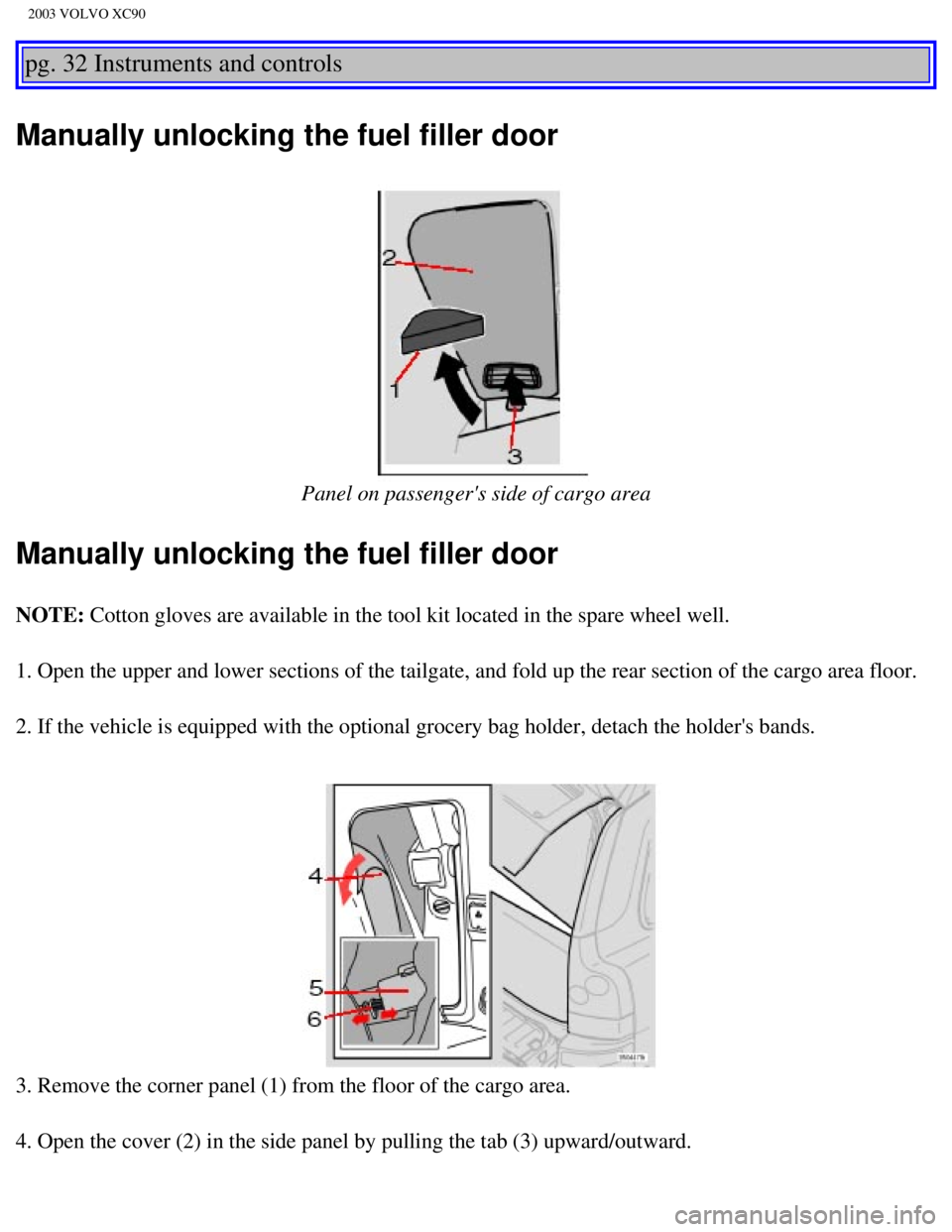
Manually unlocking the fuel filler door
Panel on passenger's side of cargo area
Manually unlocking the fuel filler door
NOTE: Cotton gloves are available in the tool kit located in the spare wheel \
well.
1. Open the upper and lower sections of the tailgate, and fold up the re\
ar section of the cargo area floor.
2. If the vehicle is equipped with the optional grocery bag holder, deta\
ch the holder's bands.
3. Remove the corner panel (1) from the floor of the cargo area.
4. Open the cover (2) in the side panel by pulling the tab (3) upwar\
d/outward.
file:///K|/ownersdocs/2003/2003_XC90/03xc90_02a.htm (13 of 16)12/30/20\
06 4:18:52 PM