2003 VOLVO V70 tires
[x] Cancel search: tiresPage 71 of 117

Never allow the wheels to lock up during braking.
Snow tires, studded tires *
Tires for winter use:
Owners who live in or regularly travel through areas with sustained periods of snow or icy driving conditions
are strongly advised to fit suitable winter tires to help retain the highest degree of traction. It is important to
install winter tires on all four wheels to help retain traction during cornering, braking, and accelerating. Failure to do
so could reduce traction to an unsafe level or adversely affect handling. Volvo does not recommend tire rotation.
However, as with any other radial tires, if rotated, the tires must be kept on the same side of the car so that they
revolve in the same direction as before rotation.
Volvo recommends 195/65 R15 snow tires on non-turbo models. Turbo models should be equipped with 205/55
R16 snow tires on all four wheels (215/65 R16 tires should be used on the XC70).
Winter tires wear more quickly on dry roads in warm weather. They should be removed when the winter driving
season has ended.
Studded tires should be run-in 300-600 miles (500-1000 km) during which the car should be driven as smoothly as
possible to give the studs the opportunity to seat properly in the tires. The tires should have the same rotational
direction throughout their entire lifetime. In other words, if you wish to rotate the wheels, make sure that the same
wheels are always on the same side of the car.
NOTE: Please consult state or provincial regulations restricting the use of studded winter tires before installing such
tires.
* Where permitted.
pg. 110 Wheels and tires
Tire pressure label
Checking and correcting tire pressure
Check the tire pressure regularly.
The tire pressure should be corrected only when the tires are cold.
With warm tires, correct only when the pressure is too low. The tire temperature rises after driving just a few miles.
ProCarManuals.com
Page 72 of 117

Vehicle loading
The tires on your Volvo will perform to specifications at all normal loads when inflated as recommended on the tire
information label located on the inside of the fuel filler door*. This label also lists vehicle load limits. Do not load
your car beyond the indicated limits.WARNING!
Improperly inflated tires will reduce tire life, adversely affect vehicle handling and can possibly lead to failure
resulting in loss of vehicle control without prior warning.
Temporary Spare
The spare tire in your car is called a "Temporary Spare". It has the following designation: T125/80 R17 (T135/90 R17
on the XC70).
At the recommended tire pressure shown on the inside of the fuel filler door, the tire may be used as a temporary
replacement for a front or rear tire.
In the event of damage to this tire, a new one can be purchased from your Volvo retailer.WARNING!
Current legislation prohibits the use of the "Temporary Spare" tire other than as a temporary replacement for a
punctured tire. It must be replaced as soon as possible by a standard tire. Road holding and handling may be affected
with the "Temporary Spare" in use. Do not exceed 50 mph (80 km/h). Do not drive farther than 50 miles (80 km) on
a temporary spare tire.
CAUTION:
The car must not be driven with wheels of different dimensions or with a spare tire other than the one that came with
the car. The use of different size wheels can seriously damage your car's transmission.
NOTE: Certain models may be equipped with a full-size spare tire. When used, it should be inflated to the same
pressure as the tire it is replacing.
*Please note that the tire information label indicates pressure for both comfort and fuel economy.
pg. 111 Wheels and tires
Uniform tire quality grading
ALL PASSENGER CAR TIRES MUST CONFORM TO FEDERAL SAFETY REQUIREMENTS IN
ADDITION TO THESE GRADES
Quality grades can be found, where applicable, on the tire sidewall between the tread shoulder and maximum section
width. For example:
Treadwear 200 Traction AA Temperature A
TREADWEAR
The treadwear grade is a comparative rating based on the wear rate of the tire when tested under controlled conditions
ProCarManuals.com
Page 73 of 117

on a specified government test course. For example, a tire graded 150 would wear one and one half (1 1/2) times as
well on the government course as a tire graded 100. The relative performance of tires depends upon the actual
conditions of their use, however, and many depart significantly from the norm due to variation in driving habits,
service practices and differences in road characteristics and climate.
TRACTION
The traction grades, from highest to lowest, are AA, A, B, and C, as measured under controlled conditions on specified
government test surfaces of asphalt and concrete. A tire marked C may have poor traction performance.WARNING!
The traction grade assigned to this tire is based on braking (straight-ahead) traction tests and is not a measure of
cornering (turning) traction.
TEMPERATURE
The temperature grades are AA (the highest), A, B, and C, representing the tire's resistance to the generation of heat
and its ability to dissipate heat when tested under controlled conditions on a specified indoor laboratory test wheel.
Sustained high temperature can cause the material of the tire to degenerate and reduce tire life, and excessive
temperature can lead to sudden tire failure. The grade C corresponds to a minimum level of performance which all
passenger car tires must meet under the Federal Motor Safety Standard No. 109. Grades B and A represent higher
levels of performance on the laboratory test wheel than the minimum required by law. WARNING!
The temperature grade for this tire is established for a tire that is properly inflated and not overloaded. Excessive
speed, under-inflation, or excessive loading, either separately or in combination, can cause heat buildup and possible
tire failure.
pg. 112 Changing wheels
Insert flat end of lug wrench and turn/pull straight out
Changing wheels
The spare wheel is located under the carpet on the cargo area floor. The jack and crank are secured in the wheel recess.
There are two jack attachment points on each side of the car.
To change a wheel:
ProCarManuals.com
Page 74 of 117

Engage the parking brake.
Put the gear selector in (P)ark.
Remove the wheel cap (where applicable) using the lug wrench in the tool kit.
With the car still on the ground, use the lug wrench to loosen the wheel bolts 1/2 - 1 turn by exerting downward
pressure. Turn the bolts counterclockwise to loosen.
Loosen wheel bolts
Position the jack on the bar in the attachment (A in the illustration in right column) and crank while simultaneously
guiding the base of the jack to the ground. The base of the jack must be flat on a level, firm, non-slippery surface.
Before raising the car, check that the jack is still correctly positioned in the attachment.
Raise the vehicle until the wheel to be changed is lifted off the ground.
Unscrew the wheel bolts completely and carefully remove the wheel so as not to damage the thread on the studs.
NOTE: See also page 133
for hoisting the vehicle on a garage lift!
WARNING!
The jack must correctly engage the bar in the jack attachment (A). The car's weight must not rest on the jack
attachment (B). See illustration on page 113.
Be sure the jack is on a firm, level, non-slippery surface.
Never allow any part of your body to be extended under a car supported by a jack.
Use the jack intended for the car when replacing a wheel. For any other job, use stands to support the side of the
car being worked on.
Apply the parking brake and put the gear selector in the (P)ark position.
Block the wheels standing on the ground, use rigid wooden blocks.
pg. 113 Wheels and tires
ProCarManuals.com
Page 75 of 117

Attaching the jack
NOTE: To avoid excessive wear and the necessity of rebalancing, mark and reinstall wheels in the same location and
position as before removal. To lessen the chance of imbalance, each wheel hub is equipped with a guide stud to ensure
that a removed wheel can be reinstalled in its original position (as when changing over to winter tires/wheels).
NOTE: Refer to page 133
for hoisting the vehicle on a garage lift.
Jack for AWD models
CAUTION:
The car must not be driven with wheels of different dimensions or with a spare tire other than the one that came with
the car. The use of different size wheels can seriously damage your car's transmission.
Correct tightening torque on wheel bolts must be observed. The wheel bolts should never be greased or lubricated.
The extended, chromed wheel bolts must not be used with steel rims, as they make it impossible to fit the hub caps.
Correct tightening order for wheel bolts
Installing the wheel
Clean the contact surfaces on the wheel and hub.
Lift the wheel and place it on the hub. Make sure that you align the wheel with the guide stud on the wheel hub prior
to installation.
Install the wheel bolts and tighten hand -tight. Using the lug wrench, tighten crosswise (see illustration above) until
all bolts are snug.
Lower the vehicle to the ground and alternately tighten the bolts crosswise to 100 ft. lbs. (136 Nm).
Install the wheel cap (where applicable).
ProCarManuals.com
Page 112 of 117
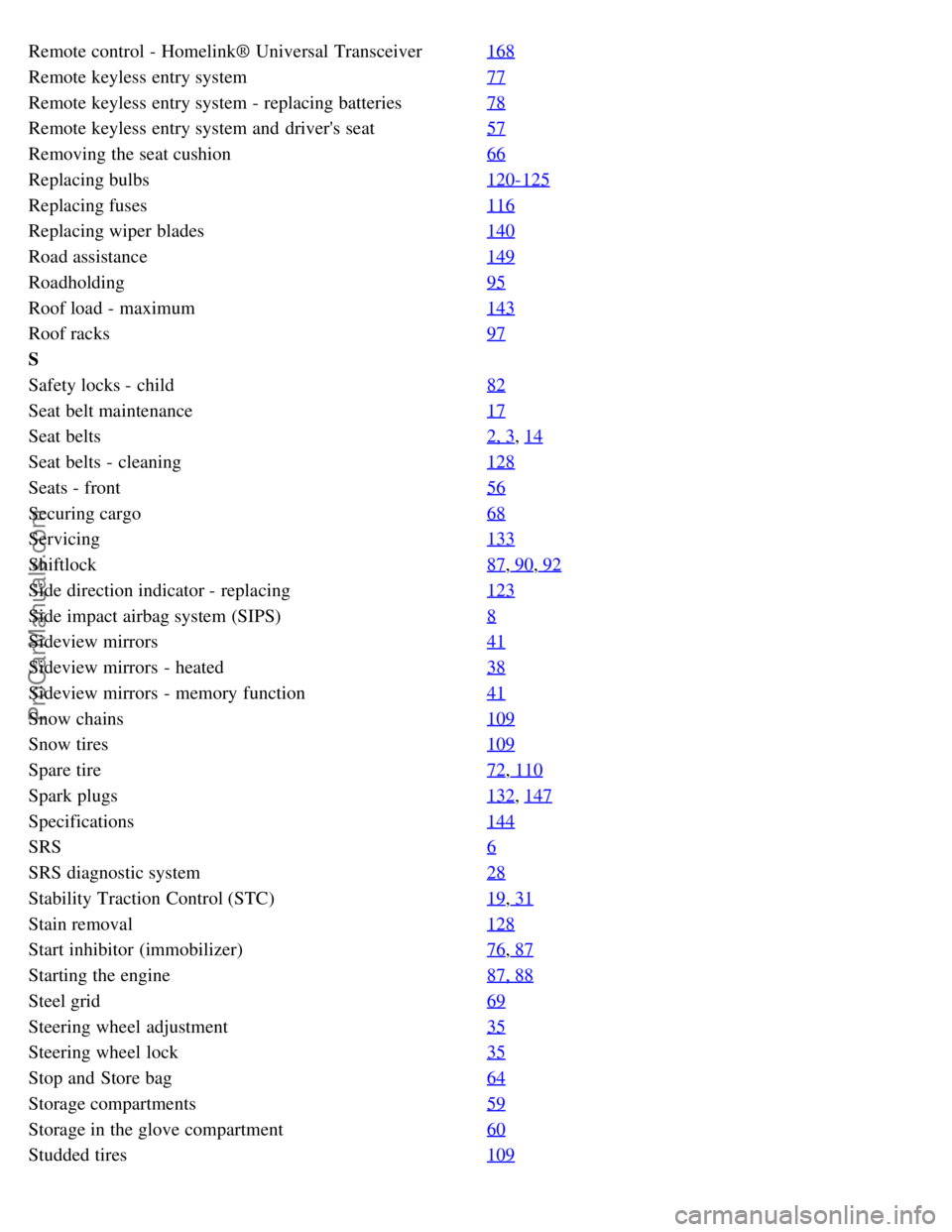
Remote control - Homelink® Universal Transceiver168
Remote keyless entry system77
Remote keyless entry system - replacing batteries78
Remote keyless entry system and driver's seat57
Removing the seat cushion66
Replacing bulbs120-125
Replacing fuses116
Replacing wiper blades140
Road assistance149
Roadholding95
Roof load - maximum143
Roof racks97
S
Safety locks - child82
Seat belt maintenance17
Seat belts2, 3, 14
Seat belts - cleaning128
Seats - front56
Securing cargo68
Servicing133
Shiftlock87, 90, 92
Side direction indicator - replacing123
Side impact airbag system (SIPS)8
Sideview mirrors41
Sideview mirrors - heated38
Sideview mirrors - memory function41
Snow chains109
Snow tires109
Spare tire72, 110
Spark plugs132, 147
Specifications144
SRS6
SRS diagnostic system28
Stability Traction Control (STC)19, 31
Stain removal128
Start inhibitor (immobilizer)76, 87
Starting the engine87, 88
Steel grid69
Steering wheel adjustment35
Steering wheel lock35
Stop and Store bag64
Storage compartments59
Storage in the glove compartment60
Studded tires109
ProCarManuals.com
Page 113 of 117

Subwoofer72, 166
Sun roof42, 43
Supplemental Restraint System4, 28
Suspension147
Switches in center console31
T
Tachometer27
Tailgate - locking/unlocking79
Tailgate wiper blade - replacing140
Temperature gauge27
Temporary spare tire110
Text window30
Three-way catalytic converters106
Timing belt132
Tire pressure110
Tires108 -111
Tires - changing112, 113
Tool bag72
Towing a trailer101
Towing eyelet99
Towing the car99, 100
Trailer towing101
Trailer weight - maximum143
Transmission - automatic90-94
Trip computer32
Trip odometer27
Turn signals36
U
Uniform tire quality grading111
Unlocking the tailgate79
Upholstery - cleaning128
V
Vanity mirror lights - replacing124
Vehicle Identification Number (VIN)142
Vehicle loading110
Ventilation46
Volvo On Call149
Volumes (oils and fluids)146
W
Warning flashers38
Warning light - center28
Warning lights28, 29
Warranty129
Washer fluid reservoir133
ProCarManuals.com
Page 114 of 117

Washer fluid solvent104
Washing the car127, 128
Waxing128
Weight distribution95
Wheels - changing112, 113
Wheels and tires108-113
Whiplash Protection System (WHIPS)10
Windows - electrically operated40
Windshield washer solvent104
Windshield wiper blades - replacing140
Windshield wipers/washers37
Winter driving104
Winter tires109
Winter/Wet driving mode91, 93, 104
Wiper blades - replacing140
Contents | Top of Page
ProCarManuals.com