Page 234 of 340
03 SIENNA_U (L/O 0207)
2302003 MY SIENNA (OM45410U)
CAUTION
�Avoid inhaling the engine exhaust.
It contains carbon monoxide, which
is a colorless and odorless gas. It
can cause unconsciousness or even
death.
�Make sure the exhaust system has
no holes or loose connections. The
system should be checked from
time to time. If you hit something,
or notice a change in the sound of
the exhaust, have the system
checked immediately.
�Do not run the engine in a garage
or enclosed area except for the
time needed to drive the vehicle in
or out. The exhaust gases cannot
escape, making this a particularly
dangerous situation.
�Do not remain for a long time in a
parked vehicle with the engine run-
ning. If it is unavoidable, however,
do so only in an unconfined area
and adjust the heating or cooling
system to force outside air into the
vehicle.
�Keep the back door and quarter
windows closed while driving. An
open or unsealed back door and
quarter windows may cause exhaust
gases to be drawn into the vehicle.
�To allow proper operation of your
vehicle’s ventilation system, keep
the inlet grilles in front of the wind-
shield clear of snow, leaves, or oth-
er obstructions.
�If you smell exhaust fumes in the
vehicle, drive with the windows
open and the back door and quarter
windows closed. Have the cause im-
mediately located and corrected.
FUNCTIONS OF ENGINE OIL
Engine oil has the primary functions of
lubricating and cooling the inside of the
engine, and plays a major role in main-
taining the engine in proper working order.
ENGINE OIL CONSUMPTION
It is normal that an engine should con-
sume some engine oil during normal
engine operation. The causes of oil
consumption in a normal engine are as
follows.
�Oil is used to lubricate pistons, piston
rings and cylinders. A thin film of oil
is left on the cylinder wall when a pis-
ton moves downwards in the cylinder.
High negative pressure generated when
the vehicle is decelerating sucks some
of this oil into the combustion chamber.
This oil as well as some part of the oil
film left on the cylinder wall is burned
by the high temperature combustion
gases during the combustion process.
�Oil is also used to lubricate the stems
of the intake valves. Some of this oil
is sucked into the combustion chamber
together with the intake air and is
burned along with the fuel. High tem-
perature exhaust gases also burn the
oil used to lubricate the exhaust valve
stems.
Engine exhaust cautionsFacts about engine oil
consumption
Page 235 of 340
03 SIENNA_U (L/O 0207)
2312003 MY SIENNA (OM45410U)
The amount of engine oil consumed de-
pends on the viscosity of the oil, the
quality of the oil and the conditions the
vehicle is driven under.
More oil is consumed by highspeed driv-
ing and frequent acceleration and decel-
eration.
A new engine consumes more oil, since
its pistons, piston rings and cylinder walls
have not become conditioned.
When judging the amount of oil con-
sumption, note that the oil may become
diluted and make it difficult to judge
the true level accurately.
As an example, if a vehicle is used for
repeated short trips, and consumes a nor-
mal amount of oil, the dipstick may not
show any drop in the oil level at all, even
after 1000 km (600 miles) or more. This
is because the oil is gradually becoming
diluted with fuel or moisture, making it
appear that the oil level has not changed.
The diluting ingredients evaporate out
when the vehicle is then driven at high
speeds, as on an express way, making it
appear that oil is excessively consumed
after driving at high speeds.IMPORTANCE OF ENGINE OIL LEVEL
CHECK
One of the most important points in prop-
er vehicle maintenance is to keep the en-
gine oil at the optimum level so that oil
function will not be impaired. Therefore, it
is essential that the oil level be checked
regularly. Toyota recommends that the oil
level be checked every time you refuel
the vehicle.
NOTICE
Failure to check the oil level regularly
could lead to serious engine trouble
due to insufficient oil.
For detailed information on oil level check,
see “Checking the engine oil level” in Sec-
tion 72.
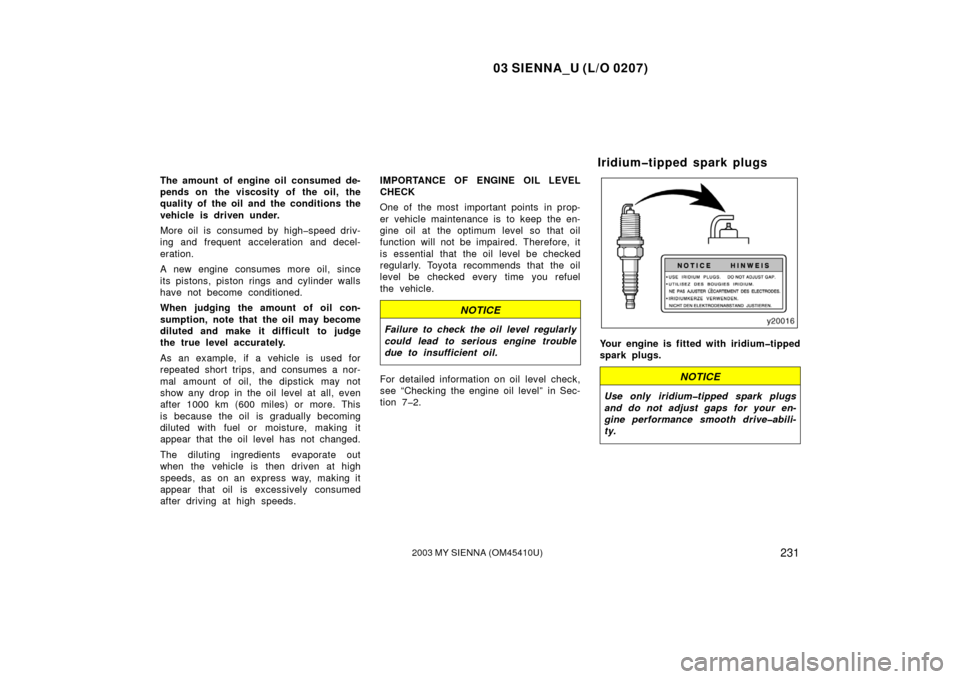
Your engine is fitted with iridiumtipped
spark plugs.
NOTICE
Use only iridiumtipped spark plugs
and do not adjust gaps for your en-
gine performance smooth driveabili-
ty.
Iridiumtipped spark plugs
Page 288 of 340

03 SIENNA_U (L/O 0207)
2842003 MY SIENNA (OM45410U)
Lights
Make sure the headlights, stop lights, tail
lights, turn signal lights, and other lights
are all working. Check headlight aim.
Service reminder indicators and warning
buzzers
Check that all service reminder indicators
and warning buzzers function properly.
Steering wheel
Be alert for changes in steering condition,
such as hard steering or strange noise.
Seats
Check that all seat controls such as seat
adjusters, seatback recliner, etc. operate
smoothly and that all latches lock securely
in any position. Check that the head re-
straints move up and down smoothly and
that the locks hold securely in any latched
position. For foldingdown rear seatbacks
and detachable rear seats, check that the
latches lock securely.
Seat belts
Check that the seat belt system such as
buckles, retractors and anchors operate
properly and smoothly. Make sure the belt
webbing is not cut, frayed, worn or dam-
aged.Accelerator pedal
Check the pedal for smooth operation and
uneven pedal effort or catching.
Brake pedal
Check the pedal for smooth operation and
that the pedal has the proper clearance.
Check the brake booster function.
Brakes
At a safe place, check that the brakes do
not pull to one side when applied.
Parking brake
Check that the pedal has the proper travel
and that, on a safe incline, your vehicle
is held securely with only the parking
brake applied.
Automatic transmission “Park” mecha-
nism
On a safe incline, check that your vehicle
is held securely with the selector lever in
“P” position and all brakes released.
IN THE ENGINE COMPARTMENT
Items listed below should be checked
from time to time, e.g. each time when
refueling.
Washer fluid
Make sure there is sufficient fluid in the
tank. See Section 73 for additional in-
formation.
Engine coolant level
Make sure the coolant level is between
the “FULL” and “LOW” lines on the see
through reservoir when the engine is cold.
See Section 72 for additional information.
Radiator, condenser and hoses
Check that the front of the radiator and
condenser are clean and not blocked with
leaves, dirt, or insects. See Section 72
for additional information.
Battery electrolyte level
Your Toyota has a maintenance free bat-
tery. You do not have to add distilled wa-
ter. For longer life of the battery, however,
see Section 73 for additional information.
Brake fluid level
Make sure the brake fluid level is correct.
See Section 72 for additional information.
Page:
< prev 1-8 9-16 17-24