Page 57 of 256
50
22p013
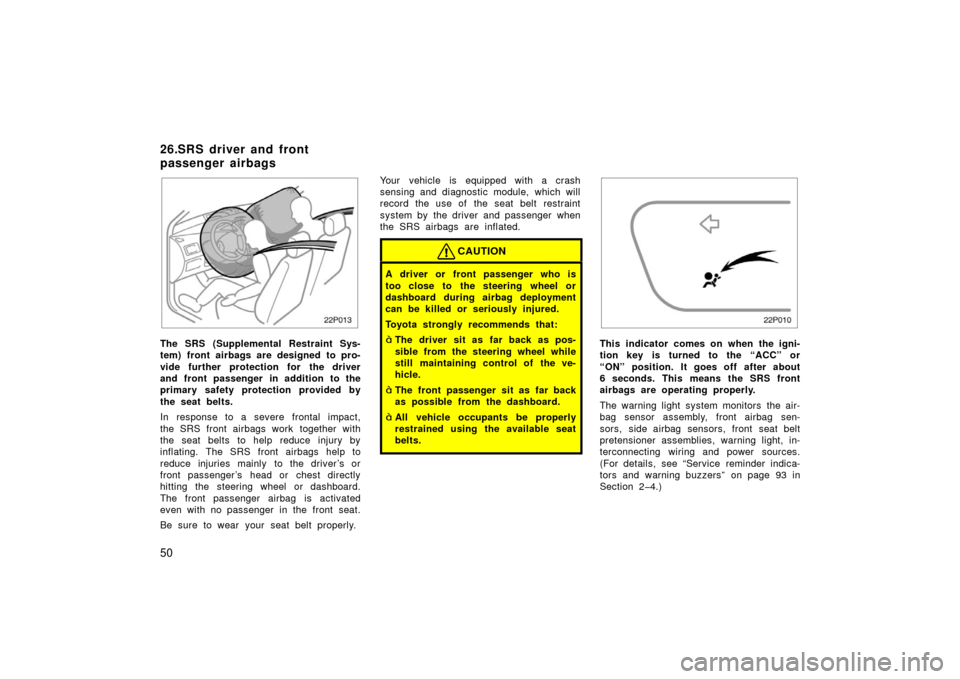
The SRS (Supplemental Restraint Sys-
tem) front airbags are designed to pro-
vide further protection for the driver
and front passenger in addition to the
primary safety protection provided by
the seat belts.
In response to a severe frontal impact,
the SRS front airbags work together with
the seat belts to help reduce injury by
inflating. The SRS front airbags help to
reduce injuries mainly to the driver ’s or
front passenger ’s head or chest directly
hitting the steering wheel or dashboard.
The front passenger airbag is activated
even with no passenger in the front seat.
Be sure to wear your seat belt properly.Your vehicle is equipped with a crash
sensing and diagnostic module, which will
record the use of the seat belt restraint
system by the driver and pass
enger when
the SRS airbags are inflated.
CAUTION
A driver or front passenger who is
too close to the steering wheel or
dashboard during airbag deployment
can be killed or seriously injured.
Toyota strongly recommends that:
�The driver sit as far back as pos-
sible from the steering wheel while
still maintaining control of the ve-
hicle.
�The front passenger sit as far back
as possible from the dashboard.
�All vehicle occupants be properly
restrained using the available seat
belts.
22p010
This indicator comes on when the igni-
tion key is turned to the “ACC” or
“ON” position. It goes off after about
6 seconds. This means the SRS front
airbags are operating properly.
The warning light system monitors the air-
bag sensor assembly, front airbag sen-
sors, side airbag sensors, front seat belt
pretensioner assemblies, warning light, in-
terconnecting wiring and power sources.
(For details, see “Service reminder indica-
tors and warning buzzers” on page 93 in
Section 24.)
26.SRS driver and front
passenger airbags
Page 59 of 256
52
22p017a
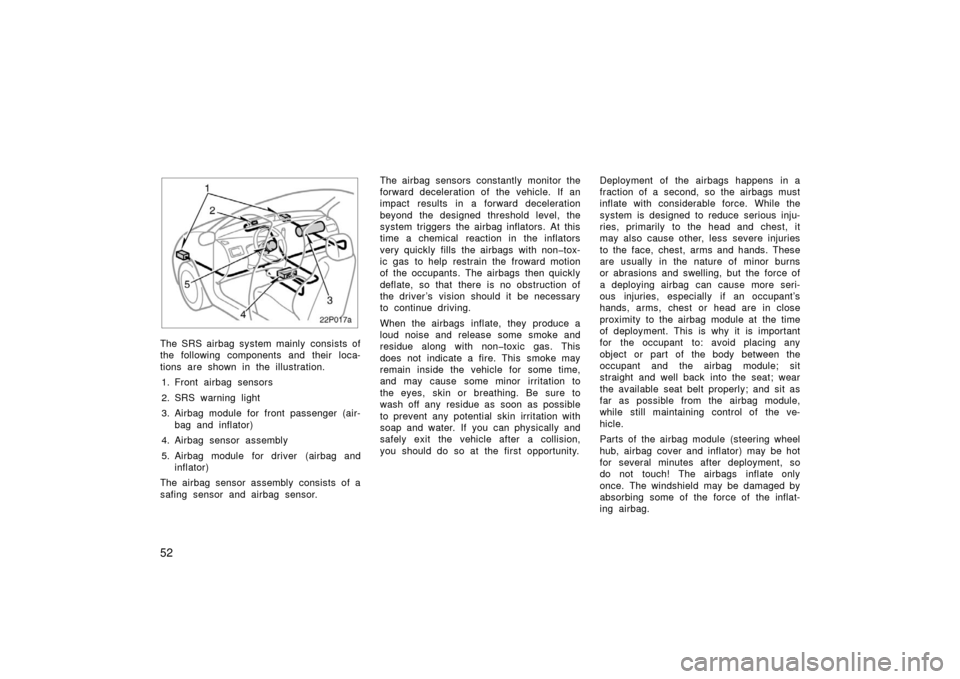
The SRS airbag system mainly consists of
the following components and their loca-
tions are shown in the illustration.1. Front airbag sensors
2. SRS warning light
3. Airbag module for front passenger (air- bag and inflator)
4. Airbag sensor assembly
5. Airbag module for driver (airbag and inflator)
The airbag sensor assembly consists of a
safing sensor and airbag sensor. The airbag sensors constantly monitor the
forward deceleration of the vehicle. If an
impact results in a forward deceleration
beyond the designed threshold level, the
system triggers the airbag inflators. At this
time a chemical reaction in the inflators
very quickly fills the air
bags with nontox-
ic gas to help restrain the froward motion
of the occupants. The airbags then quickly
deflate, so that there is no obstruction of
the driver ’s vision should it be necessary
to continue driving.
When the airbags inflate, they produce a
loud noise and release some smoke and
residue along with nontoxic gas. This
does not indicate a fire. This smoke may
remain inside the vehicle for some time,
and may cause some minor irritation to
the eyes, skin or breathing. Be sure to
wash off any residue as soon as possible
to prevent any potential skin irritation with
soap and water. If you can physically and
safely exit the vehicle after a collision,
you should do so at the first opportunity. Deployment of the airbags happens in a
fraction of a second, so the airbags must
inflate with considerable force. While the
system is desi
gned to reduce serious inju-
ries, primarily to the head and chest, it
may also cause other, less severe injuries
to the face, chest, arms and hands. These
are usually in the nature of minor burns
or abrasions and swelling, but the force of
a deploying airbag can cause more seri-
ous injuries, especially if an occupant’s
hands, arms, chest or head are in close
proximity to the airbag module at the time
of deployment. This is why it is important
for the occupant to: avoid placing any
object or part of the body between the
occupant and the airbag module; sit
straight and well back into the seat; wear
the available seat belt properly; and sit as
far as possible from the airbag module,
while still maintaining control of the ve-
hicle.
Parts of the airbag module (steering wheel
hub, airbag cover and inflator) may be hot
for several minutes after deployment, so
do not touch! The airbags inflate only
once. The windshield may be damaged by
absorbing some of the force of the inflat-
ing airbag.
Page 65 of 256
58
22p010
This indicator comes on when the igni-
tion key is turned to the “ACC” or
“ON” position. It goes off after about
6 seconds. This means the SRS side
airbags are operating properly.
The warning light system monitors the air-
bag sensor assembly, front airbag sen-
sors, side airbag sensors, front seat belt
pretensioner assemblies, warning light, in-
terconnecting wiring and power sources.
(For details, see “Service reminder indica-
tors and warning buzzers” on page 93 in
Section 24.)
22p025
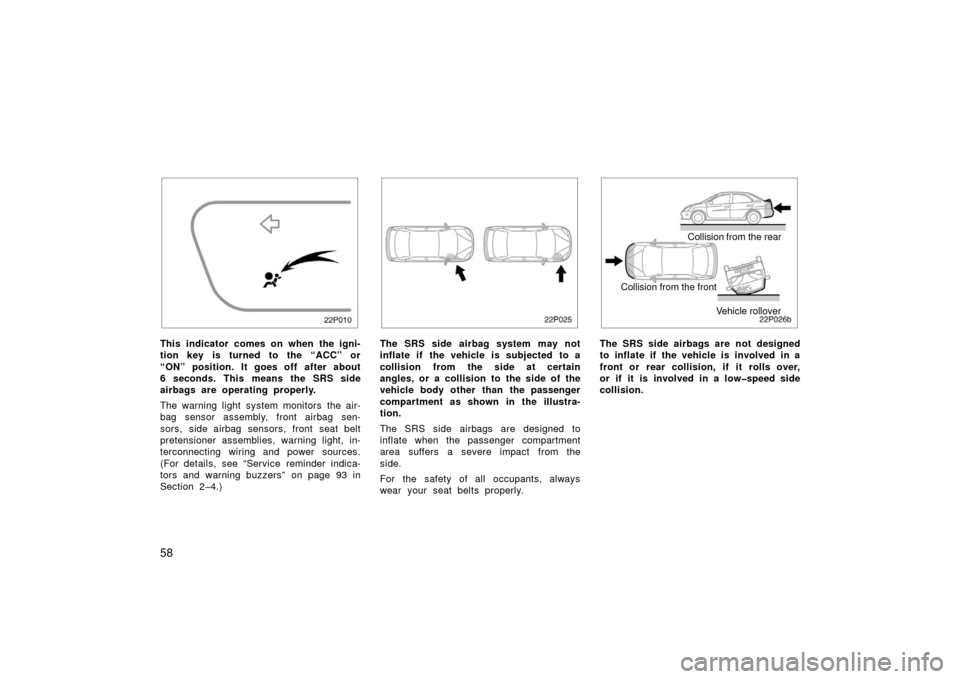
The SRS side airbag system may not
inflate if the vehicle is subjected to a
collision from the side at certain
angles, or a collision to the side of the
vehicle body other than the passenger
compartment as shown in the illustra-
tion.
The SRS side airbags are designed to
inflate when the passenger compartment
area suffers a severe impact from the
side.
For the safety of all occupants, always
wear your seat belts properly.
22p026b
Collision from the rear
Collision from the front
Vehicle rollover
The SRS side airbags are not designed
to inflate if the vehicle is involved in a
front or rear collision, if it rolls over,
or if it is involved in a lowspeed side
collision.
Page 66 of 256
59
22p027
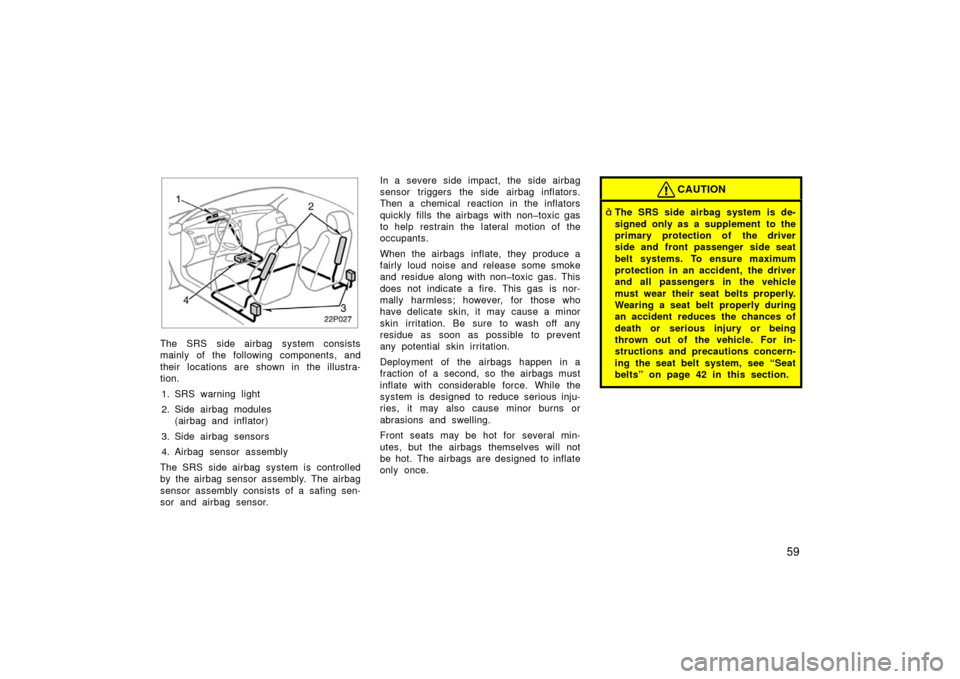
The SRS side airbag system consists
mainly of the following components, and
their locations are shown in the illustra-
tion.1. SRS warning light
2. Side airbag modules (airbag and inflator)
3. Side airbag sensors
4. Airbag sensor assembly
The SRS side airbag system is controlled
by the airbag sensor assembly. The airbag
sensor assembly consists of a safing sen-
sor and airbag sensor. In a severe side impact, the side airbag
sensor triggers the side airbag inflators.
Then a chemical reaction in the inflators
quickly fills the air
bags with nontoxic gas
to help restrain the lateral motion of the
occupants.
When the airbags inflate, they produce a
fairly loud noise and release some smoke
and residue along with nontoxic gas. This
does not indicate a fire. This gas is nor-
mally harmless; however, for those who
have delicate skin, it may cause a minor
skin irritation. Be sure to wash off any
residue as soon as possible to prevent
any potential skin irritation.
Deployment of the airbags happen in a
fraction of a second, so the airbags must
inflate with considerable force. While the
system is desi gned to reduce serious inju-
ries, it may also cause minor burns or
abrasions and swelling.
Front seats may be hot for several min-
utes, but the airbags themselves will not
be hot. The airbags are designed to inflate
only once.
CAUTION
�The SRS side airbag system is de-
signed only as a supplement to the
primary protection of the driver
side and front passenger side seat
belt systems. To ensure maximum
protection in an accident, the driver
and all passengers in the vehicle
must wear their seat belts properly.
Wearing a seat belt properly during
an accident reduces the chances of
death or serious injury or being
thrown out of the vehicle. For in-
structions and precautions concern-
ing the seat belt system, see “Seat
belts” on page 42 in this section.
Page 95 of 256
88
OPERATION OF INSTRUMENTS AND
CONTROLS
43.Gauges, Meters and Service reminder indicators
Fuel gauge89
. . . . . . . . . . . . . . . . . . . . . . . . . . . . . . . . . . . . .\
. . . . . . . . . . . .
Coolant temperature indicator and warning lights s90. . . . . . . . . . . . . .
Odometer and two trip meters 91
. . . . . . . . . . . . . . . . . . . . . . . . . . . . . . . . .
km/h or MPH button 92
. . . . . . . . . . . . . . . . . . . . . . . . . . . . . . . . . . . . \
. . . . . .
Service reminder indicators and warning buzzers 93
. . . . . . . . . . . . . . .
SECTION 2– 4
Page 97 of 256

90
24p013
At the first blinking of the light, the master
warning light in the instrument cluster
comes on and the message appears on
the multiinformation display to remind the
driver to fill fuel.
24p010a
The fuel system malfunctions in the fol-
lowing cases, so contact your Toyota
dealer.
�All the segments blink.
�The “E” mark and the segments indi-
cating remaining fuel blink.
24p003b
High coolant temperature
warning light in red
Low coolant temperature
indicator light in blue
The indicator and warning lights indi-
cate the coolant temperature when the
ignition switch is on. The hybrid sys-
tem operating temperature will vary
with changes in weather and hybrid
system load.
The red high coolant temperature warning
light will come on when the ignition key
is turned to the “ON” position. After a few
seconds, the light will go off.
If your coolant temperature is cool with
the ignition switch on, the blue low cool-
ant temperature indicator light comes on.
If it keeps lighting on with the hybrid sys-
tem fully warmed, contact your Toyota
dealer as soon as possible to service the
vehicle.
Coolant temperature indicator
an d warn in g lig h t s45.
Page 100 of 256
93
If the indicator or buzzer comes on...Do this.
(a)or
(indicator and buzzer)If parking brake is off, stop immediately and contact Toyota dealer.
(b)
(indicator and buzzer)
Fasten driver ’s seat belt.
(c)Fasten front passenger ’s seat belt.
(d)Take vehicle to Toyota dealer.
(e)Take vehicle to Toyota dealer.
(f)See multiinformation display.
(g)Drive without hard acceleration.
Service reminder indicators and warning buzzers48.
Page 101 of 256
94
If the indicator or buzzer comes on...Do this.
(h)Stop and check.
(i)orTake vehicle to Toyota dealer. If brake system warning light is also on, stop immedi-
ately and contact Toyota dealer.
(j)Take vehicle to Toyota dealer immediately.
(k)Close all doors.
(l)Fill up tank.
(m)
(in red)
Stop and check.
(n)Key reminder buzzerRemove key.
(o)Shift position
reminder buzzerPut the selector lever in “P” position.