Page 171 of 256
165
120.STARTING AND DRIVING
Starting and driving
Before starting the hybrid system166
. . . . . . . . . . . . . . . . . . . . . . . . . . . . .
How to start the hybrid system 166
. . . . . . . . . . . . . . . . . . . . . . . . . . . . . . .
Tips for driving in various conditions s167
. . . . . . . . . . . . . . . . . . . . . . . . .
Winter driving tips 168
. . . . . . . . . . . . . . . . . . . . . . . . . . . . . . . . . . . . \
. . . . . .
Dinghy towing 169
. . . . . . . . . . . . . . . . . . . . . . . . . . . . . . . . . . . . \
. . . . . . . . . .
Trailer towing 169
. . . . . . . . . . . . . . . . . . . . . . . . . . . . . . . . . . . . \
. . . . . . . . . .
How to save fuel and make your vehicle last longer, too 170
. . . . . . . . .
SECTION 4
Page 175 of 256
169
Do not use your parking brake when
there is a possibility it could freeze.
When parking, put the selector lever into
“P” and block the rear wheels. Do not use
the parking brake, or snow or water accu-
mulated in and around the parking brake
mechanism may freeze, making it hard to
release.
Keep ice and snow from accumulating
under the fenders.
Ice and snow built up under your fenders
can make steering difficult. During bad
winter driving, stop and check under the
fenders occasionally.
Depending on where you are driving,
we recommend you carry some emer-
gency equipment.
Some of the things you might put in the
vehicle are tire chains, window scraper,
bag of sand or salt, flares, small shovel,
jumper cables, etc.
40p050
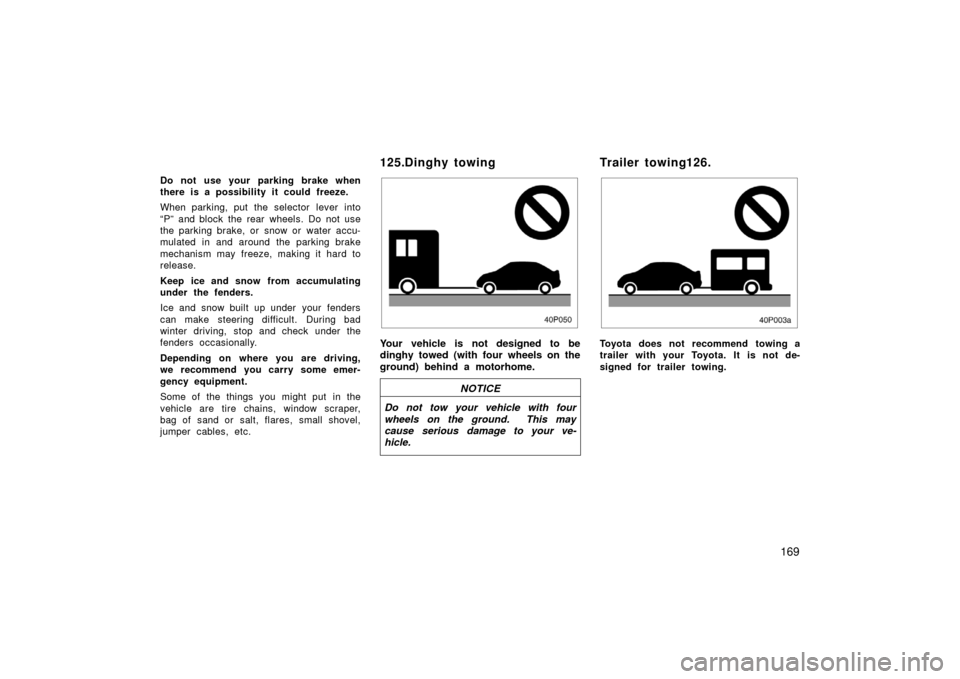
Your vehicle is not designed to be
dinghy towed (with four wheels on the
ground) behind a motorhome.NOTICE
Do not tow your vehicle with four
wheels on the ground. This may
cause serious damage to your ve-
hicle.
40p003a
Toyota does not recommend towing a
trailer with your Toyota. It is not de-
signed for trailer towing.
125.Dinghy towing Trailer towing126.
Page 177 of 256
171
128.IN CASE OF AN EMERGENCY
In case of an emergency
If your vehicle will not start172
. . . . . . . . . . . . . . . . . . . . . . . . . . . . . . . . . . .
If your hybrid system stalls while driving 176
. . . . . . . . . . . . . . . . . . . . . . .
If your vehicle overheats s 176. . . . . . . . . . . . . . . . . . . . . . . . . . . . . . . . . . .
If you have a flat tire 177
. . . . . . . . . . . . . . . . . . . . . . . . . . . . . . . . . . . . \
. . . . .
If your vehicle needs to be towed 184
. . . . . . . . . . . . . . . . . . . . . . . . . . . . .
If you cannot shift running mode selector lever 188
. . . . . . . . . . . . . . . . .
If you lose your keys 189
. . . . . . . . . . . . . . . . . . . . . . . . . . . . . . . . . . . . \
. . . .
If you lose your wireless remote control transmitter 189
. . . . . . . . . . . . .
SECTION 5
Page 178 of 256

172
Before making these checks, make sure
you have followed the correct starting
procedure given in ”How to start the
hybrid system” on page 166 in Section 4
and that you have sufficient fuel. Also
check whether the other keys will start the
hybrid system. If they work, your key may
be broken. Have the key checked at your
Toyota dealer. If none of your keys work,
the hybrid vehicle immobiliser system is
possibly broken. Call your Toyota dealer.
(See ”Keys” on page 18 in Section 21.)
If the instrument cluster dims or the
instrument cluster display turns off
with the ignition switch on—1. Check that the auxiliary battery termi- nals are tight and clean.
2. If the auxiliary battery terminals are O.K., the auxiliary battery is dis-
charged. You may try jump starting.
See “(b) Jump starting” for further in-
structions.
NOTICE
Hybrid vehicles cannot be push
started.
If the instrument cluster is shown in
appropriate brightness with the ignition
switch turned to on—
The hybrid vehicle system is suspected to
be faulty. Contact your Toyota dealer. If the auxiliary battery is discharged,
the hybrid system can be started by
jump starting. Depending on the the ve-
hicle condition, the engine may not
start.
To avoid serious personal injury and
damage to your vehicle which might re-
sult from battery explosion, acid burns,
electrical burns, or damaged electronic
components, these instructions must be
followed precisely.
If you are unsure about how to follow this
procedure, we strongly recommend that
you seek the help of a competent qualified
technician or towing service.
If your vehicle will not start—
(a) Simple checks129.
(b) Jump starting
Page 185 of 256
179
NOTICE
Your ground clearance is reduced
when the compact spare tire is
installed so avoid driving over ob-
stacles and drive slowly on rough,
unpaved roads and speed bumps.
Also, do not attempt to go through an
automatic car wash as the vehicle
may get caught, resulting in damage.
50p008a
1. Get the required tools and sparetire.
1 Wheel nut wrench
2 Jack handle
3 Towing eyelet (For emergency towing)
4Jack
5 Spare tire
To prepare yourself for an emergency, you
should fam iliarize yourself with the use of
the jack, each of the tools and their stor-
age locations.
50p009
Turn the jack joint by hand.
To remove: Turn the joint in direction 1
until the jack is free.
To store: Turn the joint in direction 2 until
the jack is firmly secured to prevent it
flying forward during a collision or s udden
braking.
133.—Required tools and
spare tire
Page 190 of 256
184
CAUTION
�When lowering the vehicle, make
sure all portions of your body and
all other persons around will not be
injured as the vehicle is lowered to
the ground.
�Have the wheel nuts tightened by
torque wrench at 103 N·m (10.5
kgf·lbf), as soon as possible after
changing wheels. Otherwise, the
nuts may loosen and the wheels
may fall off, which could cause a
serious accident.
9. Check the air pressure of the re-placed tire.
Adjust the air pressure to the specification
designated on page 243 in Section 9. If
the pressure is lower than specified, drive
slowly to the nearest Toyota dealer and fill
to the correct pressure.
Do not forget to reinstall the tire inflation
valve cap as dirt and moisture could get
into the valve core and possibly cause air
leakage. If the cap is missing, have a new
one put on as soon as possible.
10. Restow all the tools, jack and flat tire securely.
As soon as possible after changing
wheels, tighten the wheel nuts to the
torque specified on page 243 in Section
9 with a torque wrench. Have a technician
repair the flat tire and replace the spare
tire with it.
CAUTION
Before driving, make sure all the
tools, jack and flat tire are securely
in place in their storage location to
reduce the possibility of personal in-
jury during a collision or s udden
braking.
50p021
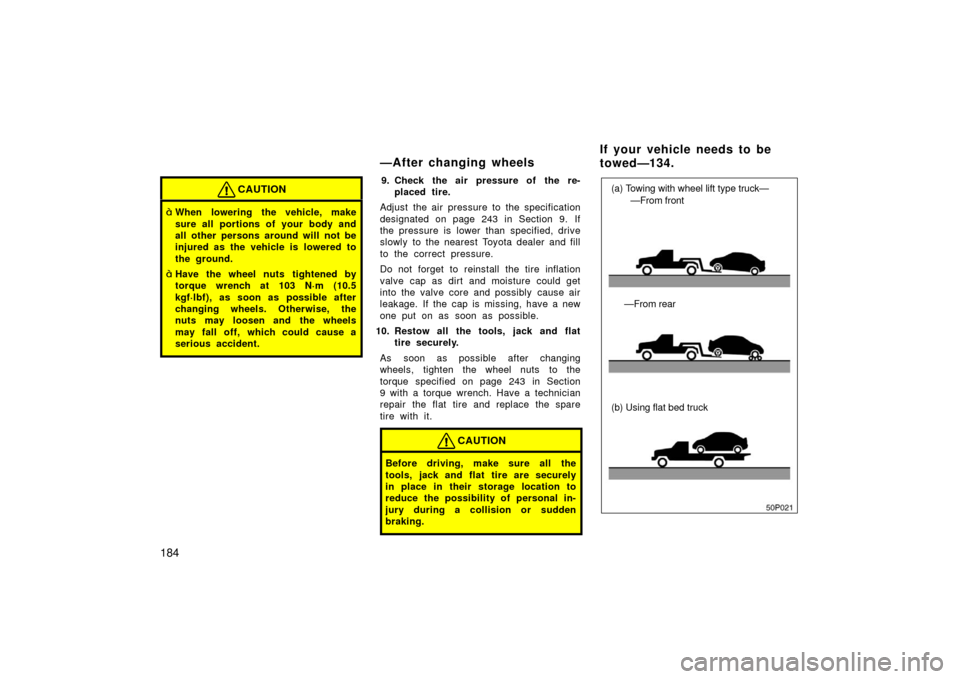
(a) Towing with wheel lift type truck—
—From front
—From rear
(b) Using flat bed truck
—After changing wheels If your vehicle needs to be
towed—134.
Page 191 of 256
185
If towing is necessary, we recommend
you to have it done by your Toyota
dealer or a commercial tow truck ser-
vice. In consultation with them, have
your vehicle towed using either (a) or
(b).
Only when you cannot receive a towing
service from a Toyota dealer or com-
mercial tow truck service, tow your ve-
hicle carefully in accordance with the
instructions given in “—Emergency tow-
ing” on page 186 in this Section.
Proper equipment will help ensure that
your vehicle is not damaged while being
towed. Commercial operators are generally
aware of the state/provincial and local
laws pertaining to towing.
Your vehicle can be damaged if it is
towed incorrectly. Although most operators
know the correct procedure, it is possible
to make a mistake. To avoid damage to
your vehicle, make sure the following pre-
cautions are observed. If necessary, show
this page to the tow truck driver.TOWING PRECAUTIONS:
Use a safety chain system for all towing,
and abide by the state/provincial and local
laws. The wheels and axle on the ground
must be in good condition. If they are
damaged, use a towing dolly.
(a) Towing with wheel lift type truck
From front
—Release the parking brake.
NOTICE
When lifting wheels, take care to en-
sure adequate ground clearance for
towing at the opposite end of the
raised vehicle. Otherwise, the under-
body of the towed vehicle will be
damaged during towing.
From rear—Use a towing dolly under the
front wheels.
NOTICE
Never tow a vehicle from the rear
with the front wheels on the ground,
as this may cause serious damage to
the transmission.
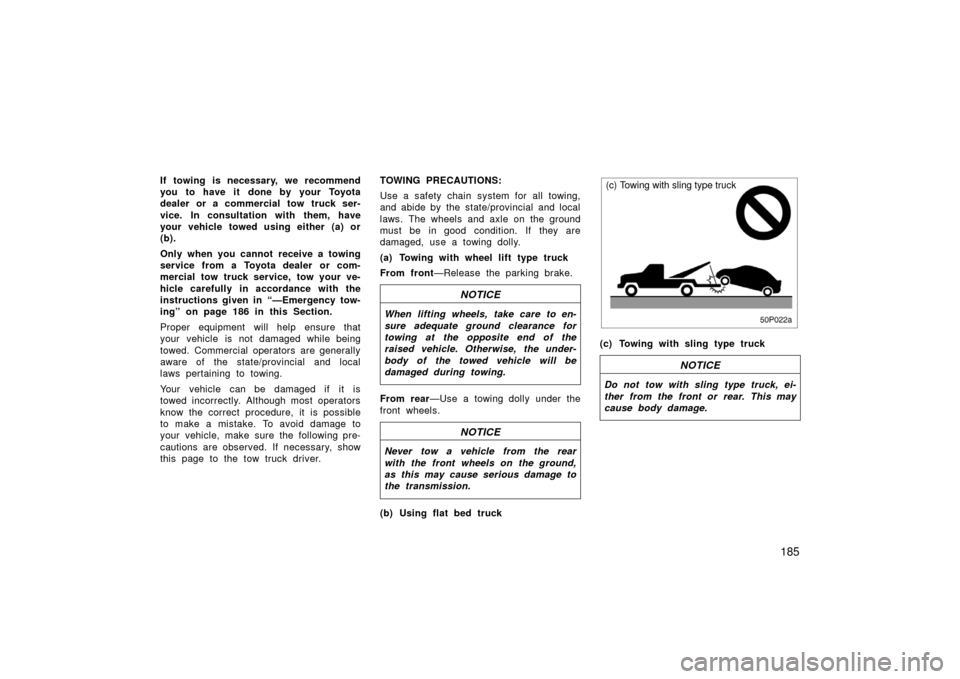
(b) Using flat bed truck
50p022a
(c) Towing with sling type truck
(c) Towing with sling type truck
NOTICE
Do not tow with sling type truck, ei-
ther from the front or rear. This may
cause body damage.
Page 192 of 256
186
50p035a
Front
50p028b
Rear
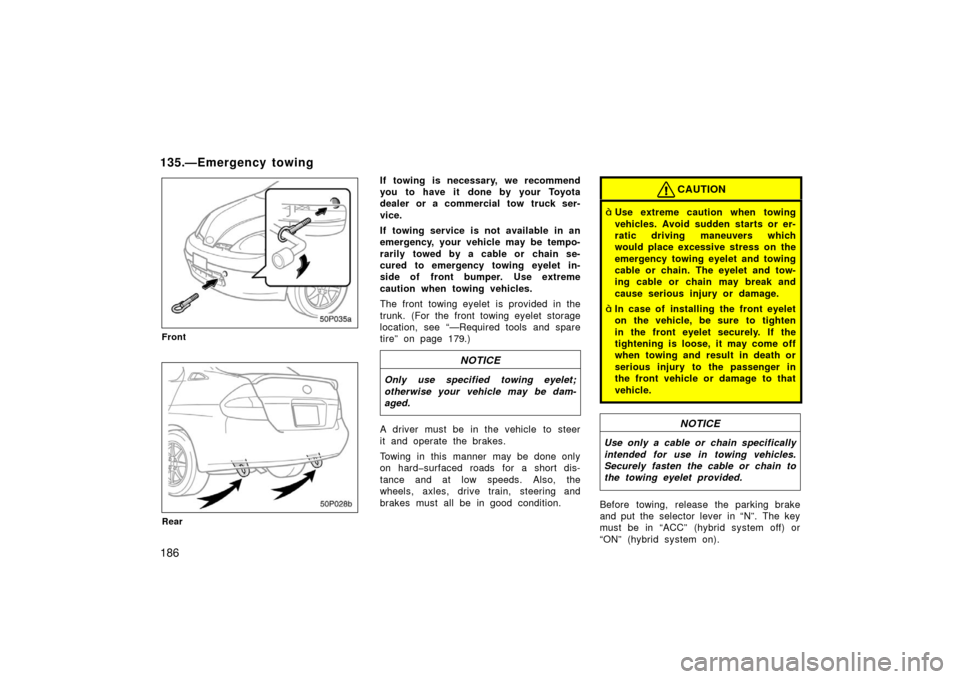
If towing is necessary, we recommend
you to have it done by your Toyota
dealer or a commercial tow truck ser-
vice.
If towing service is not available in an
emergency, your vehicle may be tempo-
rarily towed by a cable or chain se-
cured to emergency towing eyelet in-
side of front bumper. Use extreme
caution when towing vehicles.
The front towing eyelet is provided in the
trunk. (For the front towing eyelet storage
location, see “—Required tools and spare
tire” on page 179.)
NOTICE
Only use specified towing eyelet;
otherwise your vehicle may be dam-
aged.
A driver must be in the vehicle to steer
it and operate the brakes.
Towing in this manner may be done only
on hardsurfaced roads for a short dis-
tance and at low speeds. Also, the
wheels, axles, drive train, steering and
brakes must all be in good condition.
CAUTION
�Use extreme caution when towing
vehicles. Avoid sudden starts or er-
ratic driving maneuvers which
would place excessive stress on the
emergency towing eyelet and towing
cable or chain. The eyelet and tow-
ing cable or chain may break and
cause serious injury or damage.
�In case of installing the front eyelet
on the vehicle, be sure to tighten
in the front eyelet securely. If the
tightening is loose, it may come off
when towing and result in death or
serious injury to the passenger in
the front vehicle or damage to that
vehicle.
NOTICE
Use only a cable or chain specifically
intended for use in towing vehicles.
Securely fasten the cable or chain to
the towing eyelet provided.
Before towing, release the parking brake
and put the selector lever in “N”. The key
must be in “ACC” (hybrid system off) or
“ON” (hybrid system on).
135.—Emergency towing