Page 51 of 256
44
22p004a
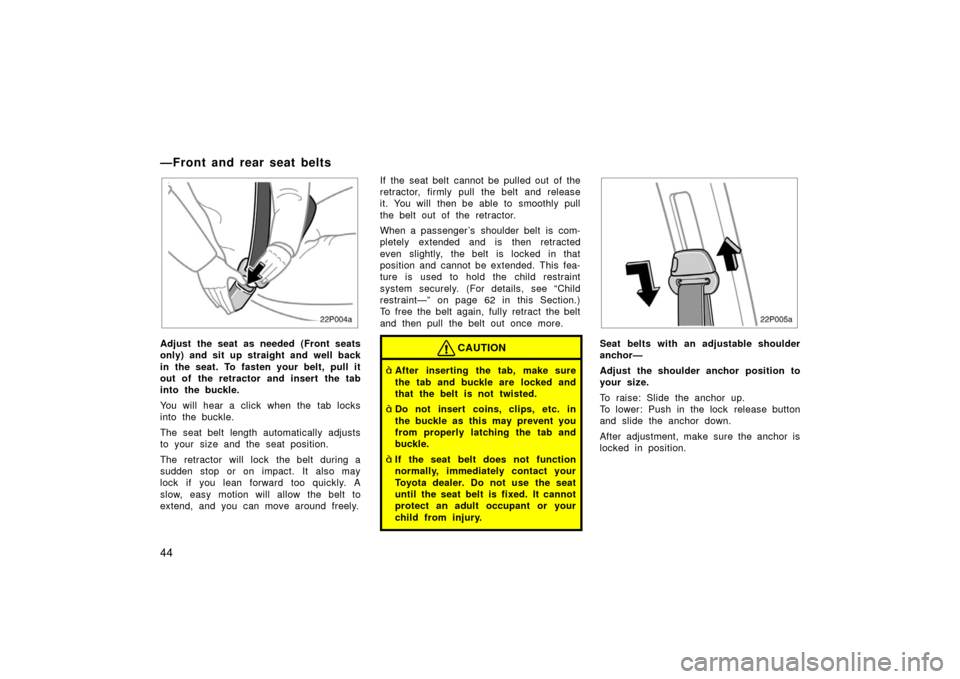
Adjust the seat as needed (Front seats
only) and sit up straight and well back
in the seat. To fasten your belt, pull it
out of the retractor and insert the tab
into the buckle.
You will hear a click when the tab locks
into the buckle.
The seat belt length automatically adjusts
to your size and the seat position.
The retractor will lock the belt during a
sudden stop or on impact. It also may
lock if you lean forward too quickly. A
slow, easy motion will allow the belt to
extend, and you can move around freely.If the seat belt cannot be pulled out of the
retractor, firmly pull the belt and release
it. You will then be able to smoothly pull
the belt out of the retractor.
When a passenger ’s shoulder belt is com-
pletely extended and is then retracted
even slightly, the belt is locked in that
position and cannot be extended. This fea-
ture is used to hold the child restraint
system securely. (For details, see “Child
restraint—” on page 62 in this Section.)
To free the belt again, fully retract the belt
and then pull the belt out once more.CAUTION
�After inserting the tab, make sure
the tab and buckle are locked and
that the belt is not twisted.
�Do not insert coins, clips, etc. in
the buckle as this may prevent you
from properly latching the tab and
buckle.
�If the seat belt does not function
normally, immediately contact your
Toyota dealer. Do not use the seat
until the seat belt is fixed. It cannot
protect an adult occupant or your
child from injury.
22p005a
Seat belts with an adjustable shoulder
anchor—
Adjust the shoulder anchor position to
your size.
To raise: Slide the anchor up.
To lower: Push in the lock release button
and slide the anchor down.
After adjustment, make sure the anchor is
locked in position.
—Front and rear seat belts
Page 60 of 256
53
CAUTION
�The SRS airbag system is designed
only as a supplement to the prima-
ry protection of the driver side and
front passenger side seat belt sys-
tems. The front seat occupants can
be killed or seriously injured by the
inflating airbags if they do not wear
the available seat belts properly.
During sudden braking just before
a collision, an unrestrained driver
or front passenger can move for-
ward into direct contact with or
close proximity to the airbag which
may then deploy during the colli-
sion. To ensure maximum protection
in an accident, the driver and all
passengers in the vehicle must
wear their seat belts properly. Wear-
ing a seat belt during an accident
reduces the chances of death or
serious injury or being thrown out
of the vehicle. For instructions and
precautions concerning the seat
belt system, see “Seat belts—” on
page 42 in this section.
�Improperly seated and/or restrained
infants and children can be killed
or seriously injured by the deploy-
ing front airbags. An infant or child
who is too small to use a seat belt
should be properly secured using a
child restraint system. Toyota
strongly recommends that all in-
fants and children be placed in the
rear seat of the vehicle and proper-
ly restrained. The rear seat is the
safest for infants and children. For
instructions concerning the installa-
tion of a child restraint system, see
“Child restraint—” on page 62 in
this section.
22p018a
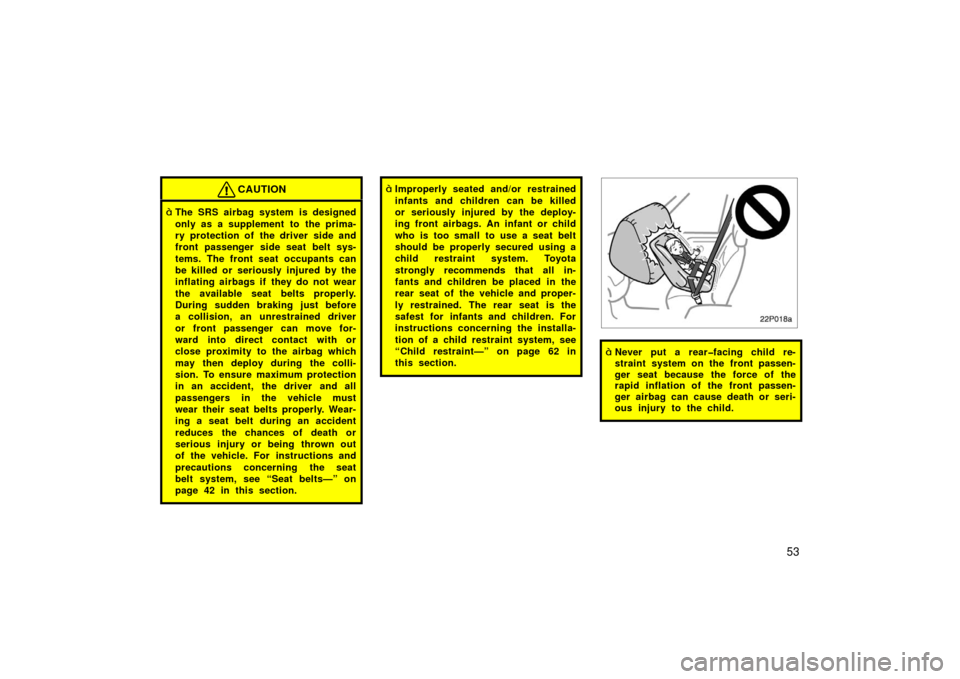
�Never put a rearfacing child re-
straint system on the front passen-
ger seat because the force of the
rapid inflation of the front passen-
ger airbag can cause death or seri-
ous injury to the child.
Page 67 of 256
60
�Improperly seated and/or restrained
infants and children can be killed
or seriously injured by the deploy-
ing airbags. An infant or child who
is too small to use a seat belt
should be properly secured using a
child restraint system. Toyota
strongly recommends that all in-
fants and children be placed in the
rear seat of the vehicle and proper-
ly restrained. The rear seat is the
safest for infants and children. For
instructions concerning the installa-
tion of a child restraint system, see
“Child restraint” on page 62 in this
section.
�Do not allow a child to lean his/her
head or any part of his/her body
against the front door or the area
of the seat from which the side air-
bag deploys even if he/she is
seated in the child restraint system.
It is dangerous if the side airbag
inflates, and the impact could cause
death or serious injury to the child.
For instructions concerning the
installation of a child restraint sys-
tem, see “Child restraint” on page
62 in this section.
22p028b
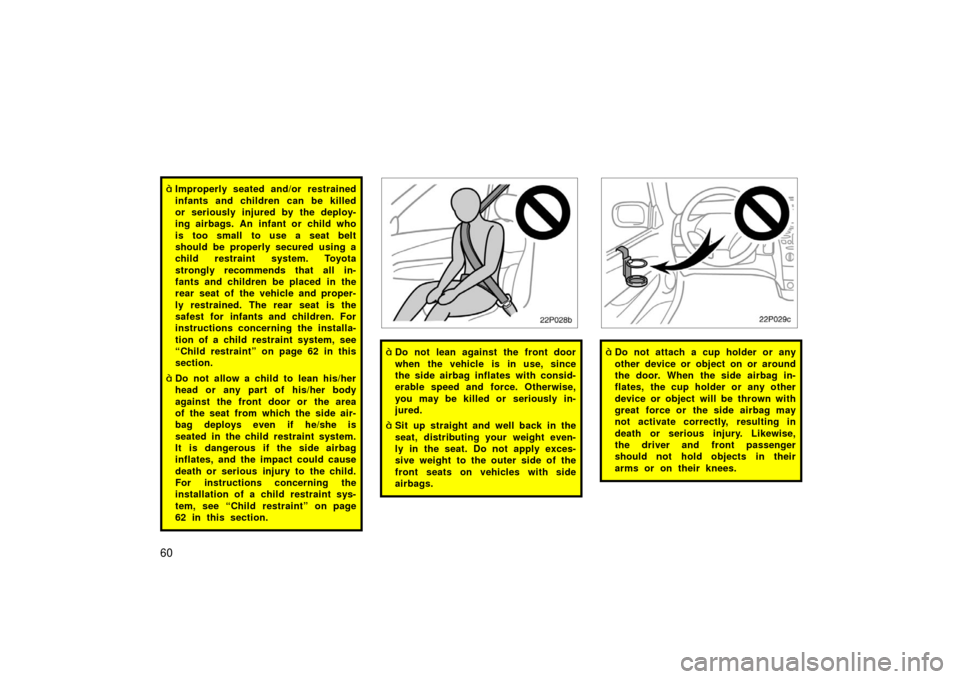
�Do not lean against the front door
when the vehicle is in use, since
the side airbag inflates with consid-
erable speed and force. Otherwise,
you may be killed or seriously in-
jured.
�Sit up straight and well back in the
seat, distributing your weight even-
ly in the seat. Do not apply exces-
sive weight to the outer side of the
front seats on vehicles with side
airbags.
22p029c
�Do not attach a cup holder or any
other device or object on or around
the door. When the side airbag in-
flates, the cup holder or any other
device or object will be thrown with
great force or the side airbag may
not activate correctly, resulting in
death or serious injury. Likewise,
the driver and front passenger
should not hold objects in their
arms or on their knees.
Page 71 of 256
64
CAUTION
�Never put a rearfacing child re-
straint system on the front seat. In
the event of an accident, the force
of the rapid inflation of the airbag
can cause death or serious injury if
a rearfacing child restraint system
is put on the front seat.
�Unless it is unavoidable, do not put
a child restraint system on the
front seat.
�A forwardfacing child restraint
system should be allowed to put on
the front seat only when it is un-
avoidable. Always move the seat as
far back as possible, because the
force of the deploying airbag could
cause death or serious injury to the
child.
�On vehicles with side airbag, do
not allow the child to lean against
the front door or around the front
door even if the child is seated in
the child restraint system. It is dan-
gerous if the side airbag inflates,
and the impact could cause death
or serious injury to the child.
�After installing the child restraint
system, make sure it is secured in
place following the manufacturer ’s
instructions. If it is not restrained
securely, it may cause death or se-
rious injury to the child in the
event of a sudden stop or accident.
When not using the child restraint system,
keep it secured with the seat belt or place
it in the trunk or somewhere other than in
the passenger compartment. This will pre-
vent it from injuring passengers in the
event of a sudden stop or accident.
For instructions about how to use the an-
chor bracket, see “—Using a top strap” on
page 74 in this section.Child restraint systems are classified into
the following 3 types depending on the
child’s age and size.
(A) Infant seat
(B) Convertible seat
(C) Booster seat
Install the child restraint system following
the instructions provided by its manufac-
turer.
Child restraint lower anchorages approved
for your vehicle may also be used. See
“—Installation with child restraint lower an-
chorages” on page 76 in this section.
—Types of child restraint
system
Page 74 of 256
67
CAUTION
�After inserting the tab, make sure
the tab and buckle are locked and
that the lap and shoulder portions
of the belt are not twisted.
�Do not insert coins, clips, etc. in
the buckle as this may prevent you
from properly latching the tab and
buckle.
�If the seat belt does not function
normally, it cannot protect your
child from injury. Contact your
Toyota dealer immediately. Do not
use the child restraint system until
the seat belt is fixed.
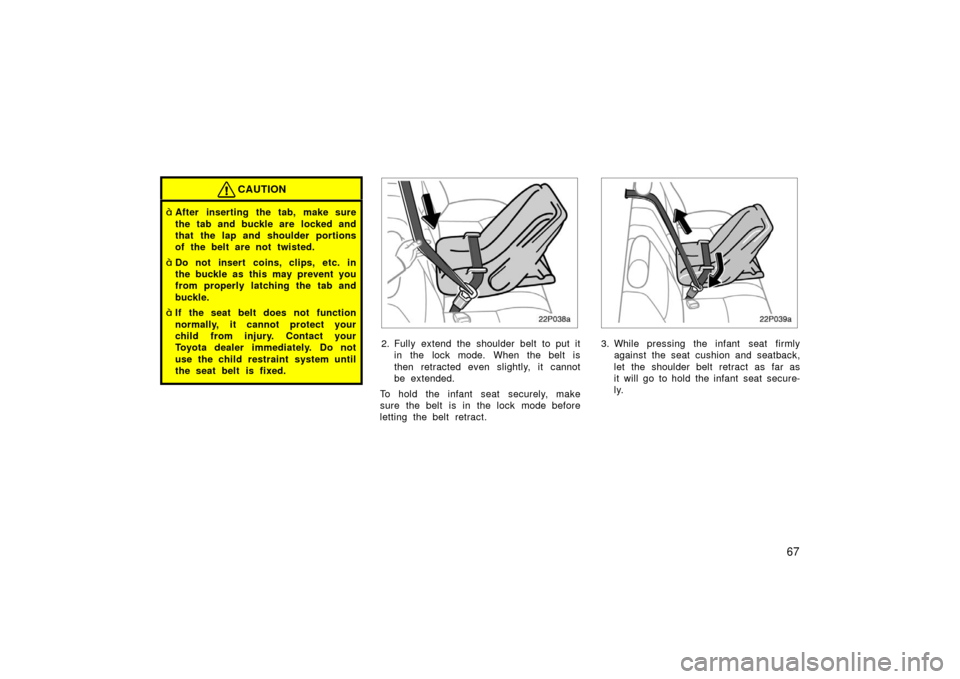
22p038a
2. Fully extend the shoulder belt to put itin the lock mode. When the belt is
then retracted even slightly, it cannot
be extended.
To hold the infant seat securely, make
sure the belt is in the lock mode before
letting the belt retract.
22p039a
3. While pressing the infant seat firmly against the seat cushion and seatback,
let the shoulder belt retract as far as
it will go to hold the infant seat secure-
ly.
Page 75 of 256
68
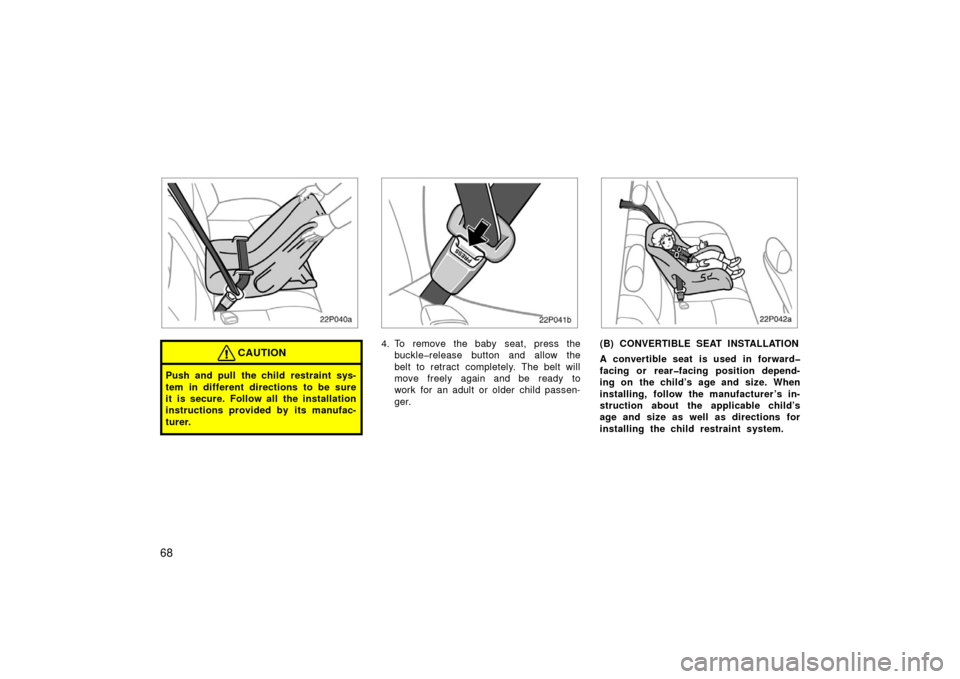
22p040a
CAUTION
Push and pull the child restraint sys-
tem in different directions to be sure
it is secure. Follow all the installation
instructions provided by its manufac-
turer.
22p041b
4. To remove the baby seat, press thebucklerelease button and allow the
belt to retract completely. The belt will
move freely again and be ready to
work for an adult or older child passen-
ger.
22p042a
(B) CONVERTIBLE SEAT INSTALLATION
A convertible seat is used in forward
facing or rearfacing position depend-
ing on the child’s age and size. When
installing, follow the manufacturer’s in-
struction about the applicable child’s
age and size as well as directions for
installing the child restraint system.
Page 77 of 256
70
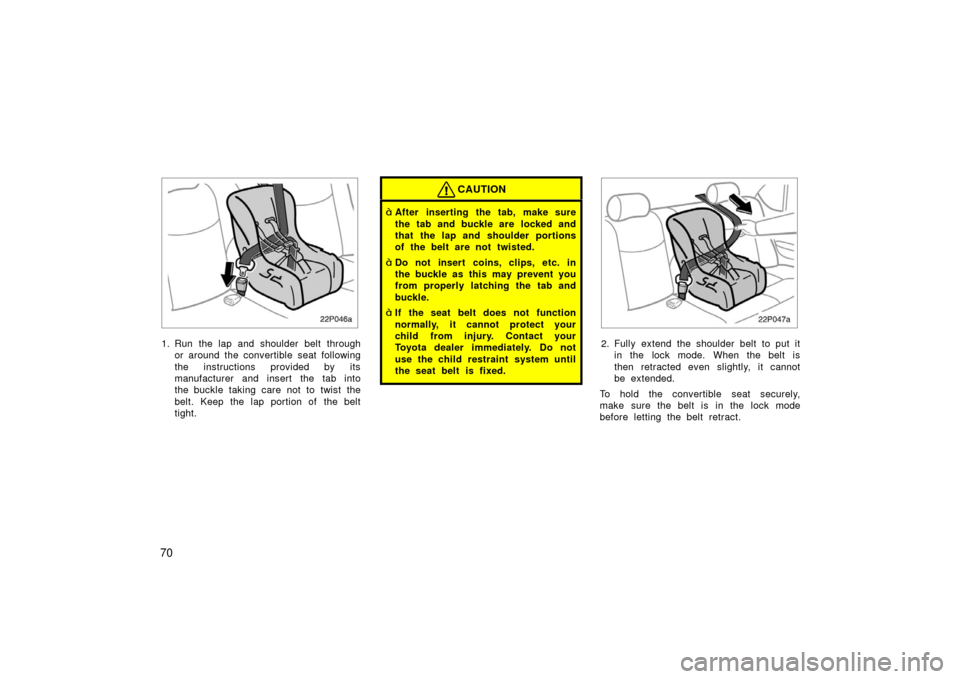
22p046a
1. Run the lap and shoulder belt throughor around the convertible seat following
the instructions provided by its
manufacturer and insert the tab into
the buckle taking care not to twist the
belt. Keep the lap portion of the belt
tight.
CAUTION
�After inserting the tab, make sure
the tab and buckle are locked and
that the lap and shoulder portions
of the belt are not twisted.
�Do not insert coins, clips, etc. in
the buckle as this may prevent you
from properly latching the tab and
buckle.
�If the seat belt does not function
normally, it cannot protect your
child from injury. Contact your
Toyota dealer immediately. Do not
use the child restraint system until
the seat belt is fixed.
22p047a
2. Fully extend the shoulder belt to put itin the lock mode. When the belt is
then retracted even slightly, it cannot
be extended.
To hold the convertible seat securely,
make sure the belt is in the lock mode
before letting the belt retract.
Page 78 of 256
71
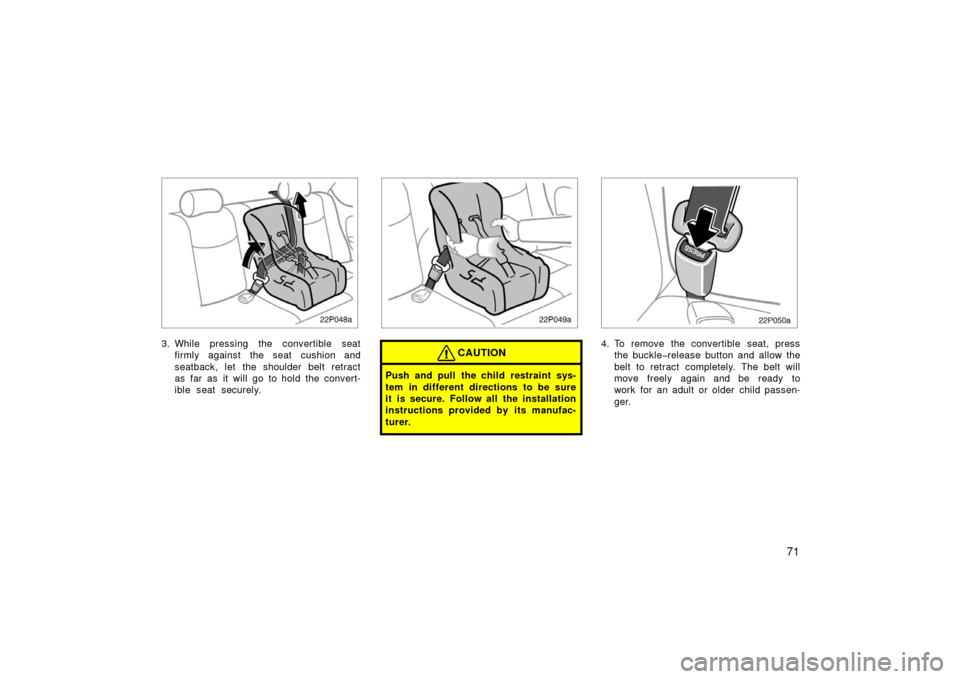
22p048a
3. While pressing the convertible seatfirmly against the seat cushion and
seatback, let the shoulder belt retract
as far as it will go to hold the convert-
ible seat securely.
22p049a
CAUTION
Push and pull the child restraint sys-
tem in different directions to be sure
it is secure. Follow all the installation
instructions provided by its manufac-
turer.
22p050a
4. To remove the convertible seat, pressthe bucklerelease button and allow the
belt to retract completely. The belt will
move freely again and be ready to
work for an adult or older child passen-
ger.