Page 217 of 265

2082003 MR2 from Aug. ’03 Prod. (OM17511U)
Z72109
To ensure excellent lubrication
performance for your engine, “Toyota
Genuine Motor Oil” is available, which has
been specifically tested and approved for
all Toyota engines.
Please contact your Toyota dealer for
further details about “Toyota Genuine
Motor Oil”.Look at the seethrough coolant reser-
voir when the engine is cold. The cool-
ant level is satisfactory if it is between
the “FULL” and “LOW” lines on the
reservoir. If the level is low, add the
coolant. (For the coolant type, see
“Coolant type selection” described be-
low.)
The coolant level in the reservoir will vary
with engine temperature. However, if the
level is on or below the “LOW” line, add
coolant. Bring the level up to the “FULL”
line.
If the coolant level drops within a short
time after replenishing, there may be a
leak in the system. Visually check the
radiator, hoses, drain cock and water
pump.
If you can find no leak, have your Toyota
dealer test the cap pressure and check
for leaks in the cooling system.
CAUTION
To prevent burning yourself, do not
remove the coolant reservoir cap or
air release valve when the engine is
hot.
Coolant type selection
Use of improper coolants may damage
your engine cooling system.
Only use “Toyota Super Long Life Coolant”
or similar high quality ethylene glycol
based nonsilicate, nonamine, nonnitrite,
and nonborate coolant with longlife hy-
brid organic acid technology. (Coolant with
longlife hybrid organic acid technology
consists of the combination of low phos-
phates and organic acids.)
“Toyota Super Long Life Coolant” is pre-
mixed with 50% coolant and 50% deion-
ized water. This coolant provides protec-
tion down to about 35
°C (31 °F).
NOTICE
Do not use plain water alone.
03 07.07
Checking the engine coolant
level
Page 219 of 265
2102003 MR2 from Aug. ’03 Prod. (OM17511U)
If the level is low, add SAE J1703 or
FMVSS No.116 DOT 3 brake fluid to the
brake reservoir.
Remove and replace the reservoir cap by
hand. Fill the brake fluid to the dotted
line. This brings the fluid to the correct
level when you put the cap back on.
Use only newly opened brake fluid. Once
opened, brake fluid absorbs moisture from
the air, and excess moisture can cause a
dangerous loss of braking.
CAUTION
Take care when filling the reservoir
because brake fluid can harm your
eyes and damage painted surfaces. If
fluid gets in your eyes, flush your
eyes with clean water immediately. If
you still feel uncomfortable with your
eyes, go to the doctor.
NOTICE
If you spill the fluid, be sure to wash
it off with water to prevent it from
damaging the parts or paint.
SB72002
Open
Close
If hot add
If cold addIf hot
O.K.
If cold
O.K.
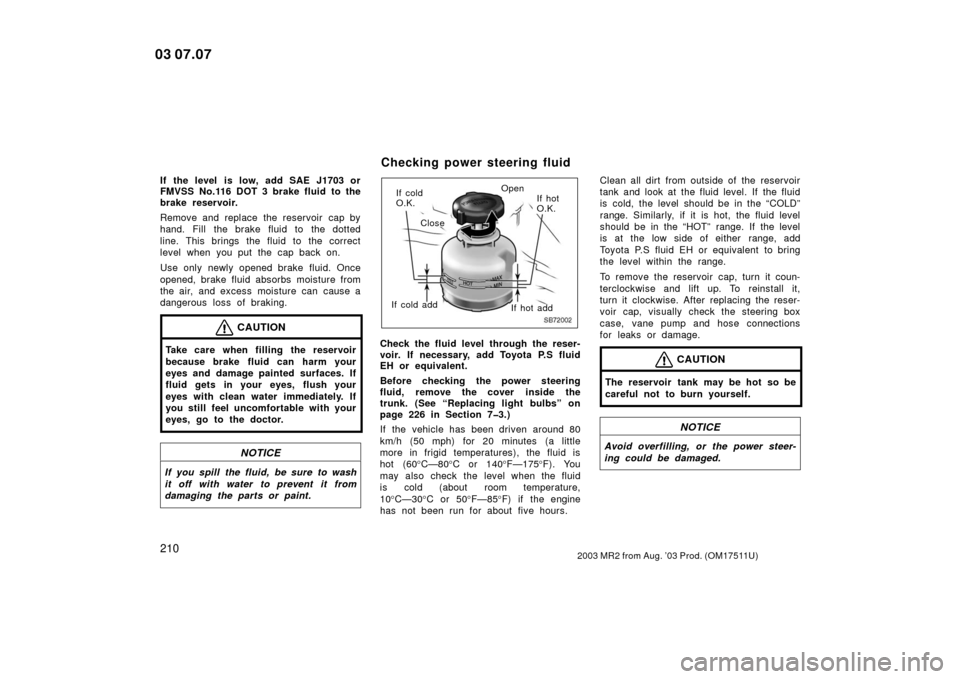
Check the fluid level through the reser-
voir. If necessary, add Toyota P.S fluid
EH or equivalent.
Before checking the power steering
fluid, remove the cover inside the
trunk. (See “Replacing light bulbs” on
page 226 in Section 73.)
If the vehicle has been driven around 80
km/h (50 mph) for 20 minutes (a little
more in frigid temperatures), the fluid is
hot (60
°C—80 °C or 140 °F—175 °F). You
may also check the level when the fluid
is cold (about room temperature,
10 °C—30 °C or 50 °F—85 °F) if the engine
has not been run for about five hours. Clean all dirt from outside of the reservoir
tank and look at the fluid level. If the fluid
is cold, the level should be in the “COLD”
range. Similarly, if it is hot, the fluid level
should be in the “HOT” range. If the level
is at the low side of either range, add
Toyota P.S fluid EH or equivalent to bring
the level within the range.
To remove the reservoir cap, turn it coun-
terclockwise and lift up. To reinstall it,
turn it clockwise. After replacing the reser-
voir cap, visually check the steering box
case, vane pump and hose connections
for leaks or damage.
CAUTION
The reservoir tank may be hot so be
careful not to burn yourself.
NOTICE
Avoid overfilling, or the power steer-
ing could be damaged.
03 07.07
Checking power steering fluid
Page 221 of 265

2122003 MR2 from Aug. ’03 Prod. (OM17511U)
�Always use a tire pressure
gauge. The appearance of a tire
can be misleading. Besides, tire
inflation pressures that are even
just a few pounds off can degrade
ride and handling.
� Do not bleed or reduce tire
inflation pressure after driving.
It is normal for the tire inflation
pressure to be higher after driving.
� Never exceed the vehicle capac-
ity weight. The passenger and
luggage weight should be located
so that the vehicle is balanced.Tire pressure gauge
INSPECTION AND ADJUSTMENT
PROCEDURE 1. Remove the tire valve cap.
2. Press the tip of the tire pressure gauge to the tire valve.
3. Read the pressure using a gradua- tion of the gauge.
4. In case that the tire inflation pres- sure is not within the prescribed
range, insert the compressed air
from the valve. In case of applying
too much air, press the center of
t he valv e and releas e the air to ad-
just. 5. After completing the tire inflation
pressure measurement and ad-
justment, apply soap water to the
valve and check the leakage.
6. Install the tire valve cap.
If the gauge and the air pump are not
available, have your vehicle checked
by your Toyota dealer.
CAUTION
Be sure to reinstall the tire valve
caps. Without the valve caps, dirt
or moisture could get into the
valve core and cause air leakage.
If the caps have been lost, have
new ones put on as soon as pos-
sible.
Incorrect tire infl ation pressure may
waste fuel, reduce the comfort of driv-
ing, reduce tire life and make your ve-
hicle less safe to drive.
If a tire frequently needs refilling,
have it checked by your Toyota deal-
er.
03 07.07