Page 159 of 265

1502003 MR2 from Aug. ’03 Prod. (OM17511U)
�Do not drive with objects left
on top of the instrument panel.
They may interfere with the
driver’s field of view. Or they
may move during sharp vehicle
acceleration or turning, and im-
pair the driver’s control of the
vehicle. In an accident they
may injure the vehicle occu-
pants.Cargo capacity depends on the to-
tal weight of the occupants.
(Cargo capacity) = (Total load capac-
ity) – (Total weight of occupants)
STEPS FOR DETERMINING
CORRECT LOAD LIMIT
1. Locate the statement “The combined weight of occupants and
cargo should never exceed XXX
pounds” on your vehicle’s placard.
2. Determine the combined weight of the driver and passengers that will
be riding in your vehicle.
3. Subtract the combined weight of the driver and passengers from
XXX kilograms or XXX pounds. 4. The resulting figure equals the
available amount of cargo and lug-
gage load capacity. For example,
if the “XXX” am ount equals 1400
lbs. and there will be five 150 lb.
passengers in your vehicle, the
amount of available cargo and lug-
gage load capacity is 650 lbs.
(1400–750 (5x150)=650 lbs).
5. Determine the combined weight of luggage and cargo being loaded
on the vehicle. That weight may
not safely exceed the available
cargo and luggage load capacity
calculated in Step 4.
6. If your vehicle will be towing a trailer, load from your trailer will
be transferred to your vehicle.
Consult this manual to determine
how this reduces the available car-
go and luggage load capacity of
your vehicle.
Toyota does not recommend towing
a trailer with your vehicle. Your ve-
hicle is not designed for trailer towing.
03 07.07
—Capacity and distribution
Page 162 of 265
1532003 MR2 from Aug. ’03 Prod. (OM17511U)
STARTING AND DRIVING
Starting and driving
Before starting the engine154
. . . . . . . . . . . . . . . . . . . . . . . . . . . . . . . . . . .
How to start the engine 154
. . . . . . . . . . . . . . . . . . . . . . . . . . . . . . . . . . . . \
. .
Tips for driving in various conditions 155
. . . . . . . . . . . . . . . . . . . . . . . . . .
Winter driving tips 156
. . . . . . . . . . . . . . . . . . . . . . . . . . . . . . . . . . . . \
. . . . . .
Dinghy towing 157
. . . . . . . . . . . . . . . . . . . . . . . . . . . . . . . . . . . . \
. . . . . . . . . .
Trailer towing 158
. . . . . . . . . . . . . . . . . . . . . . . . . . . . . . . . . . . . \
. . . . . . . . . .
How to save fuel and make your vehicle last longer, too 158
. . . . . . . . .
03 07.07
SECTION 3
Page 166 of 265

1572003 MR2 from Aug. ’03 Prod. (OM17511U)
Do not use your parking brake when
there is a possibility it could freeze.
When parking, put the transmission into
“S(1)” or “R” (sequential manual transmis-
sion) or into first or reverse (manual
transmission) and block the front wheels.
Do not use the parking brake, or snow or
water accumulated in and around the
parking brake mechanism may freeze,
making it hard to release.
Keep ice and snow from accumulating
under the fenders.
Ice and snow built up under your fenders
can make steering difficult. During bad
winter driving, stop and check under the
fenders occasionally.
Depending on where you are driving,
we recommend you carry some emer-
gency equipment.
Some of the things you might put in the
vehicle are tire chains, window scraper,
bag of sand or salt, flares, small shovel,
jumper cables, etc.
Dinghy towing
SB31003a
Your vehicle can be dinghy towed (with
four wheels on the ground) from the
front behind a motorhome.
CAUTION
Dinghy towing requires special equip-
ment and accessories. Please refer to
your service outlet of the motorhome
manufacture for the recommended
equipment.
NOTICE
Dinghy towing does not eliminate the
possibility of damage to your vehicle.
DINGHY TOWING TIPS
Before dinghy towing, be sure to ob-
serve the following in order to reduce
the damage to your vehicle.1. Shift the gear into neutral.
2. Turn the ignition switch to the “ACC” position. Make sure the audio is turned
off.
NOTICE
To avoid the locking of the steering
wheel, turn the ignition switch to the
“ACC” position.
3. Release the parking brake.
After dinghy towing, let the engine idle for
more than 3 minutes before driving the
vehicle.
03 07.07
Page 167 of 265
1582003 MR2 from Aug. ’03 Prod. (OM17511U)
SB31004a
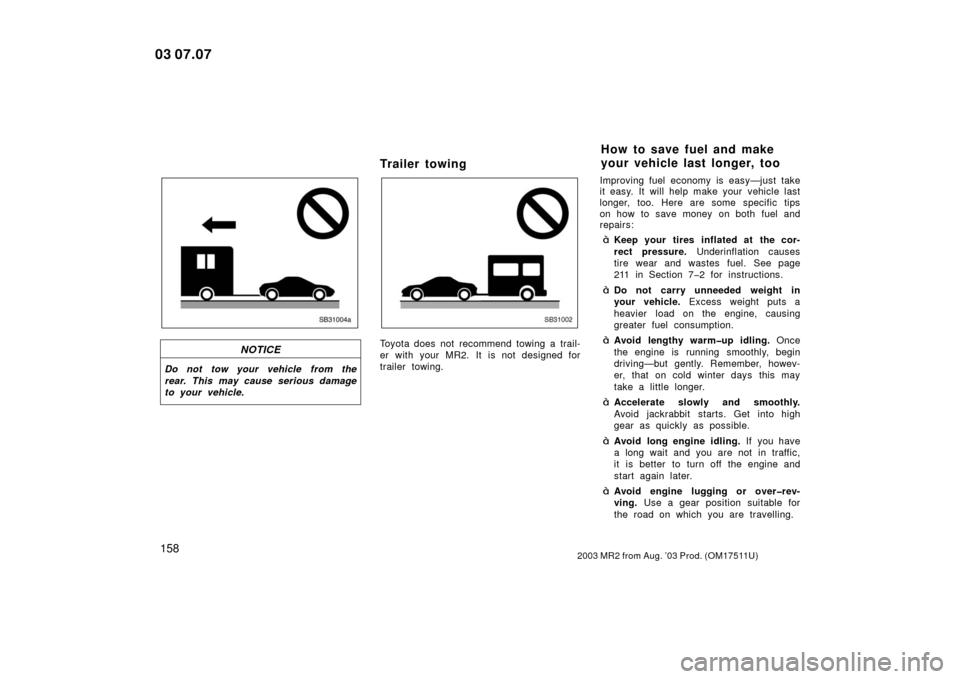
NOTICE
Do not tow your vehicle from the
rear. This may cause serious damage
to your vehicle.
Trailer towing
SB31002
Toyota does not recommend towing a trail-
er with your MR2. It is not designed for
trailer towing.Improving fuel economy is easy—just take
it easy. It will help make your vehicle last
longer, too. Here are some specific tips
on how to save money on both fuel and
repairs:
�Keep your tires inflated at the cor-
rect pressure.
Underinflation causes
tire wear and wastes fuel. See page
211 in Section 72 for instructions.
�Do not carry unneeded weight in
your vehicle. Excess weight puts a
heavier load on the engine, causing
greater fuel consumption.
�Avoid lengthy warmup idling. Once
the engine is running smoothly, begin
driving—but gently. Remember, howev-
er, that on cold winter days this may
take a little longer.
�Accelerate slowly and smoothly.
Avoid jackrabbit starts. Get into high
gear as quickly as possible.
�Avoid long engine idling. If you have
a long wait and you are not in traffic,
it is better to turn off the engine and
start again later.
�Avoid engine lugging or overrev-
ving. Use a gear position suitable for
the road on which you are travelling.
03 07.07
How to save fuel and make
your vehicle last longer, too
Page 170 of 265

1612003 MR2 from Aug. ’03 Prod. (OM17511U)
IN CASE OF AN EMERGENCY
In case of an emergency
If your vehicle will not start162
. . . . . . . . . . . . . . . . . . . . . . . . . . . . . . . . . . .
If your engine stalls while driving 165
. . . . . . . . . . . . . . . . . . . . . . . . . . . . .
If you cannot increase the engine speed 166
. . . . . . . . . . . . . . . . . . . . . .
If your vehicle overheats 166
. . . . . . . . . . . . . . . . . . . . . . . . . . . . . . . . . . . . \
If you have a flat tire 167
. . . . . . . . . . . . . . . . . . . . . . . . . . . . . . . . . . . . \
. . . . .
If your vehicle becomes stuck 176
. . . . . . . . . . . . . . . . . . . . . . . . . . . . . . . .
If your vehicle needs to be towed 177
. . . . . . . . . . . . . . . . . . . . . . . . . . . . .
If you cannot shift the sequential manual transmission selector lever 181
. . . . . . . . . . . . . . . . . . . . . . . . . . . . . . . . . . . . \
. . . . . . . . . .
If you lose your keys 182
. . . . . . . . . . . . . . . . . . . . . . . . . . . . . . . . . . . . \
. . . .
03 07.07
SECTION 4
Page 172 of 265

1632003 MR2 from Aug. ’03 Prod. (OM17511U)
NOTICE
Do not crank for more than 30 sec-
onds at a time. This may overheat the
starter and wiring systems.
(c) Jump starting
To avoid serious personal injury and
damage to your vehicle which might re-
sult from battery explosion, acid burns,
electrical burns, or damaged electronic
components, these instructions must be
followed precisely.
If you are unsure about how to follow this
procedure, we strongly recommend that
you seek the help of a competent me-
chanic or towing service.
CAUTION
�Batteries contain sulfuric acid
which is poisonous and corrosive.
Wear protective safety glasses when
jump starting, and avoid spilling
acid on your skin, clothing, or ve-
hicle.
�If you should accidentally get acid
on yourself or in your eyes, remove
any contaminated clothing and flush
the affected area with water imme-
diately. Then get immediate medical
attention. If possible, continue to
apply water with a sponge or cloth
while en route to the medical office.
�The gas normally produced by a
battery will explode if a flame or
spark is brought near. Use only
standardized jumper cables and do
not smoke or light a match while
jump starting.
Warning: Battery posts, terminals and
related accessories contain lead and
lead compounds, chemicals known to
the State of California to cause can-
cer and reproductive harm. Wash
hands after handling.
NOTICE
The battery used for boosting must
be 12 V. Do not jump start unless you
are sure that the booster battery is
correct.
03 07.07
Page 184 of 265

1752003 MR2 from Aug. ’03 Prod. (OM17511U)
—After changing wheels
9. Check the air pressure of the re-placed tire.
Adjust the air pressu re to the specifi-
cation designated on page 242 in
Section 8. If the pressure is lower,
drive slowly to the nearest service
station and fill to the correct pressure.
Do not forget to reinstall the tire infla-
tion valve cap as dirt and moisture
c ould get int o the valv e cor e a nd pos-
sibly cause air leakage. If the cap is
missing, have a new one put on as
soon as possible.
10.Restow all the tools, jack and flat tire securely.
As soon as possible after changing
wheels, tighten the wheel nuts to the
torque specified on page 242 in Sec-
tion 8 with a torque wrench. Have a
technician repair the flat tire and re-
place the spare tire with it.CAUTION
Before driving, make sure all the
tools, jack and flat tire are se-
curely in place in their storage
location to reduce the possibility
of personal injury during a colli-
sion or sudden braking.
SB41025
Remove the wheel ornament from the
flat tire before restowing the flat tire.
03 07.07
Page 185 of 265

1762003 MR2 from Aug. ’03 Prod. (OM17511U)
SB41037
NOTICE
The size of the front wheel and
the rear wheel is different. In
order to prevent the wrong
installation, there is a pin on
the assembly surface inside the
rear wheel as shown above.
Therefore, the rear wheels can-
not be installed on the front.
If your vehicle becomes stuck in snow,
mud, sand, etc., then you may attempt
to rock the vehicle free by moving it
forward and backward.
CAUTION
Do not attempt to rock the vehicle
free by moving it forward and back-
ward if people or objects are any-
where near the vehicle. During the
rocking operation the vehicle may
suddenly move forward or backward
as it becomes unstuck, causing injury
or damage to nearby people or ob-
jects.
NOTICE
If you rock your vehicle, observe the
following precautions to prevent dam-
age to the transmission and other
parts.
�Do not depress the accelerator ped-
al while shifting the selector lever
or before the transmission is com-
pletely shifted to forward or reverse
gear.
� Do not race the engine and avoid
spinning the wheels.
� If your vehicle remains stuck after
rocking the vehicle several times,
consider other ways such as tow-
ing.
03 07.07
If your vehicle becomes stuck
