Page 9 of 312
’03 L/C U (L/O 0301)
5
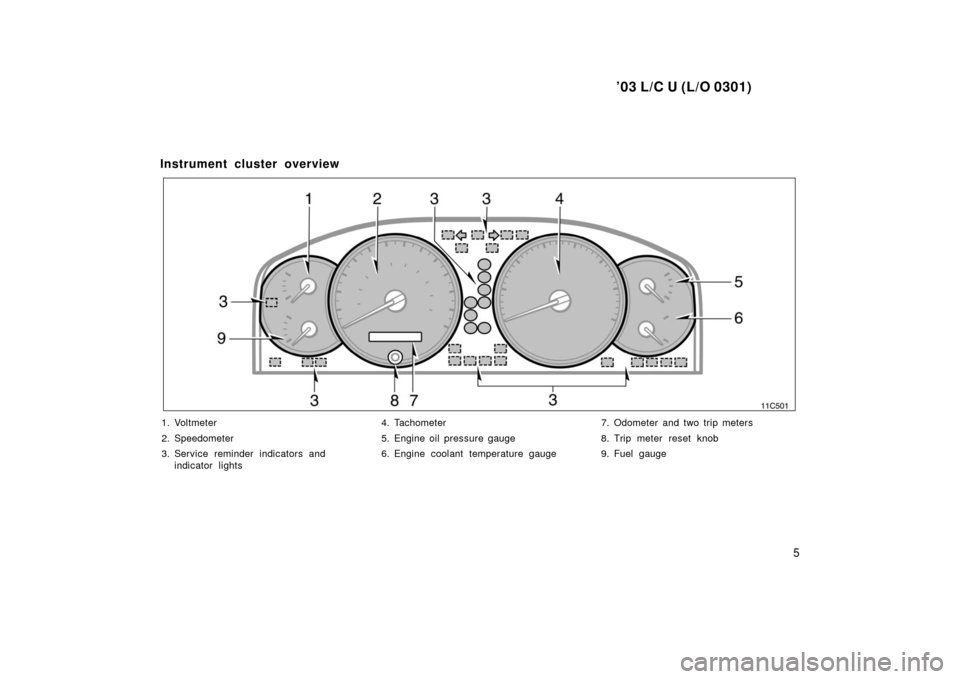
Instrument cluster overview
1. Voltmeter
2. Speedometer
3. Service reminder indicators and indicator lights 4. Tachometer
5. Engine oil pressure gauge
6. Engine coolant temperature gauge
7. Odometer and two trip meters
8. Trip meter reset knob
9. Fuel gauge
Page 117 of 312
’03 L/C U (L/O 0301)
11 3
OPERATION OF INSTRUMENTS AND
CONTROLS
Gauges, Meters and Service reminder indicators
Fuel gauge11 4
. . . . . . . . . . . . . . . . . . . . . . . . . . . . . . . . . . . . .\
. . . . . . . . . . .
Engine coolant temperature gauge 11 4
. . . . . . . . . . . . . . . . . . . . . . . . . . .
Engine oil pressure gauge 11 5
. . . . . . . . . . . . . . . . . . . . . . . . . . . . . . . . . . .
Vo ltme te r 11 6
. . . . . . . . . . . . . . . . . . . . . . . . . . . . . . . . . . . . \
. . . . . . . . . . . . . .
Tachometer 11 6
. . . . . . . . . . . . . . . . . . . . . . . . . . . . . . . . . . . . \
. . . . . . . . . . . .
Odometer and two trip meters 11 7
. . . . . . . . . . . . . . . . . . . . . . . . . . . . . . . .
Service reminder indicators and warning buzzers 11 8
. . . . . . . . . . . . . .
Trip information display 125
. . . . . . . . . . . . . . . . . . . . . . . . . . . . . . . . . . . . \
. .
SECTION 1 5
Page 121 of 312
’03 L/C U (L/O 0301)
11 7
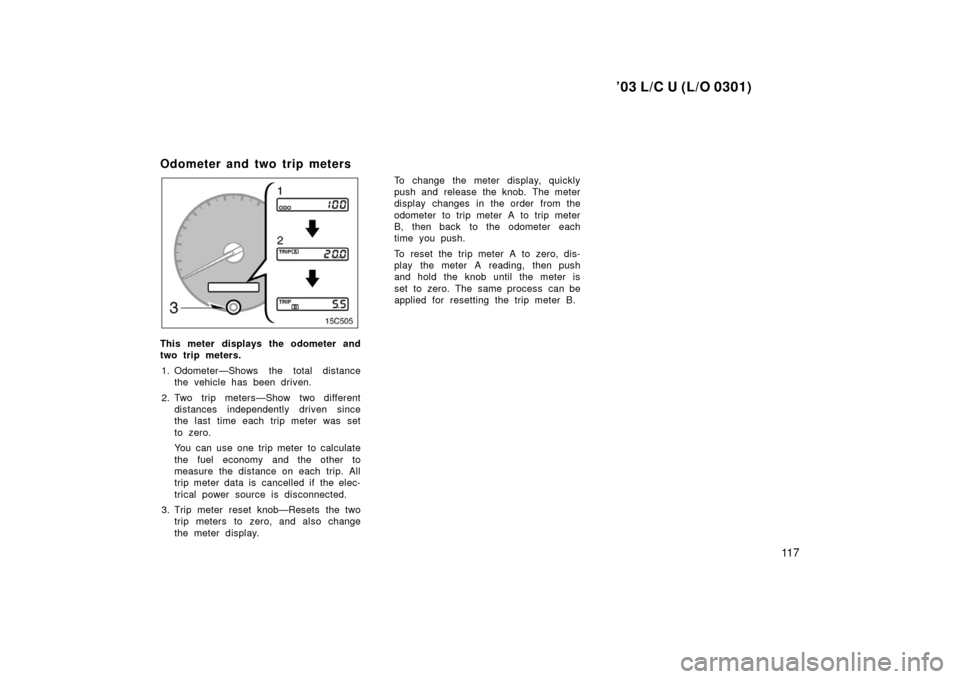
Odometer and two trip meters
This meter displays the odometer and
two trip meters.1. Odometer—Shows the total distance the vehicle has been driven.
2. Two trip meters—Show two different distances independently driven since
the last time each trip meter was set
to zero.
You can use one trip meter to calculate
the fuel economy and the other to
measure the distance on each trip. All
trip meter data is cancelled if the elec-
trical power source is disconnected.
3. Trip meter reset knob—Resets the two trip meters to zero, and also change
the meter display. To change the meter display, quickly
push and release the knob. The meter
display changes in the order from the
odometer to trip meter A to trip meter
B, then back to the odometer each
time you push.
To reset the trip meter A to zero, dis-
play the meter A reading, then push
and hold the knob until the meter is
set to zero. The same process can be
applied for resetting the trip meter B.
Page 125 of 312

’03 L/C U (L/O 0301)
121
(b) Driver’s Seat Belt Reminder Lightand Buzzer
This light and buzzer remind you to
buckle up the driver’s seat belt.
Once the ignition key is turned to ”ON” or
”START”, the reminder light flashes and
the buzzer sounds if the driver ’s seat belt
is not fastened. Unless the driver fastens
the belt, the light keeps on flashing and
the buzzer sounds 4 to 8 seconds.
(c) Front Passenger ’s Seat Belt Re- minder Light
This light remind you to buckle up the
front passenger ’s seat belt.
Once the ignition key is turned to ”ON” or
”START”, the reminder light flashes if a
passenger sits in the front passenger seat
and does not fasten the seat belt. Unless
the front passenger fastens the belt, the
light stays flashing.
If luggage or other load is placed on the
front passenger seat, depending on its
weight and how it is placed on the seat,
builtin sensors in the seat cushion may
detect the pressure, causing the reminder
light to come on. (d) Discharge Warning Light
This light warns that the battery is being
discharged.
If it comes on while you are driving, there
is a problem somewhere in the charging
system.
The engine ignition will continue to oper-
ate, however, until the battery is dis-
charged. Turn off the air conditioning,
blower, radio, etc., and drive directly to
the nearest Toyota dealer or repair shop.
NOTICE
Do not continue driving if the engine
drive belt is broken or loose.
(e) Engine Oil Replacement Reminder
Light
This light reminds you when to replace
the engine oil.
This light will come on when the ignition
switch is turned to ”ON”, and will go off
after about a few seconds. When you drive for about 8000 km (5000
miles) after engine oil replacement, this
light illuminates for about 3 seconds and
then flashes for about 12 seconds with
the ignition key is turned to ”ON” position.
If you continue driving without engine oil
replacement, and if the driving range ex-
ceeds 12000 km (7500 miles), the light
will come on after the ignition key is
turned to ”ON” position. The light will re-
main on thereafter.
If the light is flashing, we recommend that
you replace the engine oil at an early
opportunity depending on the driving and
road condition. If the light comes on, re-
place it as soon as possible.
You need to reset the light after the en-
gine oil replacement. Reset the light by
following the procedure below:
1. Turn the ignition key to the ”OFF” posi- tion
with the odometer reading shown.
(For details, see “Odometer and trip me-
ter” on page 117).
2. Turn the ignition key to the ”ON” posi- tion while holding down the ”ODO/
TRIP” knob.
Hold down the knob until the light goes
off. Before the light goes off, it illuminates
for 3 seconds, flashes for 2 seconds, illu-
minates for 1 second.
Page 279 of 312
’03 L/C U (L/O 0301)
275
Checking and replacing tires
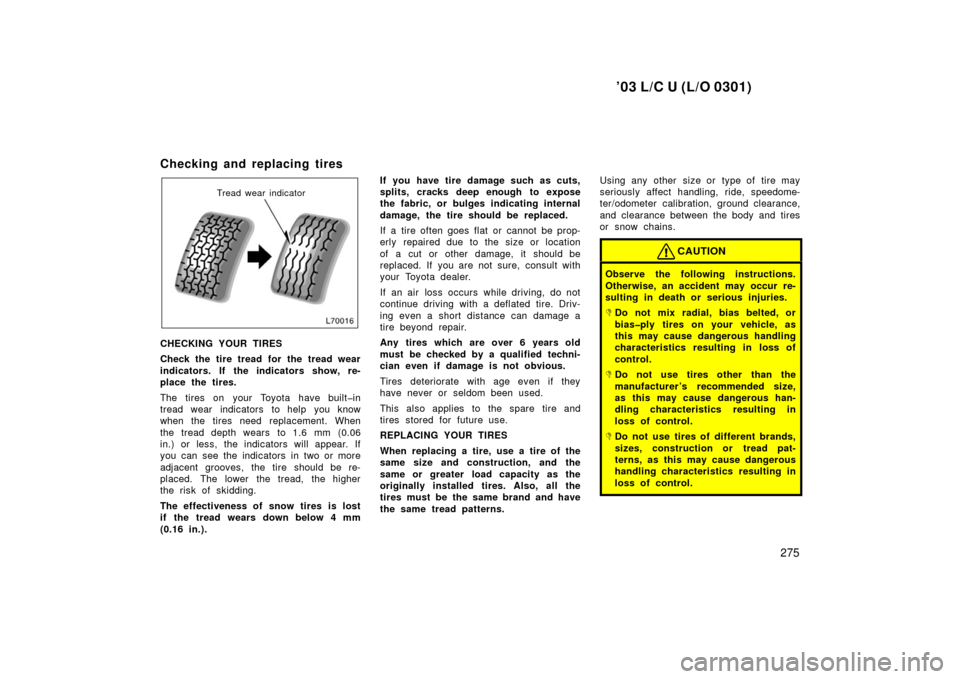
Tread wear indicator
CHECKING YOUR TIRES
Check the tire tread for the tread wear
indicators. If the indicators show, re-
place the tires.
The tires on your Toyota have builtin
tread wear indicators to help you know
when the tires need replacement. When
the tread depth wears to 1.6 mm (0.06
in.) or less, the indicators will appear. If
you can see the indicators in two or more
adjacent grooves, the tire should be re-
placed. The lower the tread, the higher
the risk of skidding.
The effectiveness of snow tires is lost
if the tread wears down below 4 mm
(0.16 in.).If you have tire damage such as cuts,
splits, cracks deep enough to expose
the fabric, or bulges indicating internal
damage, the tire should be replaced.
If a tire often goes flat or cannot be prop-
erly repaired due to the size or location
of a cut or other damage, it should be
replaced. If you are not sure, consult with
your Toyota dealer.
If an air loss occurs while driving, do not
continue driving with a deflated tire. Driv-
ing even a short distance can damage a
tire beyond repair.
Any tires which are over 6 years old
must be checked by a qualified techni-
cian even if damage is not obvious.
Tires deteriorate with age even if they
have never or seldom been used.
This also applies to the spare tire and
tires stored for future use.
REPLACING YOUR TIRES
When replacing a tire, use a tire of the
same size and construction, and the
same or greater load capacity as the
originally installed tires. Also, all the
tires must be the same brand and have
the same tread patterns.
Using any other size or type of tire may
seriously affect handling, ride, speedome-
ter/odometer calibration, ground clearance,
and clearance between the body and tires
or snow chains.
CAUTION
Observe the following instructions.
Otherwise, an accident may occur re-
sulting in death or serious injuries.
�Do not mix radial, bias belted, or
biasply tires on your vehicle, as
this may cause dangerous handling
characteristics resulting in loss of
control.
�Do not use tires other than the
manufacturer ’s recommended size,
as this may cause dangerous han-
dling characteristics resulting in
loss of control.
�Do not use tires of different brands,
sizes, construction or tread pat-
terns, as this may cause dangerous
handling characteristics resulting in
loss of control.