Page 62 of 303

’03 HIGHLANDER_U (L/O 0208)
562003 HIGHLANDER from Aug. ’02 Prod. (OM48441U)
The SRS airbag system consists mainly of
the following components, and their loca-
tions are shown in the illustration.
1. Front airbag sensors
2. SRS warning light
3. Airbag module for front passenger (airbag and inflator)
4. Airbag sensor assembly
5. Airbag module for driver (airbag and inflator)
The airbag sensor assembly consists of a
safing sensor and airbag sensor. In a severe frontal impact, the sensor de-
tects deceleration and the system triggers
the airbag inflators. At this time a chemi-
cal reaction in the inflators quickly fills the
airbags with nontoxic gas to help restrain
the forward motion of the occupants.
When the airbags inflate, they produce a
fairly loud noise and release some smoke
and residue along with nontoxic gas. This
does not indicate a fire. This gas is nor-
mally harmless; however, for those who
have delicate skin, it may cause a minor
skin irritation. Be sure to wash off any
residue as soon as possible to prevent
any potential skin irritation.
Deployment of the airbags happens in a
fraction of a second, so the airbags must
inflate with considerable force. While the
system is desi
gned to reduce serious inju-
ries, it may also cause minor burns or
abrasions and swelling.
Parts of the airbag module (steering wheel
hub, dashboard) may be hot for several
minutes, but the airbags themselves will
not be hot. The airbags are designed to
inflate only once. A crash severe enough to inflate the air-
bags may break the windshield as the
vehicle buckles. In vehicles with a pas-
senger airbag the windshield may also be
damaged by absorbing some of the force
of the inflating airbag.
Page 68 of 303

’03 HIGHLANDER_U (L/O 0208)
622003 HIGHLANDER from Aug. ’02 Prod. (OM48441U)
This indicator comes on when the igni-
tion key is turned to the “ON” position.
It goes off after about 6 seconds. This
means the SRS side airbags are operat-
ing properly.
This warning light system monitors the
airbag sensor assembly, front airbag sen-
sors, side airbag sensor, front seat belt
pretensioner assemblies, inflators, warning
light, interconnecting wiring and power
sources. (For details, see “Service remind-
er indicators and warning buzzers” on
page 105 in Section 15.)The SRS side airbag system may not
activate if the vehicle is subjected to a
collision from the side at certain
angles, or a collision to the side of the
vehicle body other than the passenger
compartment as shown in the illustra-
tion.
The SRS side airbags are designed to
inflate when the passenger compartment
area suffers a severe impact from the
side.
For the safety of all occupants, always
wear your seat belts properly.
Collision from the rear
Collision from the front Vehicle rollover
The SRS side airbags are not designed
to inflate if the vehicle is involved in a
front or rear collision, if it rolls over,
or if it is involved in a lowspeed side
collision.
Page 69 of 303

’03 HIGHLANDER_U (L/O 0208)
632003 HIGHLANDER from Aug. ’02 Prod. (OM48441U)
The SRS side airbag system consists
mainly of the following components, and
their locations are shown in the illustra-
tion.
1. SRS warning light
2. Side airbag modules (airbag and inflator)
3. Side airbag sensors
4. Airbag sensor assembly
The SRS side airbag system is controlled
by the airbag sensor assembly. The airbag
sensor assembly consists of a safing sen-
sor and airbag sensor. In a severe side impact, the side airbag
sensor triggers the side airbag inflators.
At this time a chemical reaction in the
inflators quickly fills the air
bags with non
toxic gas to help restrain the lateral mo-
tion of the occupants.
When the airbags inflate, they produce a
fairly loud noise and release some smoke
and residue along with nontoxic gas. This
does not indicate a fire. This gas is nor-
mally harmless; however, for those who
have delicate skin, it may cause a minor
skin irritation. Be sure to wash off any
residue as soon as possible to prevent
any potential skin irritation.
Deployment of the airbags happen in a
fraction of a second, so the airbags must
inflate with considerable force. While the
system is desi gned to reduce serious inju-
ries, it may also cause minor burns or
abrasions and swelling.
Front seats may be hot for several min-
utes, but the airbags themselves will not
be hot. The airbags are designed to inflate
only once.
CAUTION
�The SRS side airbag system is de-
signed only as a supplement to the
primary protection of the driver
side and front passenger side seat
belt systems. To ensure maximum
protection in an accident, the driver
and all passengers in the vehicle
must wear their seat belts properly.
Wearing a seat belt properly during
an accident reduces the chances of
death or serious injury or being
thrown out of the vehicle. For
instructions and precautions con-
cerning the seat belt system, see
“Seat belts” on page 46 in this sec-
tion.
Page 107 of 303
’03 HIGHLANDER_U (L/O 0208)
1012003 HIGHLANDER from Aug. ’02 Prod. (OM48441U)
OPERATION OF INSTRUMENTS AND
CONTROLS
Gauges, Meters and Service reminder indicators
Fuel gauge 102
. . . . . . . . . . . . . . . . . . . . . . . . . . . . . . . . . . . . .\
. . . . . . . . . . .
Engine coolant temperature gauge 102
. . . . . . . . . . . . . . . . . . . . . . . . . . .
Tachometer 103
. . . . . . . . . . . . . . . . . . . . . . . . . . . . . . . . . . . . \
. . . . . . . . . . . .
Odometer and two trip meters 103
. . . . . . . . . . . . . . . . . . . . . . . . . . . . . . . .
Service reminder indicators and warning buzzers 105
. . . . . . . . . . . . . .
SECTION 1 5
Page 108 of 303
’03 HIGHLANDER_U (L/O 0208)
1022003 HIGHLANDER from Aug. ’02 Prod. (OM48441U)
Low fuel level
warning light
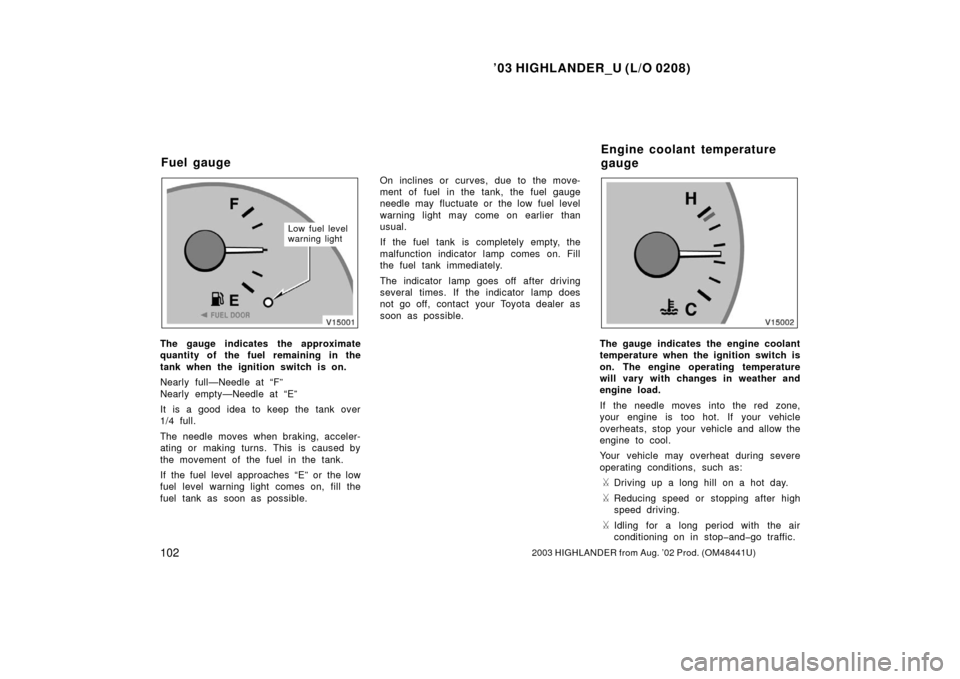
The gauge indicates the approximate
quantity of the fuel remaining in the
tank when the ignition switch is on.
Nearly full—Needle at “F”
Nearly empty—Needle at “E”
It is a good idea to keep the tank over
1/4 full.
The needle moves when braking, acceler-
ating or making turns. This is caused by
the movement of the fuel in the tank.
If the fuel level approaches “E” or the low
fuel level warning light comes on, fill the
fuel tank as soon as possible. On inclines or curves, due to the move-
ment of fuel in the tank, the fuel gauge
needle may fluctuate or the low fuel level
warning light may come on earlier than
usual.
If the fuel tank is completely empty, the
malfunction indicator lamp comes on. Fill
the fuel tank immediately.
The indicator lamp goes off after driving
several times. If the indicator lamp does
not go off, contact your Toyota dealer as
soon as possible.The gauge indicates the engine coolant
temperature when the ignition switch is
on. The engine operating temperature
will vary with changes in weather and
engine load.
If the needle moves into the red zone,
your engine is too hot. If your vehicle
overheats, stop your vehicle and allow the
engine to cool.
Your vehicle may overheat during severe
operating conditions, such as:
�Driving up a long hill on a hot day.
�Reducing speed or stopping after high
speed driving.
�Idling for a long period with the air
conditioning on in stopandgo traffic.
Fuel gauge
Engine coolant temperature
gauge
Page 111 of 303
’03 HIGHLANDER_U (L/O 0208)
1052003 HIGHLANDER from Aug. ’02 Prod. (OM48441U)
If the indicator or buzzer comes on...Do this.
(a)orIf parking brake is off, stop immediately and contact Toyota dealer.
(b)
(indicator and buzzer)
Fasten driver ’s seat belt.
(c)Fasten front passenger ’s seat belt.
(d)Stop and check.
(e)Stop and check.
(f)orTake vehicle to Toyota dealer.
(g)Low fuel level warning lightFill up tank.
Service reminder indicators and warning buzzers
Page 112 of 303
’03 HIGHLANDER_U (L/O 0208)
1062003 HIGHLANDER from Aug. ’02 Prod. (OM48441U)
If the indicator or buzzer comes on...Do this.
(h)orTake vehicle to Toyota dealer.
If brake system warning light is also on, stop immediately and contact Toyota dealer.
(i)Close all side doors and back door.
(j)Stop and check.
(k)Take vehicle to Toyota dealer immediately.
(l)Take vehicle to Toyota dealer.
(m)Add washer fluid.
(n)Key reminder buzzerRemove key.
Page 113 of 303

’03 HIGHLANDER_U (L/O 0208)
1072003 HIGHLANDER from Aug. ’02 Prod. (OM48441U)
(a) Brake System Warning Light
This light comes on in the following cases
when the ignition key is in the “ON” posi-
tion.
�When the parking brake is applied...
This light comes on for a few seconds
when the ignition key is turned to the
“ON” position even after the parking brake
is released.
�When the brake fluid level is low...
CAUTION
It is dangerous to continue driving
normally when the brake fluid level is
low.
Have your vehicle checked at your
Toyota dealer in the following cases:
�The light does not come on even if the
parking brake is applied when the igni-
tion key is in the “ON” position.
�The light does not come on even if the
ignition key is turned on with the park-
ing brake released. A warning light turning on briefly during
operation does not indicate a problem.
CAUTION
If either of the following conditions
occurs, immediately stop your vehicle
at a safe place and contact your
Toyota dealer.
�The light does not turn off even
after the parking brake is released
while the engine is running.
In this case, the brakes may not
work properly and your stopping
distance will become longer. De-
press the brake pedal firmly and
bring the vehicle to an immediate
stop.
�The brake system warning light re-
mains on together with the “ABS”
warning light.
In this case, not only the antilock
brake system will fail but also the
vehicle will become extremely un-
stable during braking.
(b) Driver’s Seat Belt Reminder Light
and Buzzer
This light and buzzer remind you to
buckle up the driver’s seat belt.
Once the ignition key is turned to “ON” or
“START”, the reminder light flashes and
buzzer sounds if the driver ’s seat belt is
not fastened. Unless the driver fastens the
belt, the light keeps flashing and the
buzzer stops after about 4 to 8 seconds.
(c) Front Passenger ’s Seat Belt Reminder Light
This light reminds you to buckle up the
front passenger ’s seat belt.
Once the ignition key is turned to “ON” or
“START”, the reminder light flashes if a
passenger sits in the front passenger seat
and does not fasten the seat belt. Howev-
er, if a front passenger uses an additional
seat cushion, the light may not flash even
when the seat belt is not buckled up.
If luggage load is placed on the front
passenger seat, depending on its weight
and how it is placed on the seat, builtin
sensors in the seat cushion may detect
the pressure, causing the reminder light to
keep flashing.