Page 222 of 303

’03 HIGHLANDER_U (L/O 0208)
2162003 HIGHLANDER from Aug. ’02 Prod. (OM48441U)
Before making these checks, make sure
you have followed the correct starting
procedure given in “How to start the
engine” on page 202 in Section 3 and that
you have sufficient fuel. If your vehicle is
equipped with the engine immobiliser sys-
tem, also check whether the other keys
will start the engine. If they work, your
key may be broken. Have the key
checked at your Toyota dealer. If none of
your keys work, the system is possibly
broken. Call your Toyota dealer. (See
“Keys (with engine immobiliser system)”
on page 12 in Section 12.)
If the engine is not turning over or is
turning over too slowly—
1. Check that the battery terminals are tight and clean.
2. If the battery terminals are O.K., switch on the interior light.
3. If the light is out, dim or goes out when the starter is cranked, the battery
is discharged. You may try jump start-
ing. See “(c) Jump starting” on page
217 for further instructions.
If the light is O.K., but the engine still will
not start, it needs adjustment or repair.
Call a Toyota dealer or qualified repair
shop.NOTICE
Do not pullor pushstart the vehicle.
It may damage the vehicle or cause
a collision when the engine starts.
Also the threeway catalytic converter
may overheat and become a fire haz-
ard.
If the engine turns over at its normal
speed but will not start— 1. Turn the ignition key to “ACC” or “LOCK” and try starting the engine
again.
2. If the engine will not start, the engine may be flooded because of repeated
cranking. See “(b) Starting a flooded
engine” on page 216 for further instruc-
tions.
3. If the engine still will not start, it needs adjustment or repair. Call a Toyota
dealer or qualified repair shop. If the engine will not start, your engine
may be flooded because of repeated
cranking.
If this happens, turn the key to “START”
with the accelerator pedal held down.
Keep the key and accelerator pedal these
positions for 15 seconds and release
them. Then try starting the engine with
your foot off the accelerator pedal.
If the engine does not start after 15 se-
conds of cranking, release the key, wait
a few minutes and try again.
If the engine still will not start, it needs
adjustment or repair. Call a Toyota dealer
or qualified repair shop for assistance.
NOTICE
Do not crank for more than 30 se-
conds at a time. This may overheat
the starter and wiring systems.
If your vehicle will not start—
(a) Simple checks
(b) Starting a flooded engine
Page 225 of 303

’03 HIGHLANDER_U (L/O 0208)
2192003 HIGHLANDER from Aug. ’02 Prod. (OM48441U)
Do not connect it to or near any part
that moves when the engine is
cranked.
CAUTION
When making the connections, to
avoid serious injury, do not lean over
the battery or accidentally let the
jumper cables or clamps touch any-
thing except the correct battery termi-
nals or the ground.
5. Start your engine in the normal way.
After starting, run it at about 2000 rpm
for several minutes with the accelerator
pedal lightly depressed.
6. Carefully disconnect the cables in the exact reverse order: the negative cable
and then the positive cable.
7. Carefully dispose of the battery cover cloths—they may now contain sulfuric
acid.
8. If removed, replace all the battery vent plugs.
If the cause of your battery discharging is
not apparent (for example, lights left on),
you should have it checked at your Toyota
dealer. If your engine stalls while driving...
1. Reduce your speed gradually, keeping a straight line. Move cautiously off the
road to a safe place.
2. Turn on your emergency flashers.
3. Turn the ignition key to “ACC” or “LOCK”, and try starting the engine
again.
If the engine will not start, see “If your
vehicle will not start” on page 216.
CAUTION
If the engine is not running, the pow-
er assist for the brakes and steering
will not work so steering and braking
will be much harder than usual.
If your engine coolant temperature
gauge indicates overheating, if you ex-
perience a loss of power, or if you hear
a loud knocking or pinging noise, the
engine has probably overheated. You
should follow this procedure... 1. Pull safely off the road, stop the ve- hicle and turn on your emergency
flashers. Put the transmission in “P”
and apply the parking brake. Turn off
the air conditioning if it is being used.
2. If coolant or steam is boiling out of the radiator or reservoir, stop the engine.
Wait until the steam subsides before
opening the hood. If there is no coolant
boiling over or steam, leave the engine
running and make sure the electric
cooling fan is operating. If it is not,
turn the ignition off.
CAUTION
To help avoid personal injury, keep
the hood closed until there is no
steam. Escaping steam or coolant is
a sign of very high pressure.
If your engine stalls while
driving If your vehicle overheats
Page 227 of 303
’03 HIGHLANDER_U (L/O 0208)
2212003 HIGHLANDER from Aug. ’02 Prod. (OM48441U)
�Stop the vehicle on a level firm
ground, firmly set the parking brake
and put the transmission in “P”.
Block the wheel diagonally opposite
to the one being changed if neces-
sary.
�Make sure to set the jack properly
in the jack point. Raising the ve-
hicle with jack improperly posi-
tioned will damage the vehicle or
may allow the vehicle to fall off the
jack and cause personal injury.
�Never get under the vehicle when
the vehicle is supported by the jack
alone.
�Use the jack only for lifting your
vehicle during wheel changing.
�Do not raise the vehicle with some-
one in the vehicle.
�When raising the vehicle, do not
place any objects on top of or un-
derneath the jack.
�Raise the vehicle only high enough
to remove and change the tire.
NOTICE
Do not continue driving with a de-
flated tire. Driving even a short dis-
tance can damage a tire and wheel
beyond repair.
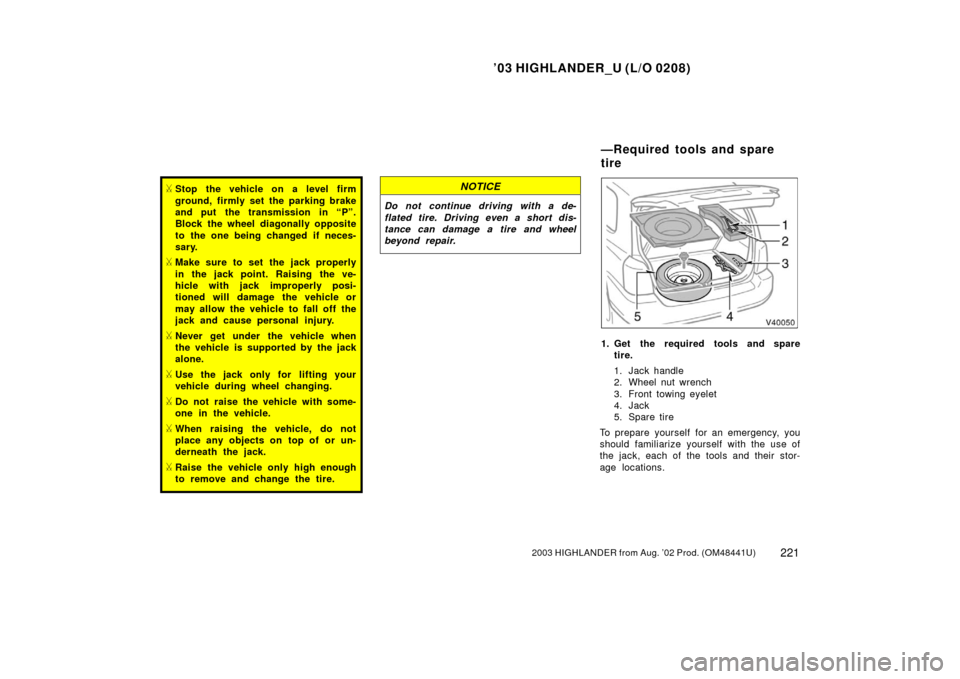
1. Get the required tools and spare
tire.
1. Jack handle
2. Wheel nut wrench
3. Front towing eyelet
4. Jack
5. Spare tire
To prepare yourself for an emergency, you
should fam iliarize yourself with the use of
the jack, each of the tools and their stor-
age locations.
—Required tools and spare
tire
Page 228 of 303
’03 HIGHLANDER_U (L/O 0208)
2222003 HIGHLANDER from Aug. ’02 Prod. (OM48441U)
Turn the jack joint by hand.
To remove: Turn the joint in direction 1
until the jack is free.
To store: Turn the joint in direction 2 until
the jack is firmly secured to prevent it
flying forward during a collision or s udden
braking.To remove the spare tire:
1. Hang the deck board on the weather- strip.
2. Remove the spare tire cover.
3. Loosen the bolt and remove it.2. Block the wheel diagonally opposite the flat tire to keep the vehicle from
rolling when it is j acked up.
When blocking the wheel, place a wheel
block in front of one of the front wheels
or behind one of the rear wheels.
—Blocking the wheel
Page 229 of 303
’03 HIGHLANDER_U (L/O 0208)
2232003 HIGHLANDER from Aug. ’02 Prod. (OM48441U)
Steel wheels
Aluminium wheels
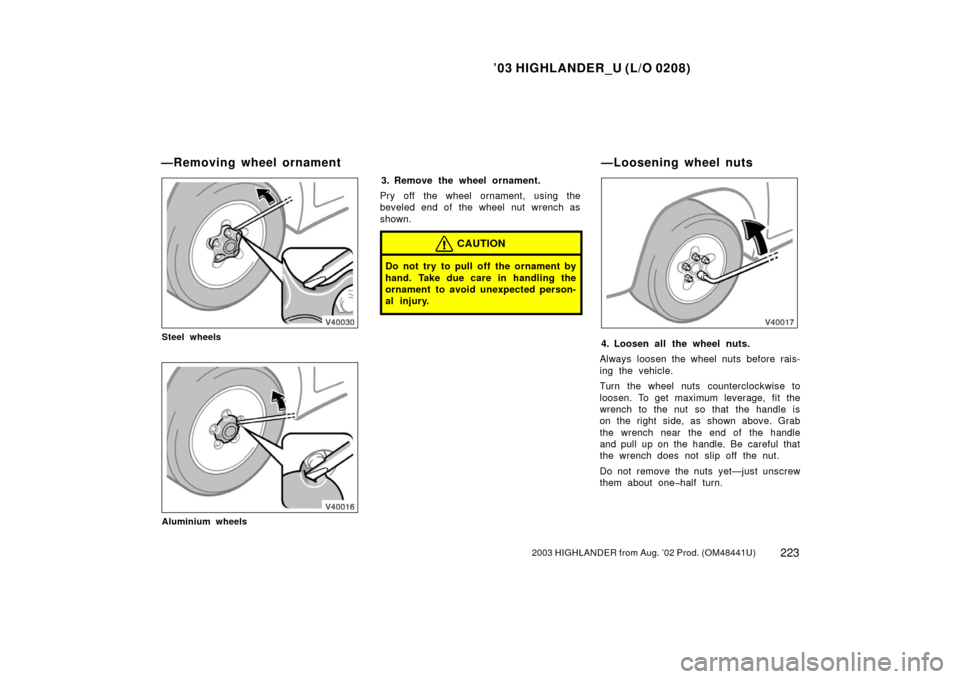
3. Remove the wheel ornament.
Pry off the wheel ornament, using the
beveled end of the wheel nut wrench as
shown.
CAUTION
Do not try to pull off the ornament by
hand. Take due care in handling the
ornament to avoid unexpected person-
al injury.
4. Loosen all the wheel nuts.
Always loosen the wheel nuts before rais-
ing the vehicle.
Turn the wheel nuts counterclockwise to
loosen. To get maximum leverage, fit the
wrench to the nut so that the handle is
on the right side, as shown above. Grab
the wrench near the end of the handle
and pull up on the handle. Be careful that
the wrench does not slip off the nut.
Do not remove the nuts yet—just unscrew
them about onehalf turn.
—Removing wheel ornament —Loosening wheel nuts
Page 230 of 303
’03 HIGHLANDER_U (L/O 0208)
2242003 HIGHLANDER from Aug. ’02 Prod. (OM48441U)
CAUTION
Never use oil or grease on the bolts
or nuts. The nuts may loose and the
wheels may fall off, which could cau-
se a serious accident.
5. Position the jack at the correct jack
point as shown.
Make sure the jack is positioned on a
level and solid place.6. After making sure that no one is in the vehicle, raise it high enough so
that the spare tire can be installed.
Remember you will need more ground
clearance when putting on the spare tire
than when removing the flat tire.
To raise the vehicle, insert the jack handle
into the jack (it is a loose fit) and turn it
clockwise. As the jack touches the vehicle
and begins to lift, doublecheck that it is
properly positioned.
—Positioning the jack —Raising your vehicle
Page 232 of 303
’03 HIGHLANDER_U (L/O 0208)
2262003 HIGHLANDER from Aug. ’02 Prod. (OM48441U)
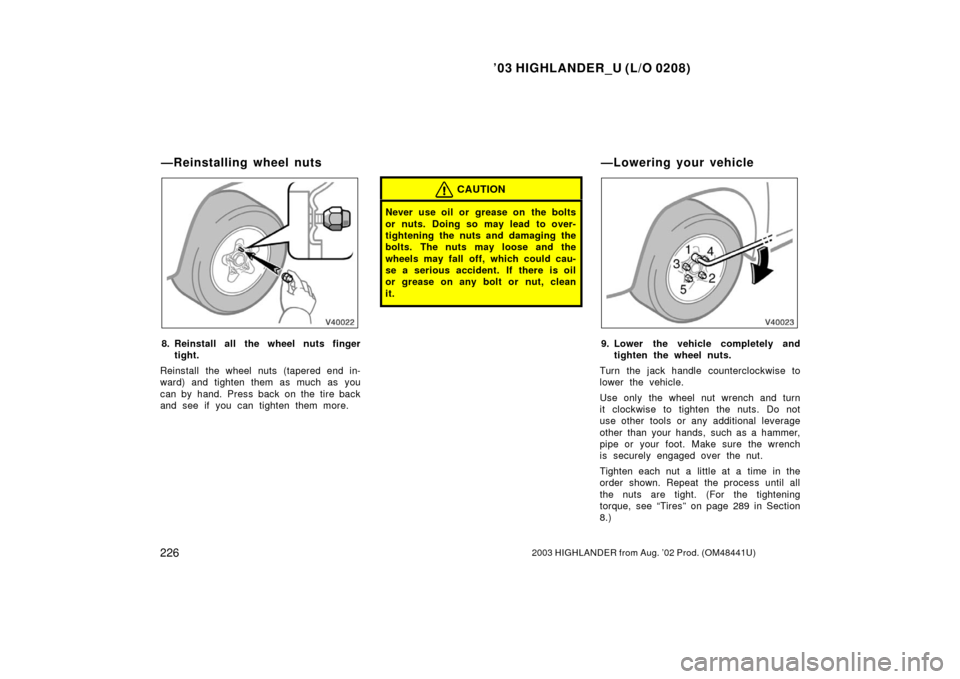
8. Reinstall all the wheel nuts finger
tight.
Reinstall the wheel nuts (tapered end in-
ward) and tighten them as much as you
can by hand. Press back on the tire back
and see if you can tighten them more.
CAUTION
Never use oil or grease on the bolts
or nuts. Doing so may lead to over-
tightening the nuts and damaging the
bolts. The nuts may loose and the
wheels may fall off, which could cau-
se a serious accident. If there is oil
or grease on any bolt or nut, clean
it.
9. Lower the vehicle completely and tighten the wheel nuts.
Turn the jack handle counterclockwise to
lower the vehicle.
Use only the wheel nut wrench and turn
it clockwise to tighten the nuts. Do not
use other tools or any additional leverage
other than your hands, such as a hammer,
pipe or your foot. Make sure the wrench
is securely engaged over the nut.
Tighten each nut a little at a time in the
order shown. Repeat the process until all
the nuts are tight. (For the tightening
torque, see “Tires” on page 289 in Section
8.)
—Reinstalling wheel nuts —Lowering your vehicle
Page 238 of 303
’03 HIGHLANDER_U (L/O 0208)
2322003 HIGHLANDER from Aug. ’02 Prod. (OM48441U)
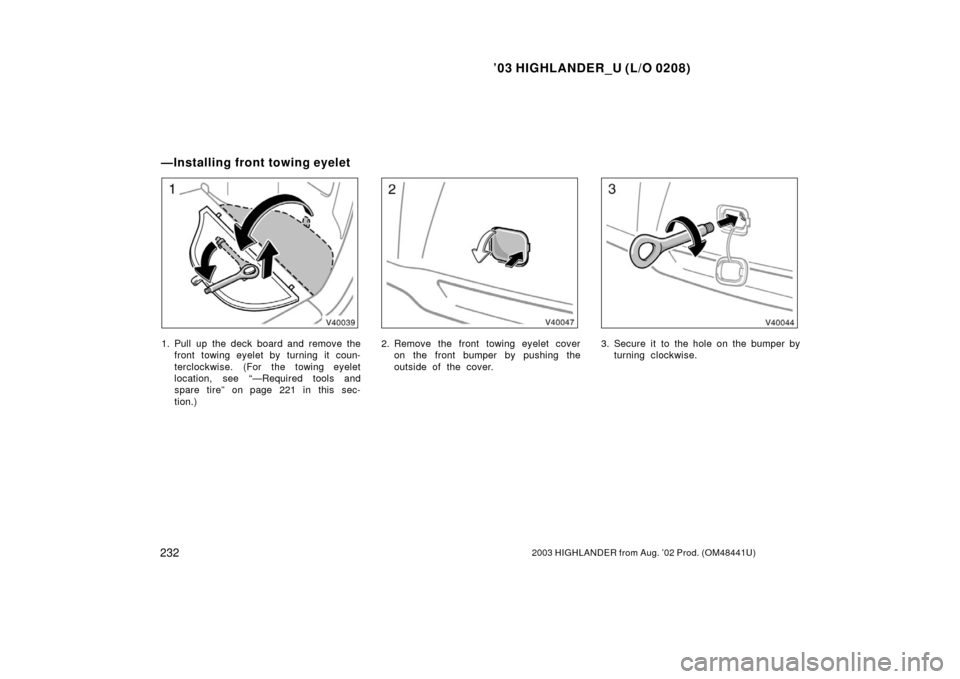
1. Pull up the deck board and remove the
front towing eyelet by turning it coun-
terclockwise. (For the towing eyelet
location, see “—Required tools and
spare tire” on page 221 in this sec-
tion.)2. Remove the front towing eyelet coveron the front bumper by pushing the
outside of the cover.3. Secure it to the hole on the bumper byturning clockwise.
—Installing front towing eyelet