Page 159 of 241

155
Do not use your parking brake when
there is a possibility it could freeze.
When parking, put the transmission into
“P” (automatic) or into first or reverse
(manual) and block the rear wheels. Do
not use the parking brake, or snow or
water accumulated in and around the
parking brake mechanism may freeze,
making it hard to release.
Keep ice and snow from accumulating
under the fenders.
Ice and snow built up under your fenders
can make steering difficult. During bad
winter driving, stop and check under the
fenders occasionally.
Depending on where you are driving,
we recommend you carry some emer-
gency equipment.
Some of the things you might put in the
vehicle are tire chains, window scraper,
bag of sand or salt, flares, small shovel,
jumper cables, etc.
SU31002
Your vehicle is not designed to be
dinghy towed (with four wheels on the
ground) behind a motorhome.
NOTICE
Do not tow your vehicle with four
wheels on the ground. This may
cause serious damage to your vehicle.
SU31003
Your vehicle can be dinghy towed (with
four wheels on the ground) from the
front behind a motorhome.
CAUTION
Dinghy towing requires special equip-
ment and accessories. Please refer to
your service outlet of the motorhome
manufacture for the recommended
equipment.
NOTICE
Dinghy towing does not eliminate the
possibility of damage to your vehicle.
2003 ECHO from Aug. ’02 Prod. (OM52481U)
Dinghy towing
(with automatic transmission) Dinghy towing
(with manual transmission)
Page 160 of 241
156
DINGHY TOWING TIPS
Before dinghy towing, be sure to ob-
serve the following in order to reduce
the damage to your vehicle.1. Put the shift lever in neutral.
2. Turn the ignition switch to the “ACC” position. Make sure the audio is turned
off and any item is not plugged into
the power outlet.
NOTICE
To avoid the locking of the steering
wheel, turn the ignition switch to the
“ACC” position.
3. Release the parking brake.
After dinghy towing, let the engine idle for
more than 3 minutes before driving the
vehicle.
SU31004
NOTICE
Do not tow your vehicle from the
rear. This may cause serious damage
to your vehicle.
Trailer towing
SU31001
Toyota does not recommend towing a trail-
er with your Echo. It is not designed for
trailer towing.
2003 ECHO from Aug. ’02 Prod. (OM52481U)
Page 169 of 241

165
�Stop the vehicle on a level firm
ground, firmly set the parking brake
and put the transmission in “P”
(automatic) or reverse (manual).
Block the wheel diagonally opposite
to the one being changed if neces-
sary.
�Make sure to set the jack properly
in the jack point. Raising the ve-
hicle with jack improperly posi-
tioned will damage the vehicle or
may allow the vehicle to fall off the
jack and cause personal injury.
�Never get under the vehicle when
the vehicle is supported by the jack
alone.
�Use the jack only for lifting your
vehicle during wheel changing.
�Do not raise the vehicle with some-
one in the vehicle.
�When raising the vehicle, do not
put an object on or under the jack.
�Raise the vehicle only high enough
to remove and change the tire.
NOTICE
Do not continue driving with a de-
flated tire. Driving even a short dis-
tance can damage a tire and wheel
beyond repair.
SU41031
Compact spare tire
The compact spare tire is designed for
temporary emergency use only.
The compact spare tire is identified by the
distinctive wording “TEMPORARY USE
ONLY” molded into the side wall of the
tire.
To keep the compact spare tire noticeable,
do not hide the wheel by a wheel cover
or such.
The compact spare tire saves space in
your luggage compartment, and its lighter
weight helps to improve fuel economy and
permits easier installation in case of a flat
tire.
2003 ECHO from Aug. ’02 Prod. (OM52481U)
Page 171 of 241
167
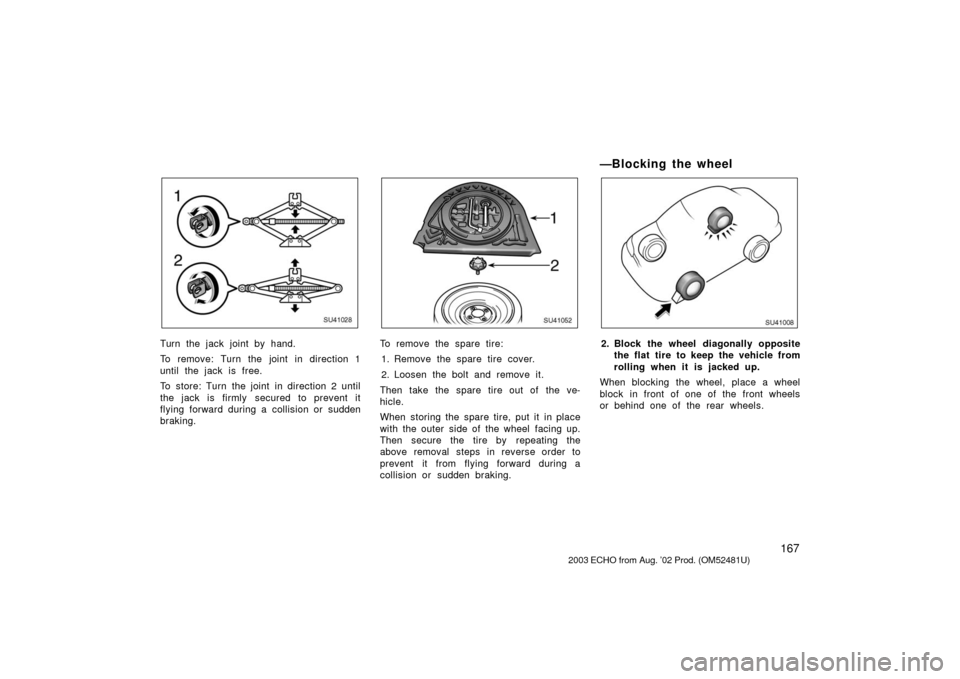
SU41028
Turn the jack joint by hand.
To remove: Turn the joint in direction 1
until the jack is free.
To store: Turn the joint in direction 2 until
the jack is firmly secured to prevent it
flying forward during a collision or sudden
braking.
SU41052
To remove the spare tire:
1. Remove the spare tire cover.
2. Loosen the bolt and remove it.
Then take the spare tire out of the ve-
hicle.
When storing the spare tire, put it in place
with the outer side of the wheel facing up.
Then secure the tire by repeating the
above removal steps in reverse order to
prevent it from flying forward during a
collision or sudden braking.
—Blocking the wheel
SU41008
2. Block the wheel diagonally opposite the flat tire to keep the vehicle from
rolling when it is j acked up.
When blocking the wheel, place a wheel
block in front of one of the front wheels
or behind one of the rear wheels.
2003 ECHO from Aug. ’02 Prod. (OM52481U)
Page 172 of 241
168
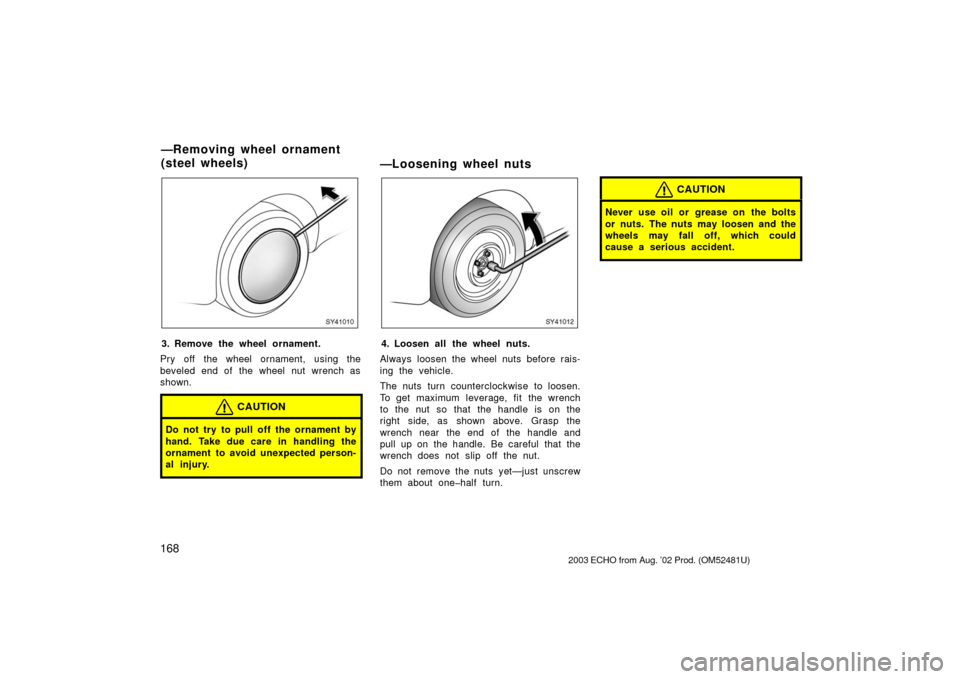
SY41010
3. Remove the wheel ornament.
Pry off the wheel ornament, using the
beveled end of the wheel nut wrench as
shown.
CAUTION
Do not try to pull off the ornament by
hand. Take due care in handling the
ornament to avoid unexpected person-
al injury.
—Loosening wheel nuts
SY41012
4. Loosen all the wheel nuts.
Always loosen the wheel nuts before rais-
ing the vehicle.
The nuts turn counterclockwise to loosen.
To get maximum leverage, fit the wrench
to the nut so that the handle is on the
right side, as shown above. Grasp the
wrench near the end of the handle and
pull up on the handle. Be careful that the
wrench does not slip off the nut.
Do not remove the nuts yet—just unscrew
them about onehalf turn.
CAUTION
Never use oil or grease on the bolts
or nuts. The nuts may loosen and the
wheels may fall off, which could
cause a serious accident.
2003 ECHO from Aug. ’02 Prod. (OM52481U)
—Removing wheel ornament
(steel wheels)
Page 173 of 241
169
—Positioning the jack
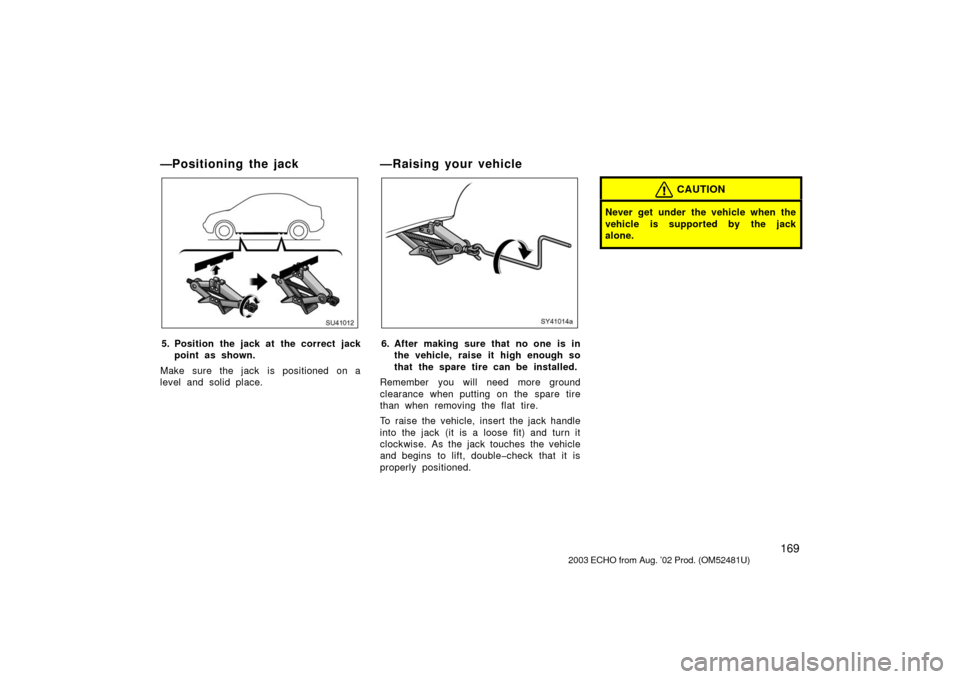
SU41012
5. Position the jack at the correct jackpoint as shown.
Make sure the jack is positioned on a
level and solid place.
—Raising your vehicle
SY41014a
6. After making sure that no one is in the vehicle, raise it high enough so
that the spare tire can be installed.
Remember you will need more ground
clearance when putting on the spare tire
than when removing the flat tire.
To raise the vehicle, insert the jack handle
into the jack (it is a loose fit) and turn it
clockwise. As the jack touches the vehicle
and begins to lift, doublecheck that it is
properly positioned.
CAUTION
Never get under the vehicle when the
vehicle is supported by the jack
alone.
2003 ECHO from Aug. ’02 Prod. (OM52481U)
Page 175 of 241
171
CAUTION
Never use oil or grease on the bolts
or nuts. Doing so may lead to over-
tightening the nuts and damaging the
bolts. The nuts may loosen and the
wheels may fall off, which could
cause a serious accident. If there is
oil or grease on any bolt or nut,
clean it.
—Lowering your vehicle
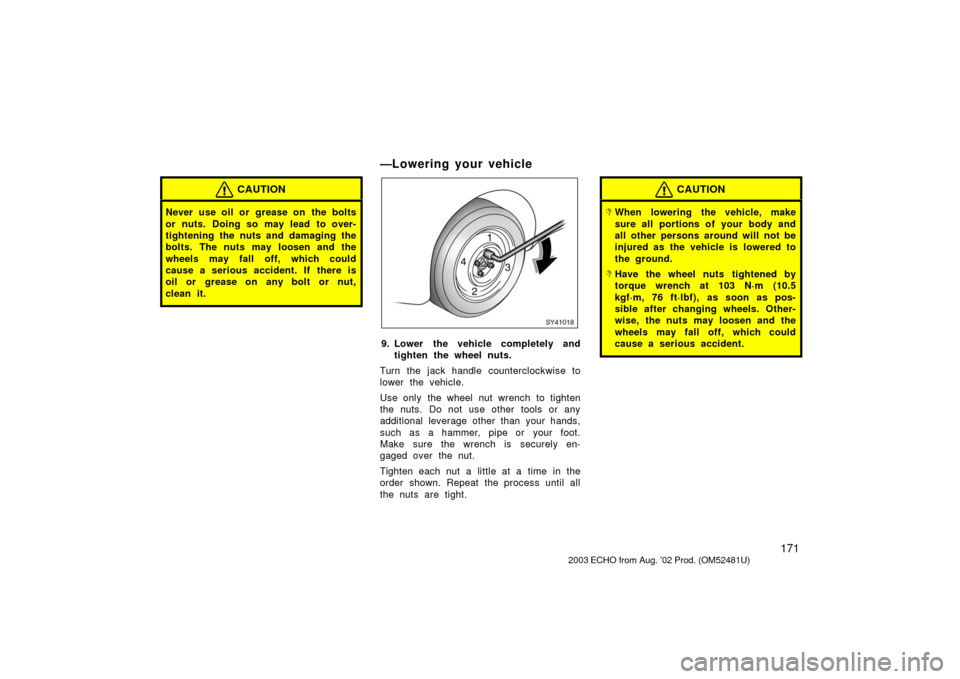
SY41018
9. Lower the vehicle completely andtighten the wheel nuts.
Turn the jack handle counterclockwise to
lower the vehicle.
Use only the wheel nut wrench to tighten
the nuts. Do not use other tools or any
additional leverage other than your hands,
such as a hammer, pipe or your foot.
Make sure the wrench is securely en-
gaged over the nut.
Tighten each nut a little at a time in the
order shown. Repeat the process until all
the nuts are tight.
CAUTION
�When lowering the vehicle, make
sure all portions of your body and
all other persons around will not be
injured as the vehicle is lowered to
the ground.
�Have the wheel nuts tightened by
torque wrench at 103 N·m (10.5
kgf·m, 76 ft·lbf), as soon as pos-
sible after changing wheels. Other-
wise, the nuts may loosen and the
wheels may fall off, which could
cause a serious accident.
2003 ECHO from Aug. ’02 Prod. (OM52481U)
Page 178 of 241
174
If towing is necessary, we recommend
you to have it done by your Toyota
dealer or a commercial tow truck ser-
vice. In consultation with them, have
your vehicle towed using either (a) or
(b).
Only when you cannot receive a towing
service from a Toyota dealer or com-
mercial tow truck service, tow your ve-
hicle carefully in accordance with the
instructions given in “—Emergency
towing” in this section.
Proper equipment will help ensure that
your vehicle is not damaged while being
towed. Commercial operators are generally
aware of the state/provincial and local
laws pertaining to towing.
Your vehicle can be damaged if it is
towed incorrectly. Although most operators
know the correct procedure, it is possible
to make a mistake. To avoid damage to
your vehicle, make sure the following few
precautions are observed. If necessary,
show this page to the tow truck driver.
TOWING PRECAUTIONS:
Use a safety chain system for all towing,
and abide by the state/provincial and local
laws. The wheels and axle on the ground
must be in good condition. If they are
damaged, use a towing dolly.(a) Towing with wheel lift type truck
From front—
Release the parking brake.
NOTICE
When lifting wheels, take care to en-
sure adequate ground clearance for
towing at the opposite end of the
raised vehicle. Otherwise, the bumper
and/or underbody of the towed vehicle
will be damaged during towing.
From rear—
�Manual transmission:
We recommend using a towing dolly
under the front wheels. If you do not
use a towing dolly, place the ignition
key in the “ACC” position and put the
transmission in neutral.
NOTICE
Do not tow with the key removed or
in the “LOCK” position when towing
from the rear without a towing dolly.
The steering lock mechanism is not
strong enough to hold the front
wheels straight.
�Automatic transmission:
Use a towing dolly under the front
wheels.
NOTICE
Never tow a vehicle with an automatic
transmission from the rear with the
front wheels on the ground, as this
may cause serious damage to the
transmission.
(b) Using flat bed truck
2003 ECHO from Aug. ’02 Prod. (OM52481U)