Page 147 of 249
’03MY CELICA U (L/O 0208)
143
2003 CELICA from Aug. ’02 Prod. (OM20809U)
When stowing luggage or cargo in the
vehicle, observe the following:
�Put luggage or cargo in the luggage
compartment when at all possible. Be
sure all items are secured in place.
�Be careful to keep the vehicle bal-
anced. Locating the weight as far for-
ward as possible helps maintain bal-
ance.
�For better fuel economy, do not carry
unneeded weight.
CAUTION
�To prevent luggage or packages
from sliding forward during braking,
do not stack anything in the lug-
gage compartment higher than the
seatbacks. Keep luggage or package
low, as close to the floor as pos-
sible.
�Never allow anyone to ride in the
luggage compartment. It is not de-
signed for passengers. They should
ride in their seats with their seat
belts properly fastened. Otherwise,
they are much more likely to suffer
serious bodily injury, in the event
of sudden braking or a collision.
�Do not place anything on the lug-
gage cover. Such items may be
thrown about and possibly injure
people in the vehicle during sudden
braking or an accident.
�Do not drive with objects left on
top of the instrument panel. They
may interfere with the driver’s field
of view. Or they may move during
sharp vehicle acceleration or turn-
ing, and impair the driver’s control
of the vehicle. In an accident they
may injure the vehicle occupants.
NOTICE
Do not load the vehicle beyond the
vehicle capacity weight specified in
Section 8.
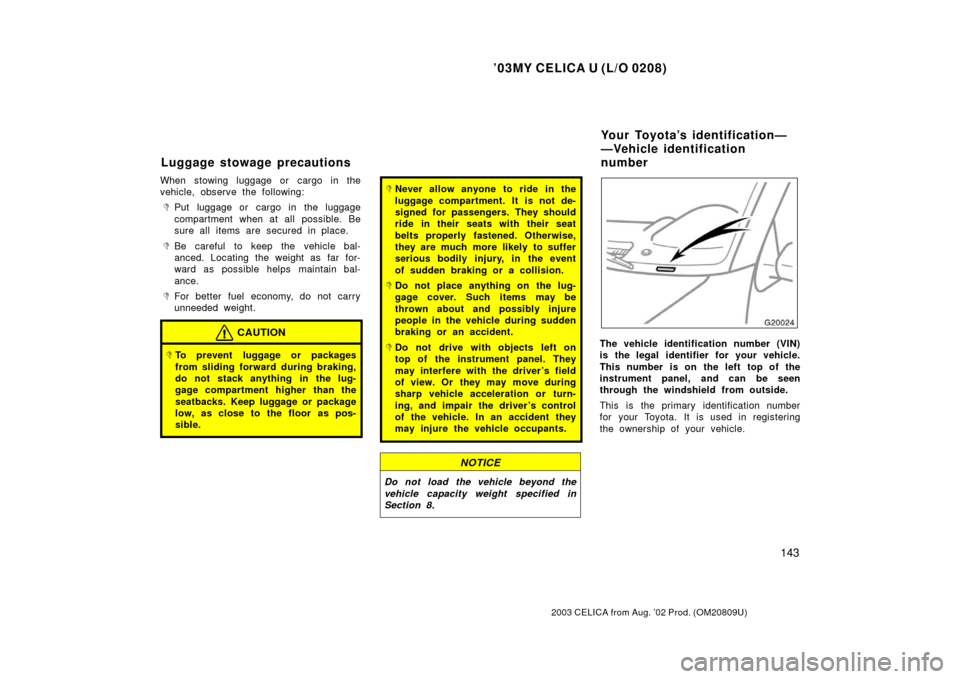
The vehicle identification number (VIN)
is the legal identifier for your vehicle.
This number is on the left top of the
instrument panel, and can be seen
through the windshield from outside.
This is the primary identification number
for your Toyota. It is used in registering
the ownership of your vehicle.
Luggage stowage precautions Your Toyota’s identification—
—Vehicle identification
number
Page 216 of 249
’03MY CELICA U (L/O 0208)
212
2003 CELICA from Aug. ’02 Prod. (OM20809U)
If you have tire damage such as cuts,
splits, cracks deep enough to expose
the fabric, or bulges indicating internal
damage, the tire should be replaced.
If a tire often goes flat or cannot be prop-
erly repaired due to the size or location
of a cut or other damage, it should be
replaced. If you are not sure, consult with
your Toyota dealer.
If an air loss occurs while driving, do not
continue driving with a deflated tire. Driv-
ing even a short distance can damage a
tire beyond repair.
Any tires which are over 6 years old
must be checked by a qualified techni-
cian even if damage is not obvious.
Tires deteriorate with age even if they
have never or seldom been used.
This also applies to the spare tire and
tires stored for future use.REPLACING YOUR TIRES
When replacing a tire, use only the
same size and construction as original-
ly installed and with the same or great-
er load capacity.
Using any other size or type of tire may
seriously affect handling, ride, speedome-
ter/odometer calibration, ground clearance,
and clearance between the body and tires
or snow chains.
CAUTION
Observe the following instructions.
Otherwise, an accident may occur re-
sulting in death or serious injuries.
�Do not mix radial, bias belted, or
biasply tires on your vehicle, as
this may cause dangerous handling
characteristics resulting in loss of
control.
�Do not use tires other than the
manufacturer ’s recommended size,
as this may cause dangerous han-
dling characteristics resulting in
loss of control.
Toyota recommends all four tires, or at
least both front or rear tires be re-
placed as a set.
See “If you have a flat tire” in Section 4
for tire change procedure.
When a tire is replaced, the wheel
should always be balanced.
An unbalanced wheel may affect vehicle
handling and tire life. Wheels can get out
of balance with regular use and should
therefore be balanced occasionally.
When replacing a tubeless tire, the air
valve should also be replaced with a
new one.
Page 218 of 249
’03MY CELICA U (L/O 0208)
214
2003 CELICA from Aug. ’02 Prod. (OM20809U)
WHEN TO USE SNOW TIRES OR
CHAINS
Snow tires or chains are recommended
when driving on snow or ice.
On wet or dry roads, conventional tires
provide better traction than snow tires.
SNOW TIRE SELECTION
If you need snow tires, select the same
size, construction and load capacity as
the original tires on your Toyota.
Do not use tires other than those men-
tioned above. Do not install studded tires
without first checking local regulations for
possible restrictions.
CAUTION
Do not use snow tires other than the
manufacturer ’s recommended size, as
this may cause dangerous handling
characteristics resulting in loss of
control. Otherwise, an accident may
occur resulting in death or serious
injuries.
SNOW TIRE INSTALLATION
Snow tires should be installed on all
wheels.
Installing snow tires on the front wheels
only can lead to an excessive difference
in road grip capability between the front
and rear tires which could cause loss of
vehicle control.
When storing removed tires, you should
store them in a cool dry place.
Mark the direction of rotation and be sure
to install them in the same direction when
replacing.
CAUTION
�Do not drive with the snow tires
incorrectly inflated.
�Never drive over 120 km/h (75 mph)
with any type of snow tires.
TIRE CHAIN SELECTION
Use the tire chains of correct size and
type.
Use SAE Class “S” type radial tire chains
except radial cable chains or Vbar type
chains.
Regulations regarding the use of tire
chains vary according to location or
type of road, so always check them
before installing chains.
CHAIN INSTALLATION
Install the chains on the front tires as
tightly as possible. Do not use tire
chains on the rear tires. Retighten
chains after driving 0.5—1.0 km
(1/4—1/2 mile).
When installing chains on your tires, care-
fully follow the instructions of the chain
manufacturer.
If wheel covers are used, they will be
scratched by the chain band, so remove
the covers before putting on the chains.
Installing snow tires and
chains