’03MY CELICA U (L/O 0208)
35
2003 CELICA from Aug. ’02 Prod. (OM20809U)
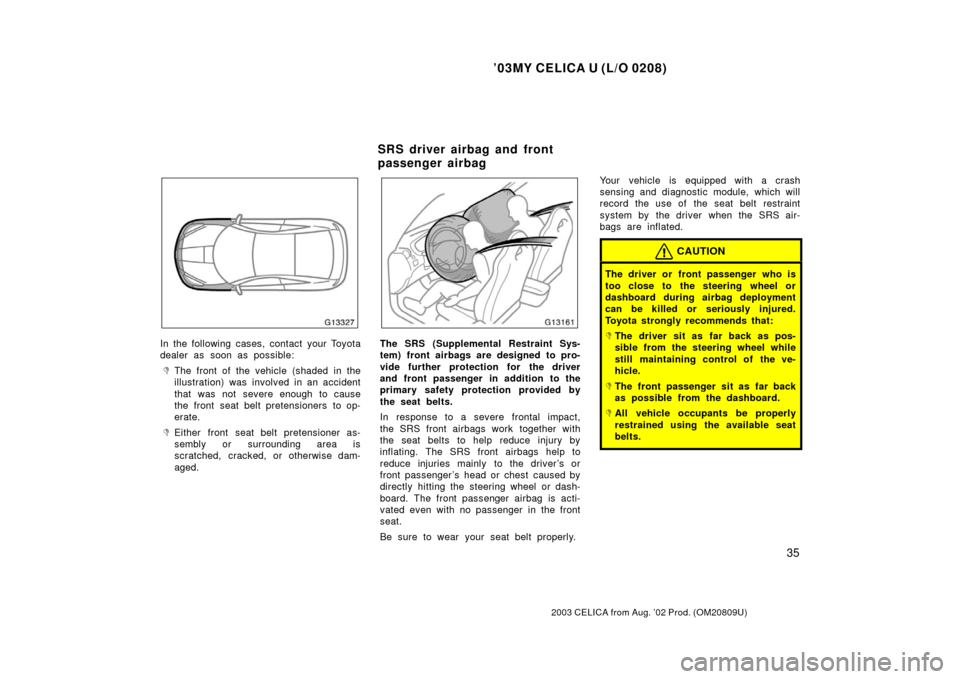
In the following cases, contact your Toyota
dealer as soon as possible:
�The front of the vehicle (shaded in the
illustration) was involved in an accident
that was not severe enough to cause
the front seat belt pretensioners to op-
erate.
�Either front seat belt pretensioner as-
sembly or surrounding area is
scratched, cracked, or otherwise dam-
aged.
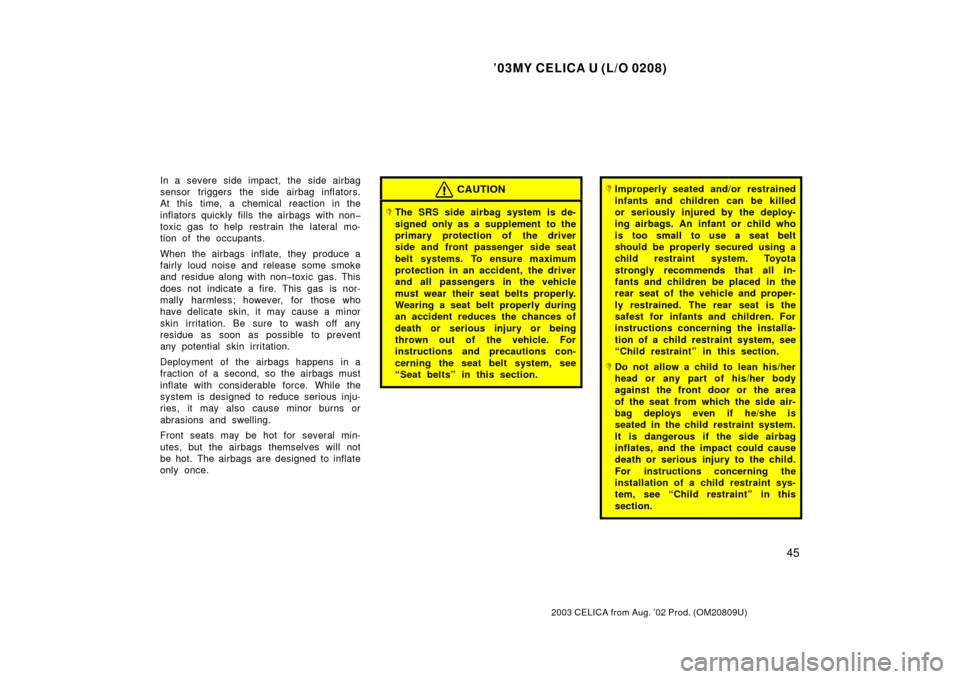
The SRS (Supplemental Restraint Sys-
tem) front airbags are designed to pro-
vide further protection for the driver
and front passenger in addition to the
primary safety protection provided by
the seat belts.
In response to a severe frontal impact,
the SRS front airbags work together with
the seat belts to help reduce injury by
inflating. The SRS front airbags help to
reduce injuries mainly to the driver ’s or
front passenger ’s head or chest caused by
directly hitting the steering wheel or dash-
board. The front passenger airbag is acti-
vated even with no passenger in the front
seat.
Be sure to wear your seat belt properly. Your vehicle is equipped with a crash
sensing and diagnostic module, which will
record the use of the seat belt restraint
system by the driver when the SRS air-
bags are inflated.
CAUTION
The driver or front passenger who is
too close to the steering wheel or
dashboard during airbag deployment
can be killed or seriously injured.
Toyota strongly recommends that:
�The driver sit as far back as pos-
sible from the steering wheel while
still maintaining control of the ve-
hicle.
�The front passenger sit as far back
as possible from the dashboard.
�All vehicle occupants be properly
restrained using the available seat
belts.
SRS driver airbag and front
passenger airbag
’03MY CELICA U (L/O 0208)
45
2003 CELICA from Aug. ’02 Prod. (OM20809U)
In a severe side impact, the side airbag
sensor triggers the side airbag inflators.
At this time, a chemical reaction in the
inflators quickly fills the airbags with non
toxic gas to help restrain the lateral mo-
tion of the occupants.
When the airbags inflate, they produce a
fairly loud noise and release some smoke
and residue along with nontoxic gas. This
does not indicate a fire. This gas is nor-
mally harmless; however, for those who
have delicate skin, it may cause a minor
skin irritation. Be sure to wash off any
residue as soon as possible to prevent
any potential skin irritation.
Deployment of the airbags happens in a
fraction of a second, so the airbags must
inflate with considerable force. While the
system is desi gned to reduce serious inju-
ries, it may also cause minor burns or
abrasions and swelling.
Front seats may be hot for several min-
utes, but the airbags themselves will not
be hot. The airbags are designed to inflate
only once.CAUTION
�The SRS side airbag system is de-
signed only as a supplement to the
primary protection of the driver
side and front passenger side seat
belt systems. To ensure maximum
protection in an accident, the driver
and all passengers in the vehicle
must wear their seat belts properly.
Wearing a seat belt properly during
an accident reduces the chances of
death or serious injury or being
thrown out of the vehicle. For
instructions and precautions con-
cerning the seat belt system, see
“Seat belts” in this section.
�Improperly seated and/or restrained
infants and children can be killed
or seriously injured by the deploy-
ing airbags. An infant or child who
is too small to use a seat belt
should be properly secured using a
child restraint system. Toyota
strongly recommends that all in-
fants and children be placed in the
rear seat of the vehicle and proper-
ly restrained. The rear seat is the
safest for infants and children. For
instructions concerning the installa-
tion of a child restraint system, see
“Child restraint” in this section.
�Do not allow a child to lean his/her
head or any part of his/her body
against the front door or the area
of the seat from which the side air-
bag deploys even if he/she is
seated in the child restraint system.
It is dangerous if the side airbag
inflates, and the impact could cause
death or serious injury to the child.
For instructions concerning the
installation of a child restraint sys-
tem, see “Child restraint” in this
section.