Page 181 of 249
’03MY CELICA U (L/O 0208)
177
2003 CELICA from Aug. ’02 Prod. (OM20809U)
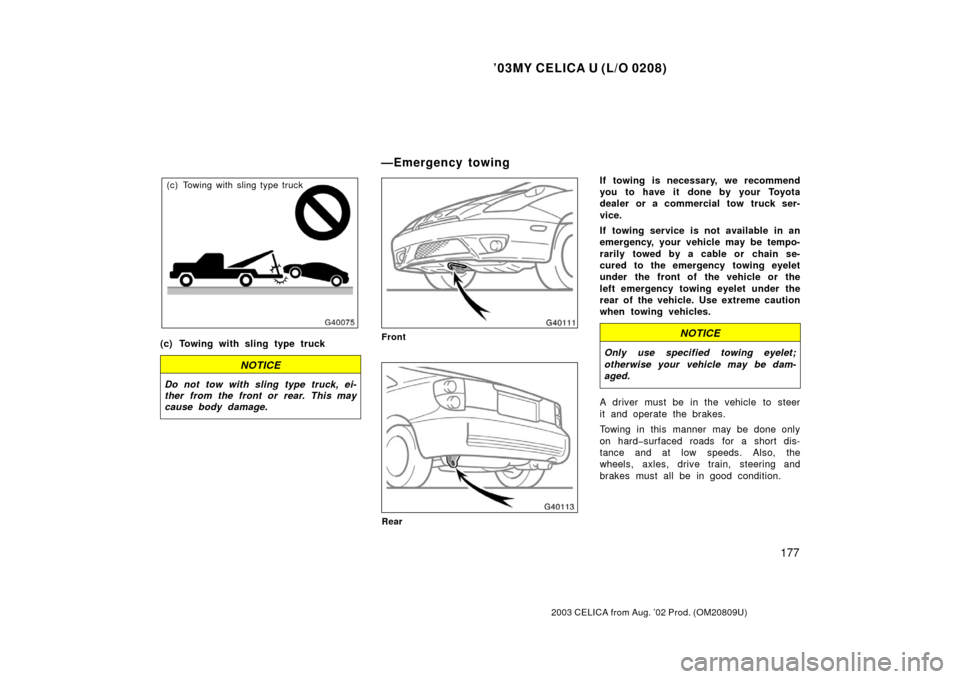
(c) Towing with sling type truck
(c) Towing with sling type truck
NOTICE
Do not tow with sling type truck, ei-
ther from the front or rear. This may
cause body damage.
Front
Rear
If towing is necessary, we recommend
you to have it done by your Toyota
dealer or a commercial tow truck ser-
vice.
If towing service is not available in an
emergency, your vehicle may be tempo-
rarily towed by a cable or chain se-
cured to the emergency towing eyelet
under the front of the vehicle or the
left emergency towing eyelet under the
rear of the vehicle. Use extreme caution
when towing vehicles.
NOTICE
Only use specified towing eyelet;
otherwise your vehicle may be dam-
aged.
A driver must be in the vehicle to steer
it and operate the brakes.
Towing in this manner may be done only
on hardsurfaced roads for a short dis-
tance and at low speeds. Also, the
wheels, axles, drive train, steering and
brakes must all be in good condition.
—Emergency towing
Page 182 of 249
’03MY CELICA U (L/O 0208)
178
2003 CELICA from Aug. ’02 Prod. (OM20809U)
CAUTION
Use extreme caution when towing ve-
hicles. Avoid sudden starts or erratic
driving maneuvers which would place
excessive stress on the emergency
towing eyelets and towing cable or
chain. The eyelets and towing cable
or chain may break and cause serious
injury or damage.
NOTICE
Use only a cable or chain specifically
intended for use in towing vehicles.
Securely fasten the cable or chain to
the towing eyelets provided.
Before towing, release the parking brake
and put the transmission in neutral (manu-
al) or “N” (automatic). The key must be
in “ACC” (engine off) or “ON” (engine run-
ning).
CAUTION
If the engine is not running, the pow-
er assist for the brakes and steering
will not work so steering and braking
will be much harder than usual.
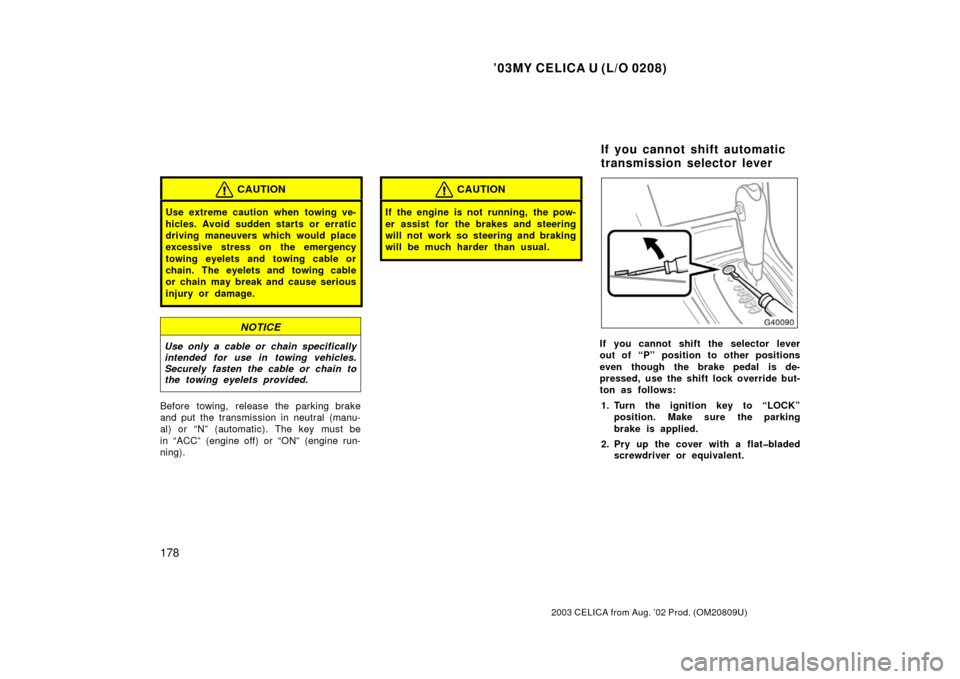
If you cannot shift the selector lever
out of “P” position to other positions
even though the brake pedal is de-
pressed, use the shift lock override but-
ton as follows:1. Turn the ignition key to “LOCK” position. Make sure the parking
brake is applied.
2. Pry up the cover with a flatbladed screwdriver or equivalent.
If you cannot shift automatic
transmission selector lever
Page 183 of 249
’03MY CELICA U (L/O 0208)
179
2003 CELICA from Aug. ’02 Prod. (OM20809U)
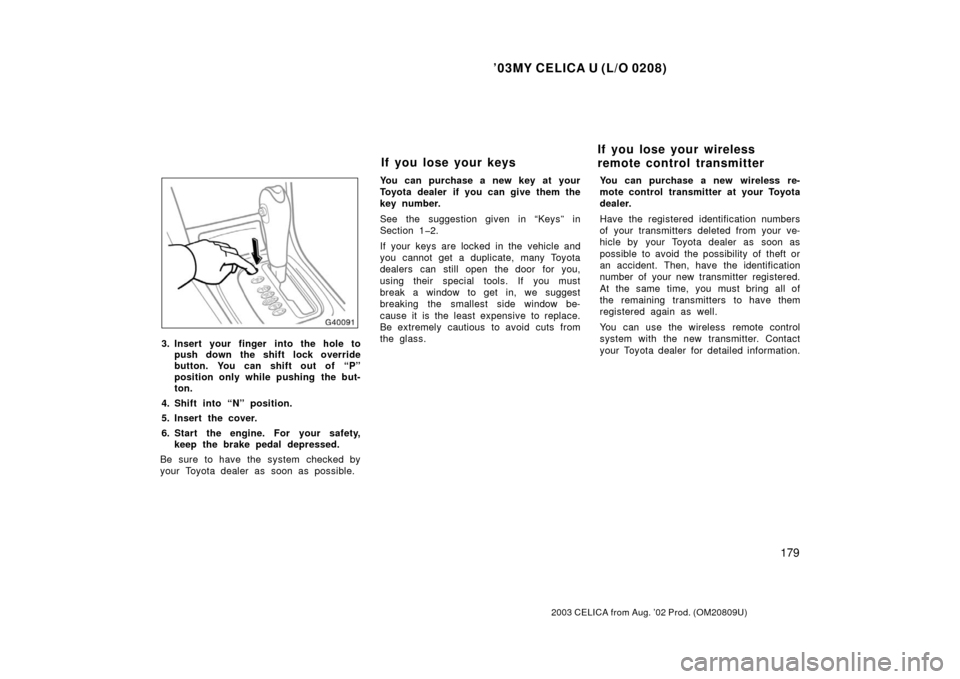
3. Insert your finger into the hole topush down the shift lock override
button. You can shift out of “P”
position only while pushing the but-
ton.
4. Shift into “N” position.
5. Insert the cover.
6. Start the engine. For your safety, keep the brake pedal depressed.
Be sure to have the system checked by
your Toyota dealer as soon as possible. You can purchase a new key at your
Toyota dealer if you can give them the
key number.
See the suggestion given in “Keys” in
Section 12.
If your keys are locked in the vehicle and
you cannot get a duplicate, many Toyota
dealers can still open the door for you,
using their special tools. If you must
break a window to get in, we suggest
breaking the smallest side window be-
cause it is the least expensive to replace.
Be extremely cautious to avoid cuts from
the glass.
You can purchase a new wireless re-
mote control transmitter at your Toyota
dealer.
Have the registered identification numbers
of your transmitters deleted from your ve-
hicle by your Toyota dealer as soon as
possible to avoid the possibility of theft or
an accident. Then, have the identification
number of your new transmitter registered.
At the same time, you must bring all of
the remaining transmitters to have them
registered again as well.
You can use the wireless remote control
system with the new transmitter. Contact
your Toyota dealer for detailed information.
If you lose your keys
If you lose your wireless
remote control transmitter
Page 196 of 249

’03MY CELICA U (L/O 0208)
192
2003 CELICA from Aug. ’02 Prod. (OM20809U)
INSIDE THE VEHICLE
Items listed below should be checked
regularly, e.g. while performing periodic
services, cleaning the vehicle, etc.
Lights
Make sure the headlights, stop lights, tail
lights, turn signal lights, and other lights
are all working.
Service reminder indicators and warning
buzzers
Check that all service reminder indicators
and warning buzzers function properly.
Steering wheel
Be alert for changes in steering condition,
such as hard steering or strange noise.
Seats
Check that all front seat controls such as
seat adjusters, seatback recliner, etc. op-
erate smoothly and that all latches lock
securely in any position. For foldingdown
rear seatbacks, check that the latches
lock securely.
Seat belts
Check that the seat belt system such as
buckles, retractors and anchors operate
properly and smoothly. Make sure the belt
webbing is not cut, frayed, worn or dam-
aged.Accelerator pedal
Check the pedal for smooth operation and
uneven pedal effort or catching.
Clutch pedal
Check the pedal for smooth operation.
Brake pedal
Check the pedal for smooth operation and
that the pedal has the proper clearance.
Check the brake booster function.
Brakes
At a safe place, check that the brakes do
not pull to one side when applied.
Parking brake
Check that the lever has the proper travel
and that, on a safe incline, your vehicle
is held securely with only the parking
brake applied.
Automatic transmission “Park” mecha-
nism
Check the lock release button of the se-
lector lever for proper and smooth opera-
tion. On a safe incline, check that your
vehicle is held securely with the selector
lever in “P” position and all brakes re-
leased.
IN THE ENGINE COMPARTMENT
Items listed below should be checked
from time to time, e.g. each time when
refueling.
Washer fluid
Make sure there is sufficient fluid in the
tank. See Section 73 for additional infor-
mation.
Engine coolant level
Make sure the coolant level is between
the “FULL” and “LOW” lines on the see
through reservoir when the engine is cold.
See Section 72 for additional information.
Radiator, condenser and hoses
Check that the front of the radiator and
condenser are clean and not blocked with
leaves, dirt, or insects. See in Section
72 for additional information.
Battery condition
Check the battery condition by the indica-
tor color. See Section 73 for additional
information.
Brake fluid level
Make sure the brake fluid level is correct.
See Section 72 for additional information.
Page 197 of 249
’03MY CELICA U (L/O 0208)
193
2003 CELICA from Aug. ’02 Prod. (OM20809U)
Engine oil level
Check the level on the dipstick with the
engine turned off and the vehicle parked
on a level spot. See Section 72 for addi-
tional information.
Power steering fluid level
Check the level through the reservoir. The
level should be in the “HOT” or “COLD”
range depending on the fluid temperature.
See Section 72 for additional information.
Exhaust system
If you notice any change in the sound of
the exhaust or smell exhaust fumes, have
the cause located and corrected immedi-
ately. (See “Engine exhaust cautions” in
Section 2.)Be on the alert for changes in perfor-
mance, sounds, and visual tipoffs that
indicate service is needed. Some impor-
tant clues are as follows:
�Engine missing, stumbling, or pinging
�Appreciable loss of power
�Strange engine noises
�A leak under the vehicle (however, wa-
ter dripping from the air conditioning
after use is normal.)
�Change in exhaust sound (This may
indicate a dangerous carbon monoxide
leak. Drive with the windows open and
have the exhaust system checked im-
mediately.)
�Flatlooking tire; excessive tire squeal
when cornering; uneven tire wear
�Vehicle pulls to one side when driving
straight on a level road
�Strange noises related to suspension
movement
�Loss of brake effectiveness; spongy
feeling brake or clutch pedal; pedal al-
most touches floor; vehicle pulls to one
side when braking
�Engine coolant temperature continually
higher than normalIf you notice any of these clues, take your
vehicle to your Toyota dealer as soon as
possible. It probably needs adjustment or
repair.
CAUTION
Do not continue driving with the ve-
hicle unchecked. It could result in se-
rious vehicle damage and possibly
personal injury.
Does your vehicle need
repairing?
Page 200 of 249
’03MY CELICA U (L/O 0208)
196
2003 CELICA from Aug. ’02 Prod. (OM20809U)
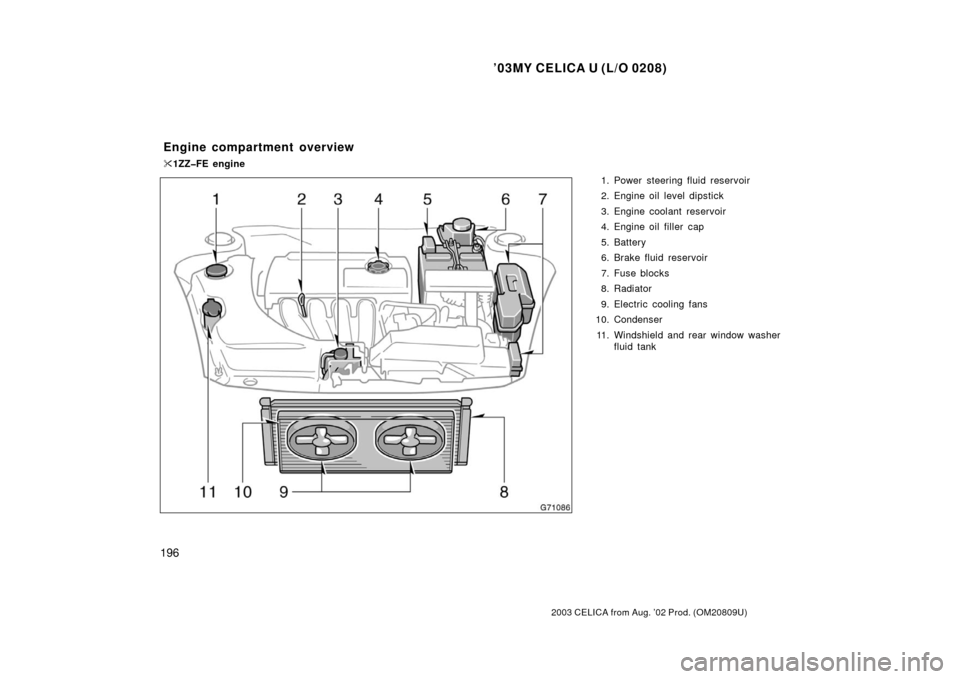
1. Power steering fluid reservoir
2. Engine oil level dipstick
3. Engine coolant reservoir
4. Engine oil filler cap
5. Battery
6. Brake fluid reservoir
7. Fuse blocks
8. Radiator
9. Electric cooling fans
10. Condenser
11. Windshield and rear window washer fluid tank
Engine compartment overview
�1ZZFE engine
Page 201 of 249
’03MY CELICA U (L/O 0208)
197
2003 CELICA from Aug. ’02 Prod. (OM20809U)
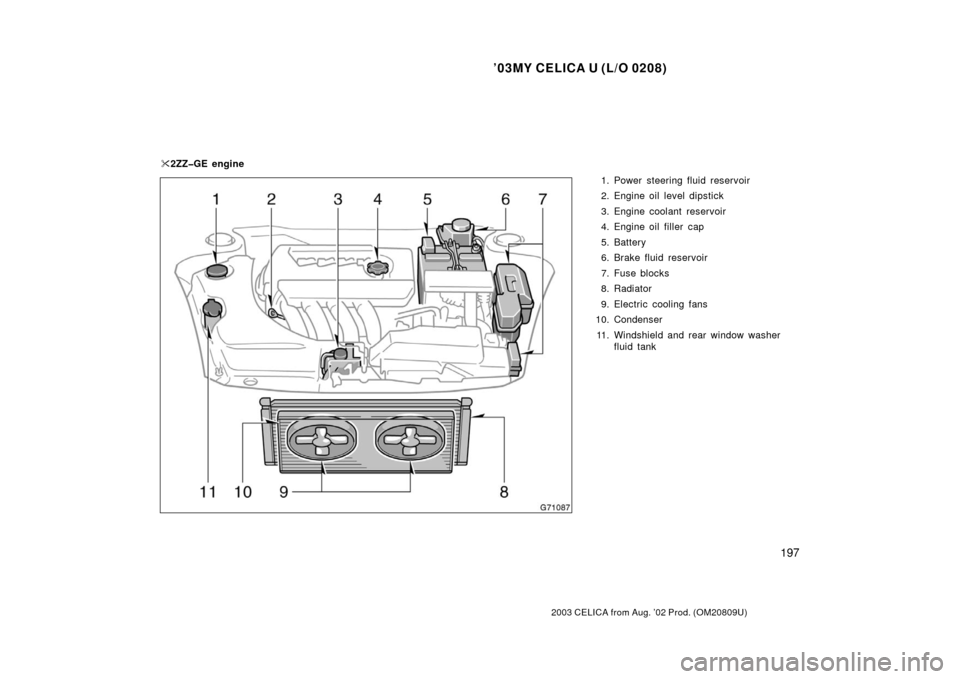
1. Power steering fluid reservoir
2. Engine oil level dipstick
3. Engine coolant reservoir
4. Engine oil filler cap
5. Battery
6. Brake fluid reservoir
7. Fuse blocks
8. Radiator
9. Electric cooling fans
10. Condenser
11. Windshield and rear window washer fluid tank
�
2ZZGE engine
Page 205 of 249
’03MY CELICA U (L/O 0208)
201
2003 CELICA from Aug. ’02 Prod. (OM20809U)
When jacking up your vehicle with the
jack, position the jack correctly as
shown in the illustrations.
CAUTION
When jacking, be sure to observe the
following to reduce the possibility of
personal injury:
�Follow jacking instructions.
�Do not put any part of your body
under the vehicle supported by the
jack. Personal injury may occur.
�Do not start or run the engine while
your vehicle is supported by the
jack.
�Stop the vehicle on a level firm
ground, firmly set the parking brake
and put the transmission in “P”
(automatic) or reverse (manual).
Block the wheels on the opposite
side of the jack up point if neces-
sary.
�Make sure to set the jack properly
in the jack point. Raising the ve-
hicle with jack improperly posi-
tioned will damage the vehicle or
may allow the vehicle to fall off the
jack and cause personal injury.
�Never get under the vehicle when
the vehicle is supported by the jack
alone.
�Do not raise the vehicle with some-
one in the vehicle.
�When raising the vehicle, do not
place any objects on top of or un-
derneath the jack.
NOTICE
Make sure to place the jack correctly,
or your vehicle may be damaged.
Here is a list of parts and tools you will
need on performing doityourself mainte-
nance. Remember all Toyota parts are de-
signed in metric sizes, so your tools must
be metric.
CHECKING THE ENGINE OIL LEVEL
Parts (if level is low):
�“Toyota Genuine Motor Oil” or equiva-
lent
See Section 72 for details about en-
gine oil selection.
Tools:
�Rag or paper towel
�Funnel (only for adding oil)
CHECKING THE ENGINE COOLANT
LEVEL
Parts (if level is low):
�“Toyota Genuine Long Life Coolant” or
equivalent
See Section 72 for details about cool-
ant type selection.
�Demineralized or distilled water
Tools:
�Funnel (only for adding coolant)
Parts and tools