Page 204 of 249
’03MY CELICA U (L/O 0208)
200
2003 CELICA from Aug. ’02 Prod. (OM20809U)
�Be extremely cautious when work-
ing on the battery. It contains poi-
sonous and corrosive sulfuric acid.
�Warning: Battery posts, terminals
and related accessories contain lead
and lead compounds, chemicals
known to the State of California to
cause cancer and reproductive
harm. Wash hands after handling.
NOTICE
�Remember that battery and ignition
cables carry high currents or volt-
ages. Be careful of accidentally
causing a short circuit.
� Add only demineralized or distilled
water to fill the radiator. And if you
spill some of the coolant, be sure
to wash it off with water to prevent
it from damaging the parts or paint.
� Do not allow dirt or anything else
to fall through the spark plug holes.
� Do not pry the outer electrode of a
spark plug against the center elec-
trode.
�Use only spark plugs of the speci-
fied type. Using other types will
cause engine damage, loss of per-
formance or radio noise.
� Do not reuse iridiumtipped spark
plugs by cleaning or regapping.
� Do not overfill automatic transmis-
sion fluid, or the transmission
could be damaged.
� Do not drive with the air cleaner
filter removed, or excessive engine
wear could result. Also backfiring
could cause a fire in the engine
compartment.
� Be careful not to scratch the glass
surface with the wiper frame.
� When closing the engine hood,
check to see that you have not for-
gotten any tools, rags, etc.
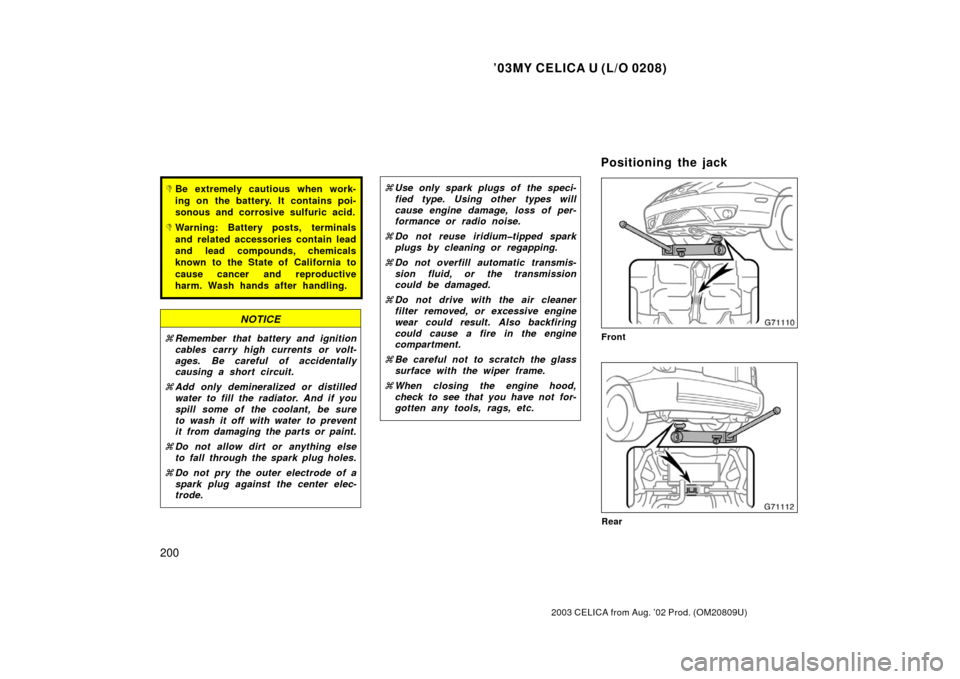
Front
Rear
Positioning the jack
Page 224 of 249
’03MY CELICA U (L/O 0208)
220
2003 CELICA from Aug. ’02 Prod. (OM20809U)
GoodBlown
Ty p e A
Good Blown
Ty p e B
Good Blown
Ty p e C
Good Blown
Ty p e D
If the headlights or other electrical
components do not work, check the
fuses. If any of the fuses are blown,
they must be replaced.
See “Fuse locations” in Section 71 for
locations of the fuses.
Turn the ignition switch and inoperative
component off. Pull a suspected fuse
straight out and check it.
Determine which fuse may be causing the
problem. The lid of the fuse box shows
the name of the circuit for each fuse. See
Section 8 of this manual for the functions
controlled by each circuit.
Checking and replacing fuses
Page 226 of 249
’03MY CELICA U (L/O 0208)
222
2003 CELICA from Aug. ’02 Prod. (OM20809U)
NOTICE
Do not use engine antifreeze or any
other substitute because it may dam-
age your vehicle’s paint.
The following illustrations show how to
gain access to the bulbs. When replacing
a bulb, make sure the ignition switch and
light switch are off. Use bulbs with the
wattage ratings given in the table.
CAUTION
�To prevent burning yourself, do not
replace the light bulbs while they
are hot.
�Vehicles with discharge headlights—
Do not disassemble, repair or take
apart the headlight bulbs, connec-
tor, power supply circuits and ro-
tated components. Or you may be
injured by electric shocks. Call your
dealer when the headlights fail to
work or have to be replaced or dis-
posed of.
�Halogen bulbs have pressurized gas
inside and require special handling.
They can burst or shatter if
scratched or dropped. Hold a bulb
only by its plastic or metal case.
Do not touch the glass part of a
bulb with bare hands.
The inside of the lens of exterior lights
such as headlights may temporarily fog up
when the lens becomes wet in the rain or
in a car wash. This is not a problem
because the fogging is caused by the
temperature difference between the outside
and inside of the lens, just like the
windshield fogged up in the rain. However,
if there is a large drop of water on the
inside of the lens, or if there is water
pooled inside the light, contact your
Toyota dealer.
NOTICE
Only use a bulb of the listed type.
Replacing light bulbs—
