2003 SUBARU IMPREZA brake
[x] Cancel search: brakePage 264 of 425

Driving tips
8-11
– CONTINUED –
cold weather. Heavy summer oil will cause harder
starting.
Keep the door locks from freezing by squirting themwith deicer or glycerin.
Forcing a frozen door open may damage or sepa-
rate the rubber weather strips around the door. If the
door is frozen, use hot water to melt the ice, and af-
terwards thoroughly wipe the water away. Use a windshield washer fluid that contains an anti-
freeze solution. Do not use engine antifreeze or oth-
er substitutes because they may damage the paint of the vehicle.
Before driving your vehicle
Before entering the vehicle, remove any snow or ice
from your shoes because that could make the ped-
als slippery and dangerous.
While warming up the vehicle before driving, check that the accelerator pedal, brake pedal, and all oth-
er controls operate smoothly. Clear away ice and snow that has accumulated un-
der the fenders to avoid making steering difficult.
During severe winter driving, stop when and where it is safe to do so and check under the fenders peri-
odically.
Parking in cold weather
Do not use the parking brake when parking for long
periods in cold weather since it could freeze in that
position. Instead, observe the following:
1. Place the shift lever in “1” or “R” for manual trans-
mission vehicles, and in “P” for automatic transmis-
sion vehicles.
2. Use tire stops under the tires to prevent the ve-
hicle from moving.
When the vehicle is parked in snow or when it
snows, raise the wiper blades off the glass to pre-vent damage to them.
When the vehicle has been left parked after use on
roads heavily covered with snow, or has been left
parked during a snowstorm, icing may develop onthe brake system, which could cause poor braking
action. Check for snow or ice buildup on the sus-
pension, disc brakes and brake hoses underneath the vehicle.
If there is caked snow or ice, remove it, being care-ful not to damage the disc brakes and brake hoses
and ABS harness.
Page 265 of 425

Driving tips
8-12
WARNING
Snow can trap dangerous exhaust gases under your vehicle. Keep snow clear of the
exhaust pipe and from around your vehicle ifyou park the vehicle in snow with the engine running.
Refueling in cold weather
To help prevent moisture from forming in the fuel
system and the risk of its freezing, use of an anti-
freeze additive in the fuel tank is recommended dur-
ing cold weather.
Use only additives that are specifically designed for
this purpose. When an antifreeze additive is used,
its effect lasts longer if the tank is refilled whenever
the fuel level reaches half empty. If your SUBARU is not going to be used for an ex-
tended period, it is best to have the fuel tank filled to
capacity. Driving on snowy and icy roads
To prevent skidding and slipping, avoid sudden braking, abrupt acceleration, high-speed driving,
and sharp turning when driving on snowy or icy roads.
Always maintain ample distance between your ve-
hicle and the vehicle ahead of you to avoid the needfor sudden braking.
To supplement the foot brake, use the engine brake
effectively to control the vehicle speed. (Shift into a
lower gear when necessary.)
Avoid shifting down abruptly. Such behavior cancause the wheels to lock, possibly leading to loss of
vehicle control.
An anti-lock brake system (ABS) e
nhances your
vehicle’ s braking performance on snowy and icy
roads. Refer to the “ABS (Anti-Lock Brake System) ”
section in chapter 7 for information on braking on
slippery surfaces. NOTE The optional 17-inch tires for the WRX are sum- mer tires. Compared with winter and all-season tires, summer tires give significantly less grip on
snowy and icy road surfaces. Avoid driving onsnowy and icy road surface with summer tires.
Page 276 of 425
Driving tips
8-23
– CONTINUED –
the four T-30 crossbar clamp screws have been
checked, and retightened if necessary to 35 inch
lbs. (4.0 N-m, 0.41 kg-m), as outlined in Step #5above. Trailer hitch (if equipped) The trailer hitch is designed to tow a Class 1 rated
load. A maximum of
2,000 lbs. (906 kg) gross trailer
weight and a maximum of 200 lbs. (90 kg) gross
tongue weight are permissible for the trailer hitch.
When you tow a trailer, follow the instructions in the next section “Trailer towing ”.
WARNING
Never exceed the maximum weight specified
for the trailer hitch. Exceeding the maximum weight could cause an accident resulting inserious personal injuries. Permissible trailerweight changes depending on the situation.Refer to the next section “Trailer towing ” for
possible recommendations and limitations. Trailer brakes are required when the towing
load exceeds 1,000 lbs. (453 kg). Be sure yourtrailer has safety chains and that each chainwill hold the trailer ’s maximum gross weight.
Towing trailers without safety chains could create a traffic safety hazard if the trailer sepa- rates from the hitch due to coupling damageor hitch ball damage. Be sure to check the hitch pin and safety pin
Page 279 of 425

Driving tips
8-26
Hitch harness connector – Wagon
8. Connect the hitch wire harness ’s black four –pin
wire connector to the towing trailer ’s wire harness
9. Confirm proper function of the hitch wire harness
by individually activating the brake, right turn signal,
left turn signal, stop, and parking lights on the trailer. NOTE Always disconnect the trailer wire harness be- fore launching or retrieving a watercraft. When you do not tow a trailer
Remove the ball mount from the hitch receiver
tube and insert the receiver cover onto the hitch re- ceiver tube.
Place the dust cap over the four –pin connector of
the hitch wire harness to protect against possibledamage. Occasionally lubricate terminals of the four –pin
connector using terminal grease.
Page 280 of 425
Driving tips
8-27
– CONTINUED –
Trailer towing
Your car is designed and intended to be used pri-
marily as a passenger-carrying vehicle. Towing a
trailer puts additional loads on your car ’s engine, dri-
vetrain, brakes, tires and suspension and has an
adverse effect on fuel economy.
If you do decide to tow a trailer, your safety and sat-
isfaction depend upon proper use of correct equip-
ment and cautious operation of your vehicle. Seekthe advice of your SUBARU dealer to assist you in
purchasing a hitch and other necessary towing
equipment appropriate for your vehicle. In addition,
be sure to follow the instructions on correct installa-
tion and use provided by the trailer and other towing
equipment manufacturers.
SUBARU assumes no responsibility for injuries or
vehicle damage that result from trailer towing equip-
ment, or from any errors or omissions in the instruc- tions accompanying such equipment or for your fail-
ure to follow the proper instructions. Warranties and maintenance
SUBARU warranties do not apply to vehicle damage or malfunction caused by trailer towing. If you use
your vehicle to tow a trailer, more frequent mainte-
nance will be required due to the additional load. (Refer to
“Maintenance schedule under severe driv-
ing conditions ” in the “Warranty and Maintenance
Booklet”.)
Under no circumstances should a trailer be towedwith a new vehicle or a vehicle with any new power-
train component (engine, transmission, differential, wheel bearings, etc.) for the first 1,000 miles (1,600 km) of driving. Maximum load limits
WARNING
Never exceed the maximum load limits ex-
plained below. Exceeding the maximum loadlimits could cause personal injury and/or ve-hicle damage.
CAUTION
Adequate size trailer brakes are required
when the trailer and its cargo exceed 1,000 lbs (453 kg) total weight. Before towing a trailer, check the trailer total
weight, GVW, GAWs and tongue load. Make sure the load and its distribution in your
vehicle and trailer are acceptable.
Page 281 of 425

Driving tips
8-28
Total trailer weight
Total trailer weight
The total trailer weight (trailer weight plus its cargo load) must never exceed the maximum weight
shown below. Model
ConditionsMaximum
total trailer
weight
MT modelsWhen towing a trailer with- out brakes.1,000 lbs(453 kg)
When towing a trailer with brakes.2,000 lbs(906 kg)
AT modelsWhen towing a trailer with- out brakes.1,000 lbs (453 kg)
When towing a trailer with brakes.2,000 lbs(906 kg)
When towing a trailer on a long uphill grade continu- ously for over 5 miles (8km) with an outside tem-perature of 104 °F (40 °C) or
above.1,000 lbs (453 kg)
Page 286 of 425

Driving tips
8-33
– CONTINUED –
CAUTION
Do not modify the vehicle exhaust system,
brake system, or other systems when instal- ling a hitch or other trailer towing equipment. Do not use axle-mounted hitches as they
can cause damage to the axle housing, wheelbearings, wheels or tires.
WAGON including OUTBACK SPORT
The use of a genuine SUBARU trailer hitch is recom-
mended. A genuine SUBARU hitch is available from
your SUBARU dealer.
If use of a non-genuine hitch is unavoidable, be sure
the hitch is suited to your vehicle and trailer. Consult
with a professional hitch supplier to assist you in
choosing an appropriate hitch for your vehicle. Be
sure to follow all of the hitch manufacturer ’s instruc-
tions for installation and use.
Never use a hitch that mounts only to the rear bum-
per. The bumper is not designed to handle that typeof load.
For all types of hitches, regularly check that the
hitch mounting bolts and nuts are tight.
SEDAN
SUBARU does not offer accessory trailer hitches. Consult with a professional hitch supplier to assist
you in choosing an appropriate hitch for your ve-
hicle. Be sure to follow all of the hitch manufacturer
’s
instructions for installation and use.
Never use a hitch that mounts only to the rear bum-
per. The bumper is not designed to handle that type of load. Regularly check that the hitch mounting bolts and
nuts are tight.
Connecting a trailer
Trailer brakes
If your trailer ’s total weight (trailer weight plus its
cargo weight) exceeds 1,000 lbs (453 kg), the trailer
is required to be equipped with its own brake sys-
tem. Electric brakes or surge brakes are recom-
mended, and must be installed properly. Check thatyour trailer ’s brakes conform with Federal, state/
province and/or other applicable regulations. Your
SUBARU’ s brake system is not designed to be
tapped into the trailer ’s hydraulic brake system.
Please ask your SUBARU dealer and professional
trailer supplier for more information about the trail-er’ s brake system.
Page 287 of 425
Driving tips
8-34
WARNING
Adequate size trailer brakes are required
when the trailer and its cargo exceed 1,000 lbs (453 kg) total weight. Do not directly connect your trailer ’s
hydraulic brake system to the hydraulic brake
system in your vehicle. Direct connectionwould cause the vehicle ’s brake performance
to deteriorate and could lead to an accident.
Trailer safety chains
In case the trailer hitch connector or hitch ball
should break or become disconnected, the trailer
could get loose and create a traffic safety hazard.
For safety, always connect the towing vehicle and
trailer with trailer safety chains. Pass the chains
crossing each other under the trailer tongue to pre-
vent the trailer from dropping onto the ground in
case the trailer tongue should disconnect from the
hitch ball. Allow sufficient slack in the chains taking
tight-turn situations into account; however, be care-
ful not to let them drag on the ground.
For more information about the safety chain connec-
tion, refer to the instructions for your hitch and trailer.
WARNING
Always use safety chains between your ve-
hicle and the trailer. Towing a trailer withoutsafety chains could create a traffic safety haz-ard if the trailer separates from the hitch due to coupling damage or hitch ball damage.
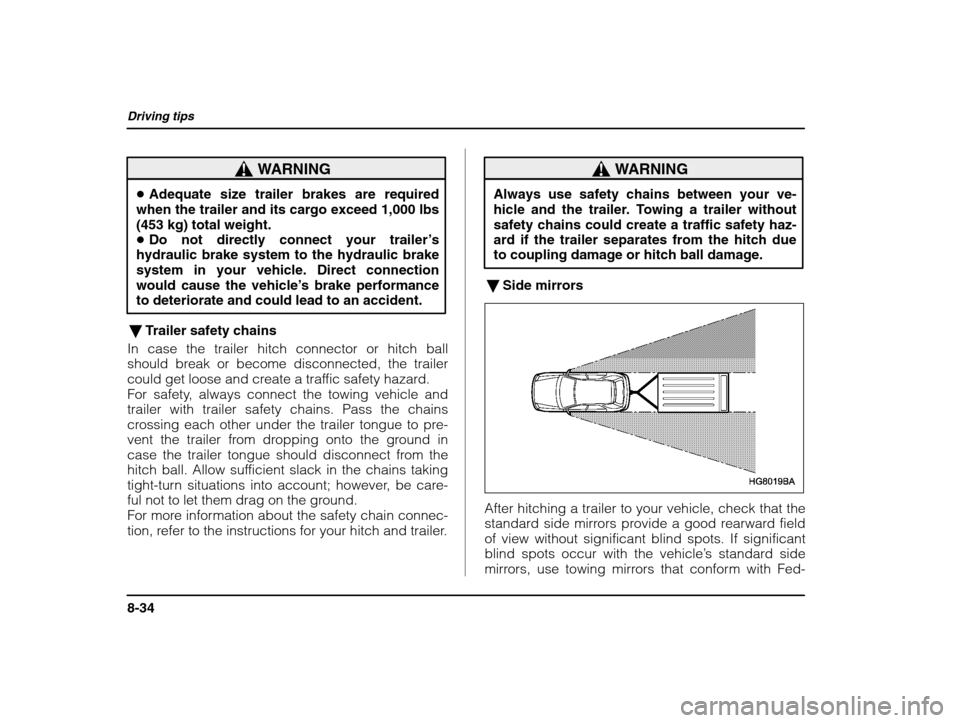
Side mirrors
After hitching a trailer to your vehicle, check that the
standard side mirrors provide a good rearward field of view without significant blind spots. If significant blind spots occur with the vehicle ’s standard side
mirrors, use towing mirrors that conform with Fed-