2003 SUBARU FORESTER air condition
[x] Cancel search: air conditionPage 329 of 420

10-4
Appearance care
Corrosion protection
Your SUBARU has been designed and built to resist
corrosion. Special material
s and protective finishes
have been used on most parts of the vehicle to help
maintain fine appearance, strength, and reliable oper-
ation. Most common causes of corrosion
The most common causes of corrosion are:
1. The accumulation of moisture retaining dirt and de-
bris in body panel sections, cavities, and other areas.
2. Damage to paint and other protective coatings
caused by gravel and stone chips or minor accidents.
Corrosion is accelerated on the vehicle when:
1. It is exposed to road salt or dust control chemicals,
or used in coastal areas where there is more salt in the
air, or in areas where there is considerable industrial
pollution.
2. It is driven in areas of high humidity, especially
when temperatures range just above freezing.
3. Dampness in certain parts of the vehicle remains
for a long time, even though other parts of the vehicle
may be dry.
4. High temperatures will cause corrosion to parts of
the vehicle which cannot dry quickly due to lack of proper ventilation.
To help prevent corrosion
Wash the vehicle frequently. If you drive on salted
roads in the winter or if you live in a coastal area, you
should flush the underbody with fresh water frequent- ly.
After the winter has ended, it is recommended that the
underbody be given a very thorough washing.
Before the beginning of winter, check the condition of
underbody components, such as the exhaust system,
fuel and brake lines, brake cables, suspension, steer-
ing system, floor pan, and fenders. If any of them are
found to be rusted, they should be given an appropri-
ate rust prevention treatment or should be replaced.
Contact your SUBARU dealer to perform this kind of
maintenance and treatment if you need assistance.
Repair chips and scratches in the paint as soon as you
find them.
Check the interior of the vehicle for water and dirt ac-
cumulation under the floor mats because that could
cause corrosion. Occasionally check under the mats
to make sure the area is dry.
Keep your garage dry. Do not park your vehicle in a
Page 332 of 420

11 - 1
11
Maintenance and service
Maintenance schedule ................................ 11-3
Maintenance precautions ........................... 11-3 Before checking or servicing in the engine
compartment ................................................... 11-4
When you do checking or servicing in the
engine compartment while the engine is
running ............................................................. 11-5
Engine hood ................................................. 11-5
Engine compartment overview .................. 11-8
Engine oil ..................................................... 11-9 Checking the oil level ..................................... 11-9
Changing the oil and oil filter ........................ 11-10
Recommended grade and viscosity .............. 11-12
Recommended grade and viscosity under
severe driving conditions .............................. 11-14
Synthetic oil ..................................................... 11-14
Cooling system ............................................ 11-14 Cooling fan, hose and connections .............. 11-15
Engine coolant ................................................ 11-15
Air cleaner element ..................................... 11-19 Replacing the air cleaner element ................. 11-19
Spark plugs .................................................. 11-20 Recommended spark plugs ........................... 11-21
Drive belts .................................................... 11-21
Manual transmission oil .............................. 11-22 Checking the oil level ..................................... 11-22
Recommended grade and viscosity .............. 11-23
Automatic transmission fluid ..................... 11-24 Checking the fluid level .................................. 11-24 Recommended fluid ....................................... 11-25
Front differential gear oil (AT vehicles) ..... 11-26 Checking the oil level ..................................... 11-26
Recommended grade and viscosity ............. 11-26
Rear differential gear oil .............................. 11-27 Checking the gear oil level ............................ 11-27
Recommended grade and viscosity ............. 11-28
Power steering fluid ..................................... 11-29 Checking the fluid level .................................. 11-29
Recommended fluid ....................................... 11-30
Brake fluid .................................................... 11-30 Checking the fluid level .................................. 11-30
Recommended brake fluid ............................. 11-31
Clutch fluid (MT vehicles) ........................... 11-31 Checking the fluid level .................................. 11-31
Recommended clutch fluid ............................ 11-32
Brake booster ............................................... 11-32
Brake pedal ................................................... 11-33 Checking the brake pedal free play .............. 11-33
Checking the brake pedal reserve distance . 11-33
Clutch pedal (MT vehicles) .......................... 11-34 Checking the clutch function ........................ 11-34
Checking the clutch pedal free play ............. 11-34
Hill holder (MT vehicles — if equipped) ..... 11-35
Replacement of brake pad and lining ........ 11-35 Breaking-in of new brake pads and linings .. 11-36
Parking brake stroke ................................... 11-37
Tires and wheels .......................................... 11-37 Types of tires .................................................. 11-37
Page 350 of 420
11 -1 9
Maintenance and service
–CONTINUED –
Air cleaner element
The air cleaner element functions as a filter screen.
When the element is perforated or removed, engine
wear will be excessive and engine life shortened.
The air cleaner element is a viscous type. It is unnec-
essary to clean or wash the element.
Do not operate the engine with the air cleaner
element removed. The air cleaner element not
only filters intake air but also stops flames if the
engine backfires. If the air cleaner element is
not installed when the engine backfires, you
could be burned.
Replacing the air cleaner element
Replace the air cleaner element according to the
maintenance schedule in the “Warranty and Mainte-
nance Booklet”. Under extremely dusty conditions, re-
place it more frequently. It is recommended that you
always use genuine SUBARU parts.
0
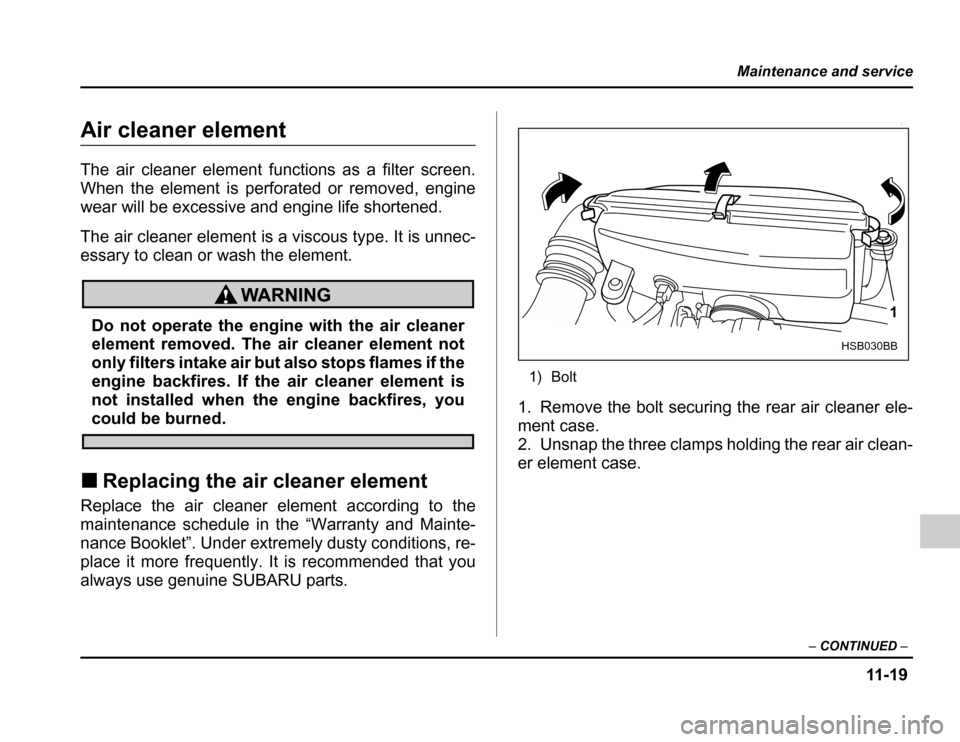
1) Bolt
1. Remove the bolt securing the rear air cleaner ele-
ment case.
2. Unsnap the three clamps holding the rear air clean-
er element case.
1
HSB030BB
Page 352 of 420
11 -2 1
Maintenance and service
–CONTINUED –
bles. Make sure the cables are replaced in the cor-
rect order.
Recommended spark plugs
RC10YC4 (Champion)
BKR6E-11 (NGK)
BKR5E-11 (NGK)
Drive belts
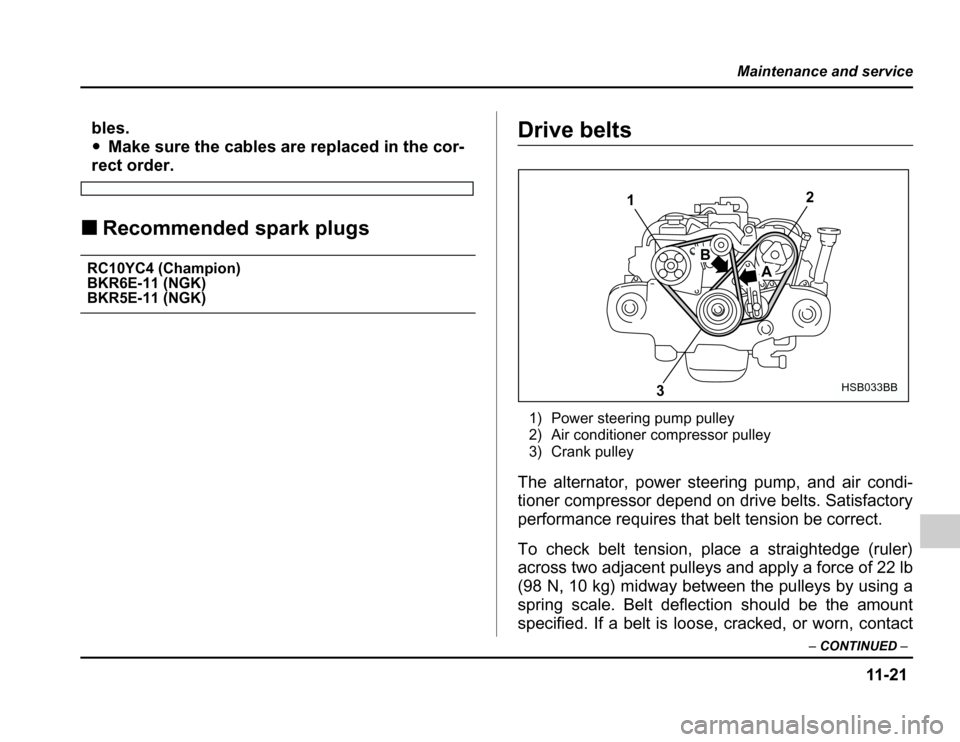
1) Power steering pump pulley
2) Air conditioner compressor pulley
3) Crank pulley
The alternator, power steering pump, and air condi-
tioner compressor depend on drive belts. Satisfactory
performance requires that belt tension be correct.
To check belt tension, place a straightedge (ruler)
across two adjacent pulleys and apply a force of 22 lb
(98 N, 10 kg) midway between the pulleys by using a
spring scale. Belt deflection should be the amount
specified. If a belt is loose, cracked, or worn, contact
2
3 A
B
1
HSB033BB
Page 367 of 420
11 - 3 6
Maintenance and service
If you continue to drive despite the scraping
noise from the audible brake pad wear indica-
tor, it will result in the need for costly brake ro-
tor repair or replacement.
Breaking-in of new brake pads and lin- ings
When replacing the brake pad or lining, use only gen-
uine SUBARU parts. After replacement, the new parts
must be broken in as follows: Brake pad and lining
While maintaining a speed of 30 to 40 mph (50 to 65
km/h), step on the brake pedal lightly. Repeat this five
or more times. Parking brake lining
1. Drive the vehicle at a speed of about 22 mph (35
km/h).
2. With the parking brake release button pushed in,
pull the parking brake lever SLOWLY and GENTLY.
(Pulling with a force of approximately 33 lb [147 N, 15kg].)
3. Drive the vehicle for about 220 yards (200 meters) in this condition.
4. Wait 5 to 10 minutes for the parking brake to cool
down. Repeat this procedure.
5. Check the parking brake stroke. If the parking
brake stroke is out of the specified range, adjust it by
turning the adjusting nut located on the parking brake lever.
Parking brake stroke:
7 – 8 notches / 44 lb (196 N, 20 kg)
A safe location and situation should be select-
ed for break-in driving.
Pulling the parking brake lever too forcefully
may cause the rear wheels to lock. To avoid
this, be certain to pull the lever up slowly and
gently.
Page 402 of 420
12-7
Specifications
– CONTINUED –
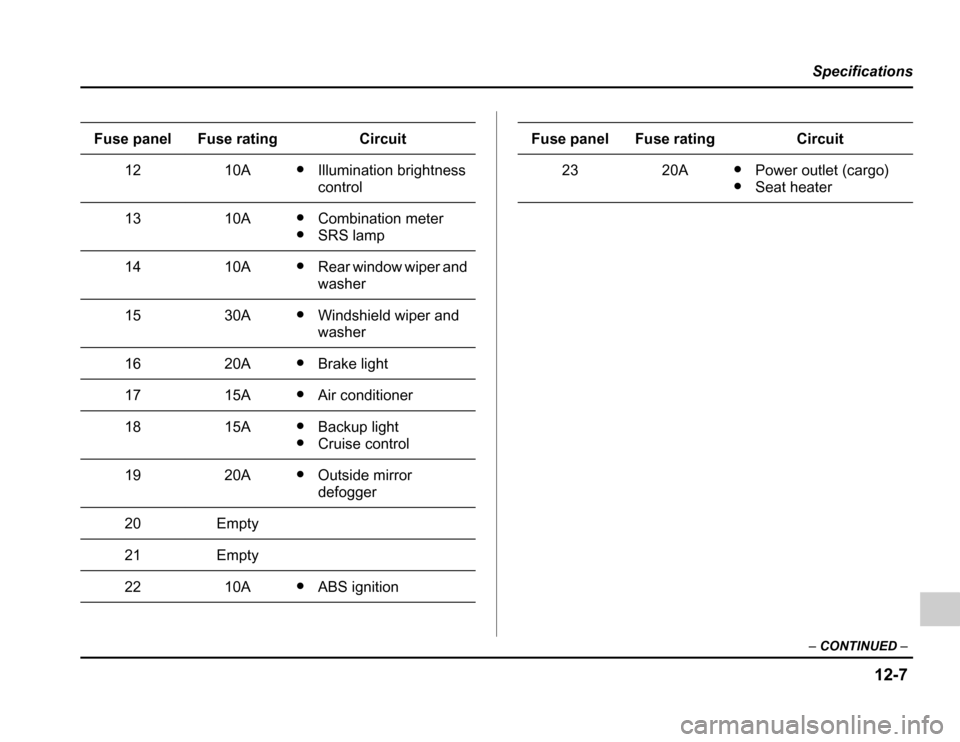
1210AIllumination brightness control
1310ACombination meter
SRS lamp
1410ARear window wiper and
washer
1530AWindshield wiper and
washer
1620ABrake light
1715AAir conditioner
1815ABackup light
Cruise control
1920AOutside mirror defogger
20Empty
21Empty
2210AABS ignition
Fuse panelFuse ratingCircuit
2320APower outlet (cargo)
Seat heater
Fuse panelFuse ratingCircuit