Page 260 of 400
8-22
5. Pull the ball mount to make sure it does not come off the hitch re-
ceiver.
HB8020AA
6. Use only a hitch ball that is appropriate for the ball mount and your
trailer. The hitch ball must be securely installed on the ball mount.
7. Connect your trailer to the hitch ball.
8. Connect the trailer and the hitch with safety chains that will holdthe trailer’s maximum gross weight. The chains should cross under
the trailer tongue to prevent the tongue from dropping onto the
ground in case it should disconnect from the hitch ball. Allow suffi-
cient slack in the chains taking tight –turn situations into account; how-
ever, be careful not to let them drag on the ground.
HB8022BB
HB8020BB
Page 261 of 400

Driving tips8-23
–
CONTINUED –
9. Connect the hitch wire harness ’s black four –pin wire connector to
the towing trailer ’s wire harness.
HB8021BB
10. Confirm proper function of the hitch wire harness by individually
activating the brake, right turn signal, left turn signal, stop, and park-
ing lights on the trailer. NOTE Always disconnect the trailer wire harness before launching or retrieving a watercraft. When you are not towing a trailer CAUTION
Remove the ball mount from the hitch receiver tube when the tail-
gate is open and the bed extender is used. The rear license platewill not be visible because the license plate bracket can not beused at the lowered/open position when the ball mount is con-nected.
Remove the ball mount from the hitch receiver tube and insert the
receiver cover onto the hitch receiver tube. Place the dust cap over the four –pin connector of the hitch wire
harness to protect against possible damage. Occasionally lubricate the terminals of the four –pin connector us-
ing terminal grease, and cover with the attached rubber cap.
Page 262 of 400

8-24
Trailer towing
Your vehicle is designed and intended to be used primarily to carry pas-
sengers and cargo. Towing a trailer puts additional loads on your
vehicle’s engine, drivetrain, brakes, tires and suspension and has an ad-
verse effect on fuel economy.
If you do decide to tow a trailer, your safety and satisfaction depend
upon proper use of correct equipment and cautious operation of your ve-
hicle. Seek the advice of your SUBARU dealer to assist you in purchas-
ing a hitch and other necessary towing equipment appropriate for your
vehicle. In addition, be sure to follow the instructions on correct installa-
tion and use provided by the trailer and other towing equipment
manufacturers.
SUBARU assumes no responsibility for injuries or vehicle damage that
result from trailer towing equipment, or from any errors or omissions in
the instructions accompanying such equipment or for your failure to fol-
low the proper instructions.
Warranties and maintenance
SUBARU warranties do not apply to vehicle damage or malfunction
caused by trailer towing. If you use your vehicle to tow a trailer, more
frequent maintenance will be required due to the additional load.(Refer to “Maintenance schedule under severe driving conditions ” in
the “Warranty and Maintenance Booklet ”.)
Under no circumstances should a trailer be towed with a new vehicle
or a vehicle with any new powertrain component (engine, transmis-
sion, differential, wheel bearings, etc.) for the first 1,000 miles (1,600km) of driving. Maximum load limits
WARNING
Never exceed the maximum load limits explained below. Exceed- ing the maximum load limits could cause personal injury and/or
vehicle damage.
Page 263 of 400
Driving tips8-25
–
CONTINUED –
CAUTION
Adequate size trailer brakes are required when the trailer and
its cargo exceed 1,000 lbs (453 kg) total weight. Before towing a trailer, check the trailer total weight, GVW,
GAWs and tongue load. Make sure the load and its distribution inyour vehicle and trailer are acceptable.
n Total trailer weight
The total trailer weight (trailer weight plus its cargo load) must never
exceed the maximum weight shown below.
Model
ConditionsMaximum totaltrailer weight
MT modelsWhen towing a trailer without brakes.1,000 lbs (453 kg)
When towing a trailer with brakes.2,400 lbs (1,087 kg)
AT modelsWhen towing a trailer without brakes.1,000 lbs (453 kg)
When towing a trailer with brakes.2,400 lbs (1,087 kg)
When towing a trailer on a long uphill grade continuously for over 5 miles (8 km) with an outside temperature of 104 °F
(40 °C) or above.1,200 lbs (543 kg)
OM-H2781
Total trailer weight
Page 264 of 400
8-26
nGross Vehicle Weight (GVW) and Gross Vehicle Weight Rating (GVWR)
The Gross Vehicle Weight (GVW) must never exceed the Gross
Vehicle Weight Rating (GVWR).
Gross Vehicle Weight (GVW) is the combined total of the weight of the
vehicle, driver, passengers, luggage, trailer hitch, trailer tongue load
and any other optional equipment installed on your vehicle. Therefore,
the GVW changes depending on the situation. Determine the GVW
each time before going on a trip by putting your vehicle and trailer ona vehicle scale.
GVWR is shown on the certification label located on the driver ’s door
of your vehicle.
HB8043BA
HB8038BB
Gross Axle Weight (GAW) and Gross Axle Weight Rating
(GAWR)
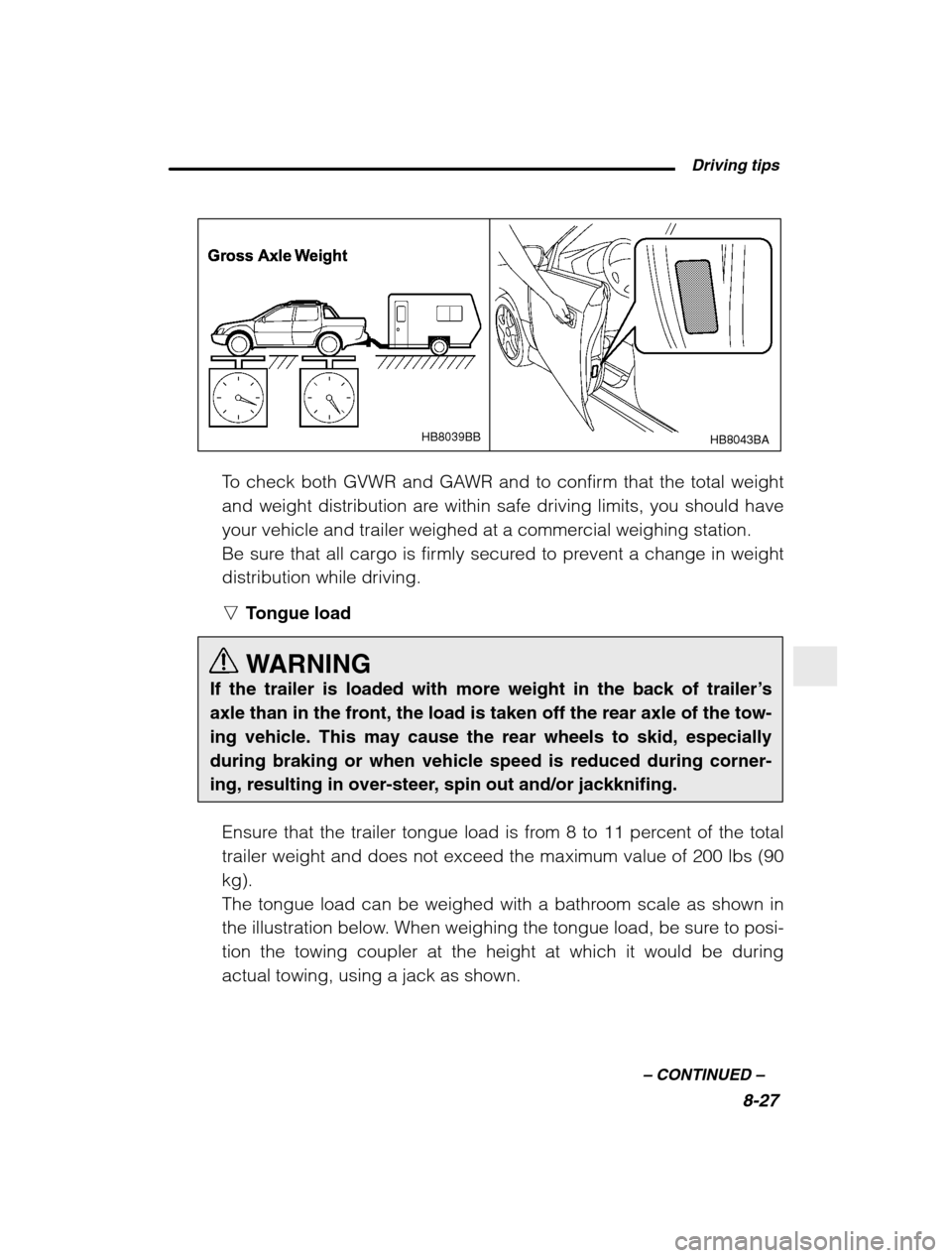
The total weight applied to each axle (GAW) must never exceed the
Gross Axle Weight Rating (GAWR). The front and rear GAWs can be
adjusted by relocating passengers and luggage inside the vehicle.
The front and rear GAWR are also shown on the certification label.
Page 265 of 400
Driving tips8-27
–
CONTINUED –
HB8043BA
HB8039BB
To check both GVWR and GAWR and to confirm that the total weight
and weight distribution are within safe driving limits, you should have
your vehicle and trailer weighed at a commercial weighing station.
Be sure that all cargo is firmly secured to prevent a change in weight
distribution while driving. n
Tongue load
WARNING
If the trailer is loaded with more weight in the back of trailer ’s
axle than in the front, the load is taken off the rear axle of the tow- ing vehicle. This may cause the rear wheels to skid, especiallyduring braking or when vehicle speed is reduced during corner-
ing, resulting in over-steer, spin out and/or jackknifing.
Ensure that the trailer tongue load is from 8 to 11 percent of the total
trailer weight and does not exceed the maximum value of 200 lbs (90kg).
The tongue load can be weighed with a bathroom scale as shown in
the illustration below. When weighing the tongue load, be sure to posi-
tion the towing coupler at the height at which it would be during
actual towing, using a jack as shown.
Page 266 of 400
8-28
HB8040BB
Tongue load
OM-H2785
The tongue load can be adjusted by proper distribution of the load in
the trailer. Never load the trailer with more weight in the back than in
the front; approximately 60 percent of the trailer load should be in the
front and approximately 40 percent in the rear. Also, distribute theload as evenly as possible on both the left and right sides.
Be sure that all cargo is firmly secured to prevent a change in weight
distribution while driving.
OM-H2787
Page 267 of 400
Driving tips8-29
–
CONTINUED –
Trailer hitches
WARNING
Never drill the frame or under-body of your vehicle to install a
commercial trailer hitch. If you do, dangerous exhaust gas, wateror mud may enter the passenger compartment through the drilledhole. Exhaust gas contains carbon monoxide, a colorless andodorless gas which is dangerous, or even lethal, if inhaled. Also,drilling the frame or under-body of your vehicle could cause dete-rioration of strength of your vehicle and cause corrosion aroundthe drilled hole.
CAUTION
Do not modify the vehicle exhaust system, brake system, or
other systems when installing a hitch or other trailer towingequipment. Do not use axle-mounted hitches as they can cause damage to
the axle housing, wheel bearings, wheels or tires.
The use of a genuine SUBARU trailer hitch is recommended. A genu-
ine SUBARU hitch is available from your SUBARU dealer.
If use of a non-genuine hitch is unavoidable, be sure the hitch is
suited to your vehicle and trailer. Consult with a professional hitch
supplier to assist you in choosing an appropriate hitch for your
vehicle. Be sure to follow all of the hitch manufacturer ’s instructions for
installation and use.
Never use a hitch that mounts only to the rear bumper. The bumper isnot designed to handle that type of load.
For all types of hitches, regularly check that the hitch mounting bolts
and nuts are tight.